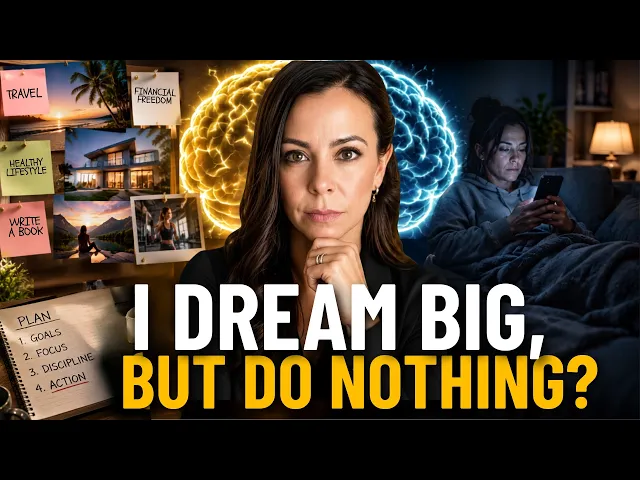
There's a feeling that a lot of people are walking around with right now and they can't [music] explain it. They have big dreams. They can see the version of themselves that is confident, disciplined, in shape, calm with their kids, and [music] doing the work that they actually care about.
They can see it so clearly and then nothing. The alarm [music] goes off and they hit snooze. The notebook stays closed.
The gym bag sits at the door. They tell themselves, "Next week, next month, when things [music] settle down. " What if I told you that that gap between dreaming big and doing nothing can be closed?
It's not because you're lazy. It's [music] not because you don't want it enough. It's because you don't understand how to utilize the part of your brain [music] that gets things done, that goes after the dreams in your heart.
Now, I've been studying neuroscience and cognitive behavioral psychology [music] since 2015, long before I got certified as a life coach in 2022. And since then, I've helped hundreds of people discipline their mind, end unwanted habits, and actually go after goals that matter to [music] them. And here's what I've learned, my friend.
The people who stay stuck and the people who go after their dreams, they have the same [music] fears, the same doubts, the same impulses. The difference isn't [music] motivation. The difference is understanding what's happening in your nervous system and then learning how to override that by managing and disciplining [music] your mind.
And in this episode, I'm going to walk you through the neuroscience of why you dream big but do nothing, including the research of Don Peddle, who spent 20 [music] years proving that procrastination is an emotional regulation problem, and Dr Piers Steel, [music] who turned it all into a single equation. By the end, you're going to understand why [music] your brain sabotages your ambition, and I'm going to give you one decision-making tool that's going [music] to help you close that gap for good. Let's dive in.
So, here's the thing. Inside of your skull, you have two competing systems that are fighting for control over your life. The first is your prefrontal cortex.
This is the higher part of your brain. This is the part of your brain that dreams big. It thinks about your goals.
It's the part of you that knows how to get to your goals. It can anticipate obstacles and it knows how to overcome those obstacles because it's more evolved. It has your best interests at heart.
And it's actually the part of your brain that can override the procrastination part of your brain, the part of your brain that actually keeps you stuck repeating the same habits, the same unwanted result in your life. This is also the part of your brain that makes you distinctly human. And the second part of your brain is your limbic system.
This is your lower part of your brain. And the star player of your lower part of your brain is your amygdala. And the amygdala has one primary job, and that is to keep you safe.
It scans for threats, for discomfort, and for anything unfamiliar. And it does not care two cents about your five-year plan. It doesn't care about the person you want to become.
It wants what's familiar, what's proven, what's comfortable, what feels good, and it wants it right now. It loves immediate gratification. Now, here's where it gets interesting, and I want to credit two researchers that have mapped this out better than anybody.
Dr Tim Pychyl spent over 20 years studying procrastination, and his conclusion is deceptively simple. Procrastination is not a time management problem, but rather it is an emotional regulation problem. You don't avoid the task because you're bad at scheduling, or because you're broken, or because you have ADHD.
You avoid doing the task because it feels bad to do the task. And your lower brain does not want to feel discomfort. This is what I talk about on every one of my episodes.
Your lower brain is wired for that immediate gratification. So, whenever it registers a negative emotion, dread, restlessness, boredom, procrastination, it wants to avoid those emotions and go after the immediate gratification in the moment. Then Dr Pierce Steel took it a step further.
He wrote the procrastination equation and showed that procrastination is literally your limbic system vetoing the decisions of your prefrontal cortex. So, in other words, your higher brain says, "Let's work on the book today. " And then your limbic system says, "That feels hard and boring.
Pick up your phone instead. " And because your amygdala has been evolving for longer, it's usually faster and it usually wins. And so, Steel boiled it down to this equation.
He says, "Motivation equals expectancy times value divided by impulses times delay. " Now, this sounds confusing, but in other words, the more that you doubt that you can do it, the less that you'll value the reward. Then the more impulsive you are, and then the longer that the payoff takes.
And the longer that the payoff takes, the more you will procrastinate. Now, that equation to me kind of sounds a bit confusing confusing. It's not going to be something that I'm going to take with me every single day and like try to do the math.
It really just boils down to two things. And I'm going to explain it for you here so that you can start paying attention. Hey, quick interruption to the episode.
I created something for you. It's a guide called the identity gap and a short mini training called the disciplined mind. I take you through a guided exercise in this training that will help you close the gap from where you are and how you're showing up [music] today to how you would like to show up in the future.
This is going to help you understand your patterns [music] better, but more importantly, it's going to help you start changing them in real time. You can grab it in the description or the show notes. All right, back to the episode.
The real reason why you dream big and do nothing is because you have a low tolerance for negative emotion. And the part of the reason why people are walking around with such a low tolerance for negative emotion is because they have a low emotional IQ. Understanding emotion, what it is, how it feels in your body, being able to name your emotion, how emotions are created, how you can shift your emotional state, that is an intelligence, and it's not something that you're born with.
It's a skill that you acquire. And the more emotionally intelligent you are, the faster you're going to achieve the things that you want in your life, and the faster you're going to stop doing the things in your life that you wish that you could stop doing, that feel hard to stop doing. The simplest way to explain an emotion is it's a vibration that's happening in your body.
Meaning, you feel it somewhere in your body, okay? It's actually inside of you. Your hands are like shaking, maybe you get a bit of a tight chest, maybe you feel butterflies in your stomach.
With each emotion that you experience, you're going to feel it in different places in your body. That's why I'm calling it a vibration. I don't mean to say that to be woo-woo.
It's not. And the thing with the lower brain is your lower brain is basically getting you to go do something else instead of sitting with the emotions. So, having the skill of feeling your feelings is an incredibly important skill.
If you haven't yet, you should definitely check out this video where I teach you how to develop that skill. So, when it comes to going for your dreams, making the phone call, going to the gym, writing the first page, all of those actions will cause you to feel negative emotions. You might be feeling fear, vulnerability, anxiousness, uncertainty, doubt.
And when those emotions register in your body, your brain has gotten really good at tossing up a thought. And usually the thought is super simple. It sounds like let's go watch TV instead.
I need to go tidy my room. I need a snack. And what those thoughts cause you to do is feel permissive.
In fact, when you give yourself relief from the negative emotions, your brain actually releases dopamine. So, before you turn on the TV, just the act of you getting up off of the chair to go get the remote, you're actually getting a little drip of dopamine in your brain, which feels good. That reward makes your brain feel safe.
And this is what Pychyl calls the avoidance loop. So, you feel the discomfort, you avoid the task, you go get temporary relief, and then your brain learns that avoiding equals safety. So, that the next time the discomfort feels even bigger, you will avoid again.
And that loop tightens. So, it's not your fault. This isn't something that you were taught in elementary school, and most of our parents didn't teach us that emotions were harmless, that you can feel uncomfortable or embarrassed and still take actions towards your goal, right?
Most of us learned to take actions that have us avoiding or procrastinating or seeking a ton of comfort instead. So, we grab our phone, we go get a snack, we buffer. And here is the cruelest part.
The more that you avoid, the more that your amygdala updates the threat assessment. So, it's like, "Oh, we didn't do it. It must be really dangerous.
Next time, we're going to resist even harder. " And over time, what that can do is it rewires your identity. Your brain keeps track that you don't do hard things.
It starts to affirm that belief that you have about yourself that you're a procrastinator, that you start but then you stop, that you have all these great ideas, but you don't know how to get started. So, the more that you avoid hard things, the more that neural pathway gets strengthened of I'm just not the kind of person who follows through. And once that identity gets locked in, then your reticular activating system, which is this built-in part of your brain, starts to look for evidence to prove that true day after day.
Because remember, my friend, your amygdala does not care if your identity is empowering or whether it's keeping you stuck. It just wants what's familiar. It wants you to repeat and recycle and stay the same.
I think the parable of the talents in Matthew 25 describes this perfectly. The master gives three servants different amounts of money. Two of them take action, they invest, they risk, and they multiply what is given to them.
But the third, he buries his talents in the ground. He was afraid, he played it safe, and when the master returned, the third servant lost everything. This lesson isn't just spiritual, it's very neurological.
If you bury what you've been given, your ideas, your calling, your potential, because you're afraid of discomfort, well, your brain learns, this is who we are, we don't act, we don't grow, we don't risk, and it's better to just stay safe being the same old, same old. As I like to say, peace comes after you obey the calling. Peace does not come before you act.
So, we have named the enemy. The villain in our lives is not the schedule, it's not the people in our life, it's not because we're broken or we have ADHD, it's because we have an amygdala, this old outdated system that's running our lives on autopilot. And because we haven't been utilizing the part of our brain that has the ability to override the lower brain, we default to taking these actions to avoid negative emotions that are always going to be on the path to going after the dreams that we want.
One of the tools that I love using for myself and for my clients and what I learned from my coach Brooke Castillo from the Life Coach School is doing something called a dread sprint because let's face it, friend. On the path to whatever it is that you want to create in your life, there is going to be some discomfort there. And one of the most, I would say, intolerable emotions that we face when we have to go do something that gets us closer to our goal is the emotion of dread.
Okay? Drad is this emotion that feels heavy. It immediately causes our lower brain to toss up urges to go pick up our phone, get a snack, go tidy something, basically do anything but the actual task that we need to do.
And what my coach offers is doing something called a dread sprint. So, it's telling yourself in that moment, "I'm going to do a dread sprint and get this task done. " So, you're not trying to shift out of that emotion.
You're not trying to convince yourself that you're excited to do it. You're just being very neutral and calm about the fact that you are experiencing dread. So, you're going to say to yourself, "We're doing a dread sprint.
Later on today, I'm going to be doing a dread sprint when I do four loads of laundry that are sitting in my laundry room. Instead of procrastinating, getting that task done, I'm just telling myself the truth. This is going to be a dread sprint.
" Meaning, I'm going to feel dread and I'm going to do it anyways. Now, here's the thing. This is where identity work can come in.
When your brain observes you do something hard and you feel the emotion anyways and you give your brain the evidence that you didn't die, that it was totally fine and you make it mean something about you, meaning you consciously decide, I just did a hard thing today. Maybe it's possible that I will reach this goal. When you fill your brain with evidence of who you are becoming, the next time you go do something and you're feeling dread, you've already given your brain evidence that you can handle it.
This is how you become somebody who identifies as a procrastinator, somebody who starts and stops, somebody who doesn't really follow through to somebody who does follow through, somebody who has self-integrity. Self-integrity is I do what I say that I'm going to do. I have so much self-trust that when I make a decision, it's as good as done.
That is the goal, my friend. Getting to be a 10 out of 10 with self-integrity. And if you want help with that, I highly recommend you go check out the Disciplined Mind mini course and the identity gap.
It's in the show notes, it's a free mini training and that's going to help you get started on building the life of your dreams and becoming the version of you who does what she or he says that they will do. Love reading your comments. Let me know, what is the thing that you've been dreaming of but that you're not doing?
Drp it below and don't forget to hit subscribe. If you [music] love this episode, be sure to check out these two videos and I will see you on next week's [music] episode. Bye-bye.