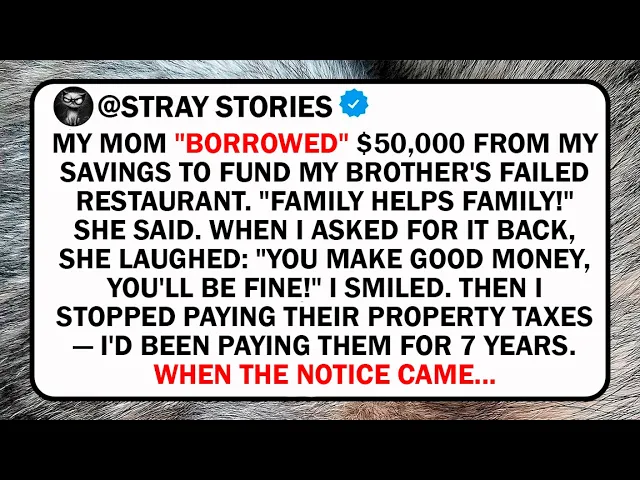
My mom borrowed $50,000 from my savings to fund my brother's failed restaurant. Family helps family, she said. When I asked for it back, she laughed.
You make good money, you'll be fine, I smiled. Then I stopped paying their property taxes. I'd been paying them for 7 years.
When the foreclosure notice came, my name is Adam. I'm 32 and I sell bikes in Portland. Seven months ago, my mom borrowed $50,000 from my savings to fund my brother's new restaurant.
"Family helps family," she said, patting my hand like I was a kid and not the idiot wiring over most of my emergency fund. Later, when I tried to talk about getting it back, she actually laughed. "You make good money, you'll be fine," she said.
"Your brother needs this more than you. You don't even have kids. " That line burned because she said it in front of my brother, his fiance, and two of my cousins like I was some endless ATM with legs.
They thought I'd swallow it like I always did. They didn't know I'd been paying their property taxes for 7 years. They definitely didn't know that the house they woripped as mom's forever home only existed because I had quietly kept the county off their backs since dad's stroke.
and they really didn't know whose name was on the taxlean paperwork or what would happen if I stopped. So when my mom's 60th birthday rolled around and she packed the house with 65 relatives and friends to celebrate herself, I brought two things. A generic gift bag with a scented candle and a thick white envelope from the county, plus a copy of the tax records folded neatly behind it because I knew at some point that night she'd grab a microphone, make a speech, and trot out that same line.
Family helps family. I also knew that hours later when that envelope was opened and read out loud, everything would change. This wasn't one bad day.
People love to say it can't be that bad. She's your mom. So, let me back up.
In my family, be flexible never meant we're a team. It meant Adam will bend until he snaps so everyone else can stay comfortable. The birthday, I was nine the year it started to click.
It was my birthday, but the house looked like it belonged to my older brother, Mark. He was 11, the golden child, already being talked about as the one who really makes something of himself. There were two piles of gifts on the table, a modest one with my name on it, and a huge one technically for both of you, which somehow ended up mostly in his room by bedtime.
I got a used Game Boy with a cracked screen and a new bike helmet because you ride that thing everywhere, honey. Safety first. Mark got a brand new console for both of you, which plugged into the TV in the living room but migrated to his bedroom within a week.
When I frowned, mom pulled me aside. Don't be selfish, she said. Your brother's older.
He needs encouragement. You're easy. You're flexible.
That's when I learned the rule. Be flexible meant be invisible. The scholarship when I was 17, I got a partial scholarship to a state college.
Not glamorous, not Ivy League, but it was mine. I'd been saving for years from my part-time job at the bike shop. Four years of patching tires, cleaning chains, and inhaling chain lube so thick it felt like it coated my lungs.
One night, about a month before graduation, I came home from my shift and found mom at the kitchen table with a stack of bills. She looked up with that tight, worried face she wore like jewelry. "We need to talk about your savings," she said.
My stomach dropped. "Why? " "It's just sitting there," she said.
Mark's car died. He needs something reliable to get to his new job. It's an investment in his future.
It's my college, I said very carefully, she sighed. You have a scholarship, she said. And you're so good with money.
You'll figure it out. Your brother needs this more. Family helps family.
I remember staring at her, feeling like someone had taken an eraser to my future plans. Dad was in the living room, TV low, eyes glued to the news. Dad, I called.
He didn't turn around. Mom lowered her voice. Don't drag your father into this.
He's stressed enough. Two weeks later, most of my savings were gone. Mark drove off in a used Honda with a big grin.
I took out extra loans, picked up more shifts, and learned that in our house, investment in the future meant Mark's future. The joke. By 25, I decided college wasn't worth drowning in more debt for a degree I didn't want.
I was working full-time at a local bike shop, moved up to assistant manager. I liked it. Handson, straightforward.
You fix things, they work. No guessing, no guilt. At a family barbecue, my aunt asked, "So, Adam, what are you up to these days?
" Before I could answer, "Mom laughed. " "He plays with bikes," she said. "But he's happy, right, honey?
" She said, "Plays like I was coloring instead of paying my rent and my loans and occasionally helping them with their bills. I manage a bike shop. " I said, "It's a career, Mom.
" She waved that away. He'll get a real job someday, she told my aunt. He's just finding himself.
I took a sip of my beer instead of correcting her again because in our family, if I pushed back, I was sensitive. If I shut up, I was so easy. And easy is very close to invisible.
The restaurant and the loan. The final setup came last year. Dad had a minor stroke a few years before and couldn't work anymore.
Mom started saying the house was too expensive, but she never cut back on anything that mattered to her. Manny Petty's, wine club, endless little extras. Mark had already failed at two business ventures, a gym that never opened, an online coaching thing that somehow required a leased BMW.
Then he fell in love with the idea of a restaurant. He showed us the mood boards, the concept, the projected numbers. We just need a little help to get the lease and renovations going.
Mom said, eyes shining like this was a shared dream. "We? " I asked.
She didn't hesitate. "You," she said. "You've been so smart with money.
You don't have kids. You don't own a house. You can afford to help.
Your brother needs this chance. " We were at their dining table. My bank app was open on my phone.
My stomach cramped when I looked at the number. 53,000 in savings. It had taken me years.
side hustles, skipping vacations, fixing other people's bikes on weekends. How much are you asking? I said.
She didn't blink. 50,000. I laughed because I thought it was a joke.
You want basically all of it. It's not want, it's need, she said. Family helps family.
We'll pay you back when the restaurant gets going. You make good money, you'll be fine. Dad sat there, silent, rubbing his temple.
Mark looked anywhere but at me. It felt like being nine again, watching the bigger gift pile slide across the table. I told myself this time was different.
I'd get it in writing. I'd structure it as a loan. I'd protect myself.
I drafted a simple agreement, repayment terms, a timeline, interest that was almost symbolic. Mom skimmed it, frowned at the word loan, and said, "We don't need to be so formal, do we? It's family.
I insisted. She rolled her eyes but signed. Mark signed too.
And stupidly I took that as safety. I wired the $50,000. The restaurant opened 3 months later.
It closed 5 months after that. Unforeseen circumstances. Bad foot traffic.
Pick your excuse. The repayment I got? A laugh.
A pat on the hand. And you make good money. You'll be fine.
property taxes and quiet resentment. Here's the part they didn't know. Seven years ago, right after dad's stroke, they'd almost lost the house.
I found out when I came over and saw a bright orange notice half crumpled in the trash. Final warning. Delinquent property taxes.
Mom, I said, pulling it out carefully. What is this? She snatched it.
Nothing you need to worry about. How far behind are you? I asked.
She changed the subject that night. I went online and looked up the county records. They were two years behind.
There were interest charges, penalties, the whole mess. Foreclosure wasn't a theoretical future. It was scheduled.
I didn't tell her that. I just went back to my crappy studio apartment and stared at my own numbers. I made a choice.
I paid off the overdue taxes for my savings. Then I set up an automatic payment for my account for their property taxes every quarter. It wasn't just charity.
The county had a program. If a third party paid off delinquent taxes, they could put a lean in their name. There was a whole process, paperwork, signatures.
I sat mom and dad down, explained that I could help, but I needed my name on the paperwork so I had legal standing if anything went wrong. It's just a formality, I said. If you ever sell, I get reimbursed before anyone touches the equity.
That's it. Mom barely listened. You're such a good son, she said, signing where I highlighted.
Not like some people whose kids forget about them the second they move out. I remembered that line later. Over 7 years I paid every single property tax bill.
While I paid off my own student loans, while I replaced my car with a beat up Civic because the shop commute was killing my old one. While I said no to trips my friends took because I'm saving. in total, including that original delinquent amount, a bit over $40,000.
They never asked where the friendly payment reminders from the county went. Mom just bragged to her friends about how she'd managed to keep the house all these years. She loved saying I always find a way.
I let her because as long as the roof stayed over dad's head, it was worth it until the day she laughed in my face about the $50,000. You make good money, you'll be fine. I went home that night, pulled up my spreadsheet, and stared at the running total of taxes paid.
Then I looked at a new line. Property tax autopay. Cancel.
My finger hovered for a second. In my head, I heard her. Family helps family.
Then another thought slid in. Quiet but sharp. Real family doesn't treat you like a bottomless wallet.
I clicked cancel. The party, the plan, the stage. When the county wants their money, they move faster than my family ever did when I needed anything.
Three months after I stopped paying, the first delinquency notice came. It went to them and to me because of how the lean and mailing address were set up. Mom ignored it.
I knew she would. The second one used stronger language. The third was not a notice.
It was a foreclosure warning with a date. Auction scheduled. amount due lees.
My heart pounded the first time I read the word foreclosure. Even knowing I had the lean and protections, I still felt sick. I didn't want dad out on the street.
I didn't want them homeless. I wanted one thing, for them to see the cost of treating me like a bank with no feelings. So, I called someone who knew exactly what that paperwork meant.
Priya, a friend from high school who'd become a real estate attorney. We met for coffee and I slid the envelope across the table. "Tell me I'm not crazy," I said.
She read everything twice, eyes narrowing. "First," she said, "you're not crazy. Second, you're way more generous than I am.
Third, you know this gives you serious leverage, right? I don't want to ruin them. " I said, "I just want my money back, the 50, plus what I've put into the house, and I want them to stop acting like I'm being dramatic every time I say I'm tapped out.
" She nodded slowly. "You have options," she said. "But whatever you do, do it clean.
No screaming matches. " "No," he said, she said. "You have documents.
Let the documents talk. " Then the invitation came. A cream colored envelope with sparkly gold script.
Join us in celebrating Mary's 60th birthday. Of course. Big milestone, big party, big audience.
RSVP requested. Drss code garden chic. Whatever that meant.
I texted Aunt Lisa, the only person in my family who had ever quietly slipped me a 20 when I was a broke teenager, and whispered, "Don't tell your mother. " "You going? " I asked.
A few minutes later, she replied. "Wouldn't miss the circus? You?
" Yeah, I wrote. Might be the last one I attend. She sent back a single emoji.
The wide eyes. Then, "Need backup? " I stared at the foreclosure notice on my kitchen counter.
"Just don't be shocked if things get loud," I wrote. She called me. "You okay?
" she asked. "I'm tired," I said. "I'm more tired than anything else.
" You know she'll make a speech. Aunt Lisa said she'll brag. She always does.
I'm counting on it. I said the night of the party. I stood in front of my tiny closet for way too long.
Garden chic somehow translated to clean shirt, dark jeans, and the least scuffed pair of boots I owned. I wrapped a discount store candle in tissue paper and put it in a neutral gift bag. The envelope from the county and my copies of the tax records went into a hard, flat document sleeve that slipped neatly into my backpack.
On the way over, my phone buzzed. A text from Priya. You sure about this?
I'm not suing them at the party, I replied. Just revealing the truth. You said let the documents talk.
I did, she wrote. And I stand by it. If anyone starts yelling legal threats, you can put me on speaker.
I pulled up to the house. white siding, blue shutters, the same uneven front steps I'd skinned my knees on as a kid. There were cars lined up down the street.
Laughter spilled out of the open windows. I took a breath. Don't cry here, I told myself.
Not here. I walked in, gift bag in one hand, backpack over my shoulder. The living room looked like a Pinterest board had vomited.
twinkly lights, balloons with 60 in on them, a big banner that said, "Still fabulous. Mom wore a sparkly dress and a crown that literally said queen. There's my hero.
" She shouted as she saw me. "Everyone, this is Adam, the practical one. The one who always helps out.
Everyone laughed like that was adorable. " I hugged her, the scent of her heavy floral perfume hitting me like a memory and a headache. Happy birthday, Mom.
I said I handed her the bag. She peeked inside. A candle, she said.
How practical. Mark appeared behind her, clapping me on the shoulder. Hey, man.
He said, "Good to see you. Drve. " Okay.
I looked at him for a second, remembering the day I handed him $50,000 in his apartment. How his voice shook when he said, "You won't regret this. I promise.
" Traffic wasn't too bad. He didn't mention the loan. I was introduced to mom's friends as the steady one, the one who never left town, the bachelor.
Over and over, she said, "We'd lose our minds without him, honestly, like I was a quirky assistant in a sitcom. The only one who gave me a look with actual concern behind it was Aunt Lisa. " She cornered me near the dessert table.
"You brought it? " she whispered. I tapped my backpack.
Her eyes flicked toward mom, who was already three glasses of wine in and getting louder. "It's going to be a show," Aunt Lisa said. I shrugged.
"Then at least the last act will be honest," I said. Around 9, the DJ turned the music down. Mark grabbed the mic.
Everyone groaned playfully. "Time for speeches," he tapped the mic. "Okay, okay," he said.
Can I steal your attention for a second? I felt my heartbeat in my throat. This was it, the stage.
Mom giggled behind her hand, already knowing it was about her. I slid the document sleeve out of my backpack and held it by my side. Don't cry here, I told myself again.
Not here. You make good money, you'll be fine. Tonight's about mom, Mark said.
about everything she's done for us, the sacrifices, the nagging, the guilt trips. Everyone laughed. Seriously, he said.
She's the one who taught us that family helps family no matter what. He scanned the room, milking it. And some of us have really taken that to heart, he said.
Like my little brother, Adam. He waved for me to stand. Reluctantly, I did.
People clapped. Mom beamed at me like I was a trophy she'd won. Adam, Mark continued, has always been the practical one.
The saver, the guy who makes good money and will be fine. Mom laughed before he even finished. She cuped her hand around the mic and said loud enough for everyone to hear.
He bailed us out when the restaurant needed help. $50,000 just like that. He doesn't even ask for it back.
That's love. That's family. The room buzzed.
Some people looked impressed. Some looked at me with a new kind of curiosity, like I was a walking briefcase. And he's been helping with stuff around here, too, Mom added, a little drunk on attention.
He pays things, organizes things. I don't even know half of it. He makes good money.
He'll be fine. That sentence, it hit me like a hand across the face. She just turned my drained savings and seven years of quiet sacrifice into a fun fact.
a party anecdote. My chest felt tight. Someone behind me murmured, "Wow, I wish I had a brother like that.
" Another chuckled, "Hey, Adam, want to adopt me? " People laughed. I heard Aunt Lisa inhale sharply.
Mark grinned like it was all one big heartwarming story. "Stand up here with me, man," he said, gesturing. I stepped forward, but not toward him.
I walked to the center of the room where the coffee table had been pushed aside to make a makeshift dance floor. I set the document sleeve on the table. My hands didn't shake.
That surprised me. Since we're talking about family helping family, I said loud enough for the room to hear. I think it's a good time to clear a few things up.
Mom tilted her head, confused. Adam, honey, what are you doing? she said, still smiling, still sure that whatever this was would end in a punchline that made her look good.
I opened the sleeve and pulled out the foreclosure notice. The county seal glinted under the overhead lights. The room quieted.
Paper has a way of killing a mood. This, I said, holding it up, is a foreclosure notice from the county. Auction date is in 6 weeks.
Someone gasped. Mom's smile froze. What are you talking about?
She said, "That's not funny. It's not a joke. " I said, "You're four property tax payments behind.
The countyy's done waiting. " Mark snorted. "Come on, man.
" He said, "Not cool. Not tonight. " He moved toward me like he was going to snatch the paper away.
I stepped back. This is my notice, too, I said. I laid the foreclosure notice on the table and pulled out the next document, the lean paperwork, the proof of payment history.
I held them up. For the last seven years, I said, "I've been paying your property taxes every quarter, on time, quietly. " Murmurss all around.
Mom's eyes flicked from the paper to my face. "What? " she said, voice already defensive.
"No, the bank. " I cut in. "The bank doesn't handle your taxes.
" I said, "I do. There's a lean in my name to prove it. You signed the paperwork.
I slid the copies across the table toward her. You said it yourself a few minutes ago, I said. I help with stuff around here.
You just don't know half of it. Aunt Lisa stepped closer, her face pale but steady. I tried to tell you to stop years ago, she muttered mostly to me.
Mom picked up the papers with clumsy fingers. This doesn't mean anything, she said. This is just forms.
You're twisting this. You always overreact, she looked up at the room. He's always been dramatic, she said with a shaky laugh.
He thinks because he pays a bill now and then. $40,000, I said, cutting through. The room went dead silent.
In addition to the 50 I lent you for Mark's restaurant, I said, $90,000, Mom. That's what Family Helps Family has meant in practice. Someone whispered, "Jesus.
" Mark put his hands up. "Okay, okay," he said. "Let's calm down.
We're not ungrateful. All right. It's just money.
We'll pay you back when things turn around. You make good money, you'll be fine. " There it was again.
The line, the exact same shape, only this time it slid off me like water. I pulled out my phone and pressed the side button. Speaker phone.
The dial tone buzzed once, twice, then Priya's voice came through. Adam, she said, "You good? " "Yeah," I said.
"You're on speaker. This is the attorney I told you about. " Mom recoiled like I'd brought a cop.
Attorney? She snapped. Why would you bring a lawyer here?
This is my birthday. In case anyone says I'm overreacting, I said. "Can you explain what it means?
" I asked Priya. When someone has a tax lean on a property and the county issues a foreclosure notice, Priya didn't miss a beat. It means the county is about to seize and auction the house, she said.
And any proceeds after debts and leans are paid go where the paperwork says they go. And in this case, I asked Pria a sighed faintly. In this case, based on the documents you sent me, the lean holder, meaning you, Adam, is first in line to be reimbursed for all taxes paid with interest from the sale proceeds.
After that, whatever's left is the owner's equity. A cousin whispered, "Holy. " Mom slammed the papers onto the table.
"You set us up," she hissed. "You're doing this to us. How could you?
We're your parents. " My dad finally spoke from the armchair where he'd been slumped, eyes glassy. Mary," he said quietly.
"We signed that stuff. I remember. You said it was fine.
Don't you start. " She said, "You never protected us from this. You just let him.
" I held up a hand. This isn't revenge, I said, and my voice surprised me with how calm it sounded. This is reality.
I stopped paying your property taxes 3 months ago after you laughed in my face about the 50 grand and told me I'd be fine. I pointed at the notice on the table. This is what fine looks like, I said.
This is what happens when I stop quietly fixing everything you break. The room buzzed with whispers in the soft, awkward clink of someone setting down a drink too carefully. Mark tried to smile.
Okay, man. He said, you've made your point. We're sorry.
All right, just call them. Pay what we owe. We'll sign whatever you want.
You make good money, you'll don't, I said. My voice cracked like a whip. He froze.
I am done being the guy who will be fine while you treat my life like an overdraft line. I said I'm not paying another scent for this house. Mom's face crumpled then hardened.
You can't do this. She said you can't just let them take our home. What will people think of you?
Of us? That's up to you. I said you have six weeks.
You can sell, refinance, or ignore it. But whatever you do, the county will get paid, and so will I. I gestured to the papers.
It's all right there in your signatures in black and white. She shook her head, tears spilling over. You're punishing us, she said.
You're doing this because you're bitter, because you failed at life and blame us. I almost laughed. I thought of my small but solid apartment, my stupid little balcony where I drank coffee in the mornings, my job that I actually liked.
I thought of the $90,000 that had quietly disappeared into this family over the years. I didn't fail, I said. I just stopped volunteering to lose.
I looked straight at her. You don't get to rewrite what you did to me, I said. Not anymore.
That was the moment it broke. Not the party, the dynamic, the version of reality where I was the flexible one and everyone else got to be rigid and righteous. Silence hung in the air like smoke.
Then people started moving. Someone turned the music up too loud, desperately trying to change the subject. Aunt Lisa stepped to my side and put a hand on my shoulder.
I'll drive you home, she murmured. Mom's friends looked away, suddenly fascinated by their phones. I gathered the papers, slid them back into the sleeve, and put them in my backpack.
I didn't say another word. I just walked out of my parents' forever home while my mother stood under a banner that said, "Still fabulous. " with mascara streaking down her cheeks.
The next morning, my phone looked like it had been in a car crash. 23 missed calls, 17 voicemails, more texts than I wanted to scroll through. I listened to the first voicemail from mom.
Her voice was raw. How dare you humiliate me like that in front of everyone. She said, "You made me look like a beggar.
You twisted everything. You're sick, Adam. You need help.
Delete. " The next one was shorter. "You will fix this.
" She said, "I am your mother. You owe me that much. Delete.
" Mark's voicemail was more practical. Dude, he said, "I get that you're mad, but you went nuclear. Just call the county and pay it.
We'll figure something out. You're overreacting. Delete.
Aunt Lisa's message was different. You did the right thing. She said it was ugly, but it was true.
Call me when you're ready to talk. Okay, I'm on your side. I kept that one.
Pria texted you. All right. Exhausted, I wrote.
But yeah, good. She replied. When you're ready, we should talk about next steps in writing.
Over the next week, the pattern repeated. Angry call. guilt soaked call.
H silence, then a text from mom that said, "Your father isn't eating. He's so stressed. Is that what you wanted?
" I typed and deleted a lot of responses. Finally, I sent one message. I'm sorry, Dad is stressed.
I won't let the county take the house. I will not, however, keep paying your taxes. If you want to sell, my attorney will handle the paperwork.
If you want to refinance, you'll need to find a bank that will work with your situation. I am done being your emergency fund. She didn't reply.
Two days later, Dad called. His voice was weaker than I remembered. Adam, he said, can we talk about options?
We met at a coffee shop. No, Mom. He looked smaller in regular clothes than he did in my memory of him at the head of the dinner table.
I didn't know how much you were actually paying, he said quietly. I thought it was a few bills. Your mother handled the rest.
She didn't, I said. He nodded, staring at his hands. I can't ask you to fix this again, he said.
But I also don't want to lose the house with nothing to show for it. Your mother, she won't talk about selling. She thinks it's a bluff.
It's not, I said. He looked up. I know, he said.
So help me convince her to sell. We pay you back first. Then whatever's left, we'll use to find something smaller.
An apartment, maybe. Something we can actually afford. It was the first time he'd ever said, "We can't afford this.
" Out loud. Priya drafted the emails. Clear, formal.
The gist was simple. Option A, list the house, sell it before the auction, pay off the taxes, and reimburse me. Everyone walks away with something and no foreclosure on their record.
Option B, do nothing and let the county auction it. I still get reimbursed before any equity goes to them, but they lose control of the timing and the price. Mom refused to reply to Priya.
She did, however, text me, "I can't believe you'd rather sell my home than just help us. " I stared at the screen for a long time. Then I wrote back, "I helped you for 7 years.
Selling is helping you now. Staying in denial is not. In the end, reality did what I couldn't.
The county sent a final notice with the auction date circled in bold. Mom cracked. Fine, she said.
We'll sell, but I won't gravel. You'll get your precious money. We listed the house.
It sold in 3 weeks. The market was still good enough to cushion the blow. at closing.
After the mortgage balance and costs and my lean were all paid, there was money left over for them. Not what mom thought the house was worth in her fantasies, but enough for a decent condo. Priya sat across from me in the title office, flipping through documents.
This line here, she said softly, tapping the section that detailed the lean payoff. This is the moment you stop bleeding. The wire hit my account 2 days later.
92,400 and some change. I stared at the numbers on my screen. I didn't feel victorious.
I felt level, like someone had finally set a crooked picture frame straight on the wall. A week after they moved into the condo, Mark showed up at my apartment building. I saw him through the peepphole, shifting his weight from foot to foot.
I opened the door but left the chain on. "Hey," he said. "Place looks small.
It's what I can afford," I said. He smirked, then caught himself. Look, he said, "Mom's a mess.
She keeps saying you stole her house. " "I didn't. " I said, "She sold it instead of letting the county auction it.
You know that. " He shrugged. "I know," he said.
"But feelings aren't rational, ma'am. " "Anyway, I'm actually here because I'm thinking of starting something new. Not a restaurant," he added quickly.
Something smaller. A food truck maybe. I learned a lot from last time.
If you could spot me like 20 grand to get started. I closed the door until the chain was taught. His eyes widened.
I'm not your bank, I said. You're still mad, he said incredulous. After mom already gave you the house money.
You got what you wanted? I shook my head. No, I said what I wanted was a family that didn't see me as a resource first and a person second.
I got my money back. That's different. He scoffed.
Wow. He said, "You've changed. " "Yeah," I said.
"That's kind of the point. " I shut the door. Then I slid the chain off and turned the deadbolt more for the symbolism than the security.
People ask when they hear the story if I regret doing it publicly. the truth sometimes, not because it was wrong, but because it forced everyone to pick a side in a single night. A few relatives unfollowed me on everything.
One cousin DM'd me to say, "Honestly, good for you, but I'm staying out of your family drama. " Aunt Lisa came over with takeout and a bottle of wine. "You did what needed doing," she said.
"If you'd kept it private, she'd have spun it. This way, at least the truth is loud enough that she can't erase it. I started therapy.
First session, my therapist asked, "What do you want out of this? " I sat there picking at a loose thread on my sleeve. "I want to stop feeling guilty for not lighting myself on fire to keep everyone else warm," I said.
We unpacked anger that was older than my bank account. We pulled apart the words family helps family and looked at how one-sided that help had been. Slowly, I built a new rule.
Helping is a choice, not an obligation. And if the help costs you your stability, your safety, or your self-respect, it's not help. It's self harm dressed up as loyalty.
Contact with my parents now is minimal. I text my dad on holidays. He sends back short replies with too many ellipses.
Mom sends the occasional group message with inspirational quotes about forgiveness. I don't reply. The boundary I finally set is simple.
I will not discuss money with them. I will not give them money. Any conversation that drifts toward can you just ends.
A few weeks ago, I cleaned out a drawer in my apartment and found an old framed photo. Me, Mark, and mom in front of the house. She's in the center, arms around us, smiling like she built everything we see.
For a second, I almost put it on a shelf. Instead, I set it face down in the drawer and closed it. Not thrown away, not honored, just not on display anymore.
That's what this whole thing has become for me. Not a revenge story, a reshelving, a quiet decision about what stays visible in my life and what doesn't. I still sell bikes.
I still get called practical by people who mean boring. But there's money in my savings account now that has my future's name on it, not my family's emergencies. There are lines I don't cross for anyone, no matter how loudly they shout, "Family helps family.
" Because the biggest thing I learned is this. I was never just the flexible one. I was the structure they leaned on while pretending they were holding everything up.
And the day I stopped propping up their denial, the whole thing shook. Not because I ruined it, but because it was never stable without me. I didn't ruin them.