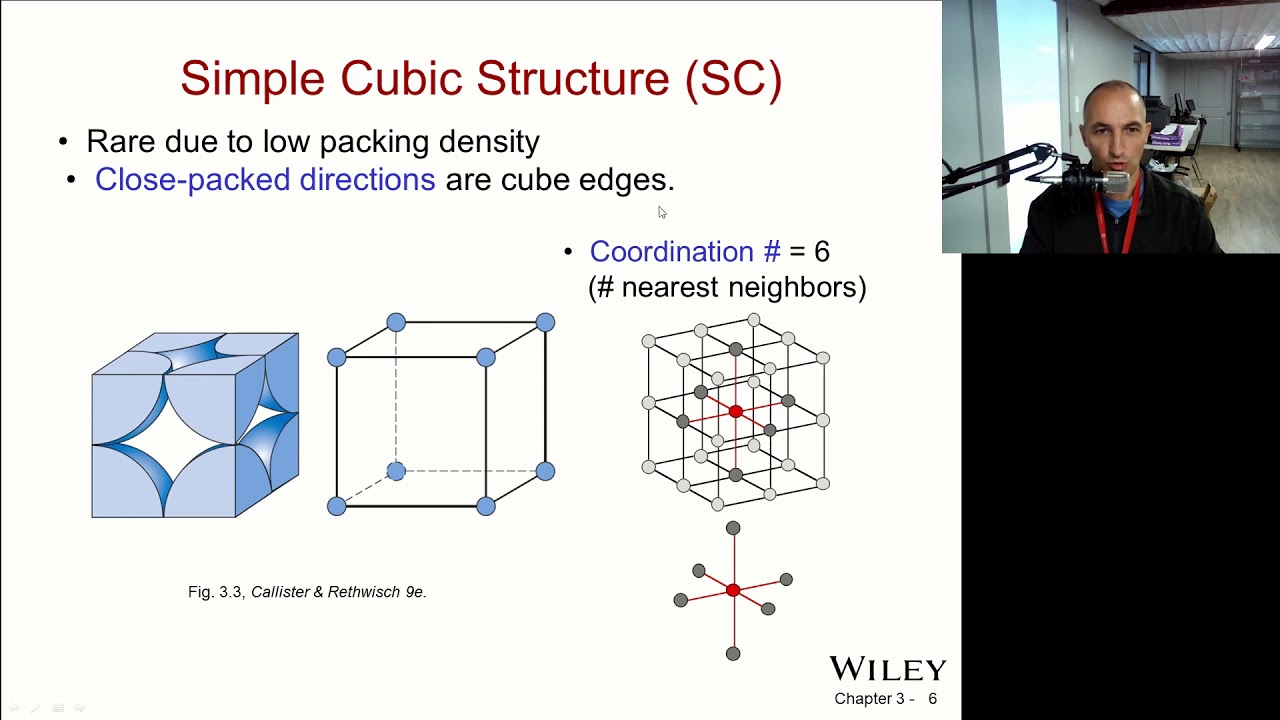
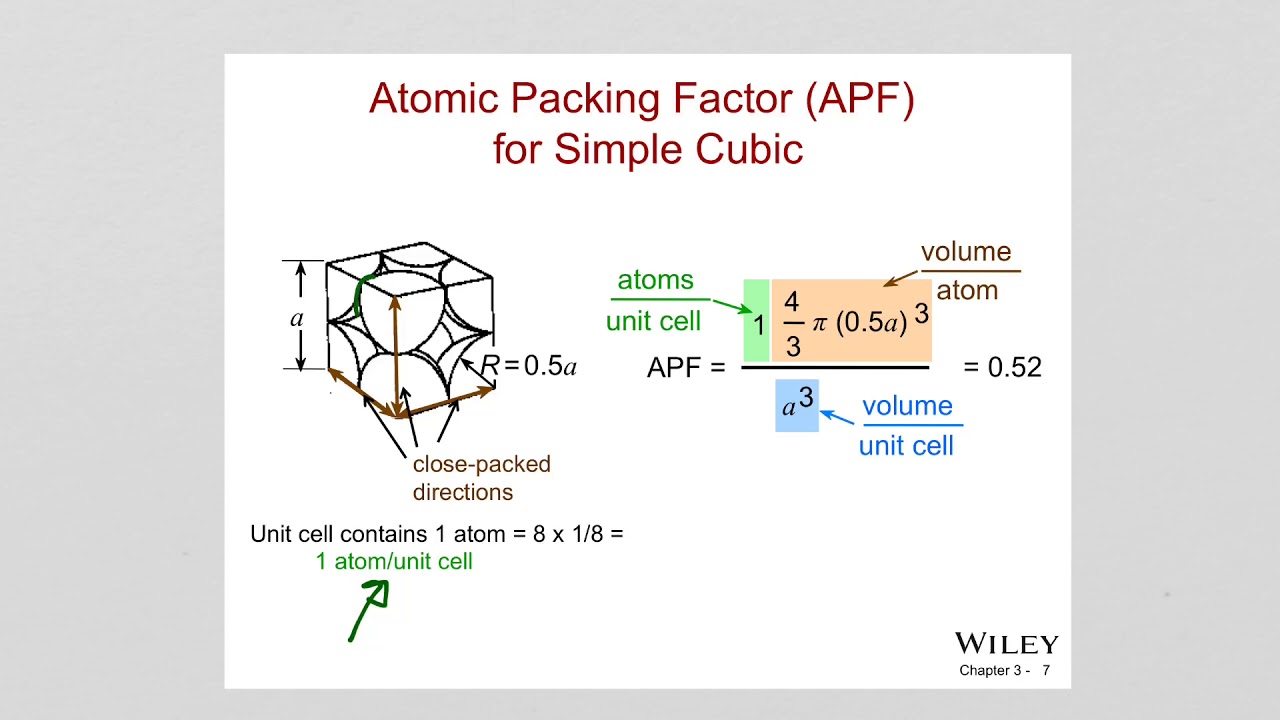
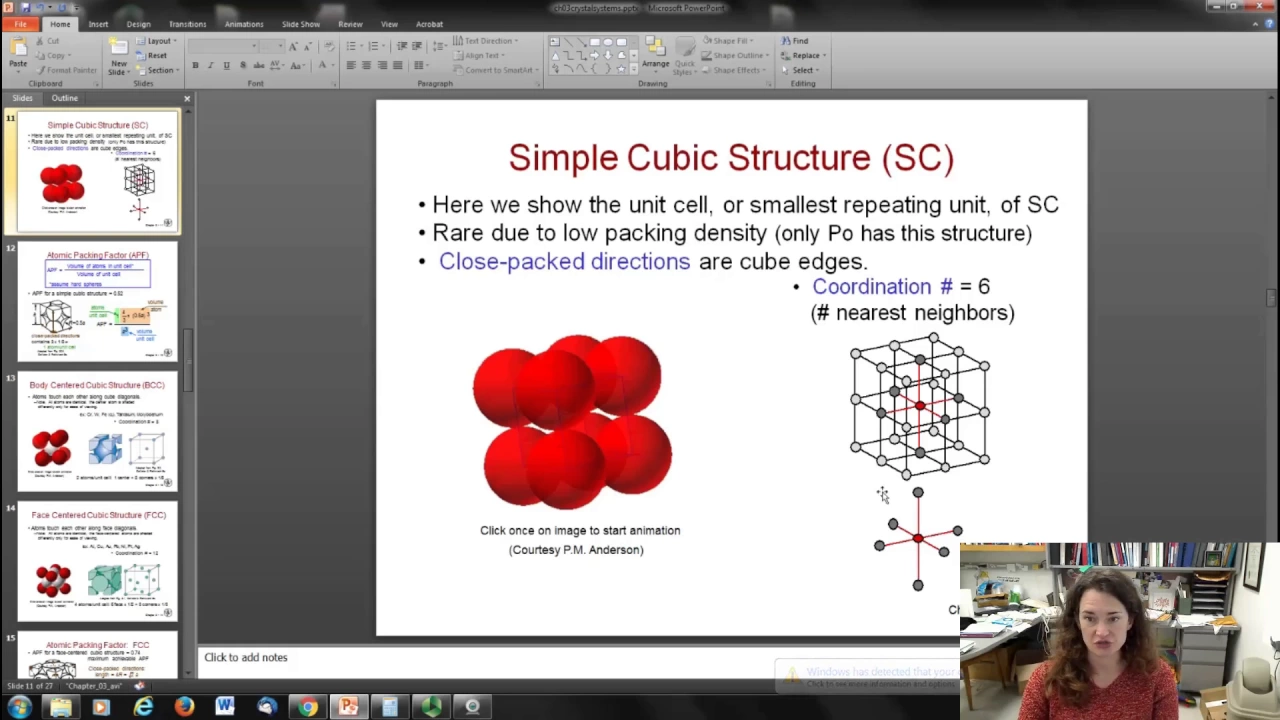
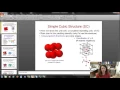
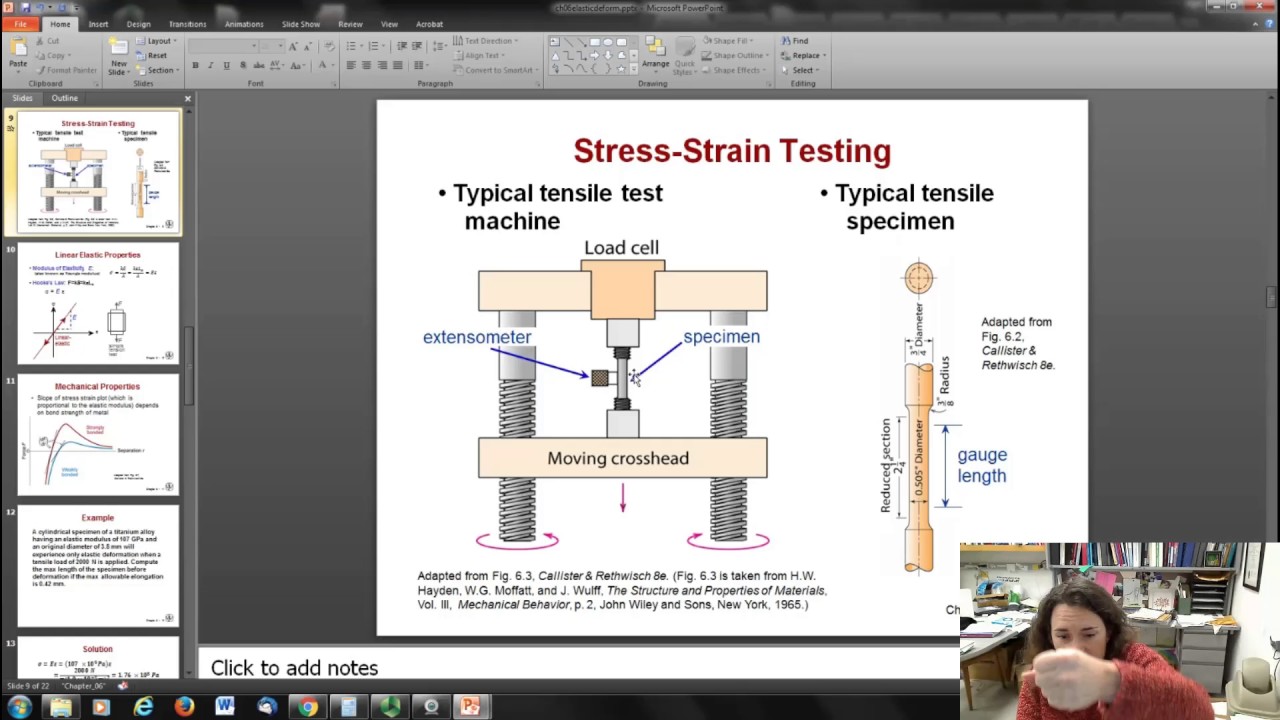
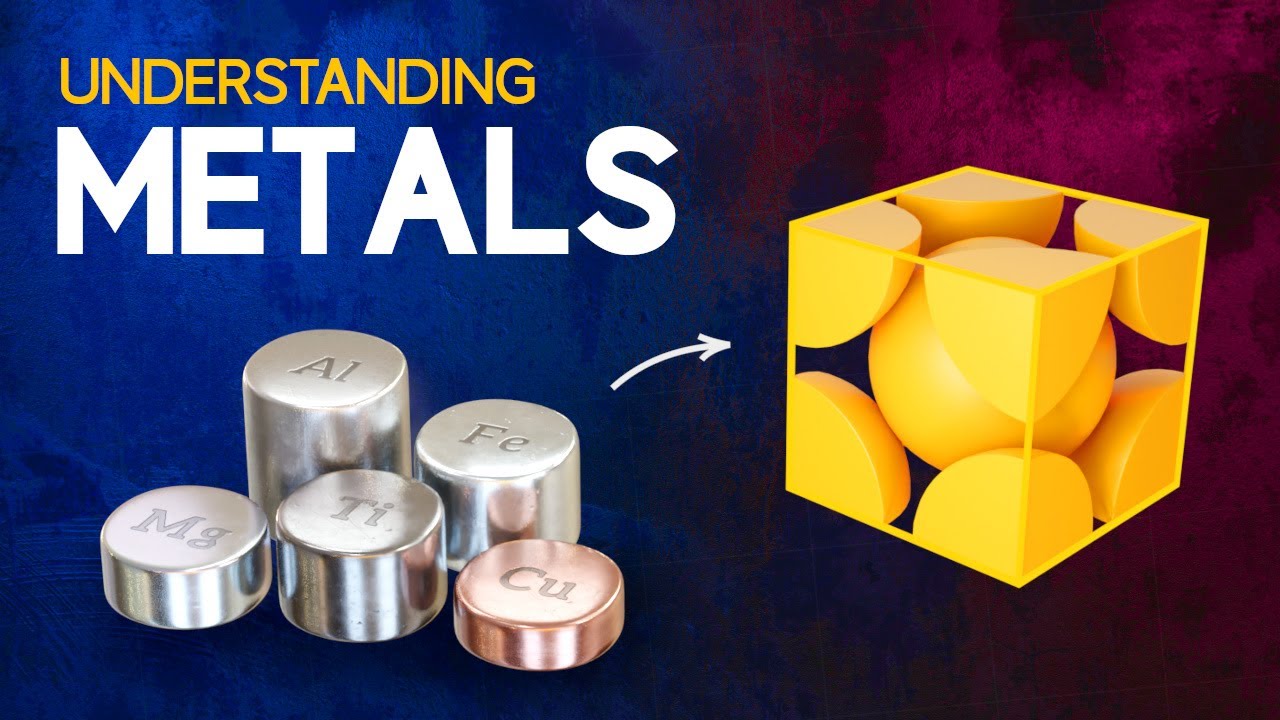
hi so what I'd like to move on and talk about now is chapter three and the structure of crystalline solids and what we're going to be discussing in today's lecture are some of the common structures that you see and especially metals and those kind of crystalline solids on how to calculate various values for those structures so to first define a little bit crystalline materials which is what we're going to be studying in this chapter they have atoms that pack and periodic three dimensional arrays and this is typical with metals and many ceramics and even some polymers in them you see long-range order across large atomic distances but for non crystalline materials you don't have any kind of periodic packing and this occurs for some complex structures that also sometimes occurs in metals if you cool them rapidly or if for example in some metals these days and more advanced metal structures they have a whole bunch of alloys that has atoms in there with really different sizes and then you can get some non crystalline metals that way it can also just sort of be a matter of degree you can have short-range order but not long-range order and those are often called semi crystalline materials a new vocabulary word for you will use the term amorphous when we're referring to non crystalline material so here's just a few examples that I have to show you for crystalline materials this is a scanning tunneling microscopy microscope image of graphite that we took here at Appalachian State and you can see here that this is very ordered so this is obviously a crystalline material with long-range order if you look at what the structure looks like in sort of a topo plot and you can see it there and just borrowing from the web a little bit this is what the structure of graphite looks like in three dimensions and an STM obviously you can only see one plane you can only see one set of atoms but what happens is in between planes they kind of stack like this so you get a whole bunch of sheets that look like us in there stocked one on top of the other here are some more images which you can see in lots of crystalline materials is that you'll have a segment called the domain of the material that has a crystalline structure that looks a certain way and then right next to that domain will be a domain that also crystalline but maybe rotated with respect to its neighbor and so this is really typical of metals and this is taken from another publication here this is an example of an amorphous material this is a scanning electron microscope of polymer spaghetti so this is obviously amorphous kind of material here this isn't the atomic scale there's only magnified 278 times but you can imagine that it must be amorphous just by the way that it looks and this is an gaining electron microscope image of an oriented polymer fiber so here you have short-range order and you can see that the polymer is growing in a specific direction you can see here it's oriented vertically on your screen and it's growing that way and lots of times in polymers the short-range order is going to have a fractal character and this is an Sen time series lapse image of something undergoing polymerization you can see it has kind of a fractal structure as it moves out that's fun okay but moving back on and for the energies what happens is in crystal structures for dense ordered packing then you're going to have a energy that's going to be minimized they tend to have lower energies and they have a typical bond neighbor link that's sitting right down there at the minimum of this bonding energy curve that you can see so crystalline structures tend to have lower energies than amorphous structures now how do you stack metal atoms to minimize empty space what we're going to do is we're going to use the hard sphere model where we assume that the atoms are basically perfect spheres that touch each other now course this is model with many flaws but it does work pretty well for describing the metal structures that you'll see in the end agonal close-packed face centered cubic body-centered cubic it explains those structures very well and it's a nice model of metallic bonding where you have the atom and then surrounded by that sort of electrons see if you will so it works well for that so what you do is you have these two dimensional structures with these hard spheres and then what you do is you form a two dimensional structure and then you add another layer on top of that another layer on top of that and so we'll describe it described in some cases how those layers are packed on top of one another now metallic crystal structures they tend to be densely packed the reasons for this are typically in the structures that we're going to talk about today at least there's only one element present so we'll talk about the structure for copper for example or platinum so therefore all the atomic radii are sustained also metallic bonding is not directional remember that you have that ion core surrounded by the sea of electrons and the electrons see can go in any direction which makes the bonding non directional unlike covalent bonding and your nearest neighbor distance distances tend to be small in order to lower that bond energy in metals and the electron cloud shields the cores of the ions from each other and so you have a nice tight short bond they also have the simplest crystalline structures so they're the easiest ones to talk about first the ones that we're going to talk about today are simple cubic face-centered cubic hexagonal close-packed and body centered cubic structures and you can see that if you look at atoms that are typically metals here shown in a periodic table then you can see what structures are used from these metals now here they abbreviate hexagonal close-packed as CCP I'm sorry face centered cubic as CCP instead of FCC which is what your book does so you can see that that's in the red the hexagonal clips talk to HCP is in the green body centered cubic blue and so on and so forth so you can you can see them all here in this little periodic table now it's important to realize and we'll discuss this in later chapters that at different temperatures some crystals are undergoing to undergo a phase change now unlike a typical phase change where you're going from a solid to a liquid which is kind of what we discussed in introductory physics courses 1150 1151 crystalline structures can undergo a phase change from one type of crystalline structure to another type of crystalline structure for example iron will go through phase changes and go through from an alpha to gamma phase and that changes the structure so that's kind of interesting so the first line that we're going to discuss is the simple cubic structure sometimes it's abbreviated FC it's the easiest to talk about because it's the simplest structure so we always do it first however I do want to note this is a pretty rare on crystalline structure and the reason is that it has a very low packing density so out of all the ones in the periodic table only polonium cuts this structure so the closed type directions are the cube edges and those ones with the highest packing density inside the cube is kind of not taking up much space with solids there let's discuss a little bit of vocabulary sometimes you'll talk about the coordination number for a structure and a coordination number is simply the number of nearest neighbors that each atom has okay so that's the nearest neighbors to the shortest distance Center to Center between atoms so if you look at some sort of an extended view of what a simple cubic structure would look like it's shown here in this little cartoon and you can see that each corner of the cube is going to touch six other neighbors in the shortest possible distance okay so for example if you look at the one that I'm sort of highlighting and pointing to here and now extrapolate what that would look like in a larger 3-dimensional array it would touch six other neighbors in that way so the coordination number is six okay now here we're going to show the unit cell and the unit cell is the smallest simplest structure that shows all the bonds okay so here the unit cell is a little pube of course and the atoms are pictured at usual one of the cube corners another thing that we want to define and as often talked about for crystalline structures is the atomic packing factor and it's related near Texas APF the apse the atomic packing factor is the volume of the atoms in the unit cell divided by the volume of the unit cell so basically it's just a fraction that shows how much space is occupied inside the cell now ApS for a simple cubic structure is 0. 5 to so let me go through as an example how you would do that calculation for an atomic packing factor first you would multiply the number of atoms in that unit cell and then you would multiply times the volume that each atom has and then you would divide by the volume of the total cell now oftentimes in your book they talk about the length of the unit cell now this is a cube so in each direction along the edge is all a is the length of the cube here okay now if you look at what it looks like within the cell then each corner of that cube is going to slice through one of the atoms okay so the cube is made by connecting Center to Center of all the atoms in the cube and when you do that you're going to cut off part of the atoms part of the atoms are going to stick out so in each corner here so you have eight corners to the cube and at each corner you've got 1/8 of an atom okay 1/8 of an atom so the number of atoms per unit cell is the eight corners times the 1/8 which gives you for a simple cubic structure one total atom per unit cell now the volume of the cell is the volume of an atom if you assume a heart to your model the volume of the sphere is 4/3 PI R cubed but the radius of each atom is actually going to be equal to half of the length of the unit cell you can see here you've got two atoms touching at the bottom corners of the cube and a is equal to 2r there okay so 4/3 pi times the radius cubed would be half of a cubed and you would put that on top and now because it is a cube the volume of the unit cell is just going to be linked times with some type all this is the same they're equal to a so it's a cubed now if you multiply all this stuff divide numerator by denominator then the A's cancel out and you end up with 0. 5 to for the atomic packing factor for a simple cubic structure okay the next one up is the body centered cubic structure this is all often abbreviated bcc the thing is here the atoms at the corners of cube are no longer touching each other unlike in the simple cubic structure and that's because you've got this atom right here in sort of the middle of the cube so all the atoms on the corners are touching the one that's on the inside there examples of metals that have this structure chromium tungsten alpha phase of iron tantalum molybdenum so on and so forth the coordination number here is a number of nearest neighbors for each atom is eight so you can look at that the one in the center of the cube is touching all these other atoms on the corners and of course there's eight corners to a cube so the one in the center is touching eight okay so the coordination number or the number of nearest neighbors for each atom is eight because of course you can consider any one particular atom to be at the center of another cube okay if that makes sense now this one is going to have two atoms per unit cell alright you've got the one in the center of course and then you add that on to the corners of the cube okay which is of course eight atoms at the corners of the cube but they're going to be sliced off so that's times 1/8 so the two in the center are the one in the center plus the one the one atom that comes from all the corners and that gives you two atoms first off ok the face centered cubic structure in this line what you have is of course the atoms of the corners of a cube but then you have an atom that sitting at the center of each face of your cube now when there's no atom in the very center just the ones along the faces all right some examples of this structure aluminum copper gold nickel platinum silver this will have a much higher coordination number so to explain this the coordination number is 12 so if you look at this atom here on the center of this right hand face it's touching the four at the cube the corners of this side of the cube it's also touching each one of these guys that's hitting the face of the front in the back and the top and the bottom faces it's also touching those and then of course if you kind of move it out and imagine that you have an array of these little structures it would be touching the four grey atoms from the neighboring cube okay and 4 plus 4 plus 4 is 12 so the coordination of verse 12 the FCC structure also has a higher number of atoms per unit cell okay each one of these atoms that sits on the face all right is going to get sliced in half and there's six faces so 6 times 1/2 gives you 3 and then plus the atoms of course at the corners times 1/8 so that's eight corners times 1/8 gives you one so that gives you four atoms per unit cell let's go ahead and calculate the atomic packing factor for an FCC the atomic packing factor the APS is 0.
74 I emphasize this because it's the maximum achievable atomic packing factor that you can get all right so remembering that you want to multiply for an atomic packing factor the number of atoms per unit cell times the volume of an atom and then divided by the volume of the cell all right we already talked about the number of atoms per cell that's 4 ok and the volume of your unit cell is a cube just like it is because it's that it's still a cubic structure and then the volume for an atom would be 4/3 PI R cubed now in order to figure out what R is in relationship to a then we can look kind of along this face right here ok so you can see that along this space you've got one radius from the corner to the atom on the center of the face and then the atom on the center of the face you've got two radii right and then another corner gives you another radius so that's for our four radii across the diagonal of that cube and then the diagonal of course of a square here you have a square word you have a side a and a side a right here and if you go across the diagonal that's equal to the square root of two times going to the side so that's root 2 a across that diagonal so here you have 4 R is equal to root 2 a and you can solve for R in terms of a and plug that in and you would get R is equal to root 2 over 4 times a so now if I plug that into my formula for the volume of an atom 4/3 PI R cubed then I have 4 times 4/3 pi times root 2 a over 4 cubed and then divided by 8 cubed and then when you multiply all this stuff out the A's cancel and you end up with zero point seven four for that ratio for your atomic packing factor I'd like to add that sometimes especially if it's been a while since you thought about geometry for this stuff you should probably pause me and go and stare at it real hard until you make sure that you can understand what I'm saying that's the beauty though of an online lecture you can always pause the talker let's talk about the stacking sequence um for an FCC structure so remember we talked about adding things and layers and so if you think of the green layer here is the one on the bottom we'll call that a and then the B site that's the next layer that you would add on that shown here in blue and what happens is you just put the bowl in to the minimum point right here in between forming a little pyramid between the bottom and then the next layer up and you continue to do that so that all the atoms from B send in the little low points from the atoms from a and then you do the exact same thing again for C okay so the next layer you put the orange layer here into the minimum points on B so what would happen is this is the structure to reget for example if you threw a whole bunch of ping-pong ball into a box and give it a shake until it's settled out all right and then you have your FCC unit cell and then what would happen is you would have to turn that on its side in order to see the cartoon that I showed you on the previous page it's pictured here and there's your ne B and C atoms like so right the hexagonal close-packed or HCP structure is an excellent on our list this one has an ABA B stacking sequence all right the structure this one is slightly different here you see a very hexagonal looking thing you have a hexagon here and then you have an atom at the center of the hexagon all of the atoms on nearest-neighbor distances are a as shown here and then in your next site you've got adamant atom sitting in the minimum points in between your hexagons right here and then you have another structure right here that looks the same as the bottom so oftentimes they show the HCP structure of servant upright solid that's sort of a hexagonal prism that pulls up and so what they talk about is the C over a ratio I'll derive it for you in a second but the C over a ratio would be the height of that prism C divided by the nearest neighbor distance between the atoms which is the length of one side of the hexagon which is a here all right now this one has six atoms per unit cell it's probably easiest to really stare at it to see why okay you've got your three on the inside here and then you have the ones that get sliced off from the top and the bottom layers right and the coordination number is 12 just like in an FCC structure the atomic packing factor also like an FCC structure is the maximum achievable which is 0. 74 all right let me do an example problem concerning the HCP crystal structure so the question for this example problem is for the HCP crystal structure shows with that IPL C over a ratio is one point six three three three okay so no this is the HCP crystal structure okay here you have your hexagon and your little triangle in the middle and your hexagon on top now if you think about it this little bee site right here forms a triangular pyramid base and then the middle and here on the top is forming the pyramid so that's the structure I'm going to go back to this middle atom in green and the top sits in the minimum point of this little triangle right here so it's kind of if you want to picture it this way like forming a little pyramid made out of balls and you're just looking at the top four atoms in that pyramid okay symbolized here so I'm going to do a little bit of geometry to solve all this here's my little triangular pyramid that I was talking about which is a very tip-top of the ball's pyramid shown on the previous page at each one of the corners of this little prism here I've got our pyramid here I've got an atom okay now this is an equilateral triangle here on the bottom of the atom or on the bottom of the pyramid and then the top atoms sit in the minimum of that sort of Valley right there which is going to be at the very dead center of that equilateral triangle okay now the nearest neighbor distance between any two atoms in an HTP structure is a okay it's also the sides of one of those hexagons so a here is going to be the distance in between the very top of that pyramid and then along the diagonal of the pyramid to the atom here on this side okay so that's a now if I drop a line a plumb line basically from the top of the pyramid to the bottom right there then that gives me C / - okay that's the height of your hexagonal prism over - because of course it has that a be a stacking okay and so you're only going from A to B you're not going a BA okay so that's half so that's C / - all right and now D here would be the distance from this corner of your pyramid right here to the midpoint of the base okay so that's my that's my prism pyramid now if I look at this triangle right here which is formed from the top of the pyramid to this corner and then a long D here to the plumb line Seaver - okay so if I look at that triangle but I can apply the Pythagorean theorem to that triangle and what I've got is that the square of the sides of this right triangle will then sum to equal the hypotenuse squared so here I have C over 2 squared plus d squared equals a squared right now I can also look at on this triangle right here okay this is the base of my pyramid all right now this would be one of the legs of that triangle and of course if I draw a line half way along that and then connect it to the midpoint of the triangle then I can form a little right triangle right here so each one of the angles and equilateral triangles 60 degrees half of it would be from the one line from here to here so that's half of that is thirty degrees so I've got a little right triangle right here with sides a over two and then a hypotenuse of D right here okay so I can set up a cosine relationship the cosine of 30 degrees would be a over two over D and then I can solve software the cosine is solve for B and I get D is equal to a over root 3 now from that I can plug it back into my earlier relationship for my Pythagorean theorem okay and then I get rid of one of my variables so I have C over 2 squared plus d squared which I'm now subbing in a over root 3 squared is equal to a squared and now I can solve for C in terms of a so when I do that I get C squared is 8/3 a squared and then solving for C over a taking the square root of both sides I get D over a is the root of 8 thirds which is one point six three three so that gives us the ratio that it was asked for in the problem yet again probably a good idea pause it stare at it make sure you get it we can also compute the theoretical density for any crystalline structure now the thing is it's a theoretical density because this assumes absolutely no defects and as we'll see in later chapters there are lots of defects so usually your theoretical density will be more dense than your actual density for your material because of the defects in the crystalline solid so we're going to use Rho as the symbol for our density and Rho will be equal to the mass of the atoms in the unit cells divided by the total volume of the unit cell okay so that will give us a unit of kilograms per cubic metre in SI units or sometimes grams per centimeters cubed is use because it's convenient now to find this mass and atoms in the cell you multiply the number of atoms per cell times the atomic weight of each atom and then you divide by the volume of the cell aq free for simple a cube for a cubic cell and then you multiply that times Avogadro's number 6. 022 times 10 to the 23rd atoms per mole okay now we've done cubic and hexagonal structures so far but face centered body centred cubic simple systems don't have to be cubic okay they could be other parallelepiped shapes as well and this often happens especially if you have instead of just a single type of atom in your crystalline structure you have some blend or alloy then you're going to get more complex looking structures so here are some of the possibilities this is a tetra g''l structure right here and it's just a trigonal structure you have a square on the bottom but then the height of your upright solid isn't the same as the length of the base all angles here are 90 degrees you can also have a rhombohedral structure or a trigonal structure they are all the lengths are the same but the angles don't have to be 90 degrees for all of them you have an orthorhombic structure where none of the lengths of the sides is attained ABC all different but they are 90 degrees you can have a monoclinic structure where a doesn't equal B doesn't equal C but not only angles have to be 90 degrees or you have a triclinic structure where a doesn't equal B doesn't equal C and none of the angles are 90 degrees okay so you can have all these different choices of structures all right so let's do an example problem iodine has an orthorhombic unit cell for which the ABC lattice parameters are zero point four seven nine zero point seven two five and zero point nine seven eight nanometers respectively if the atomic packing factor and the radius are zero point five four seven and zero point one seven seven nanometers respectively then determine the number of atoms in each cell and the atomic weight of iodine is given as 100 26.
91 grams per mole so compute its theoretical density okay so first of all let's compute the volume of the cell this is an orthorhombic it looks like this sort of upright solid here a B and C are not the same but they're all 90-degree angles so here um you just multiply length times width times height for yourself so you have point four seven nine times 0. 72 five times 0. 9 seven eight nanometers for each one of those things if you write it out so that point four seven nine times ten to minus nine then you can get in terms of meters cubed if you want to and then you can multiply all three of those things then the volume of the cell is three point four times ten to the minus twenty eight cubic meters the volume of a single atom it gave you the radius of the atom as point one seven seven so we're going to use 4/3 PI R cubed as the volume of a sphere for the volume of our atom as an approximation for that and when we do that we get 2.
3 times 10 minus 29 cubic meters so that means that we know our atomic packing factor is 0. 5 4 7 and we can use the formula to the atomic packing factor to calculate the number of atoms because remember the APF is equal to the number of atoms times the volume of the madam divided by the volume of the cell so here we have the number times two point three times ten to minus twenty nine divided by three point four times ten to minus 28 we set that equal to point five four seven we saw for a number and that gives the number approximately equal to eight now we can also use our formula for our theoretical density and solve for it so now we know the number of atoms in the unit cell is 8 we solve for that in Part A so we can plug that in here is the atomic weight it's given in grams per mole okay so we're going to multiply times that and then we divide by the volume of the cell which we already saw for three point four times ten months 28 and then we multiplied by Avogadro number you can see here the purpose of aggregate advocators numbers of the conversion factor because if you have your atomic weight in grams per mole then you need to convert that out okay so that's what we've done here multiplying through during your dimensional analysis you can see that you get 4 point 9 6 times 10 to the 6 grams per meter cubed that's not typical for how you give a density usually you give it either kilograms per meter cubed to convert that you just divide by a thousand and you've got it in terms of kilograms per cubic meter 4. 96 times 10 to the 3 kilograms per cubic meter another typical unit for density is grams per centimeters cubed so I've done that conversion here and you get 4.



![Nat King Cole, Bing Crosby, Frank Sinatra, D.Martin🌟Classic Christmas Music [12 Hour Fireplace Loop]](https://img.youtube.com/vi/Mc_KC93VfXQ/maxresdefault.jpg)