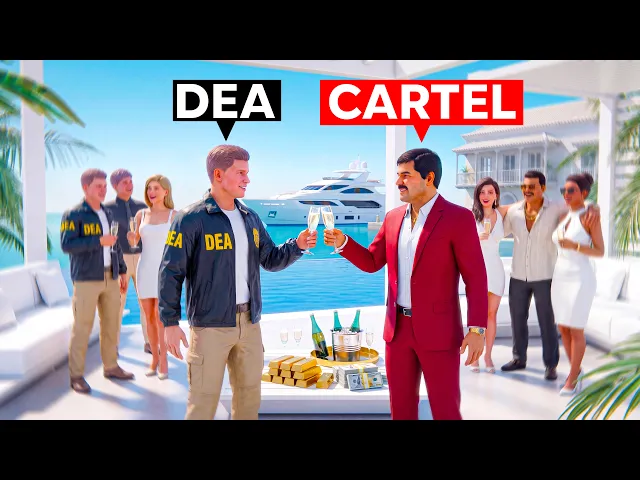
March 14th, 2017. Cardagana, Colombia. Music pulses off an infinity pool overlooking the Caribbean.
A yacht bobs in the marina below. The guests sipping champagne on the rooftop terrace aren't cartel bosses. They're DEA agents.
And this $767,000 mansion with ocean views. It belongs to one of their own. Special agent Joseari raises a glass to his colleagues.
His wife flashes a $30,000 Tiffany diamond ring. Three years earlier, he'd been drowning in half a million dollars of debt. The math doesn't work because Iari isn't undercover.
He's running one of the most sophisticated criminal operations ever built inside a federal agency. For nearly a decade, he exploited a classified DEA program where agents legally laundered cartel cash to trace drug money. Irizari was trusted with millions.
Instead of tracing it, he took it. The FBI sealed those documents. No one else was charged.
The judge at his sentencing said what the government wouldn't. You were the one who got caught. But it is apparent to this court that there are others.
How did the DEA let a criminal build an empire inside their own walls? And why did the government bury what he told them? On paper, it sounds insane.
Federal agents laundering drug money. But that's precisely what happens in attorney general exempt operations. DOJ sanctions stings where agents pose as money launderers, moving dirty cash for cartels to trace where it flows.
Open a front company, run cash through a DEA controlled bank account, ship a pallet of bills overseas. Every year, tens of millions in cartel cash flows through DEA front operations. It's a highstakes infiltration game and only a select group of agents receive [music] clearance to play.
Jose Irizari was one of them. By 2009, Irizari appeared perfect for this shadowy work. Bilingual, born in Puerto Rico, street smart about smuggling routes.
He'd worked as a federal air marshal, then border patrol agent before joining the DEA. In Miami, he was assigned to a specialized money laundering group focused on the black market peso exchange. The complex web cartels used to convert drug profits into clean money.
Sharp, eager, disturbingly good at thinking like the criminals he pursued. From day one, his new job handed him extraordinary access. Undercover bank accounts flushed with cartel cash, authority to conduct international wire transfers, clearance to cultivate criminal informants.
But behind the polished resume, red flags were snapping in the wind. The DEA ignored everyone. In 2010, Irizari filed for personal bankruptcy, $500,000 in debt.
Around the same time, his standard higher polygraph exam indicated deception. That result should have ended his candidacy, but the agency was desperate for Spanish-sp speakaking agents with moneyaundering expertise. They hired him anyway.
And one more detail. Irizari's longtime friend, the man who would become godfather to his twin daughters, was a suspected money launderer for Colombian traffickers. The DEA didn't press.
Welcome to the drug war. Here's your badge and your secret bank account. As Irizari immersed himself in Miami's undercover moneyaundering missions, he learned something critical.
Stealing from these operations would be almost trivially easy. Virtually no oversight existed. And he noticed something else.
The DEA's metrics for success had nothing to do with actually reducing drug trafficking. Success meant seizing cash. Making flashy arrests.
Outcomes were irrelevant. Appearances were everything. The thought that began to corrupt him emerged from this realization.
Why play by the rules of an unwinable game? 2011. A briefing room in Miami.
Irizari watches his supervisor present seizure stats to visiting brass. 47 kilos intercepted this quarter. Six arrests.
$2. 3 million seized. Applause.
Irizari knows the truth. 47 kilos is a rounding error. The Medelene network moves 200 kilos a week through their sector alone.
These victories are theater. That night, staring at his bankruptcy papers, a thought crystallizes. If the war is fake, why can't the spoils be real?
Late 2011, somewhere in Miami, Joseé Irizari makes the choice that will ultimately destroy his career and expose the DEA's rotten infrastructure. He steps across the invisible line from [music] agent to thief with a move so simple it's almost laughable. He has access to dirty [music] money.
His boss isn't watching closely. Why not take a little for [music] himself? He's about to discover just how easy robbery becomes when you're the one dealing the cards.
But here's what Iari didn't anticipate. The same lack of oversight that let him steal would eventually let someone else betray him. The question isn't whether he'll be caught.
It's who will turn on him first and what they'll reveal about everyone else involved. At the end of his first year, special agent Irizari isn't just tracing cartel cash anymore. He's taking it.
The scheme starts small. Irizari partners with a trusted DEA informant, a Colombian fixer who arranges money pickups. Using a stolen identity, they open a private bank account in Miami, not a DEA front account with oversight off the books in someone else's name.
Then, with a few keystrokes, Irizari redirects a stream of cartel cash into this phantom account. money that should be documented in sting ledgers. Instead, it becomes his slush fund.
With that secret account operational, Irizari weaponizes the DEA's own playbook. He knows exactly how undercover funds move, what paperwork authorizes a transfer, how to avoid scrutiny. First, he files a false report claiming the DEA needs to transfer $200,000 of investigative cash from a seizure in one country to a bank in another.
Then he instructs a colleague to wire that [music] money overseas. They comply without question. Irizari is known for making big cases.
But here's the trick. That overseas account. It's the one Iriari secretly controls.
The money lands. A chunk kicks back to him. Then he does it again and again dozens [music] of times.
He masters bureaucratic camouflage, creating paper trails [music] just believable enough to avoid scrutiny. using DEA resources as cover. Sometimes he designates bogus [music] mission cities for pickups simply because he wants to visit.
Craving a real Madrid match? Schedule a money pickup in Madrid to coincide? Want Sun and Sand?
Justify a meeting with an informant at a tropical resort. To his DEA superiors, these are legitimate field operations. to Irizari and his inner circle.
They're all expenses paid vacations funded by Uncle Sam's blind spot. As the money rolls in, Irizari's personal life transforms. That $30,000 Tiffany ring for his wife, a Colombian beauty queen he married after a whirlwind romance.
A $135,000 Lamborghini. Three houses, one in South Florida, one in Puerto Rico, [music] and the crown jewel is the Cardana mansion with the rooftop pool. A yacht docked in the harbor for weekend getaways.
Designer suits, VIP club tabs, [music] Louis Vuitton handbags gifted to friends. Irizari isn't hiding a modest nest egg. He's flaunting a [music] fortune.
Living like the traffickers he's supposed to be dismantling. Where was the oversight? A 2020 Department of Justice [music] audit, sparked partly by Irizari's case, found the DEA had failed to [music] file required annual reports to Congress on these undercover operations since at least 2006.
For over a decade, the DEA's moneyaundering [music] stings operated in a vacuum with almost no accountability or external scrutiny. There is limited congressional insight, [music] the Inspector General's report noted. translation.
In the vast majority of these cashmoving operations, no one was minding the store. Even internally, basic safeguards [music] were absent. The undercover accounts Arazzari managed were supposed to require detailed logs and supervisor signoffs.
Instead, [music] the audit found numerous instances of agents running stings with minimal documentation or approval. [music] Irizari had free reign to wire money around the world. The DEA's internal culture had become trusting to the point of negligence.
[music] As long as an agent delivered big busts and big seizures, higher-ups didn't ask questions. If you're finding this story as disturbing as I do, consider subscribing. There's much more to uncover about how deep this corruption [music] spread, and you won't want to miss what happens when Irizari's own partner turns against him.
By 2014 [music] to 2015, Irizari's scheme has diverted at least $3. 8 8 million in drug proceeds that should have been evidence, likely much more that went undetected. He's personally pocketed around $1 million in kickbacks and bribes.
And remarkably, he's still considered a rising star. His Miami bosses praise his work. He received a promotion and transfer to a dream post in Cardigana, Colombia, the heart of the drug world in 2015.
The same year the DEA's reputation was rocked by a sex party scandal. [music] Agents in Colombia caught carousing with prostitutes paid by cartels. Irizari is sent closer [music] to the action with even less oversight.
The fox isn't guarding the hen house. He's been put in charge of the entire farm. His colleagues watch him depart for Colombia with envy and suspicion.
Some wonder [music] quietly. How is Jose affording all this? Rumors swirl, but rather than report him, a few agents are lured by the same temptation that corrupted Iriari.
They see the yacht parties, [music] the five-star travel, the easy money, and they want in. If the boss isn't asking questions, why not join the fun? By 2016, Jose Irizari isn't longer running a one-man operation.
He's the ring leader of a growing band of agents, [music] informants, and prosecutors who've decided to treat the war on drugs as a get-richqu scheme. That band would earn a nickname straight from dark comedy. They called themselves Team America.
The name started as a joke, a riff on the Team America World Police movie, but it fit perfectly. This wasn't an official DEA task force. It was an offduty fraternity of agents and informants who discovered the drug war could double as a worldwide party tour.
According to Irizari, dozens were involved. DEA agents from Miami and beyond. federal prosecutors who enjoyed the perks, trusted informants, and even actual cartel smugglers who tagged along.
What united them was an unspoken pact. Keep producing results on paper and keep reality buried. Why conduct business in drab conference rooms when you can do it in ibita?
Team America chose cities for money pickups based on party potential. Barcelona during a Champions League match. Paris the week of the French Open.
Work trips timed to coincide with Real Madrid games or a Rafael Nadal tennis [music] match in Monaco. The investigative justification was often thin or fabricated entirely. Once on site, agents blew undercover cash on lavish [music] dinners, nightclubs, and sex workers.
Irizari later admitted 90% of his field operations were bogus excuses, vehicles for partying rather than legitimate work. In Colombia, Irizari hosted colleagues on a Colombian businessman's yacht. Plenty of booze and more than a dozen prostitutes.
These weren't covert meetings. These were debauched blowouts funded by drug money the DEA was circulating. We would generate money pickups in places we wanted to go, told investigators.
And once we got there, it was about drinking and girls. For years, this hedonistic subculture remained an open secret. In 2017, five DEA agents kept a WhatsApp group chat that read like a hybrid of frat house bragging and criminal conspiracy.
They dubbed their globe trotting escapades a world debauchery tour of boozing and whoring on Uncle Sam's tab. They swapped photos of sexual conquests and joked about how thoroughly they were exploiting the system. At one point, the chat devolved into jokes about rape, which would haunt them when one of those agents was later accused of sexual assault.
[music] The messages dripped with arrogance. They didn't bother with code words. None of this was hidden from colleagues.
Irizari's bosses heard rumors. His peers saw Instagram photos on boat decks and at soccer stadiums. Some junior agents felt uncomfortable, but reporting a star agent connected to big seizures was career suicide.
Many others were having too much fun to care. Shared guilt kept everyone silent. Washington wasn't entirely oblivious.
In 2015, a Justice Department inspector general investigation exposed sex parties with prostitutes funded by Colombian cartels that DEA agents in Bogota had attended. Headlines: congressional outrage. DEA leadership promised sweeping [music] reforms.
Some agents received light discipline, many just a few days suspension. But the message never reached team America. In the same year, DEA brass assured lawmakers it won't happen again.
Irizari was escalating his crime spree and being rewarded. The DEA transferred him from Miami to Cardigana, a posting with even greater access to sensitive operations. Any oversight he might have faced stateside was now a continent away.
In Cartagana, Irizari came into [music] his own point man on major international moneyaundering investigations, liazing with top Colombian officials, still skimming with impunity. DEA colleagues rotated through on temporary duty and enjoyed his hospitality, wild nights funded by undercover cash. The line between the DEA and the cartels had blurred into shared appetites for easy money.
But not everyone in Irari's orbit was blinded by the fun. One man had been watching closely, a veteran informant who'd been Irrizari's partner from the start. This informant helped Irizari steal money.
He attended the parties, took his cut, observed Irizari's escalating recklessness. By 2017, he was getting nervous. He saw Irizari growing bolder, less careful.
The agents high-flying lifestyle was drawing attention. If the DEA's House of Cards collapsed, everyone involved faced serious prison time. The informant realized he had a choice.
Go down with Irizari or save himself by cutting a deal first. The betrayal that would ultimately expose Joseé Irizari wouldn't come from an internal investigation or a vigilant supervisor. It would come from inside his own trusted circle.
But here's the twist. Irizari never anticipated. The informant wouldn't just expose him.
He would hand investigators a road map to corruption that extended far beyond one rogue agent. The question is, how many names were on that list? And why haven't we heard about their arrests?
For nearly a decade, Joseé Irizari proved astonishingly adept at gaming the system. But his downfall was orchestrated by the one person he never saw as a threat, [music] his closest informant. Call him Mario.
His real identity remains protected even now. Mario was there from the beginning, helping Irizari divert money, setting up accounts, enjoying the perks. If Iari was the king of Team America, Mario was his right hand.
But by 2018, Mario looked at Iriari's mansion, the flashy cars, the accumulating evidence of corruption, and had an epiphany. Jose is going to get us all caught. Mario quietly reached out to US federal prosecutors.
A DEA informant walking into a US embassy or attorney's office saying, "I have a story about one of your agents. " Skepticism must have been intense. Irizari, the star agent with all those big busts.
But Mario came prepared. He had receipts literally and figuratively. False reports, secret bank accounts, wire transfers to shell companies, names, dates, places, documents showing how money logged as undercover operations ended up in private accounts he and Iari controlled.
The ultimate informant play, betraying his handler [music] to save his own skin. A quiet investigation began. By late 2019, [music] the Justice Department had assembled a case.
Irizari, oblivious, had left the DEA. He resigned abruptly in [music] 2018 amid whispers that internal affairs had finally started sniffing around. He was [music] living in San Juan, Puerto Rico, perhaps sensing walls closing in, but unaware Mario had flipped.
February 2020, a dawn raid in a gated community near San Juan. Federal agents swarm Iriari's residence. He and his wife are still groggy when handcuffs click around their wrists on the front lawn.
The indictment, 19 federal counts, conspiracy to launder money, bank fraud, wire fraud, identity theft. The numbers are [music] staggering. At least $9 million diverted from DEA operations with [music] over $1 million lining Irizari's own pockets and the rest funneled to co-conspirators.
Facing essentially the rest of his life in prison if convicted on all counts, Irizari does the only sensible thing left. He cooperates. In September 2020, he pleaded guilty to every charge.
No deal for leniency is promised outright, but his attorneys hope that by spilling everything, he might receive some mercy at sentencing. Conference room, FBI field office, Miami, March 2020. Jose Irizari sits across from three federal prosecutors and two FBI agents.
A court reporter types silently in the corner. Irizari's attorney has advised [music] him to cooperate fully. It's his only path to reducing a potential life sentence.
Let's start with the Miami agents, the lead prosecutor says, sliding a roster across the table. Who else was involved? Iari picks up a pen.
He starts circling names. 1 3 7 12. The prosecutors exchange glances.
This is worse than they thought. Over 60 debriefing sessions spanning 40 hours. [music] Irizari doesn't just name names.
He provides a blueprint, wire transfer logs, WhatsApp screenshots, [music] dates, amounts, destinations. He implicates DEA agents [music] from three field offices. Federal prosecutors who looked the other way.
supervisors who approved [music] bogus expense reports. When he's done, the lead prosecutor leans back and exhales. [music] This, he says, is going to be sealed.
The prosecutors listen, take notes, and then do something telling. They ask a federal judge to seal certain documents. Transcripts of Irizari's debriefings and specific names of uncharged co-conspirators are deemed sensitive.
The judge agrees, citing concern that unsealing the information could impede an ongoing criminal investigation cause targets [music] to flee and hinder cooperation from other witnesses. The implication chills. Irizari's cooperation [music] has revealed active corruption probes still underway, and people within law enforcement might run or obstruct if they knew [music] what he'd said.
By late 2021, Irizari has done all he can to mitigate his fate. In one interview [music] before heading to prison, a remorseful yet defiant Irizari claims he was schooled in how to be corrupt from the day he joined the DEA. Coming from the man now acknowledged as one of the most corrupt agents [music] in DEA history, it sounds like a desperate excuse, but after everything revealed in this saga, is there not a kernel of truth in it?
December 9th, 2021, Tampa, Florida, a federal courtroom. Jose Irizari, age 46, stands before Judge Charlene Honeywell in a prison jumpsuit. His once cocky demeanor is subdued.
His wife, also convicted, faces her own sentence. His young children are with relatives. But this story isn't over until the judge speaks, and her words will ricochet far beyond that room.
Federal prosecutors outline the seriousness of Irizari's crimes, the breach of public trust, the blatant aiding of a Colombian cartel, the stain on the DEA's reputation. They ask for a severe sentence to send a message. Irizari's defense pleads for leniency given his cooperation.
His attorney, Maria Dominguez, delivers a damning assessment of the DEA itself. She describes an alternate universe inside the agency where taking gifts from informants and skimming money felt normalized. Judge Honeywell listens intently.
A former prosecutor herself, she's no stranger to crime and betrayal. But this case clearly strikes a nerve. When she speaks, disgust sharpens her voice not just for Irizari, but for the environment that enabled him.
She calls it one of the most egregious betrayals of trust she's seen. She speaks of the human toll. How floods of drugs ravage communities while those fighting the war partied on the sidelines.
Then she aims squarely at the DEA. This has to stop. Irizari's head bows as she delivers the line that will make headlines.
[music] You were the one who got caught. But it is apparent to this court that there are others. [music] In that moment, the narrative reframes.
Irizari isn't an isolated villain. He's the fall guy for a systemic problem. The judge openly calls for those corrupted by the allure of easy money to be investigated and brought to justice.
A rare and scathing indictment of [music] an agency by a federal judge during sentencing. The gavvel comes down. 145 months in federal prison, just over [music] 12 years.
Restitution of approximately $11,000. Forefeite [music] of the diamond ring and luxury cars. Everything Irizari built through his criminal enterprise, the mansions, vehicles, bank [music] accounts seized or squandered.
His marriage shattered, his wife Natalia, who pleaded guilty to a [music] minor role, later filed for divorce. The Globe trotting agent who dined in five-star [music] restaurants would eat from a prison cafeteria for the next decade. Outside the courthouse, reporters shout questions.
What about the others? Were more agents involved? Prosecutors and DEA officials remain tight-lipped, offering generic statements about no one being above the law.
But Judge Honeywell's pointed remarks hang in the air. In the months that followed, investigative journalists, particularly the Associated Press, uncovered that more than a dozen DEA personnel who crossed paths with Irizari, quietly faced internal discipline, suspensions, forced retirements, no additional criminal charges. The DEA, stung by the PR disaster, announced policy changes, new rules on handling evidence money, refresher ethics training, a task force convened to examine the agency's culture abroad.
Skeptics note, we've heard this before. After the 2015 sex party scandal, similar vows were made. January 5th, 2022.
The night before he must report [music] to federal prison. Jose Irizari sits down with an AP reporter for one final interview. He looks humbler now.
The cockiness has drained away and he says something that sums up the entire sorry tale. The drug war is a game. It was a very fun game that we were playing.
Bitterness seeps through at himself at the DEA at the entire charade. He reiterates that in this unwinable war, the DEA knows it cannot truly stop the flow of drugs. Agents know it, too.
And when real victory is off the table, incentives twist. It became about playing the game for personal gain. Why not?
Irizari thought he could win his version. He lost badly. As Irizari disappeared behind prison walls, the uncomfortable questions he raised still linger.
He insists he told authorities everything and gave them a map to the rot. All they have to do is dig, he said. But will they?
The [music] judge herself voiced what many wonder. If Iari was the one who got caught, who are the others still out there? Jose Irizari exploited the DEA from the [music] inside, stealing millions while the agency looked the other way.
But if you think that's the most twisted relationship between a criminal and federal law enforcement, you haven't heard about Whitey Bulier, the Boston gangster who didn't just infiltrate the FBI. He made them his personal hit squad. For two decades, FBI agents fed him intelligence, eliminated his rivals, and warned him when other cops were closing in.
He didn't work [music] for the FBI. The FBI worked for him. You can see it here.