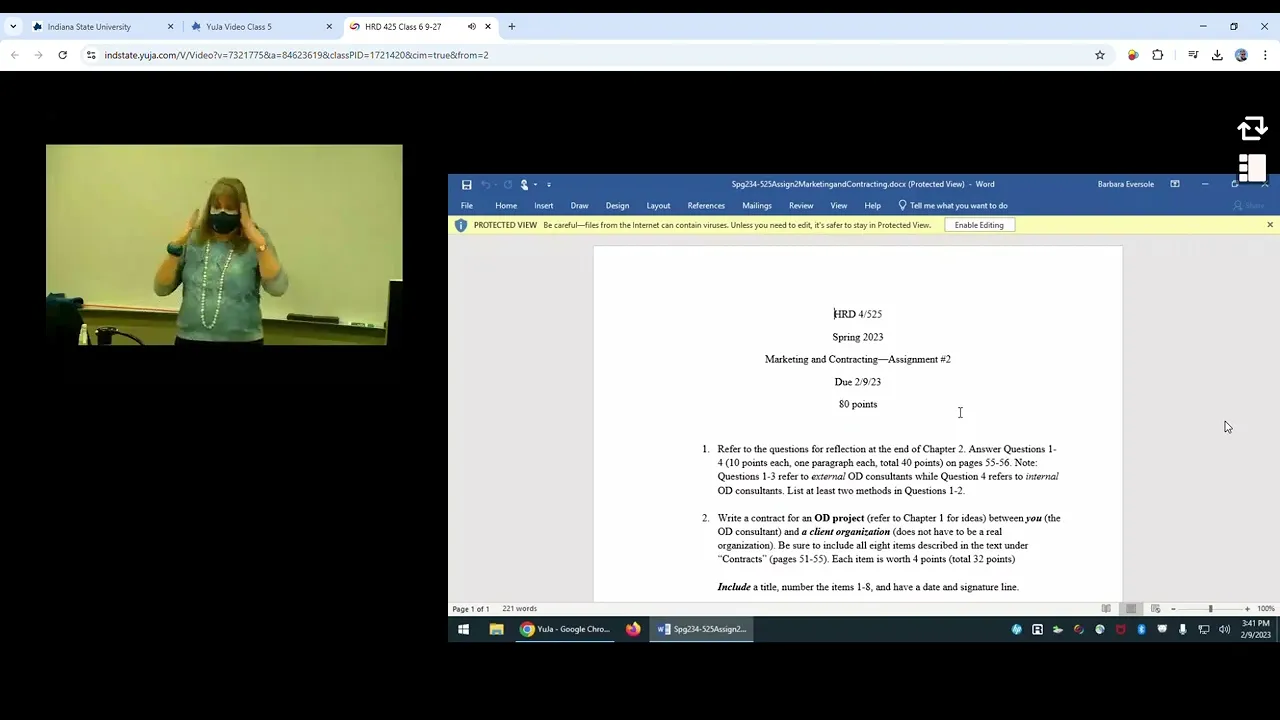
Okay let's start by right through the assignment that's due tonight anybody have any questions about the assignment yes on the syllabus it says that assignment two is 75 points but then it said that this is 80 it's 80 okay just making sure Yeah there was a discrepancy with the discussion points discussion question so I had to change that I thought I changed it on the syllabus but I guess I didn't in the say outcome um is can be the common CME because they work if they work together the organization with the consultant sorry I'm not
sure what the question is the in the second question is the of the contract yeah no it's not a question just to put It and can my problem is at at the time to write so I can put for example organization and the consultant so these will be the blah blah blah these would be the outcomes for the organization organization yeah okay so what will the organization have as a result of the project what they are looking with this project yes so what will they at the end of the project what will the organization have
oh okay Will they have a training program will they have increased sales will they have improved communication throughout the organization okay so what are you going to leave them with they have a coaching program for all their managers so the client came to you for a reason right they had some problem that they needed to have solved something was affecting their Organization's performance right so presumably came to you first with a presenting problem which wasn't exactly really what was going on right so you did a little mini diagnosis and you thought okay this is what
I really think is going on not what they actually came to me with right and you had a conversation with them and you decided yeah this is what going on and this is how I can help you this is what I can do for you yes so you have to come up with Like the your own problem like can does it have to be something specific or yeah so in other words um let's say the client comes to you and they say well I think there's poor communication going on within my organization and so you
talk to him a little bit him or her and you think well it's not really that it's really that um the client isn't listening to what people are telling them so then that's what you say you say well I think Actually communication problem is happening up towards you and that you need some Executive coaching in in listening to your people the client says okay I can buy that so then you say this uh the project that we're going to do is I'm going to do Executive coaching with you and your managers so that in in
terms of how do I listen to my employees so what's the outcome of that right you have a coaching program put in place for all of your employees right That would be the outcome is that um all employees received 10 hours of coaching for the next two or three weeks that's the outcome of the project but won't be califate the the kind of project because what I'm not sure because I never work like like in this is about the times and all that that won't be cific right so the important part about number two is
that you're leaving them with Something right so it's similar to the deliverables right deliverables are are you going to leave them with a report or you going to leave them with training sessions or what is it that you're actually going to hand them right so but number two is more about what is the outcome that you want to have right so in the coaching example you want to have those those managers be coached on good communication skills right yeah but in the seven for example In in the timeline there are times that I I put
in the contract but I don't manage that that it will be real or not so that won't be okay so I'm not going to say if you tell me that you want the timeline to start now and end in five months I'm not going to say no five months is not the right amount of time okay okay I'm not I'm not going to uh criticize your project and say you didn't do the right things in your project I'm only interested that you Have all the items in the contract okay okay so I'm not grading you
on whether or not you are doing the project effectively I haven't even taught you any of the interventions right I haven't even taught you how to gather data or how to solve any of the problems right I'm only trying to teach you what goes into a contract so I'm not grading anything but that all you have to do is put all the stuff in the Contract just pick an OD project okay and pick some outcomes I don't even care if they're the right outcomes okay just make it an outcome okay because I haven't taught you
anything about how to intervene in an organization and fix a problem yet okay so make it something simple right just Pi something easy I just want but I just want outcomes right something that when you leave right the organization knows that you've been There because there's going to be some results think about results right you can make it profit is going to be improved communication's going to be improved right they'll be better managers right sales will be improved right anything just as long as it's an outcome or result okay some kind of performance will be
enhanced by the fact that you were there you did your Project yes uh is there like uh G to be a page count on it like do you care how long it is or no just as long as you address all the eight elements okay make sure you have everything in the contract that needs to go in the contract this is just practice for you in putting together what needs to go in a contract you're pretending that you're a consultant you're thinking about what are the things that I would have to include if I'm going
to contract with an employee with a client organization so to get you in the mindset of thinking about these are the kinds of things that I would have to put into a contract if I were going to work with a client organization what are the kind of things that I would be that I would have to think about so that's what assignment is about is to get you the mindset of being a consultant of What kinds of things would I have to think about and putting Together a contract so I'm less concerned with what the
actual project is and what the actual outcomes are I just want to make sure that they're outcomes some sort of outcome right but you're thinking about outcomes these thinking about deliverables you're thinking about timelines I don't care whether you put two months or two years so only you got to start date and then date right so Think in terms of the fact that your engagement your project has to be bounded by start date and an end date contract has to have that right you may end up extending it because you need more time or shortening
it because you finish early the contract needs to be for a specified amount of time so I want to get you in the mindset thinking about those things when you're writing out a contract so don't get hung up on the Details whether you got the right details for that particular project that's not what I'm worried about cuz you don't know enough yet take a little bit the anxiety away from the contract any other questions gu everybody else isn't worried about that okay okay So today we're going to wrap up chapter 4 in our book we're
going to talk about feedback so remember we analyze the data um collect the data analyze it and then part of our model is to provide feedback to the organization so after we collect the data and analyze it we feed it back to the organization so we're talk about why we feed it back I'll talk about what kind of questions do we ask during the feedback process and what are some of the takeaways about feedback so why do we provide feedback Well since we're working with the client organization we want to be sure that we have
corrected collected and analyzed the right information so we want to make sure and we do this a lot in qualitative analysis qualitative data um work is that we go back to the people who have given us the data and we ask is this data correct right so it's called member checking and we want to make sure that our data is valid right we talked Earlier about what validity means and that means that we want to make sure that the information that we have collected that we haven't misrepresented it that we've understood it and that it
is valid we also want to make sure sure that the people who we've collected the data from that they own the data but we don't want people to be saying no we didn't say that no you got it wrong this is not what we said right we want them Instead to say yes this is what we told you this is the data that you collected from us this is what we said right because we want them to own the data and not say no this is not what we said we did not say there was
a huge problem in communication we did not say that we are really feeling resentful about this that and the other thing because we want them to own the data and say yes these are the problems that are existing in our Organization because if they don't own the data then we have a real problem right because we can't go to management and say this is what your people are telling us and then have those people say no I didn't say that right so it's very important to be sure that our information is valid our interpretation is
valid and that the organizational members that we got the information from are going to say yeah this is what's going On this is what we said okay so when we're giving feedback we have to answer these questions we have to answer who do we think we should give the feedback to and who's going to actually provide the feedback and you say well shouldn't the people who collected the data provide the feedback well maybe maybe you want the consultant to do that but maybe you want the manager to provide that Feedback to their own people right
so you have a couple of options you don't necessarily have to go with the person person who collected the data and how are you going to provide the feedback right you have some options there and what should you include when you're giving feedback so there are some questions to ask about that so who should you give feedback to well The easiest answer is everyone who you ask questions of right so if you if you had them participate in the data collection then they should be feeding the data back to them and this might be scary
but if you realize that these are the people you collected the data from they already know what you're going to tell them Right if your data is valid they already know now one exception to that could be if you got some really bad information to share and it could somehow impact a highly competitive situation and you want to plan for that ahead of time and maybe some of that information you might not want to share because you don't want to harm Your client but that's usually not the situation so of course this is preco right
but now we're according to our president we're not in an emergency situation anymore CO's over so we're back to face to face right face to face is usually always best um could still have people zoom in but face to face is usually always the best way when you're feeding information Back um use a question and answer format cascading starting with the broadest interpretation first and then down to more detail of course we always like to have handouts right because handouts make it easier for people to follow along but handouts can also mean that critical proprietary
secret data can find their way into the wrong hands and usually we're dealing with um problems that the organization has That's not something that you generally want to get out to people outside the organization right so you don't necessarily want to hand things out so use a multiple variety of formats you know use PowerPoints or use some kind of uh something that everybody can see uh if you do have handouts maybe collect them back at the end of the at the end of the Session um so maybe use a video or something to help spread
the information so who should provide feedback so either the OD consultant who collected the data or the manager of the group that you're presenting the feedback to because you won't be doing feedback all at once you'll be doing it uh Group by group so if the manager does it then the manager owns that data right So that's a way for the manager to say okay I believe this data I believe that you guys said this so I believe that this is what is happening in our work group right so in many ways that is kind
of the best way to do it but there are some risks if the manager is doing it because if the employees don't trust the manager then they may not trust the data Either of course always a good idea to start big drill down it's cascading and if you know there are some big problems in that data right the manager has to be careful not to be defensive about that data right so and of course the OD consultant needs to be there right be able to answer answer questions that maybe the manager may not be able
to answer especially questions about methodology That someone may have and of course the manager needs to be coached right on the right way to answer questions and so what should be included you know always always always you know when you're giving people information about a data collection process you need to let people know how the information was gathered because people are going to have questions about methodology but going to have to provide A summary of the data right because you don't want to provide them with a ton of detail and then what is management going
to do with that information because it's not enough to just provide everybody with what it is you found out but what are the next steps right and if steps have already been taken what are those steps right you try to give as much information about the process the results that you can and if you have any historical data That will help put the current results in some context that's also helpful and then you know there's only so much information that people can take in at one time so try not to overwhelm everyone with all this
data and of just you know giving everybody a bunch of data you can start working on the data right away so present the data put it in Context and then have start have people start working on the data in small groups right away so they can start taking small actions right away so particularly if you know there's some serious problems going on then once you hear about these problems they already know them right they already know these problems exist so now that management knows about them right management probably already knew It existed so let's get
to work on them right away right now we're acknowledging that these issues exist let's get to work on them so a few things to remember about feeding back to the system it's essential right because we have to be sure that our interpretation of the data is valid and Accurate and the only way we can do this is by feeding it back to the system and having the system having the people that you gather the data from confirming the accuracy and it's very important because it's the first step in starting the action planning process which we're
going to be talking about next week so any question on feeding back our diagnostic Data okay so now we're going to take a step back and we're going to start talking about particular kind of data analysis which is the kind that you're going to be doing in your next assignment so you're going to be conducting interviews so we're going to be talking about How we analyze qualitative data so last week we talked about quantitative data nominal ordinal interval and ratio data now we're going to talk about how do we analyze qualitative data so quantitative data
quantitative data is numbers what is qualitative data [Music] it's not numbers what else would it be What's interview data made up of words words right so instead of working with ratio data or even liquor data right we're going to be looking at words and what those words mean so quantitative data if you're all the way off on one end you say there's no such thing as qualitative everything's quantitative everything has To be either zero or one if you're on the qualitative side you feel that everything is ultimately qualita so these are just different approaches to
arrive at the same Destiny which is to find out what's going on although if you want to find out what's going on you're generally over here if you want to compare different groups for example if you want to compare the effectiveness of a certain Intervention then you're sort of over here I don't know why this slide doesn't come out anyway so when we're trying to understand what is going on we're trying to understand context we trying to understand people we trying to understand how they interact so you'll find qualitative methods being used economic political social
cultural environmental and organizational Areas so how these different areas influence Health would be a qualitative question understanding how people make sense of their experiences of health and disease would be a qualitative question sense making understanding interaction how various actors or people involved in different Public Health activities interact with each Other so basic differences so purpose of qual is to describe or gain Insight figure out what's going on quanitative you might want to measure magnitude how widespread is a process so as I said also wanting to compare groups or the effect of an intervention so for
qualitative you don't have any predetermined response categories quantitative we have Predetermined response categories and standard measures so we can do our operations right ratio operations data we're typically looking in depth in our data right we're trying to explain using a small sample when we're doing qualitative for your next assignment you're going to interview three to five people so very small sample size Quantitative you're usually looking at a large number of people a large sample and you usually want a statistically representative sample we talked about this a couple of weeks ago we usually want to have
a random sample that's going to be generalizable to the whole population right that's the most powerful statistic that we can get from a quantitative standpoint And our qualitative analysis what we're looking for are patterns or themes we want Concepts and insights right we're trying to figure out what is going on from a qualitative standpoint quantitative on the other hand we want hypotheses we make guesses about what's going on we use data to support conclusions about those hypotheses can we support these hypotheses or do we reject these hypotheses qualitative result are Illustrative explanations Andor individual responses
to whatever research question we have whereas quantitative we have Aggregates and summaries responses are clustered and then sampling qualitative is usually more of a propos of sampling or theoretical sampling based on what it is we want to find out and quantitative is a statistical Sampling method as I said random okay so those are the basic differences so your research question I don't know why they switch the switch from quantitative to qualitative so the research question and quantitative is very fixed and focused right whereas the qualitative research question is more conceptual and flexible the outcome and
quantitative we identify it in advance right we know What outcomes we're looking for right our research questions are very specific our hypotheses are very specific qualitative more emergent right we're not sure what we're going to find right usually what we find the themes are emerging from our data quantitative is very linear qualitative would be more circular quantitative we have something called confounding datas or confounding Factors an experiment we try to control everything right because we're only looking for the effect of X on y but if C comes in and affects something that's bad we want
confounding factors to be out qualitative we want context we want everything that affects everything we want it all we want to understand the whole system everything to be holistic so we want those confounding factors to be in there because it helps us understand what's Going on right we're not interested in just looking at two variables in a vacuum time Dimension quanti slower qualitative wrapper to slower sampling and random versus open-ended quantitative we use a very structur data collection tool qualitative be more interactive of course quantitative we can generalize the Results we don't generalize qualitative results
right because we're not using random sampling but we do have meaningful results that give us experience and Views that can perhaps have some applic applicability to other situations so we're not looking for generalizability but we're looking for understanding we can mix methods we can do qual first and then Quant or we can do Quant first and then Qual people generally don't do them both at the same time but you can be but sometimes you'll have a qualitative analysis study first which will help you figure out the variables that are important and then you'll do a
quantitative analysis to test the relationship of those variables sometimes you'll do a quantitative analysis first to understand the relationship of variables and then use a qualitative analysis to Dig deeper into the meaning of those relationships by interviewing some people more deeply about those relationships so some interesting things that are important about qualitative use of natural settings the idea that we're looking at the whole thing instead of just Parts the idea that the researcher is the instrument and we talked about this about um also doing a Uh a doctoral level course in od so sometimes get
confused about what we talked about in here what we talked about in there but the idea of the um OD consultant as being an instrument the idea of self as instrument that's a qualitative Paradigm so the uh researcher is partly the instrument so um that's self as research instrument the fact that qualitative design is Emergent and saturation is you keep on interviewing until you've reached saturation saturation is when you aren't learning anything new so you stop interviewing When You Reach saturation different types of study designs ethnography is usually used to understand a culture of a
group phenomenology is used when you want to Understand the lived experience of participants rounded theory is trying to come up with a theory about a phenomenon participatory action research is researching um social cultural settings and experiences and then a case study is an in-depth investigation of a single or small number of units at a point in time or over a period of time so sampling generally propos of so you try to find The people who can tell you the answers to your question so in assignment three you're going to try to find three to five
people who are managers or supervisors in the company you're looking at right because these are going to be the kind of people who are going to be able to answer your questions right so going purposely look for people who have the information that you need to be able to um figure out what's going On okay so what is qualitative data it's words it's data that's not easily reduced to numbers okay so it's not something that we can just easily assign numbers to so that we can quantify it it's Concepts opinions values behaviors so qualitative data
or any transcripts that you have from Individual interviews or focus Groups it could be field notes from When You observe certain activities or any written information that you have documents or any transcripts of audio or video recordings so any sort of written document that you have is qualitative data so the transcript that you will have of your interview your interviews from the three to five people That you will interview will be qualitative data and so you're an OD consultant and you're using interviews as a method for Gathering data to find out what issues the organization
has or to confirm your mini assessment of what you think think the organizational problems are you'll most likely be using interviews some more examples structured text could be writing stories survey Comments news articles unstructured texts transcriptions interviews focus groups Rec conversation that you are transcribing audio recordings music video recordings so the ways that we are collecting the data observation right we talked about observation STI so observation can be quantitative or qualitative data If You observe and have a checklist we have to uh check one through five right that's going to be quantitative data it's a
Liquor scale agree disagree you have to click those that's going to be Quant ative data but if observation has field notes you have to write down what's going on then that's going to be qualitative data same with the interview right if an interview has a liquor scale that's going to be quantitative but the interview has open-ended essay questions right it's the kind of questions you're going to be Asking then that's going to be qualitative data asking questions listening to and recording answers from an individual or a group on a structured semi-structured or unstructured format in
an in-depth manner okay you're going to be getting answers that are words focus group discussion is the same thing they're going to be answers going to be talking with each other diversity of opinions you're going to want to get Those opinions different kinds of questions you can ask hypothetical questions if you get the chance to be an HIV scientist do you think you can discover a vaccine provocative what do you think ideal in your opinion what would be the best interpretive what do you mean by this you can ask leading questions even in qualitative interviews
you think prevention is better than a Cure did you watch that culturally degrading TV show on condom use some of your three favorite authors the book you like so doesn't follow the rules right for um survey questions right experience questions what was your experience what happened opinion what do you think about feeling things when you get to know that project was a success how did you feel Knowledge Questions what's the different ways of promoting this Input what the instructor tell you see there's a wide variety of questions you can ask and then once you have
your uh interview if you've recorded it on your phone or another recording device then you have to transcribe it because the only way you can analyze written only way you can analyze qualitative data is if you have a written transcript okay so when you do your Interviews right you're going to have to either record it or you're going to have to write it down word for word and so I suggest you record it some way because it's very difficult to write down an interview word for word course you'll have to get their permission but now
you know it's so easy with uh your cell phones you can record you have to go get a tape record Or anything so record your interviews and then transcribe them when you're trans when you're when you're doing the interview right be sure to to think about the nonverbals as the person is speaking right and not jot that down okay note that because that's more information how do they seem how do they seem when they're answering the question try to do the transcribing yourself which you probably will for This assignment but you know for further research
that you may do in the future it might be tempting to hire somebody to do the transcri destion but it's always best to do it yourself and it is timec consuming yes in that nonverbal H how you transcribe that like uh the interview where um looks like of how how you can what would be like an example yeah so the interviewer seemed the interview seemed um uh uncomfortable When they were saying this or they lost eye contact act they shifted in their chair or they seem very emphatic when they were saying this or you know
how how did they seem when they were saying something you describe the the body language a little the nonverbals yeah okay let's take a 10 minute break and then we'll talk about qualitative data analysis which is the fun part once you get all your Data transcribed then you have to analyze your data okay so qualitative data analysis so we have different methods so we move from our collection process into a way to explain understand or interpret people and the situations that were measuring it's usually based on an interpretive philosophy So there are two main ways
one is deduction and one is induction so deduction is basically when you are doing something called informed looking so in other words you are basically looking for something so you've already got an idea of what it is you're trying to find mind where is inductive is when you are going to let something emerge from the data so you're not really sure what you're looking for you can use a combination of Approaches as well where you're you know kind of what you're looking for but you're also open to other categories emerging why this is like that
okay so differences between the two data analysis analyses right so qualitative basically looking at General open-ended questions and then we're moving to more precision as information emerges from our data we don't have predefined Variables and our preliminary analysis is part of our data collection whereas quantitative we always have our variables predefined because that's what we're doing right we've got our hypotheses which Define our variables and we know that we are going to be comparing or looking at the relationship between variables and we consciously Identify the variables that we don't want anything to do with right
variables that are confounding and those variables we want to control and we want to keep out of our experiment and so data collection and data analysis are completely separate and Analysis uses formal statistical analysis procedures so some of the tools that qualitative researchers use are um Summaries which are key points that emerge when we're Gathering our data self memos are also some things that we uh tell ourselves like for example when we're doing the transcript um we want to we we're doing the recording we want to give ourselves some memos as far as what some
of the nonverbals are but any at any time during your data collection if something occurs to you about what's going on you can write yourself a memo you can keep a Diary so um some things that uh qualitative researchers use so Theory right youve all know what theory is we talk about Theory a lot themes are categories that emerge from lower level data points so a theme is basically um brings meaning to your data a characteristic is a single item or event in a text is the smallest unit of analysis and coding we're going to
be talking a lot about coding it's basically those are labels that we Assigned to lines of text so you can group and compare similar or related pieces of information and then we can sort coding Which comp files similarly coded blocks of text from different sources to a single file then indexing is a way to generate a word list comprising of substant substantive words and their location within the text entered into a program that would be a a computer program but You will be doing your coding by hand because you're will be having you won't have
so much data that you'll need of computer program so people differ in their experience and understanding of reality right which means u meaning is socially constructed it's an assumption of qualitative research a social phenomenon can't be Understood outside its own context which is why everything is contact bound so that's that's why we don't try to get rid of the confounding variables right because they provide context qualitative research can be used to describe a phenomenon phenomenology or to generate Theory grounded in the data understanding human behavior emerges slowly and it's not Linear and exceptional cases May
yield insights into a problem or create a new idea for further inquir you're just kind of philosophical principle okay and more information on qualitative data analysis as we said before it's circular and nonlinear keeps going until we have reach saturation iterative Progressive interact closely with your data which is your words and Some cases you collect data you analyze collect more data analyze you have different levels of analysis sort it in different ways okay so organize your data you identify some kind of framework for your data you sort the data into your framework and then you
use your framework for descriptive analysis and then you organize it again I think we're going to do here is we're going To watch this video about coding an expert we'll do them for you so you can do not taxes hi again America and we all love M&M's and let's face it me it only makes sense that I renaming America coding should really only be done when the researcher is fully familiar with the data that he or she has gathered but coding is actually quite straightforward in that it's about labeling sections or Passages of text with
a code word or code words encoding is about identifying within the text interesting or sent features of the data that relate to the research questions or research objectives now coding can be done at a fairly basic level what call a manifest level where whereby you are looking at the words that are in front of you and coding based on the words that are have been transcribed for Example more latent level coding is where researchers are using their own judgments and own views and perhaps reading between the lines of what's being said within the data now
that is obviously a more complex process than simply coding at at a manifest level the actual practicalities of coding is really from my experience is using highlighter pens colored pens and posted notes it's actually a very tactile experience and it's about getting more And more familiar with the data that's in front of you the idea was to go through the entire data set and code that material and you can have multiple codes for the same segment of text as you'll see from the next example this is a practical example of coding and this has come
from my own data now the actual content of what's in front of you here is irrelevant rather I want to show you what coding looks like in reality so this is an extract from a Transcript um as part of of one of my research studies now the process of coding as I've mentioned is about highlighting interesting or Salient features of the data and providing that data with a code so you can see here where I've highlighted parts of the text that are of interest to my research questions and on the right hand side in the
margin I provided a code that represents features Or meaning within that text so this is what your coding process should look like you have a long list of of codes down the right hand side of your transcript that relate to particular segments or passages of text within your transcript the actual codes that you use I'd suggest keep them brief and succinct so for example I have here a code that's called Low sickness rate and you can see how that relates to the Passage of text that's been highlighted so try and keep your codes relatively short
and succinct because that will help as you move through the qualitative data analysis process you should now see in front of you a long list of codes that relate to the data that you've collected is about refocusing and refining your analysis by sorting your codes into some sort of order or into some sort of GR grouping so it's about thinking how your codes Can be merged together and combined to form an overarching thematic category so here's an example again from my own research about how I derived the SC Banger now this related to some research
that I did in prison and bang up is a term that relates to prisoners being locked up in prison Sou now the theme bang up was derived from the initial coding process which you can see here on the left hand side So within The codes that I derived there were a number that related to the process of prisoners being locked up in their prison cell and you can see there they being locked up time slowing down in the prison cell worrying l in the prison cell boredom in the prison cell all of those clearly relate
to being locked up and bangled up so I felt that as a result of those codes I could group them together into this overall thematic category which was called bang up which Was really describing the loss of control that prisoners had was in their prison cell so just to clarify the initial coding process derived the number of codes related to the experience of being locked in PR cell I then went through a process of grouping together those codes which were similar in nature and derived theme bang up which encapsulated all of those Codes so if
you can imagine the process of grouping together codes to create broader thematic categories you can then to consider how those themes themselves May inter relate and how themes may have different levels of hierarchies so another way to think about themes how they Interlink and perhaps create hierarchies and orders thetic categories is to look at what Jennifer Atri Sterling calls thematic networks now atrad Sterling refers to Basic themes organizing themes and Global things and again I've used my data to try to illustrate what that looks like so you remember the theme that was developed earli in
this presentation called bang up and how that related to prisoners being behind their prison cell feeling kind of lack of control within my data there were other themes um that related to this sense of prisoners losing control so not go into detail about each of these themes but as An example uh prisoners felt as though they were being treated as children and that had a very disempowering effect so I created a theme called feeling infantilized now these themes or that TR stering calls and basic themes have something in common which I felt was the process
of losing control now losing control is what Jennifer Tri Sterling calls an organizing Theme so the organizing theme links together the basic themes you can take this a step further and think about global themes and how they also Interlink with organizing themes so from my data you can see I had several organizing themes that interl to create one one Global theme which in this instance was called control so a thematic Network may look something like this now again um this was from my own research and constituted A lot of qualitative data but you can see
how basic themes organizing themes and the central Global theme Interlink and relate and that's the of the Thematic Network to show those inter relationships between thematic areas I think it's useful to share what I see as some potential pits that new researchers experimen in qualitative research often face the first one which I see quite a lot especially in student work is Endless quotations that are used to support thematic idea now simply listing quotes under a thematic heading is not thematic analysis thetic analysis of course uses quotations to support the interpretation of the researcher but in
my view they should be used very sparingly and instead there should be more than analytical commentary on the scen that the Researcher has developed the second point I would make is that the data collection questions that you may use from interviews and focus groups are not themes they are just questions and so the process of moving beyond simply the raw data that's gathered through the interview and the focus group to create thematic categories does take a lot of work and often I see students trying to to cut the corners of qualitative data analysis By simply
using their uh data collection questions as a heading for which they then discuss the answers to those questions that's a very poor presentation of qualitative data analysis the final point is that your analysis must be grounded in the original data set so you must be absolutely confident that themes and ideas that you develop can be linked back to to the original raw data and that's really important because it shows A level of of trustworthiness in the way that the data has been [Music] analyzed in this video we're going to dive into the topic of qualitative
coding that's how you do it so let's look at an example easier if you guys get your computers out and look at yourself try to read it on the screen so this has some examples Of the data extract and the line by line coding so the doctor said there was nothing more he could do for her I said to him can't you give her dialysis and he said no because it would kill her I suppose it's too late in the day I don't know that's the reason he gave me it would kill her so the
codes nothing more they could do wanting dialysis treatment would kill too late to Treat do you see how they got the coating from that data that make sense so I don't really know but I thought well why wait till there's only 20% function left before you tell me in the first place so shouldn't he have told me when she could have had dialysis shouldn't someone then have said to me well look she can have dialysis before I got to The stage where she suddenly has 20% of function and she can't have it couldn't someone have
mentioned earlier you know what I'm trying to say so again treatment would kill not being told early about prognosis reduce kidney function not being involved in treatment decisions SL confusion missed treatment opportunity everyone see where those codes came from so is it just a is it just notes All from the transcription is that all Cod so these are actual units of data from the transcript and then on the right hand side are line by line coding so these are the labels or the codes like you talked about in the video that the researcher used for
this these lines of data you see where those codes came from they make sense no you would put different codes no I Don't I don't understand where he got the code from from this specific one so nothing more they could do came from the doctor said there was nothing more he could do for her I said to him can't you give her dialysis that's where wanting dialysis came from he said no because it would kill her treatment would kill I suppose it's too late in the day too late to Treat that's the reason he gave
me it would kill her treatment would kill do you see now yeah so basically a code is nothing more than a summary call it a label a summary of the data that's in the transcript so you're reducing think of it as reducing the words in the transcript to like a category so essentially what you're doing is you're reducing the amount of data in the transcript so that you can Then categorize it and move it all around so that you essentially summarizing the data in your transcript to a summary but you're doing it in blocks of
data or blocks of labels so that you can then summarize that along with other transcripts and see where there are commonalities that you can add it together okay I got it so the code makes it easier to compare your data yes and Combine with other transcripts I mean it's really analogous right to writing a turn paper where you've got like 10 different sources 10 different articles right and you want to integrate the information from those 10 different articles right so what do you do right let's say you want to um find out strengths of a
particular thing right you've got 10 different articles what would you do you'd look through the 10 different articles and you'd look for Strengths in each article and you pull out strengths from each different article so you're essentially labeling strengths each of those articles and then you would put the strengths down into a category and then when you're writing up your term paper right you would have a section called strengths and you would write down all those strengths and have the Sources right for each of those 10 articles maybe only six of those articles talked about
strengths and you would site them it's essentially the same thing right a computer program the great thing about a computer program is that it it uh knows exactly where you got everything so if you're in your summary and you want to say oh where did I get that from goes right away back to the Original article or original transcript it remembers all the steps back now if you're using you know highlighter whatever now you can also you know make your way back manually to the original transcript but a computer program does it instantly because it
remembers all the steps right so you're doing labels then you're going to try to put it into a bigger category and then a bigger category until eventually you end up with a Summary that includes the information from all your transcripts and that's your themes right have a summary with a number of themes that explains the information that's in all your transcripts and it's really analogous really similar to if you're wrri a turn paper except instead of just taking the ideas in a ter paper you're actually working at the level of the actual Words okay so
you're looking at so I don't really know but I thought well why wait until there's only 20% function left before you tell me in the first place not being told early about prognosis reduced kidney function right there's only 20% function left so so what's the point of that sentence right they weren't told early enough about what their prognosis was and the fact that it had reduced kidney Function shouldn't someone then have said to me well look she can have dialysis before I got to the stage where she suddenly has 20% of function and she can't
have it not being involved in treatment decision confusion maybe you'd put a different label on that's the label they're putting on couldn't someone have mentioned it earlier you know what I'm trying to say so what's what does that what does that Mean that means they felt like they had a mistreatment opportunity right because they weren't told and then you got all of these codes right and then how do you develop the final themes and overarching concept well so final themes may be because of the ardous nature of dialysis difficulties in getting to the hospital previous
experience of Dialysis age as a reason to start dialysis the final theme there may be informed and autonomous decisions uncertainty about treatment options not involved in treatment decisions poor understanding of disease confusion about treatments that could all all go under less informed decisions and the overarching concept or the final theme right is about the Patient's decision so I remember how I told you we're trying to get all the transcripts and finally get to a smaller and smaller label or code right and that's the overarching theme so the overarching theme here they're talking about is the
patient decision which is made up both of informed and autonomous decisions and less informed decisions which are made up of these Categories and then as um he said in the video right you want to provide an example of those right so you go back to your original and provide some examples from the original in terms of quotes you don't want it to be all quotes right you want to provide some examples that illustrate your theme because that makes it more real for the reader when they actually hear the actual words of the person to Illustrate
the theme so you want your paper or your report right your analysis to be about these themes but you'll include the stuff in there to flesh out and describe theme you do all of this work here right to get to the overarching concept or theme you don't have to do the thematic map thematic Network which is also known As a mind map right mind maps are also called that but you don't have to do the whole thematic map for the assignment you just had to come up with the themes so ready to try it so
it's the interview transcript example that's two pages so do the coding and then come up with the themes where we're going to be anzing this okay so this Is not due on third this is I haven't posted it yet okay so you're going to pick an organization where you have some access where you will be able to interview three to five people and they should be either supervisors or managers because they're going to be the ones most likely be able to answer your questions and basically what you'll be doing is identifying the culture of the
Organization and when you're um identifying the culture of the organization you're going to hopefully come up with a few problems in the organization going to ask 10 questions um prefer face to face but you can do Zoom or Skype um first six questions are required and then you can choose your own for the last four but you have to ask the same Questions of each interviewee you need to include a list of your interviewees and their contact information without that I won't grade your assignment so you're going to basically make a project report that is
addressed the Senior Management of the organization so the first thing will be an executive summary which will be a half to one page long So you won't in that abstract you won't be talking about what the organization is okay because since a since it's address the Senior Management you don't have to tell them anything about the organization in terms of what the name of the organization is or what it does you're only going to tell them the summary of your findings right so the executive summary is a summary of findings Then then you put together
a brief description of the organization and your reasons for choosing the organization that's for me and then a brief description of the participants interviewed that's for me and then the critical analysis of the culture and in that critical analysis of culture include which questions you asked how you analyze your data and your conclusions about the culture then you provide some examples Or direct quotes from your data to in to illustrate your points so how do you analyze your data how do we just analyze this data [Music] and your transcription right that's how you analyze your
data you're going to come up with themes remember how they said in the video right you're not going to present me with the raw data you're not going to Present me with the questions that you asked and then the answers right you're going to give me themes and you're going to give me some quotes to illustrate the themes right four to six pages of text a title page and a reference page in addition to the text APA seventh edition and then two scholarly references on cultural change assessment should be included and cited in the Paper
so you know Purdue online writing lab APA 7th edition that will help have to Google Purdue Owl and look for APA 7th edition so Valerie for graduate students 6 to eight pages and six scholarly References should be peer review journal articles scholarly references the questions be sure you know enough about the organization you selected so You' be knowledgeable about it first ask the person you're meeting with to give you a general overview the organization then themselves then ask your questions questions what what's the Mission Vision and core values of the Organization What's the culture of
the organization what are the major goals or objectives of the organization how does the organization currently perform with respect to these goals and objectives what the strengths and weaknesses of the organization and what barriers believe stand in the way of good performance and then these are the optional questions you can ask four out of these Questions or you can ask four of your own questions it's about gets noticed and rewarded what do you need to develop what's your employee attention rate relationship's healthy does feedback flow smoothly is destructive Behavior a problem are trust levels High
people have a sense of loyalty do you involve your employees in the decision- making process what ways does your organization Ensure and maintain employee involvement qualities does this organization want your employees to possess so we'll go through this again next week but um you basically have the tools now to be able to do this assignment because you've learned how to do qualitative data analysis because your your interview data Will you should record it and then I mean if you do a zoom interview then I think Zoom has a record function and then you transcribe it
code it come categories up with themes and then write it up so any questions on the assignment also got an additional resource for you here article on cultural assessment some more information On how to assess culture or Iceberg from shine you can't use this as one of your two articles but this is just some more information from you about culture okay so any questions about quality ative data analysis anything that we did today with cating medic analysis okay it's really not that that different Than what you do when you write a term paper like I
said they just a whole bunch of information down to a summary pretty much same kind of thing this is a that's the president of the studed shm John Hall up there and Clark is the faculty advisor and that's up there to encourage you to go to the next student sh Meeting because um most of the officers for student Sher is are graduating so we need new officers need more participation so I think the next meeting is actually Wednesday maybe now Wednesday right so definitely drop by see what it's all about come an officer great organization
all right I will see you guys next Week thank you welome thank you guys for coming I don't know why we're down to four we'll have more students next week an important lesson they should yeah thank you bye
![Upbeat Lofi - Power and Energize Your Workday - [R&B, Neo Soul, Lofi Hiphop]](https://img.youtube.com/vi/ONcY0BM5EAg/maxresdefault.jpg)