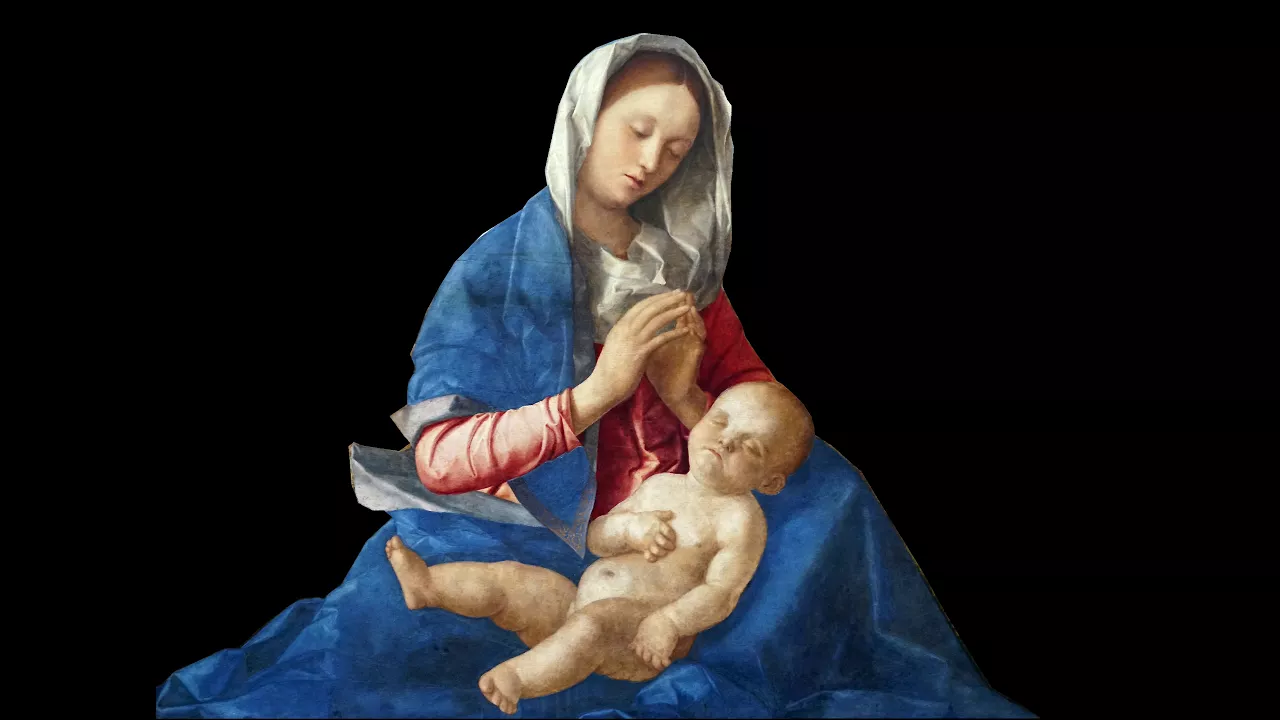
- [Steven] We're in the National Gallery in London, standing in front of Giovanni Bellini's the Madonna of the Meadow. This is a Renaissance painting from Venice. But we wanted to talk about it, as a vehicle to highlight the tools of visual analysis.
- [Beth] So here's what we're not gonna talk about. We're not gonna talk about iconography, how this painting fits in with the history of paintings of the Madonna and Child. We're not gonna talk about the symbolism that we might see in some of the animals in the background.
We're not gonna talk about the commission or who the patron was. - [Steven] We're not gonna talk about the political, social, or economic context in which this painting was made. Instead, we're gonna focus on the things we can see.
So we're gonna talk about scale, composition, pictorial space, form, line, color, light, tone, texture, and pattern. - [Beth] Let's start with the issue of scale. So here we can talk about the scale of the painting, and the scale of the figures, and what we see in the painting.
- [Steven] Well, we're in a gallery with paintings of all different sizes, there are very large altar pieces, and there are some very small paintings as well. This is a moderately sized painting, and that changes where we stand in relationship to the painting. When you stand in front of a very large painting, you tend to stand back, we want to take it all in.
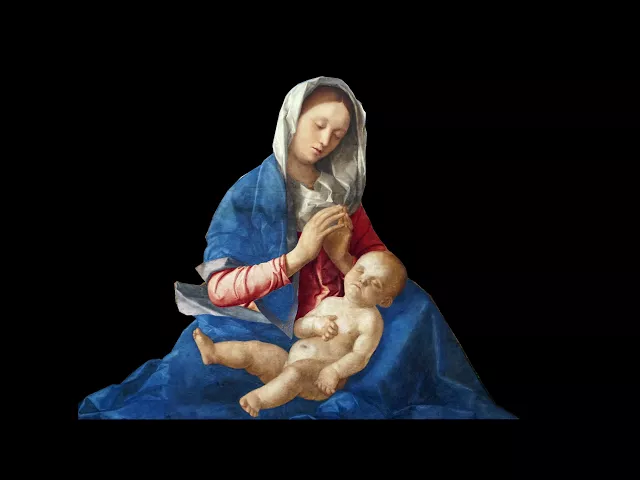
Whereas when you walk up to a very small painting, we tend to come in very close, to see as much as we can. - [Beth] We see a female figure who's smaller than life size. - [Steven] But she fills a third of the frame.
- [Beth] And that brings us to the composition. Not only does she fill a third of the frame, but the clothing that she's wearing, the drapery spreads out across the bottom length of the painting. - [Steven] Creating, in essence, a pyramid.
The base of a pyramid is broad. - [Beth] And pyramids are a very stable form. We also notice that the child in her lap is contained within the pyramidal shape of her body.
So there is an intimacy that is created between the female figure and the child. - [Steven] The artist has placed her very close to the foreground, so that she towers over the horizon line, and is clearly the primary subject. But there is also a significant amount of landscape that surrounds her, that, in a sense, frames her.
Bellini has created this pyramidal foreground, in front of a series of what are really horizontal bands, that move back into space. You see a band in the foreground of greenery, then there's a band of pebbles, then there's a band of tilled farmland, and even the clouds create horizontal bands in the sky. - [Beth] She's framed on one side by trees, and on the other side by the vertical forms of the architecture.
- [Steven] Another way we can talk about composition, is to think about the way in which the artist has composed the bodies of the figures. Look at the lovely, gentle tilt to the Virgin Mary's head, which corresponds to the angle of the Christ Child's head. But I'm also struck by the volume in between the hands of the Virgin Mary, who holds her fingertips together, defining an internal space, that has the same kind of volume as her own head and that of the child.
- [Beth] The diagonal line that forms the slope of her right shoulder corresponds to the diagonal line of her forearm, and the diagonal line of the child's body. So we have this echoing of forms, that helps to unify the composition. - [Steven] Let's turn next to pictorial space.
- [Beth] We should acknowledge that we're looking at a flat surface. And that what the artist is doing is creating an illusion of three-dimensional form and an illusion of space on this flat surface. Let's start with the figure, she's seated on the ground with the child on her lap.
So we have, immediately, a sense of one thing in front of another because of overlapping. - [Steven] But in addition, the pictorial space is defined by what we would call atmospheric and linear perspective. If we look at the sky at the top of the painting, the sky that is closest to us, it has deep, rich blues.
And as the sky moves back in space, towards the horizon, it becomes paler. Look at the mountains in the distance, how they've become paler and bluer. This is a technique that's meant to replicate the natural phenomena of looking at a great distance, looking through more atmosphere.
Details become less vivid, color becomes paler, things become bluer. - [Beth] We also notice a little bit of linear perspective if we look at the plowed field. Where we see diagonal lines that appear to recede into the distance, that lead our eye back into space.
- [Steven] Those lines are called orthogonals. They meet at a vanishing point, which in the context of this painting, is obscured by the Virgin Mary and Child in the foreground. But which nevertheless creates a sense of logic, and places us, the viewer, in a particular point in space, in relationship to the image that we're seeing.
- [Beth] Let's turn next to the question of form. - [Steven] Generally, when we speak about form, we're thinking about the representation of solids in space, and it's instructive to think about the variety of types of form that the artist is representing. - [Beth] Well we have the natural forms, we have trees, and grass, and fields, and mountains, and clouds.
We also have figurative forms, the Madonna and Child in the foreground, but we also have built forms, we have the architecture in the background. Some of these forms are rounded and curvilinear, like the Virgin Mary and the Christ Child, or even the clouds. And some of them are rectilinear like the architecture in the background.
- [Steven] Some of them feel very solid, like the figures in the foreground. And some of the form is far more delicate, look at the handling, for example, of the leaves on the trees. - [Beth] Those forms are established just by touches of color from the artist's brush.
- [Steven] Now form is often defined by line. - [Beth] And, in fact, there are contour lines used to demarcate and separate forms. So, for example, separating the Virgin Mary's drapery from the grass that she sits on.
And we also have places where we have line on its own, for example, in the branches of the tree. Line is also sometimes the corners of forms, I'm looking at the line that forms the edge of the squared turret. - [Steven] Next we wanted to talk about color.
- [Beth] One is immediately struck by the rich blue of the Virgin's mantle. But also the deep blue of the sky. And that contrast with the earth colors, the browns and the greens that we see in the fields around and behind her.
- [Steven] There are essentially three main color groups. There's the brilliant blue of the Virgin's mantle, of the sky, of the mountains. There's the red of her undergarment.
And then there's the yellows of the flesh, of the fields, and of the architecture. These are the three primary colors. - [Beth] We see white in the shawl that she wears around her head, and also in the clouds.
So Mary is connected with the heavens. - [Steven] Color is in someways a function of light, and here the artist has created a sense of the broad light of a clear day. - [Beth] The light from the sun seems to be coming from the left, maybe a little bit forward from the figures.
- [Steven] And high in the sky. - [Beth] And we see the clouds illuminated from above, there in shadow below, similarly with the Virgin Mary, if we look at her right forearm, it's illuminated from above, but in shadow below. - [Steven] And so the artist has taken pains to create a consistent of use of light and shadow.
That is, shadow is always in accordance with the source of that light. - [Beth] Look at Virgin Mary's face, her right cheek is illuminated, but the left side of her cheek is in shadow, and we have the sense of moving tones from light into darkness, what art historians often call chiaroscuro. And this helps to create a form that looks three-dimensional, that appears to exist in space.
- [Steven] But light and color are both closely related to tone as well. - [Beth] And tone refers to the amount of light and darkness in a color. - [Steven] And we can see that in many parts of this painting, we can see it in the cloak of the Virgin Mary, but it's probably most subtly handled in the representation of flesh.
Looking at the beautiful rendering of the Virgin Mary's face, and the smooth brushwork, makes me aware of the variety of textures within this painting. And the contrast that the artist is creating between the smooth textures of the flesh, or of the cloth that the figures wear, in comparison to the rough, pebbly surface that we see in the middle ground. - [Beth] Or we could look at the featheriness of the leaves on the trees which are yet another texture.
- [Steven] Texture's a tool that artists can use to create a sense of veracity, as they define different kinds of form. - [Beth] And texture is intimately related to the materials that the artist is using. Here, we know it's oil paint, which is well suited to the depiction of different textures.
- [Steven] Let's talk next about pattern. You might not expect to see pattern in a landscape, which is filled with natural forms because pattern is the repetition of a form over and over again. Often to create a decorative field.
- [Beth] Here, we see ornamentation in the Virgin Mary's blue robe, we see some gold embroidery. - [Steven] But if you look closely, there is a soft, organic pattern, especially in the foreground, in the foliage. - [Beth] We do see the repetition of leaf forms, and grass forms, that look almost like a carpet, like a decorative field, than the unruliness of nature.
- [Steven] And one of the results of pattern, is that it is often in conflict with pictorial space, with the illusionistic depth that the artist renders. And even here, it seems as if that green field stands up a little bit, in a way that remind us that this is in fact a two-dimensional surface. So by looking at scale, at composition, at pictorial space, at form, line, color, light, tone, at the textures and the patterns, we have an opportunity to look closely at the painting.
But these are only a few of the tools that art historians use to discuss and explore works of art.