hi christian everyone welcome to the principles of temple administration today we're going to cover continual improvement and we're looking at making this a permanent objective so continual improvement is defined as making a change that results in a better outcome then continual improvement is simply always identifying and making changes that result in better outcomes it's pretty simple it's pretty basic it just means that we're regularly looking how can i make this better and what does it mean for us it means how can i keep my service better how can i continue to improve the offering that
i'm making to guru and krishna so this is a really important topic and point that we're going to discuss today so we're going to look at a little overview continual improvement as a permanent objective places that we can continually improve tools for continual improvement root cause analysis and then something called as kappa c-a-p-a corrective action preventative action and then ultimately the benefits of continual improvement now we hope that by the end of this course you're going to understand the importance of continual improvement and you're going to want to keep it as a permanent objective in
your templar center you'll be able to identify areas where there can be regular and ongoing continual improvement also you'll be able to apply some of the tools for continual improvement and you'll understand root cause analysis and kappa now shilla prabha made a statement he said and we often refer to this statement as the boiling the milk approach shiloh prabhupada said that you can thin milk by adding water and you can make it more thick by boiling it then he said now is the time to begin the boiling process he said it's better to develop a
small number of devotees that we have and make them truly krishna conscious boys and girls rather than to go on getting many many many followers who don't even understand the practice and the philosophy and the real principles then he said it's better one moon than many stars now how does this relate to continual improvement because shiloh prabhupad saw that it's better to work with a few devotees continually improving them making them very strong in their krishna consciousness rather than attracting many and spreading ourselves so thin that we never really improve the quality we just increase
the quantity so continual improvement is all about increasing the quality and i assure you that naturally by increasing this quality quantity will automatically come over time but as all of these approaches i say it again and again you're going to hear this repeatedly in these videos these approaches are so mode of goodness it really helps us to come to the platform where we actually function on a level of preventative risks you know causing distress later by looking at things in the beginning and making sure and taking the time to to make them correct so what
does it mean to have continual improvement as a permanent objective well all of our managerial activities are either directed at some sort of control or improvement and managers those of you who are in managerial leadership responsibilities you're either devoting your efforts at maintaining performance or preventing change or creating change some breakthrough or maybe some improvement so if your business is at a standstill then you're going to lose your edge what does that mean for us it means that the preaching is going to suffer we have to perpetually be looking at how can we improve our
interaction with the public our interaction with our current devotees uh our presentation of the philosophy into different communities and different audiences this is continual improvement and making it a permanent objective we want it to be ongoing not that we ever stop wanting to improve wanting to stop continuing to improve our efforts in the service of krishna so what are some of the places that we can look at for improvement how about your deity worship standards it's a good place to start are the devotees satisfied in your temple are they happy do you know if they're
happy are you just assuming it's probably a place we can we can improve newcomers every day new people may be coming into your building how are they being greeted what is the experience that they're having numbers of devotees numbers is often an issue it's something we discuss about do we want to make more devotees then that's a way that we can improve book distribution numbers of books quality of book distribution quality and training of the book distributors all the different outreach programs that we have uh income of course we want to improve these things uh
improve the quality of the way that we spend our lakshmi for krishna improve our volunteer engagement i mean there's unlimited ways and places that we can improve our service for krishna so what are some of the tools for continual improvement a widely used tool in the in the management world is called a four-step quality model known as plan do check and act or the pdca cycle so these four plan first you have to identify an opportunity and then plan for change so we need to look in one of these areas these places and say okay
my dear to department um we want to have some improvement what are some of the ways that we can improve punctuality quality of prasadam or quality of the boga offering quality of dd outfits like this and then you start to make a plan do you have to implement the change and sometimes it means just on a small scale we just have to do it a little bit at a time be careful not to set your height so high that you don't do anything because you just you're shooting for such a big change or some improvement
better to scale the improvement check use some data to analyze the results of the change or the improvement that you've made to determine whether it actually has made any difference and then finally act so if the change was successful then you can try to implement it on a wider scale and then still continuously assess your results if the change didn't work then you just go back to the beginning and you start the cycle again so there's another approach that's called the kaizen approach and this is something i heard about myself before coming to iskcon except
i heard about it called the kanai approach the constant and never-ending improvement approach so it means it's a way of understanding that i have to be constantly and never endingly improving i always understood that the nature of the soul is in under my object so that means that the soul is pleasure seeking absolutely and for sure we find pleasure in growth when we feel like we're growing we're learning something we're moving closer to krishna correct isn't it true so this kaizen approach is taken from the japanese they gave the name kaizen kai means change and
zen means something that is good so it means change is good actually the approach was introduced by by an american just after world war ii in the rebuilding of japan and he introduced this this approach that we have to be constantly and never endingly improving the way that we do things and from that we see that the japanese economy grew to be something you know on the on the global scale so what is root cause analysis so there's a little video that's attached here that you can watch that explains a bit about the root cause
analysis what is rca it's a time and money saver it's the preventer of wild goose chases it's the way to permanently solve our problems rca is more commonly known as root cause analysis what is a root cause some people think it's the first idea that pops into your head some believe that it's the most obvious solution to a problem and some of these people know the answer before the problem is really defined in many group meetings the supposed root cause is the idea proposed by the person with the strongest opinion and the loudest voice frequently
the snap judgment root cause is whatever the boss says it is if these people are wrong and they frequently are then tons of money and time can be wasted addressing a cause that doesn't solve the problem a few hours of careful analysis up front can save you hundreds of wasted hours later sometimes the root cause is thought to be a person how many times have you heard an employee who has been doing the same job successfully for many years suddenly make a mistake have you ever heard that the corrective action for this is that she
needs more training for every root cause determined to be human error the corrective action always seems to be additional training or counseling it's been realized throughout history that 95 percent of supposed human error is actually management controllable this means that management could prevent 95 percent of these types of errors through mistake proofing the process obviously retraining an experienced employee is not an effective corrective action and human error is not a legitimate root cause root cause analysis is pure problem solving determining a permanent and practical solution to a systemic problem and we're all professional problem solvers
aren't we we encounter problems throughout our lives in our jobs in our families in our daily activities the more effective we are in permanently solving our problems the better the quality of our lives so you see it pays to know and practice root cause analysis effectively taking the time to first clearly define the problem and then carefully and deliberately following a root cause analysis process prevents the chances of jumping to a hasty and probably incorrect conclusion to define the problem use the who what when where and how method the problem should be precisely defined in
terms of who is involved in the problem what exactly is affected by the problem when the problem occurs or has occurred in the past where the problem occurs and how it occurs these elements need to be addressed in a short concise problem statement there are a large number of tools you can use in your rca process these will help facilitate your brainstorming and logical thinking processes to include some potential root causes and eliminate others common tools are the ishikawa or fishbone diagram the five why's the force field analysis and another effective tool is the is
is not analysis there are usually many potential root causes to the problem the more you drill down in fact there is what is known as an infinite chain of causation selecting the best solution involves choosing the one that has the greatest effect on the problem for the lowest cost that you have the most influence over obviously the perfect solution does not always exist or is impractical so the optimal solution must be determined from these three factors to illustrate this let's look at a well-known real-life example some years ago it was found that the jefferson memorial
was deteriorating at a much faster rate than the other national monuments in washington dc a group of national park rangers was asked to analyze the problem and come up with a solution they used the technique of the five why's in fact they actually drilled down to six wise they began with a problem statement the jefferson memorial is deteriorating faster than the other monuments why well because it is washed more frequently but why is it washed more frequently well it receives more bird droppings now they considered stopping here and addressing the problem by putting a waterproof
coating on the monument to make the droppings easier to wash off but that would be expensive and difficult to do it would also damage the monument further so they asked the next question why are there more bird droppings on the monument the answer was obviously that the more birds were attracted to the monument they considered adding wires to the monument to discourage birds from flying around it but this would require going through a lot of red tape to get approval to install the wires to the monument so then they asked why are more birds attracted
to this monument they found that there are more fat spiders in and around the monument for the birds to eat why are there more spiders they asked well they found that there are more insects flying around the monument in the evening which attract the spiders they considered spraying insecticide on the monument but were afraid they might poison the tourists so they asked why again why are more insects attracted to this monument they determined that the monument illumination attracted them as a result the park rangers chose the solution of turning on the monument lights one hour
later in the evening they found that this was effective in reducing the insects which reduced bird droppings by ninety percent so you can see how there are many possible solutions in the chain of causation the objective is to find the most appropriate link in the chain to effectively address the problem layers is a software tool developed specifically to provide teams or individuals with a proven root cause analysis methodology layers significantly helps to focus the logical problem solving process one step or one layer at a time peeling away into the problem until reaching the core where
the likely root cause or causes can be found this tool is effective for use in medical device and pharmaceutical industries as well as any other business or personal application it provides a complete and verifiable record of your root cause analysis process and what is kappa corrective action and preventative action so here's another video that you can have a look at and this will help you to understand this kappa is one of the most critical processes in a quality system almost all quality regulations and standards including the international organization of standards also known as iso and
the code of federal regulations as enforced by the fda require a kappa system kappa of course stands for corrective and preventive action a kappa system serves two purposes it is used to solve problems and it is used to prevent problems exactly what is a problem and what types of problems require the use of a kappa system a problem is an undesirable event or process deviation the cause of the problem is not currently known and the problem is not purely a business risk issues that are solely financial in nature do not belong in your kappa system
problems that do belong in your kappa system include those related to customer dissatisfaction health or safety regulatory risks or significant process issues which could result in one of the previous three types of issues some potential sources for kappa problems include complaints either internal that is from inside your company or externally from outside customers supplier performance metrics such as rejections of incoming materials market or customer surveys process control metrics such as in process failures quality audits although every audit observation does not belong in your kappa system your risk management process should determine kappa eligibility returned products
service reports spare parts usage mrb or material review board metrics change control metrics product recalls adverse event reports management review issues and product realization such as design control issues do not overload your kappa system with lower priority problems use other appropriate processes to address these issues such as your complaint system material review board system or change control system among others use an appropriate risk management process to determine kappa eligibility and prioritization one of the first steps is to identify the problem the problem should be precisely defined in terms of who is involved in the problem
what exactly is affected by the problem when the problem occurs or has occurred in the past where the problem occurs and how it occurs these elements need to be addressed in a short concise problem statement once you have determined that the problem is eligible to be in the kappa system you must consider three options for addressing the problem the first is correction correction is an immediate fix to the problem a band-aid that stops the problem from continuing or getting worse if a problem only requires a correction it does not belong in the kappa system next
is corrective action corrective action is an elimination of the root cause of the problem which will prevent the problem from reoccurring it is permanent fix finally preventive action preventive action is an elimination or mitigation of the cause of a potential problem a problem that has not yet occurred not every corrective action requires a preventive action but when a problem has occurred an investigation should be conducted to determine if this problem or a similar problem could occur elsewhere in your company preventive actions may be identified and implemented independently from corrective actions as well the first step
in determining corrective action or preventive action is to analyze and identify the most appropriate root cause or causes of the problem this process is known as rca or root cause analysis investigation should be conducted in conjunction with the root cause analysis to gather and analyze data required to determine the most likely and appropriate root causes we will cover the root cause analysis process in a separate video a kappa investigation plan should be developed this is similar to a project plan with specific tasks identified each task must be assigned to a responsible individual or group with
a target completion date identified one individual should have the primary responsibility for managing the kappa plan and verifying that assigned individuals or groups meet their commitments in the plan once the most appropriate root cause has been determined a kappa implementation plan should be developed this plan should be structured similarly to the investigation plan if any individual or group fails to meet a commitment there should be an established process in place to escalate the issue to higher levels of management until the task is addressed an individual or group assigned to a task needs to extend a
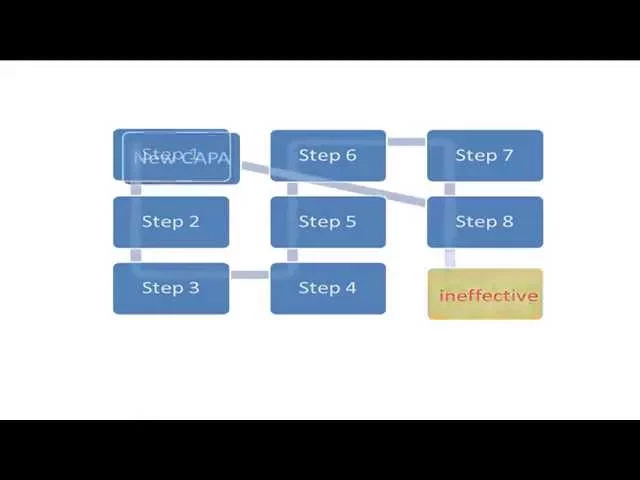
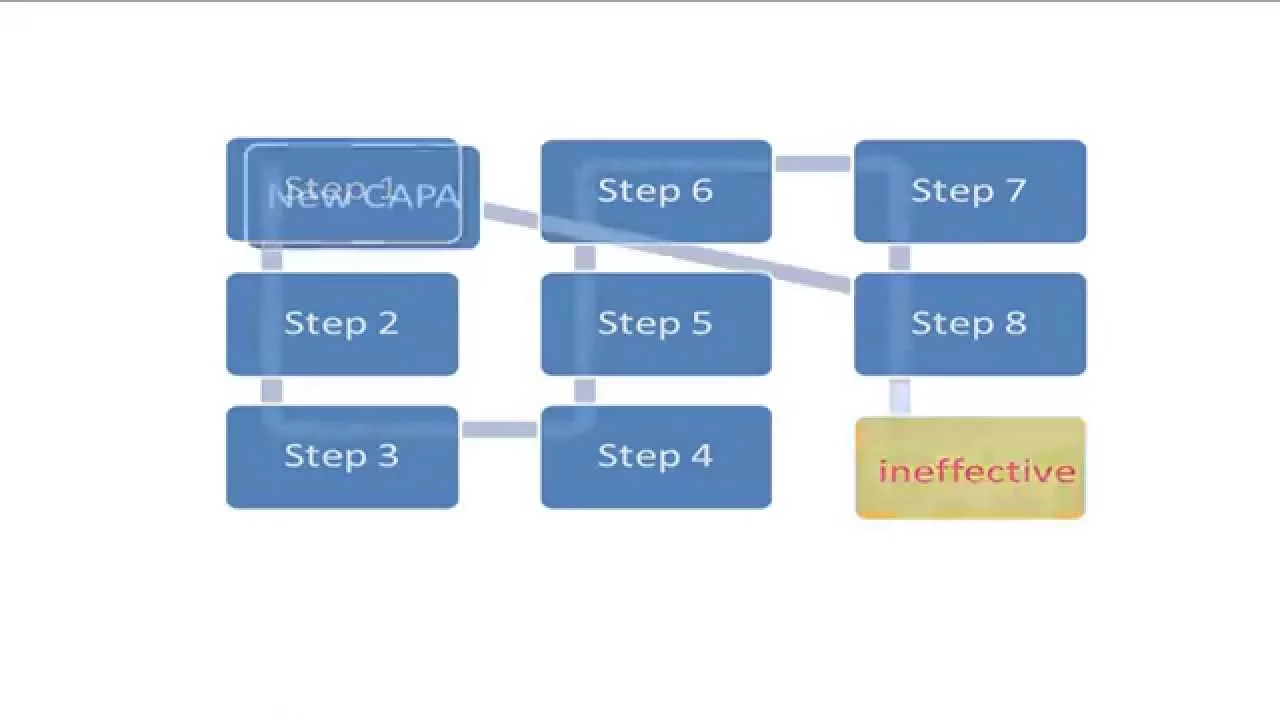
deadline or more time is needed to meet a cap a milestone an established process should be in place to justify the extension in writing with appropriate management approval all planned corrective and preventive actions must be appropriately validated to assure that they meet all requirements for safety effectiveness and regulatory compliance and will not cause additional problems once the kappa implementation plan is completed corrective and or preventive actions are implemented and appropriate signature approvals are obtained the kappa enters a new stage an effectiveness check plan is developed which includes specific measurable criteria to determine if the actions
taken were successful and effective an appropriate time period is determined for monitoring the success criteria if the kappa is determined to be effective the appropriate management review and approval is obtained and the kappa is closed as complete if the kappa is determined to be ineffective the appropriate management review and approval is obtained and the kappa is closed as ineffective a new kappa should be opened immediately to address the continuing problem and the process repeated a kappa management structure should be established to effectively manage the process a kappa management board or steering committee should be used
to monitor the effectiveness of the kappa system and provide resources tools and support when needed the kappa system itself should be managed by an assigned individual capa project or working teams must be appropriately trained in kappa and rca processes so continual improvement what do you think the benefits for continual improvement are i think that they're unlimited but just to give you a few here it's going to help to create continual improvement and the products services processes and systems within your temple it's going to help you to recognize and acknowledge so many different improvements that have
happened in your templar center it's going to help you to establish goals guide and measures to track continual improvement and it provides people with the training and the methods and tools for continual improvement across the board in the temple everyone is going to become more satisfied and more enlivened and inspired simply because they see an endeavor to continually improve even if it's only incremental improvements but everyone will see that it makes a huge difference before closing i just wanted to share one experience when i first started serving in london that the front of the building
they had done some refurb a few years before and the signs weren't on the front of the building so it seemed like um you know for me it seemed like a big deal to the temple in the restaurant didn't have a sign but it had been like that for years and there was a constant conversation about the fact that you know how can we improve how can we increase the revenue of the temple and bring people to the temple and it was brought up but what if we put signs on the front of the building
and it was quite a major major activity to do at that time for different reasons financial restrictions being one of them but i remember very clearly that once we put up the scaffolding and we started putting the signs on the building one man came in and he wrote a check for something like 10 or 15 000 pounds and he said that just by seeing the intention to correct this thing that has been wrong for so long and improving i've become inspired and therefore he he easily came forward to help and from that we just continued
to improve so many different areas of the temple so in closing we can see the continual improvement is a very very important aspect of our management of the temples and there are many areas that could be covered more in depth please look into them in your own time they're outside of the scope of this course we really sincerely hope that this has been of benefit to you and that that somehow you can become inspired to continually improve within your service personally and also on a managerial level within the templar center that you're you're overseeing thank
you very much for your time and attention hari krishna