I believe that there will be three types of people in the future. And I think that the divide is growing bigger between them every single day. And if you want to win or succeed in the next 10 years, very uncertain 10 years with where AI and everything else is going, then it is critical that you avoid becoming the first or second type of person.
And the first type of person are the purists. They are the ones who think that they stayed clean. You know, in Harry Potter, there's the pure bloods and the mud bloods.
The purists in the context of today's world are the ones who reject AI. They want nothing to do with it, and they retreat to simplicity or nature or screen-free living when they're usually the ones who are on their screens the most. And they don't realize that simply by using the internet or using social media, they are contributing to the spread of AI.
And when you look at a purist, you can't tell if they're actually being serious or if they're doing it just because it's the cool thing to do and they're doing it just because everyone else is doing it. The second type of people are the automatons or the cyborgs. They're the ones that outsource every decision.
They fully [music] adopt tech without any critical thought and it ends up ruining their brain. And that's only on the tech side of things, right? There's the hell side of things where there's the new peptides and everything else.
And these are the very riskforward people. They're willing to just inject anything into their body and they are all about the future. They're allergic to friction and addicted to optimization.
They just optimize and automate every single part of their life. This is the next evolution of the notion template and second brain people, which I have nothing against. Honestly, the second type of person is the one that I lean more towards than the first type of person because the purists or the first type of person are just so annoying.
Even if they're right, like I don't even want to be associated with them. But the automatons or the cyborgs don't know where AI ends and life begins. And just like with politics or religion or any other kind of ideology, most people think that they have to pick a side because it's just how they're wired.
You want to be accepted by a tribe so that you don't cast out and so you can survive and so you don't die. But personally, I like to be different from most people. Maybe it's a character flaw.
Maybe it sounds cringe or corny, but I find joy in it. I think it's a creative challenge to live a life that very few people live. And I found that growth and therefore meaning and fulfillment does not come from following the herd.
So I'm convinced that both sides are wrong. You don't need to fully reject AI and you don't need to fully adopt it. Crazy to think that way.
I know. And if we look at the four quadrants of reality, there's mind, body, spirit, and vocation or career or just like the external system, society. We have the upper left quadrant which is the personal mental world or the interior individual.
So your thoughts, emotions, beliefs and internal world. It's how you interpret the world. And then you have the upper right quadrant which is the personal physical world or the individual exterior.
And this is your behavior and appearance or it's how the world interprets you. It's your habits and actions. And then you have the bottom left quadrant which is the collective mental world or the collective interior.
And this is your relationship to your environment, culture, family, friends, and reality. It's meaning and connection. It's your relationship with the external world.
And then you have the bottom right quadrant, which is the collective physical world or the collective exterior. So your relationship to society, your education, your career, the economy, how you contribute to the world. And of course, this is adapted from Ken Wilbur's integral theory, which I encourage everyone to explore.
Now, the problem is that the purists reject the external world. And this is nothing new. The hippies and the people who identify too heavily with their spirituality tend to do this as well.
And then the automatons or the cyborgs or the people who fully adopt tech, they tend to reject the internal world. So they focus fully on money, power, technology, progress, etc. But that is obviously destructive to your potential because you are rejecting an entire portion of reality.
I want you to think of this like a skill tree in a video game. So when you play a video game, you have these abilities and when you gain experience, you get points that you can put into each ability. So like strength, intellect, stamina, etc.
So as you level up, you can put a bunch into strength and you get really strong. But the thing is is that these interconnect. If you only put points in strength, you're obviously going to be at a disadvantage in different parts of the game and you're going to lose more battles than you win.
And typically in video games, you can only put so many points in strength before it forces you to start putting them in intellect because they interconnect. So the actual example in the real world that applies to your life is you can try to max out your money or your finances or just go allin on business. But if you haven't improved your mind, body, or spirit at all, then obviously you're only going to be able to go so far and make so much money or take your business so far.
There comes a time where you have to improve your mind or maybe you get to the point of being so burned out and stressed out that you have to lean into spirituality because more money is not going to solve that problem. Another example is that it doesn't matter how spiritual or enlightened you are if your body is frail and you're unhealthy. And if you don't have any money to your name, which is the lifeblood of society, you're just going to suffer unnecessarily.
and more spirituality is not going to solve that problem because it's not in the same domain of reality. And even further, the solution to your problems that lies in the other domains like money, you consider evil or you reject it. So you have no choice but to just play the victim.
So obviously being a purist isn't the right move. Being an automaton or cyborg isn't the right move. And I think that there is a third option and that is to become multi-dimensional.
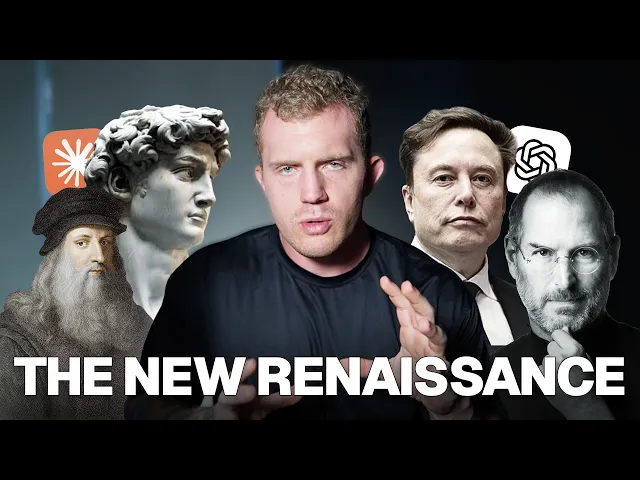
to become a new Renaissance man, a digital renaissance man. So, here is how you win in the next 10 years. We're in the middle of the second renaissance where proof of work replaces the resume, an audience replaces the employer, and taste replaces credentials.
And I believe that the greatest tragedy of our times is that we were fooled into believing that the mechanical life is the only path to success. You were told to pick a lane. you were convinced that having multiple interests was a character flaw.
Become a designer, become a writer, become an engineer, a marketer, a salesman, or just get whatever high-paying job you can because that's how you become respected, quote unquote, and live a good life, quote unquote. And honestly, that felt pretty reasonable 20 years ago, but now you just feel replaceable because that was never how humans were meant to live. And fun fact, the modern version of a job, what we call a job today, is only about 250 years old.
It is so normal for us to just get a job nowadays or a job is how you survive when that wasn't the case for hundreds upon hundreds of years. Modern life is just a small little sliver and we think we have it all figured out, but we don't. Before the modern version of the job, the ideal was a free person who knew how to do many things throughout their life and pursued their own vision.
Compared to a slave who was expected to do one specialized task and repetitive tasks, aka the modern version of a job, the artisan, the farmer, and the pirate are all examples of those who knew how to run an entire operation, not just one specialized piece of it. They were both the thinker and the maker, the artist and the scientist. They understood that in order to live a good life, they could not be limited to one area of study.
Leonardo da Vinci walked into Verrochio's workshop to learn painting and left knowing anatomy, engineering, optics, and bronze casting. Nobody told him these were separate things that were supposed to be learned as their own credential or degree. And that combination of things is what made him one of the greats.
In the Renaissance, the previous Renaissance, nobody gave a about your niche. They gave a about what you were capable of. And during industrialization, the factory model wasn't meant to destroy education, critical thinking, individual agency, and taste.
But that's exactly what it did. It steered us away from the Renaissance ideal. Education became training instead of discovery.
Employment and repetitive tasks kept us dumb to the entire entrepreneurial process. So, we didn't develop the experience or agency to do our own thing. And the unfortunate reality is that this is normal to us.
the linear career is normal to us instead of the exponential career and the masses just don't question it. And now that AI is on our doorstep, only those with an open mind and those who don't identify with a team that fully rejects the next phase of evolution will take advantage of this shift. One person can now do what a 10 to 50 person team used to do depending on the task.
One person now has any and all known information at their fingertips. And I want to highlight the word known. That's what AI is good at.
Known information, not unknown or novel information that comes from experience and diving into the unknown and pursuing an unknown path. That's what your job is. And that shines a light on how you can incorporate AI.
And along with access to all known information, one person has access to social media. oneperson media companies aka creators are popping up left and right because it's free distribution for their work if they understand media attention, human psychology, etc. So, if you are a true New Renaissance man or digital renaissance man or person or girl, whatever it is, it doesn't have to be a man.
You can be a new Renaissance toaster oven for all I care. If you are one of these people, this is the greatest time to be alive. No exaggeration, no hype.
It's obvious. And many people will try to convince you that the world is doomed. AI can now handle the machine-like repetitive tasks that for the past two centuries used to be our entire way of life.
People are so worried that AI will ruin our thinking and make us more like machines when they've already been living like machines for the whole of their lives. Seriously, think about that. I hate that argument.
AI is going to ruin your thinking. AI is going to make you more robotic and strip away your humanity. What have the past 200 years been?
It's been exactly that. and you've been living it and you're just regurgitating the program that was put into your mind that is the anti- AI ideology. If that is not a machine and a lack of critical thinking, I don't know what is.
So to those who join this second renaissance, your job is to choose your craft, leverage AI so that you can manage the entire operation aka your life's work and focus on taste, direction, and judgment because the output of AI does not have perspective. AI is simply that artificial intelligence. It's like a bag of water that you must mold.
So the point is that you must become a multi-dimensional, irreplaceable walking contradiction because the most interesting people are just that. They're walking contradictions. Jacked intellectuals, casual billionaires, spiritual warriors.
Life is better when you can't be shoved into a box that others can easily make sense of. In the future, the most interesting and valuable people will be those who live between two extremes. pure creativity and pure productivity.
They seamlessly balance the analog lifestyle of no screens, reading books, maintaining their humanity, doing the things that lead to novel ideas and novel experiences, no urgency, just pure life enjoyment, and the AI native productive lifestyle or leveraging technology to do what used to be impossible. So, it's between the two extremes of reading a book in a park carefree and being locked in hustle culture to your computer because both are very enjoyable ways to live. It's narrow focused flow state getting work done at your computer which many people have experienced and it feels really good.
And then on the other end, it's a very open state of focus where you're more connected with reality. That's where the spirituality comes into play. And by doing that, you experience the full range of consciousness and focus.
Along with that, meaning and fulfillment are not found in a flat balanced lifestyle. They are found in contrast. Because if you were happy all the time, you wouldn't consider it happiness.
You would consider it normal. And honestly, it would be a bit boring. You would need greater and greater euphoria to feel what you think happiness is.
Hence why people can't get off their phones today because a normal happy life is too boring for them. But when you fail and you struggle and you suffer for something that you care about, you learn what true happiness is on the other side. So those who win will lean into that contrast.
They work and they rest deeply. Their entire life is play because they love what they're doing. They have intense bursts of focus on their craft followed by complete and deep rest just like the world's most creative people do.
And you can see that in this graphic, the daily routines of famous creative people. As one example that I love, Charles Darwin wrote 19 books in his lifetime, which is just absurd in and of itself. But his morning routine would surprise people for that level of output.
At 7:00 a. m. , he went on a short walk and then had breakfast.
From 8 to 9:30, he had his first work session in his study, and this was his most creative block. From 9:30 to 10:30, he had a break to read letters and spend time with family. Then from 10:30 to noon he had his second work session.
And by this point Darwin considered himself to have done a good day's work. Then afternoon he had a second walk of the day around the sandwalk which is a famous quarter mile gravel path that he built specifically for thinking and reflection. I really want to do that one day.
Imagine building your own walking path. I love walks. I go on walks all the time.
It is the crux of idea generation and my work. And that is how I balance out the intense focused productivity at my computer with a more open state of creative focus. Then after lunch, Darwin read the newspaper, then rested while his wife read aloud to him.
At 4 p. m. he had the third walk of the day, usually around the sandwalk again, sometimes with company.
So Darwin worked roughly 3 hours of focused creative work per day across two sessions. And he has contributed vastly to humanity and wrote 19 books. That's just absurd.
So imagine what you can do if you were fully locked in on this path. I believe that there will be 10 times more Darwins and da Vinci of today's world simply because of the resources available to you. There will be 10 times more Plato's, Aristotles, Socrates.
But of course, we won't realize that until later into the future because unfortunately we don't really care about people's work that much until they're dead because the death brings a different kind of meaning to the work. And we can already see this playing out. There are plenty of brilliant people online sharing their knowledge.
It's crazy. I have learned more from YouTube than I ever did in school and I will stand by that. So I believe that the people of the future who are going to thrive will have some variation of this kind of routine but with the output of 10 to 20 people allowing you to do so much more and you'll be able to single-handedly build your life's work.
Or you can have an incredibly small team and just do so much. So in other words, these people will have a onehuman business, one human with technology, agents, AI at their side. And we will break down how to build this one human business in another video.
And a quote from Naval that kind of points at this is there are almost 7 billion people on this planet. Someday I hope there will be almost 7 billion companies. We are getting closer and closer to that reality.
I don't know whether all jobs are going to go away, but I really like that ideal. I believe that humans are entrepreneurial creatures. Not in the business sense, but in the sense that engaging with reality, the process of trial and error is the most meaningful and creative way to live.
Not to be locked in a cubicle doing repetitive tasks all day. That is soul sucking. We all know that now.
Before factories and industrialization, you worked until the task was done, not until your 8-hour shift was over. You worked according to the rhythm of seasons, sunlight, and energy. And more importantly, you didn't learn how to become valuable through a standardized curriculum and meaningless memorization tests.
That's what public schools are. Instead, you learned by doing. You learned in the workshop from apprentice to journeyman to master, imitating someone who knew what they were doing until your own taste and judgment were formed.
So, the question now is just that, how do you become this new or digital renaissance man? You do it all. You become a writer, a designer, a marketer, a filmmaker, a bodybuilder, a runner, or whatever your curiosity desires.
But you channel your focus and attention into one vessel, one craft, one thing that you choose to become known for. And your multiaceted development will only contribute to your ability to get ahead of everyone else. Not that you have to get ahead of everyone else, but you know what I mean.
To get ahead in the sense that you are no longer grouped in with the masses. So, here's what you do. The first thing is you choose your craft and become irreplaceable.
Most artists, writers, and creatives that you see online that are revoling against AI do so because they have identified with the skill or the tool or their specific way of working. And personally, I don't care about the argument of whether or not AI art is real or AI writing is real. That seems like the greatest distraction of this year because as you're arguing about that, you aren't creating art.
you aren't doing the thing that you say you love so much. You aren't focused on your craft. You aren't getting better.
In fact, you're just trying to bring everyone into this cesspool of hate. And most of the time, you're just doing it for the incentive because you know it's going to get a lot of views and likes. And the worst thing is that you're just reinforcing the identity that is not going to serve you in the coming years.
So, you need a craft, but you need to choose your craft wisely. Your craft lives at the intersection of what you care about, what you can uniquely do, and what others are willing to pay you for. And in my eyes, there are three layers to building an irreplaceable skill stack.
Layer one is a foundation of human nature or psychology. So, marketing, sales, writing, speaking, or just psychology itself. It's understanding the mechanics of human attention and how what people perceive as valuable is highly subjective and changes as the world does.
Everyone's worried about the dead internet and AI slop, but they don't understand that what people see as valuable changes over time. Like, oh, if AI just writes all the content, then my content just instantly becomes invaluable when that's not the case because everyone pumping out the AI content all looks the same. And so, people get used to it extremely fast and they no longer see it as valuable.
So, the humans who actually understand this then use their brain to be creative and do something novel. Marketing and content and product and business is just an extremely iterative process. It never stops.
You're always in this state of trial and error improving. So every single person who wants to succeed on their own must domain. This layer one, this is the what others are willing to pay you for.
Now layer two is your domain obsession and unique interests. So philosophy, fitness, design, coding, nutrition or anything else. None of these are going away.
They are simply evolving. And of course, marketing, sales, writing, psychology, all of those things can also be your obsession. But if they aren't, if those aren't one of your interests, you still have to master that domain.
Now, the combination of these interests is where your uniqueness lies. So, the jacked philosopher is far more valuable than the armchair philosopher who only grows their mind without direct experience to test their theories. And it's just far more interesting.
And then you pair that with marketing and sales. Imagine the jacked philosopher who actually has a business and a product so they can make money from their jacked philosopherness. They're unstoppable.
But you just take someone who's jacked and they look nice. Or you just take a philosopher and you think their mind is pretty cool but nothing else. So this layer is the what you care about and what you uniquely can do layer.
And it is the thing that people come to you for over another person. And then layer three is the technical skill. So like email marketing software or Photoshop or no code website design or social media management or typing physical code to build a software on the screen.
Now this used to be the most important because it took time and effort to learn these tools. But now AI does it all with ease. So you should not bank your future on mastery of a tool because AI is the ultimate tool.
So, if your entire identity is a tool like Photoshop, then I hate to say it, but you have a few years left. And that may sound like fear-mongering, but I think it's a pretty good bet. And that's just the pattern of every single technological shift.
You have to adapt. The mechanical part of the skill gets automated and the human role moves up a layer. The scribe became the editor and the handwaver became the machine operator.
And we'll discuss more of this in a second. The second part of becoming this new Renaissance man is becoming dangerously self-educated. Because schools teach you how to operate within society, which is fine and necessary to some extent, but they do not teach you how to navigate your own path.
Public schools are filtering and conditioning mechanisms more than anything. And again, that's fine. It's a necessary evil.
You have to be conditioned to some point. You have to learn how to walk. You have to learn how to speak.
You have to learn how to do basic math. You have to learn how to just exist. But true education is discovery.
The education that makes you irreplaceable is discovery. It is the process of learning what's necessary to achieve self-generated vision and goals, not the process of hoarding knowledge or memorizing facts to do well on a test that does not map to reality. And even worse, most people stop learning after graduation, graduating high school or college.
They turn 20 to 25 and repeat the same day for the rest of their life. They do not pursue a creative challenge that demands unique knowledge. They don't have a demand to learn something new.
They don't have a goal or vision so potent that motivates them to wake up in the morning because honestly they think that they have to know how to do it before they start which is backwards. So how do you actually learn? How do you become self-educated?
Well, you follow the apprenticeship model. You apprentice under a master or a mentor. And the beautiful thing about today's world is that you can find a mentor or a master simply by picking up a book or opening your phone and going on to YouTube.
And yes, the feed is very crowded and noisy, but that's exactly why you need a vision and goals because vision and goals are a filtering mechanism for your mind. They filter out distractions and allow you to notice signal. If you're working on building a business and you open up YouTube, you're probably not going to be interested in opening some brain rot style of entertainment video, you're going to be scrolling to find a business video intentionally that helps you get closer to your goals and learn what you need to learn.
So, in other words, you need to live an intentional life. And that's just the thing. I don't care if you use AI to get information.
I don't care if you get all your advice from one YouTube guru. What I do care about is if you have a vision, have a goal, work toward that goal, and apply what you learn to problems that come up along the way. That is how you test what you learn to verify its validity for your specific situation.
Because whether AI hallucinates or not or gives you the wrong information, there are still plenty of profoundly stupid people, humans, that you probably shouldn't listen to and that give terrible information or completely wrong. At least the AI doesn't try to lie. Humans lie all the time and they will defend their lies to death if they identify with them.
So either way, both sides are wrong. It's up to you to think critically. You need to question and test and experiment.
You can only tell if information or advice is worthwhile after you try it. You can't watch a YouTube video on how to make a million dollars and decide whether it's a scam or not if you haven't even done anything with it. So you don't learn and then do.
That's how you get stuck in tutorial hell. You do the thing first or attempt to do the thing and only then is your mind primed to receive the lesson that allows you to make forward progress. So you have your craft.
You know how to educate yourself. Now what do you do? What do you build?
You build a onehuman business. And I'm talking to people who haven't started anything yet, right? If you already have a business, you're already deep in this world.
You already know what I'm talking about. But you need to start a onehuman business and you need to join the new digital economy because creators are replacing institutions. And I know that sounds silly, but can you not see it?
Creators are the new education system. Do you not learn most of the things that are actually useful in your life on Substack, YouTube, podcasts, or niche accounts on Twitter/X? Creators shape culture, and culture shapes behavior.
Do you not trust a creator whose thoughts you've spent time with over politicians who obviously have their own self-interest in mind? The internet is permissionless leverage. You don't need approval to build an audience or start a business or sell a product.
It is the high agency path. And last, AI accelerates the generalist and the polymath, meaning you can actually become a onehuman business. Content on social media to attract an audience around your life's work.
code to build the product funnel and digital real estate and domain specific knowledge that makes what you do valuable over the next person. And now when I say creator here, you probably think of an influencer or a personal brand. But that's not exactly what I mean.
I mean someone who creates value. I mean a creator stripped of your connotations with it. They solve problems.
They create solutions. And they help others do the same. And since value exchange is the crux of human relationships, they return the favor, often in the form of money.
That's how you make money outside of a job. You create something. You create a product or you create a service.
I know that sounds very businessheavy, but that's what you do. You create something. A product or a service is just a way to frame what you've created in a way that is valuable to another person to the point where they actually pay you for it.
So, you need to create a product or service and you need to become a creator. And when you think of someone like James Clear, he has a personal brand, yes, but he's really just writing newsletters and books and content to get his life's work in front of more eyes so he can earn an independent income. I personally believe that most ambitious individuals will take this route in the future, even if what we know as social media today isn't where you put your work in front of other people.
In the past, it was the newspaper and the radio, and now it's social media. But who knows what it will be in the future. What I know is that starting on social media puts you ahead of everyone else because that's where the attention is.
Of course, there are other ways to get attention like paid ads or starting a local business in a good location. But for the person who doesn't have any money, doesn't have any starting point, they just have a thirst for learning and they are ambitious, then social media is where the attention is for the masses. That's where everyone is.
And a personal brand is just the highest leverage vessel to be a creator right now. And it's unfortunate that it's turned into a marketable content creator identity, but that's the world we live in. That doesn't mean you have to conform to what you think a content creator should be.
And of course, we're going to break down the one human business in a future video, but the next creator boot camp starts on September 9th. So, if you want to learn how to create your personal monopoly or your irreplaceable branding and create unique, heavy-hitting content from your interests and learn non-gimmicky social media growth strategies, then consider enrolling with the link in the description. So, we have our craft.
We know how to learn. We understand that we need a business, but how does AI come into play? How do we achieve the impossible with AI?
Because most people do not realize that AI is more than a slot generator and a new age search engine. They do not realize that they can quite literally ask it to build a software, a landing page, a funnel, an app, a tool, or whatever else they need to do anything on the internet. I'm serious.
Have you tried it? Like, you don't need to go and build a software right now, but I would just play around with it. Go into Claude.
Go into Claude code. I know that Claude code makes it sound scary, but it's just a chat box. Open up Claude, click on the code tab, think of a software that you want to build, a to-do app, and then just say, "Hey Claude, how can I go about building a to-do app with you, and then it'll tell you, and if you want to actually learn along the way, you just ask it, okay, what's the best way to do this?
" And then you make the decisions along the way. And if it does something that you don't know how to do, you ask it to teach you what it did. Now, if you do this for 1 2 3 days, you will have a crazy app and you'll be like, "Oh my gosh, I get it now.
" And the objection there is, "But Dan, that just leads to AI slop. " Correct? Because that's where most people stop.
They don't realize that iteration exists and that your first iteration would suck with or without AI. We went over this in another video, but there are more mobile apps than ever. But the usage of mobile apps has stayed around the same.
or the CEO, I think it I think it was the CEO of the company that's creating GTA 6. He had a quote in a podcast where he's like, "You could create a video game 10 years ago whenever you wanted. You could have learned it and built it, but you didn't.
And even if you did, it probably wasn't going to be a hit. It wasn't going to be something that people cared about. " And then he went on to say that we create hits because obviously GTA 6 is a hit.
And even if you created something close to GTA 6, that doesn't mean that it would get distribution. That doesn't mean that you'd actually get it in front of other people's hands and make millions upon millions of dollars or actually understand how to manage that size of a company or organize that size of a project with AI or without it. There's so much more to the equation.
AI is just one massive form of leverage. You still have to go and learn and do all of the other things associated with building a business or your life's work. People just don't like to see that.
They just think, "Oh, AI just creates a bunch of slop. " And it does just create a bunch of slop, but that doesn't mean that it's useless. This is black and white thinking.
Stop thinking you're so intelligent when you're obviously making a very stupid mistake with your thinking. So, the landing page that you build starts as a rough draft. Then, it's up to you to make micro adjustments until it's actually effective.
The software you build will be extremely buggy and look horrible until you fix the bugs over and over again until it's better than 99% of apps on the market. Most people just don't have that level of persistence and iteration. In short, people just aren't high agency.
People don't understand that they can just ask, "How can I do this? " and continue asking questions until a clear plan is formed, then have the AI execute on your vision that you choose and control, not a random guess, and proceed to iterate until it is valuable. That's the other thing people don't seem to understand is that the AI slop was chosen to be put out by someone that just demonstrates the level of development of the people who are putting out the AI slop.
So, I want to give you a quick start guide to do anything with AI. First is you need to know what you want and you need to know what good looks like because for most of you, you're going to use AI to build a oneperson business. And if you don't know how to build a business, then you're going to expect the AI to do it perfectly for you without knowing what you need.
It still takes years of iteration to see any form of success. Nothing has changed in that regard. You still need marketing, you still need product, you still need sales, you still need distribution, you still need all of the things you needed in the past.
But if you know what you want, what you need, and what good looks like, then you can simply ask the AI how it can help you accomplish those goals and go from there. The best place to start is by simply using AI as a tailored learning tool. Use it to learn offer creation or copywriting or social media.
You can't have AI do something for you if you don't know what to do. Number two is to have absurdly high standards. Because the reason every response you get from AI is slop is that you treat the first draft as the final draft.
You don't understand that you will still have to tweak every little design, feature, word, sentence, or whatever else you are having the AI do. What you create with AI sucks because you see AI as this thing that should just be an absolute genius rather than seeing it as a tool that meets your level of intelligence and ambition. Number three is to try to replace yourself with AI.
Yes, I believe the best way to learn AI is to try to automate yourself out of work. Why? Because you will quickly learn what can and can't be automated yet.
And if you try to continue to automate the things that can't be automated, then you're just going to fall behind and it's not going to work. And so once you understand what can and can't be automated, then only you can choose which parts of your business and craft to delegate to AI. For me, AI is obviously great at building landing pages and funnels and going through large swaths of information so I can research and find patterns and trends.
And since I know what good looks like because I built the landing pages, I built the funnels, and I know what leads to results, then I know how to guide the AI to get to that point because the first draft obviously isn't going to get there. And for content strategy, it would be silly of me at this point to manually research YouTube videos and tweets and other things that are viral or trends or things that are working because that now puts you at a massive disadvantage. That's strategy, right?
You have to understand, you have to study and gather the intel and information to create a winning strategy based on what has won in the past and what is winning now. You obviously don't want to play a losing hand because you haven't studied what's winning. So that's why you now use AI to do this and that's part of why we built Eden because I feel like that's one of the most effective ways to use AI.
So, if you're a creator or a writer or someone who researches and writes and wants a creative workspace, then consider trying Eden link in the description. And there's videos on the Eden channel. There's a full Eden guide, there's my entire content strategy, and there's an Instagram growth guide.
And I'm just going to be going through the platforms. So, how to grow on different platforms and how to write or create each specific type of post. So, Substack newsletters or X articles or tweets or Instagram carousels or things like that.
So the Eden channel itself is just going to be a repository that you can go to when you want to learn how to master social media. And that's the research side of things. But when it comes to actually writing the newsletter, the post, the script itself, one, I like the creative process of writing.
So I make it a part of my day. Two, the value of writing is in the eyes of the reader. With code, no end user cares about what the code looks like.
They don't see it. They care about if it's beneficial to them. That's why I write because it gives me fine-tuned control over the value provided.
So if you don't know where to start with automating yourself or trying to use AI to replace you, just think of anything that you do on a daily basis. Literally write down what you do at every time throughout the day. Then give that list to AI and ask what could be turned into a repeatable process with a prompt, a skill, a tool, a software or whatever.
And it will give you some options. And of course, understand that that automation, that prompt, that skill, that tool, software that you build is also a first draft and it will suck at first and you'll see it and you'll be like, "Well, this isn't helpful at all. " But that's because you're not treating AI as a digital employee.
You don't understand management or training. When you bring on an employee, they don't just automatically know how to do every single thing inside of the business. You have to train them.
You have to teach them exactly how you want it done, step by step. And one little prompt or the AI guessing obviously isn't going to get there. So, you have to communicate back and forth until it gets to that point and then boom, you have the repeatable process.
Now, in future videos, we're going to dive into everything that we've mentioned in this video. The digital renaissance, how to learn effectively, the best skills to learn, how to use AI, how to think with clarity, and more. So, thank you for watching this video.
I hope it opened your mind. Subscribe, like, check the links in the description. I'll see you in the next one.
Bye.