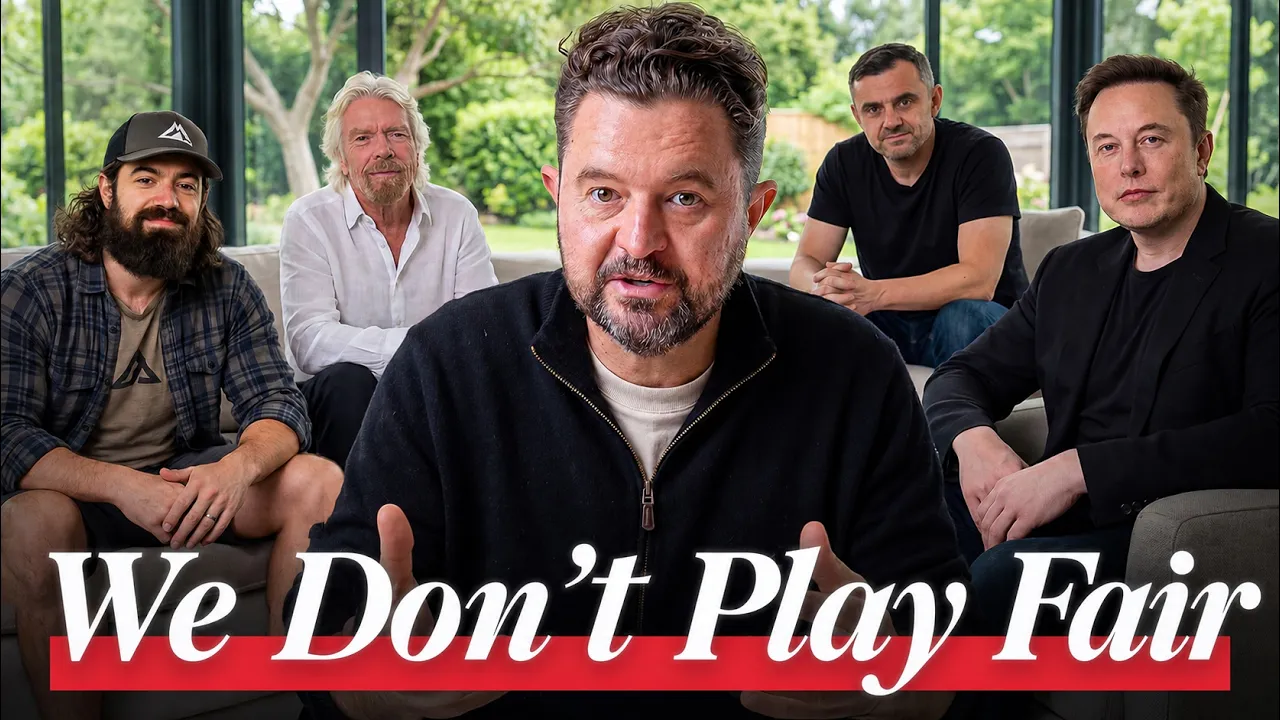
This morning I had breakfast with a billionaire. And this is not a rare event for me. I have had the opportunity to hang out with some of the world's most ultra wealthy people.
And I can tell you a little bit behind the scenes. What are some of the things they talk about that are the most important things that have got them to that crazy high level. Now, these are things you can apply to.
These are not things that you need to wait until you are a billionaire. These are the types of things that actually accelerate you towards bigger financial outcomes as well. Now, the first thing that I've learned from being around the top 0001% of people in the economy is that they are incredibly lucky, but they are in control of that luck.
Luck is a massive role in success. And all of us are going to experience varying degrees of luck. But here's the interesting thing about luck.
Luck is not something that is an onoff switch. It's a dimmer switch. And there's something called the odds of luck happening.
So there's not just lucky brakes. There's the odds of a lucky break. You're not in control of the lucky break, but you are in control of improving the odds.
So, this is something that billionaires absolutely understand the difference between luck and improving the odds. So, if I sit at home on the couch doom scrolling or watching Netflix, I have reduced the odds of anything lucky happening today. If I go out networking, I go out to a private dining experience with a group of interesting people, I've just increased the odds of luck happening.
So, the simple idea here is what can you be doing to increase the odds of luck? And let me give you a few things. The more people you pitch to where you tell them what it is you're trying to achieve, the luckier you get.
The more people you hang out with who are achieving big things, the luckier you get. The more you study trends and you understand what are the current trends and what are the things that are happening in the world that are very very onbrand on market that are creating new success stories, the luckier you get. So you can be doing things that improve your luck at any given time.
Now, I can't tell you that that lucky break is going to arrive on Tuesday at 3 p. m. But I can tell you if you keep doing things that improve the odds, you are going to eventually have a lucky break whenever that shows up.
Now, one person who massively talks about luck all the time is Richard Branson. If you ask Richard Branson how he became Richard Branson, he talks about a series of lucky breaks, lucky timing, lucky experiences, lucky people in his life. He talks a lot about the fact that he has been an incredibly lucky guy.
But what people rarely pick up on is that he put so many irons in the fire that one of them was eventually going to become lucky. He started 400 companies and a lot of them failed, but a couple of them became wildly successful. He signed up hundreds of artists to his music label and most of them did not become superstars, but a few of them became superstars.
He was doing a lot of things and he was doing enough things where he increased the odds of one of those things being wildly successful. So here's the question. Are you starting enough companies?
Are you creating enough new products? Are you out there pitching? Are you creating a video on YouTube that explains who you are and what you do and why it's valuable?
Are you putting yourself out there enough? Like all of those things are impacting your odds of success actually finally showing up. And if you're not doing many of those things, you are massively diminishing your odds of success.
So if you want to be like billionaires, recognize that you are not in control of when luck shows up, but you are in control of the odds. The second thing that I've noticed about uh billionaires or the top 01% is that they create their own currencies. They create new currencies that didn't previously exist and they can use those currencies however they like.
Now quite literally one billionaire friend of mine is one of the early stage people in the Bitcoin space and has actually created a series of all sorts of Bitcoin related currencies. But that's not what I'm talking about. What I'm talking about is things like reputation and brand.
Some of the billionaires I know, they built such a powerful reputation that simply their involvement at a board level or being a strategic adviser or being an angel investor has an outsized influence. They know that it has that influence and therefore they treat that like a currency. I know some people who have built a whopping big email list where they can push send on 600,000 people and they can absolutely get something overs subscribed.
They can launch something at speed and because they can launch it at speed, they can take an equity stake in someone's business just by clicking send. So they're looking to create these alternative currencies. One of the things that almost all billionaires have done is that they've financialized the value of their company.
They've actually raised money from angel investors or VCs and by doing so have set the value of their company at a certain threshold. That means the shares are worth something. If they want to use those shares to acquire something, they can use those shares as a form of currency.
So for example, if someone sells 10% of their company for 10 million, that values the whole company at 100 million. If they want to use another 10% of their company to go and buy a $10 million company, they can say, "Hey, we're going to do a share swap where we use the shares in this company to buy the shares in this company. " And now we've used this madeup currency that we invented, which is this this company's shares to go and acquire this real other asset over here, which is another company's shares.
So, the ability to create currencies. Now, what most people do is they think that there are only a few currencies that really exist. They treat their time as a currency, which means they're willing to trade their time.
They treat British pounds or US dollars or Japanese yen or euros as a currency which means that they will trade their time for any of those currencies. And that is a very basic very low-level way to view currency. What if you could actually think outside the box and say my shares could be a currency, my reputation could be a currency, my brand, my database, my social media following.
All of these things could be used as a currency to acquire stakes in ventures. Now, you might think that this is something that only some billionaire could do when they float on the NASDAQ. This is not true at all.
I've seen startups launch a business. They bring together an advisory board. They bring together someone who does a commitment for a distribution agreement based on those few commitments.
They raise some money from angel investors and those angel investors value the business at 4,56 million and invest at that value. And as soon as all of that happens, they now have a currency. They can use that currency to incentivize a great person to join the team or to do an acquisition.
All sorts of different things. In this new digital economy, even something like follow account can be a currency. If I've got 30 or 40,000 followers on LinkedIn, then that could be used as a influencing chip to get myself on a board seat and it could be used to get a stake in the business.
It could be used to justify the value of my time. I could then use the value of that time to take shares instead of cash flow. Right?
There's all sorts of things that I can do just by building that currency. The next one I want to share with you is the difference between reverse engineering the future and forward engineering the past. Ford engineering the past is what most people do.
They think about what is the past? What have I done up until this point? What do I do tomorrow?
Reverse engineering the future is a different way of thinking about things. It's about projecting yourself forward 3 years into the future and thinking exactly what it is that you're trying to build. This is where you know how many people are on the team, how much revenue you do, how much profit you do, what products you sell, what intellectual property you've got, what your cap table might look like, who's invested in your business.
All of that is suddenly forecasted forward into the future. And you create a vivid picture as to what the future will look like. And then you reverse engineer backwards from the future.
So you say, okay, if that was true 3 years from now, what would it be like 2 years from now? What would it be like 1 year from now? What would it be like in 6 months, in 3 months, in 1 week from now?
And the ability to reverse engineer backwards from the future to today is super powerful. Now, when billionaires do this, they always think to themselves, okay, part of this reverse engineering process is I need $10 million worth of investment. So, I'm going to tell some people about this vision for the future, and I'm going to tell them if you invest your 10 million, then we'll be able to unlock that amazing future, and you'll be part of it.
People buy into it. They might say, "Oh, part of this is that I need an amazing CEO to run the company. " So they go to the CEO, they tell the CEO, "This is the vision.
This is where we're going to be 3 years from now. " And then they show their plan as to how they're going to get there. And they say, "We need one of these CEOs.
Would you like to be that CEO? We've got a list of potential great CEOs. You'd be one of those people.
Would you be interested in being the CEO to get us to that point? " They're reverse engineering the future. They've got a clear vision.
They're putting the pieces in place and they're telling people, "This is what we're trying to achieve in the future. These are the steps along the way. This is the role that I want you to play.
" Right? And they're building it from the future backwards. They don't care where they are today.
Most billionaires, you could take everything off them and they would just rebuild it all back again because they don't care about the past. They care about the future that they're trying to create. They're going to mobilize all the resources that they need in order to achieve the future state that they've designed.
Now, because these billionaires create this vivid vision of the future, they are expert storytellers. They are explaining what they're seeing in their mind and they're enrolling you into that vision. Every single person they meet gets the story.
They get told, "This is what we're building. this is what it's going to look like. And the excitement, the enthusiasm, they have this infectious with or without you energy where you can either join or not because it's happening regardless.
And you don't have to think too hard about what it's all going to look like because the billionaire tells you this is what it's going to be like. These are the steps along the way. This is the role that you're invited to play if you want to.
And it becomes so so clear. Now, this comes to the next piece which is enrolling people into their vision and enrolling people onto their team. See, billionaires and multi multi-millionaires, they don't do a lot themselves because they know that it's impossible to do it all on your own.
If they've got a big vision, and that big vision is going to literally require 500 people to coordinate themselves together, it's going to require capital. It's going to require talent. It's going to require all of those things.
The minute that they start doing that themselves is the minute that they don't have any time available to enroll people. So the way that these billionaires work and the way that they think is that they see themselves as the organizing force to bring people together and to get things done through people. So the power of storytelling is to create alignment.
The reason that they're great storytellers is cuz they're creating an aligned vision and aligned action amongst everyone they come in contact with. If they see you as a great salesperson, their job is to try and enroll you in that vision to get you using your sales skills to sell the damn thing. If they see you as a potential investor, their job is to enroll you in the vision so that they can access the capital to get this thing done.
Even if they had the skills, they wouldn't use the skills because as soon as they put their hands onto something, they're not free to enroll people and get people aligned. They see their job is the job of enrolling and aligning people, not doing the work themselves. Now, one of the billionaires that I spend a lot of time with, he loves talent.
He will look at 10,000 people to find that one person who's 1% better than the best. He once said to me that a thousand good musicians cannot write a single symphony. But Beth Hovind wrote nine of them.
And he told me that the difference between good and great is exponentially different. And he believes his whole job is to identify, recruit, enroll, and align talented people towards really big outcomes. and he spends all of his time trying to find those bait hovvens amongst the good musicians.
He was ferocious in his ability to get the talented individual. He was looking for one person, but he didn't try and find that one person. He got a thousand people to apply for the role and he tested the heck out of them in order to find the one in a thousand.
And as a result, his latest startup went up to be worth over 2. 5 billion. Let me give you the four types of people that the billionaires are always on the lookout in order to enroll.
Number one is distribution. The ability to distribute things into markets. They want to know who are the people who've got a 100,000 followers, who are the people who've got a million email addresses, who are the people who've already got a million hits to their website every week.
They're looking for people who have access to distribution. They're keeping a list in their phone of all the people they know who can easily distribute something out to a lot of people. So, distribution is number one.
Number two is they're looking for highly talented leaders, right? People who can lead projects. It might be a sales leader.
It might be a tech leader or a product leader or it might be a CFO. Right? So think executives.
Think people who can lead teams. Number three is highly talented practitioners, highly talented execution. So it could be the absolute standout engineer.
It could be the unbelievably good singer. It could be the artist. It could be the salesperson.
It's the person who can actually execute the thing at a level that most people couldn't even dream of. Last one that I want to share with you is pools of capital. who has access to money, right?
Who are the angel investors? Who are the VC investors? Who are the people who've got access to the exit where they can sell the company for billions?
They want to know who's got capital and which category does it fall into? What's their criteria for investment or acquisition? And they're constantly on the lookout for those pools of capital.
See, a great business is a collection of exceptional people. That's all it is. It's not about the brand or the logo or the story.
It's about people who come together. If there are no people getting excited about this business, you don't have a business. I know that's a strange thing to say in the age of AI.
I know we like to think about the idea that AI is going to do everything. That's not what a great company is. A great company is great people.
It could be a small team, could be a bigger team, but it's going to be great people. It's when people get excited about something. It's when people get into alignment that magic happens.
Now, even if AI comes in and takes over industries, that will create a massive deflationary effect and it'll free up time and people to get aligned about the next big thing that humanity does. It will always be about people getting into alignment. So, the next one is once you've got people, you need to create an enemy.
Now, here's the thing. I have noticed that millionaires create outcomes. Millionaires create visions.
Millionaires create dashboards. Millionaires create all the carrots for people to move towards. Billionaires create enemies.
Billionaires create sticks to run away from. Billionaires are the ones who actually know how to use the carrot and the stick. And what they do is they create an enemy.
They know what they stand for, but they also know what they stand against. And in some cases, they create an enemy that the entire team wants to rise up against. They understand the dark side of motivation.
They don't just use the 30% of people's energy which is moving towards something. They know how to go to the dark side that has 70% of people's motivations, which is the desire to vanquish an enemy. Now, whether you like it or not, human beings are motivated a little bit by positivity and a lot by negativity.
You can get people to do all sorts of things that they never would have done if they have the right enemy that they want to beat. And billionaires know how to leverage the dark side and the light side. Let me give you some examples.
Richard Branson created an enemy out of British Airways. His whole team wanted to beat British Airways. Steve Jobs in 1984, he wanted to go up against IBM.
My friend, the billionaire this morning, he's out there to change the system. He wants to make political change and he has political enemies that he's going after. And you should see the way he grits his teeth when he talks about their names.
Now, you can do this as a small business. I've got a friend of mine who has a small chain of coffee shops and they've made Starbucks the enemy and they've enrolled their entire team to outperform Starbucks and to be 10 times better than the local Starbucks and to make sure everyone knows about it. My barber who cuts my hair, he is absolutely furious at the barber shop across the road and he wants to be 10 times better than that barber shop.
Don't just think what you're moving towards, think what you're moving away from as well. Okay, now the next one is about creating value at scale. See, here's the uncomfortable truth.
Most of us know how to be valuable, but we don't know how to be valuable at scale. Some of the most valuable people in the economy are nurses and teachers, and they're so valuable, but you have to be in the same room as them. And they can only work with one person at a time.
Billionaires and O1% entrepreneurs. They know how to be valuable for a lot of people all at once. They leverage anything that allows them to be more valuable at scale.
Even being on this YouTube channel is me trying to do value at scale. I could have a one-on-one conversation with one entrepreneur. Or I can have a one-on-one conversation with a camera.
A few thousand people see it. That's value at scale. The thing with billionaires is they know that the economy does not reward value.
It only rewards value at scale. And they know how to play both of those games. More value at greater scale than anyone could possibly imagine.
Let me give you four ways that billionaires think about scale. The first one is intellectual property. Intellectual property is anything like patents or brands, but it can also be content.
So intellectual property could be book rights or royalty rights to songs. It could be video content that you actually can put out into distribution channels, right? Where you're capturing something of value in a scalable format.
So think all things intellectual property from the written to the visual to the movies, patents to systems to franchise manuals. All of that is intellectual property and media rights. That is something that is valuable that can scale.
The next one is owning distribution channels, right? or scaling through distribution. It's the ability to have subscribers or followers or lists.
It's the ability to have retail chains. It's the ability to have websites that people buy from. Anything where you own or control the distribution is giving you more scale for you to put value through that chain.
The next one is people. If you can have a trained up army of people and those people go out and behave exactly the way that you want, that is scale. One of my billionaire friends created an army of people who could deliver home services.
So you can train up armies of people who can deliver the value at scale through those people. The final one is software. This is the big one.
It's the ability to create code that is valuable at scale. See if you can get the code to do a particular thing, if you can create code that does a particular outcome, suddenly that outcome is available all over the world to anyone who's got access to the internet and that means that anything that you code into existence that really works that delivers value is instantly scalable. It's no surprise that some of the most wealthy, successful people in the world have created their wealth through software because it is value at scale in its DNA.
See, simple scales and complexity hits walls really fast. So, billionaires are always thinking value at scale. So, they're always thinking about simplify, simplify, simplify.
How do I create something that's simple enough to scale? Whereas smaller entrepreneurs, they're constantly thinking about complexity. They want to make it up from scratch every single time.
If you want scale, you need to simplify a particular way of doing things so that it can be done that way anywhere in the world. All right, a second last one that I want to share with you is about highv value positioning. Highv value positioning is being known in every single room as the highv value person in that room.
And I'm going to tell you a little bit of a dark secret, which is the most successful people that I know are very, very good at high value positioning. They know how to show up as the key person of influence. They don't often show up and sit in the audience undercover.
They make sure that they are known to all the right people. They know how to arrive in style. They know how to show up in style.
They know how to be positioned in style, right? They know how to be perceived and positioned as a high-value person in any particular setting. And it's important for them to do that.
They want to meet on their terms. They want to meet with the framing of being a high-value person. They do things like win awards.
They do things like get known within their industry. They do things like write books, right? and give talks and give speeches because they're looking for that highv value positioning instantly gives them some standout qualities.
Now, I've seen the videos where people talk about quiet wealth and secret wealth and the billionaire who's like super undercover and nobody knows who they are. Now, that is the exception to the rule because I have been in rooms with these super successful entrepreneurs and investors. Everyone knows that they're there because they set it up that way.
I would go so far as to say that the vast majority of these people when they are in a room they like to be positioned as the highest value person in the room. Now the final thing I want to share with you is the value of exits. Almost all of the extremely wealthy people that I know have built something and eventually sold it.
they sold their company or they sold down their shares or they had a building and they sold their building or they created some sort of cryptocurrency and they sold off the cryptocurrency or they launched a company and they sold parts of the company but they actually sold the thing that they had built all their value into. There was an exit event. Now we always hear about the entrepreneurs who run the business and they make the sales and they generate the leads and they build the team, create a brand and they do all of those things that you would call running the business.
But very very rarely do we hear the story about selling the business. Now go and read the biographies of all the wealthiest people and go look closely and you will discover that there is nine times out of 10 an exit event. They either sold the business in one big transaction.
They sold it down in stages or there was some big event that came along that gave them liquidity. Something happened that changed the game and leveled them up which was an exit event. Now as a result of that exit event, they got two things.
They didn't just get the money from selling. They also got their time back. and they got their time back at a time where they had new lessons.
So imagine what it's like to sell a company. You've now got money. You've completed a whole cycle.
And in completing that whole cycle, you can reflect and say, "What would I do better or more differently or faster than before in order to get an even bigger, better result next time. " And it's those multiple learning rounds that go with exits that really set people apart. It's the ability to look back and say, "Hey, I can break this into stages.
I wish I had have done this at this point. Maybe I could have gone bigger if I had have done it at this point. " Now I've got the time.
Now I've got the money. I can go again. And this is very very common to the most successful people.
More often than not, they've had many exits that have led up to the big exits that have led up to the big big thing that they're known for. So in many cases, I look at entrepreneurs and they're holding on too tight. They started something 5, 10, 15 years ago.
It was great at the time, but they should have sold it seven or eight years ago. They should have had an exit by now. They should have gotten the time and the money.
Even if it was a small exit, even if they sold it for half a million or a million just simply to have their time and their money back plus the learnings, they could go off and start something that would be worth 5 million the next time just simply because they've got the time, the money, and the learnings. They could do something 50 million the time after that. But if they never exit, if they never clear the decks, if they never consolidate their learnings and their finances, it's unlikely that they ever get that next big breakthrough.
All right? because the current business that you've got is based on the best thinking that you had 5 years ago. And the next thing that you do is based on all of the learnings you've had ever since.
So, it may be time to draw a line under it and to actually exit it and then go do something bigger and better than ever before because that is what I see the billionaires do. Okay, I hope you enjoyed that video and I've got another one that I think you should watch next, which is this one right here. And the reason that I say that is because everyone who uses this playbook makes a million dollars.
I think you're going to enjoy it. Check it out. I hope your business is doing really, really well.