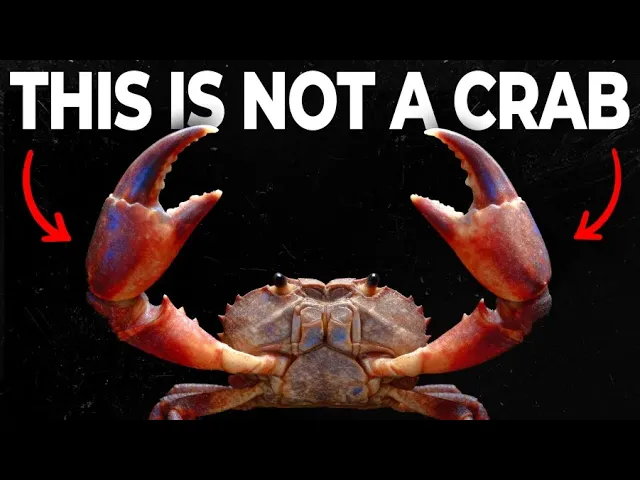
You are evolving into a crab. Well, probably not anytime soon, but this is real and probably the strangest phenomenon that's still happening today. Many animals in the wild that weren't crabs have now evolved into crabs.
Take a look here. This is not a crab. This is not a crab either.
In fact, nothing I'm showing you right now is a crab. They've all just slowly over millions of years become more and more like one. This phenomenon has been so widely studied in science that it has its own name, carcinization, which if you translate from Latin roots essentially means crabization.
The tendency for things to become crabs. Of course, this sounds ridiculous because it is. But when we look into nature, we see this effect happening everywhere.
Some did it millions of years apart. Some did it in totally different oceans. Some weren't even remotely related.
But why does it seem like this is the ultimate life form for all animals? What stops us from evolving into crabs next? And will all roads always lead to crab?
This crabification effect has been joked about online with hundreds [music] of memes about crabs being the epitome of all life. And well, this is actually right. Scientifically, this is peak performance.
But how do we know this? Well, the best explanation for [music] this goes back to an effect called convergent evolution. Essentially, this is when two different organisms that deal with similar challenges end up evolving the same traits independently.
If you've watched our video about massive squids, you'd know that two different squids have both evolved to become massive, even though they're completely different species. Being giant benefited them both, so both became giant. But why crabs?
And why do we see this so often? To get that answer, we need to understand what [music] crablike actually means. Because not every creature that looks like a crab is a real crab.
Some, and actually most crabs are just evolutionary imposters that ended up looking like them. A crablike body usually has a wide, flat shape that keeps the center of gravity low and makes the animal stable. That flattened design also lets it slip under rocks, hide in tight spaces, and avoid getting flipped over by waves or predators.
Because the last thing you want is to end up like this. Crablike bodies also obviously have a shell. But it's more [music] than just armor.
It turns the entire body into a compact tank. When your whole shape is basically a shield, you survive a lot more things than creatures with long exposed segments like lobsters or shrimp. Crabs also have short, powerful legs that give them insanely good control over [music] their movement.
Hence why they can move like this. Oh, not like that. I mean like this.
They're actually better at moving sideways, [music] which helps them dodge predators while still being able to face them. But this raises a really interesting point. If the crab shape is so effective, why isn't everything turned into lobsters instead?
Lobsters are strong, armored, and successful, too. So, why don't we see lobsterization? They're still alive today.
Clearly, they've also survived millions of years. Well, the lobster body plan is actually way harder to modify. Lobsters have long segmented bodies with big tails, and that layout limits what evolution can do with it.
You can't flatten a lobster without breaking half its anatomy. The moment you try to squash that long tail under the body the way crabs do, the whole structure stops functioning. Crabs, on the other hand, start with a compact shape that's incredibly easy to tweak.
Their body plan can widen, shorten, armor up, or shift direction without ruining their movement. Once you become crabshaped, it's very stable. species rarely stretch back out again.
Becoming lobster-like again would require re-elongating the abdomen, rechanging musculature, remodifying tail fins, and restructuring the whole body. Those changes are much harder to evolve than simply shortening the body and tucking the tail. Carsonization is mechanically easy.
Lobsterization is mechanically [music] expensive. So, who was the first crab to become a crab? Well, technically the earliest true crabs, the infer brechura, showed up over 200 million years ago, back before dinosaurs were even alive.
But the interesting part is that they weren't alone. Because around that same time, other crustations that weren't even part of the crab family tree started evolving into crabshaped forms, too. We don't call Breta true crabs because they [music] were somehow more authentic or more biologically superior.
Most of it is they were simply the ones we discovered first. Back when scientists were first trying to categorize animals, they had no clue about genetics or evolutionary history. They were working purely on appearance.
So animals in the Bratura group, the flat, wide-bodied creatures with the tucked in tail and sideways walk were what we defined as the real crabs. In a way, these are the first animals to become crabs. [music] real crabs themselves, which sounds really redundant, I know, but it does point out the fact that they are included in the effect of carcinization.
They didn't create the design themselves. We just dubbed them the official crabs. So, what other crabs are there that aren't real crabs?
Well, the most famous imposters are king crabs. Genetically, king crabs are actually giant hermit crabs that evolved out of the living in a snail shelf strategy. Their ancestors used to carry shells on their backs just like the tiny hermit crabs you see on beaches.
But over millions of years, they evolved a hardened body of their own, lost the need to swap shells, flattened out, widened, and slowly shifted into a crablike shape because that was what was effective. Even though king crabs and true crabs look way more similar on the outside than king crabs and hermit crabs, they come from completely different branches of the crustation family tree. Their last common ancestor wasn't a crab.
It was some primitive crustation hundreds of millions of years ago. We obviously can't say for sure what they looked like, but they definitely didn't look like crabs. It's interesting because anyone who's eaten king crab versus normal crab with any [music] frequency would usually be able to tell the difference from their taste, which would make sense since they aren't the same animal.
But what other things have turned into crabs? Well, take a look at porcelain crabs. Okay, wait.
Is everything that's not a crab called a crab? See, part of the problem is everything that looked like a crab when we found them was named to be one, and now that's what they're named. It's kind of hard to change, even if we actually understand how the ancestral lineage works now.
Porcelain crabs belong to the order anamora, the same branch as the squat lobsters, and they're actually incredibly similar to them, but just with a squat lobster shape. They don't fight like crabs, though, and their shells break much more easily, almost as if they're made of porcelain. However, if you were some unassuming explorer and saw these guys, I mean, who wouldn't call them a crab?
And crabific I mean, carcinization has occurred in crablike species before crabs even existed. Fossils like eocarcinis and eoproen show that carcinization has been happening long before true crabs even existed. We see this same body type with flat wide bodies and tucked in tails over and over as if evolution can't help but just keep wanting to make more crabs.
But if being a crab is such an ultimate life form, then where are these crabs now? Well, most of these early photo crabs are actually completely extinct now. The problem was they literally weren't good enough at being crabs.
Some lacked the hardened shell true crabs eventually evolved. Others didn't have the right leg structure for that sideways ultra stable movement. And a few were living in environments that completely collapsed during mass extinction events like the asteroid that killed the dinosaurs, which I guess is not entirely their fault.
But even if their descendants didn't survive, evolution remade their crab design again. It's built into the way our universe works that crabshaped bodies will continue forming as these are just effective builds for crustations. The crabs of today are the most successful crab designs that have existed so far.
But what else can or will turn into crabs? The scary answer is anything in the right environment. We've seen tons of animals drift towards this crab shape.
Even some shrimp lineages are showing early signs of flattening out and tucking their tails, the first baby steps on the long road to becoming a crab. But in reality, this process only really affects crustations to the full or any extent. We won't actually be seeing lions becoming crabs anytime soon.
Their builds are for completely different environments. Humans, especially being the dominant species on this planet, are not likely to evolve into crabs either. You're safe for now.
But something really interesting to look at is that other animals have evolved similar body shapes as crabs for similar reasons, even if they're not crustaceians at all. Take stingrays for example. They aren't crabs, not even close.
But they ended up with a body shape that's surprisingly similar in principle. A wide flattened body that's built for stability on the seafloor. Just like how crabs flatten out to stay low, resist currents, stingrays flattened out to glide through open water with almost no drag.
So, does this mean stingrays are becoming crabs, too? Well, no. But they are shaped slightly similar for a similar reason.
A case of partially convergent evolution. It's not carcinization. It's not sting rayization either.
It's just flatization. Everything is relative after all. You see these examples of partially convergent evolution in animals all the time.
Actually, we just don't often think about it. Look at dolphins [music] and sharks. These two animals could not be more different biologically.
Sharks are ancient fish with skeletons made of cartilage. Dolphins are warm-blooded mammals that breathe air, nurse their young, and are more closely related to cows than to anything in the ocean. Yet, put them side by side and they both ended up with almost the same streamlined torpedo-shaped bodies because that shape is simply the most efficient way to move fast through water.
If you want to cut through the ocean with low drag, stay stable at high speeds, and use as little energy as possible, [music] evolution starts pushing you towards that same sleek, pointed design. If you want to stay close to the seafloor, you end up becoming flatter. Birds, bats, insects, even purosaurs, all figured out, the same basic design, because the physics of flight leaves you with only a handful of options that actually work.
The environment that we live in only gives us a select amount of blueprints available to choose from. It's not that everything is becoming crabs. It's that everything that fits these [music] kind of environments is turning into this highly effective shape.
And we [music] just call this a crab. We fortunately or unfortunately won't see any animals fully crabify in most non-crustations because crustations already have the perfect body layout for turning into crabs. Their shells can widen, their tails can fold under, and their legs can shift sideways without breaking their whole design.
Other body plants don't have that flexibility. Wings, for example, need very specific structures and muscle setups, so only a few groups ever evolve them. A lion or a lizard doesn't have the starting blueprint to flatten into a crab or grow wings without losing its ability to function.
ignoring that being a crab wouldn't even help in their environment. Carsonization isn't really some universal evolutionary destiny. It's just a repeated outcome in a certain group of animals that are able to become [music] crabs.
Unfortunately, as diverse as the world is, evolution can't come up with new ideas constantly, and crustations just happen to be built in a way that keeps funneling them into becoming crabs. Thank you guys for watching. At the time this [music] video was made, we've just hit 50,000 subscribers, which is absolutely insane.
I can't thank you guys enough. If you want to see more from me, check out this video about prehistoric gigantism. And whatever you do, don't turn into a crab.