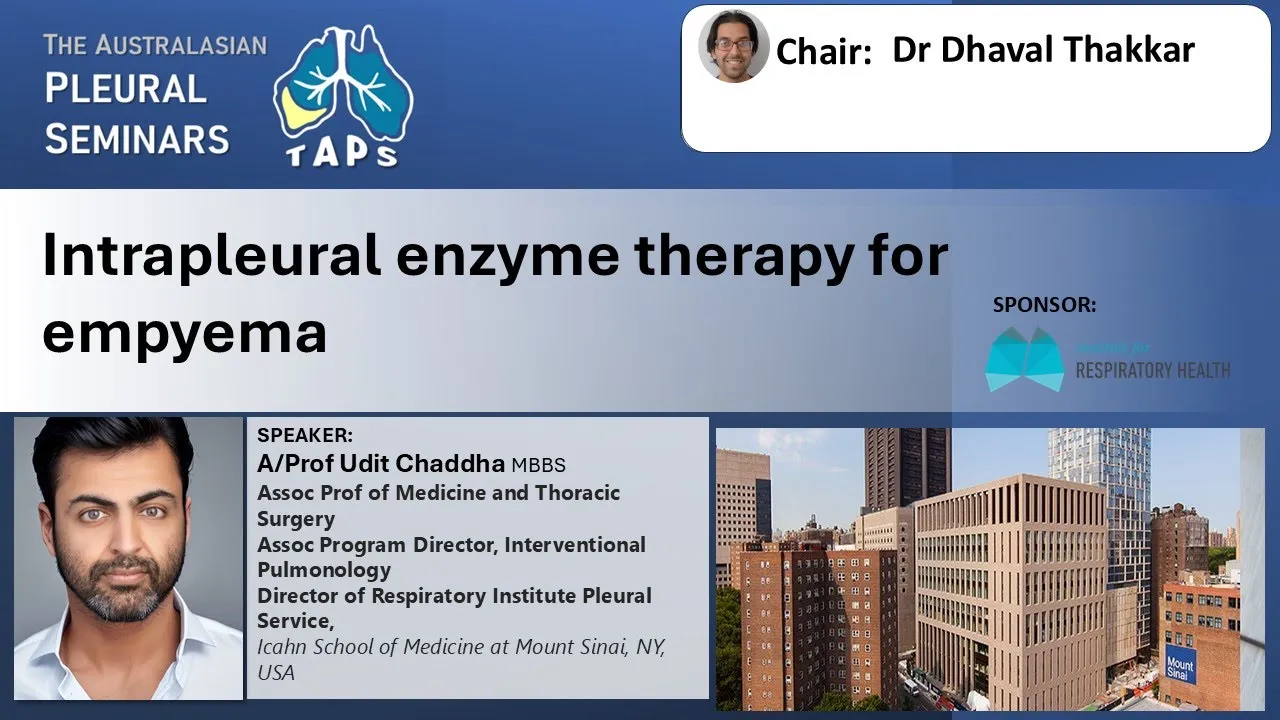
all right good morning good afternoon good evening to all our colleagues logging in from around the world please remember these sessions are recorded and published on YouTube so please feel free to watch any sessions you weren't able to attend previously um today I have the pleasure of introducing our guest speaker Drudit Chada from Mount siai Hospital New York City where he's the director of the plural service and associate director of intertial pulmonology he's an active clinician researcher and author and has a prolific number of Publications in the full spectrum of topics and Interventional pulmonology and plural disease he's also involved in National International societies developing consensus statements and updating guidelines and can be found frequently speaking at International conferences and with all of that he still finds time to pick up spend time with his family and pick up his son from school and so without further Ado I'll pass the screen over to udit and he's going to discuss with us today int plural enzyme therapy for empa thank you DAV and uh thank you to you and Gary for inviting me to speak um it's truly an honor for me so uh one of the main objectives of this talk is to basically describe how I think int plural enzyme therapy should be optimized and how you can optimize it in your care in patients with empa and consequently how you can streamline empa management I have no relevant conflicts of interest to disclose so what's the rational for IET or intal enzyme therapy so look at TPA and dnas and I talk about TPA with dnas because TPA is the only litic studied in combination with dnas but really any fibrinolytic should work with dnas DPA breaks down septations potentially has a lavage effect dnas on the other hand breaks down extra cellular DNA which reduces viscosity of the plural fluid and both of these in combination hopefully help you clear the plural space better now there may be an additional benefit to using these two in combination which is breaking down bofilm which may allow better antibiotic penetration so the question is when should you use TPA dnas or intal enzyme therapy do you use it initially as initial therapy which means as soon as an empa patient hits the door you place the chest tube you start int plural enzyme therapy or do you use it as subsequent therapy when your standard care tube thoracostomy and antibiotics fail now one thing I want to highlight for mist one and Mist two is that Placebo works so when you do insert a chest tube the thing I recommend doing is having patience and assessing whether that chest tube works or not so once you insert a chest tube you assess for the patency of the tube and you see whether it's draining or not and within an hour or within sometimes minutes of inserting a tube and flushing it you know whether the fluid is going to be drained or not and if it's draining well then you keep assessing the patient and you continue training the tube to suction on the other hand if the tube is not training well and you can make this decision very very soon with pet side assessment and sometimes even ultrasound you give TPA dnas so my suggest is to use tpna is not upfront when the patient hits the door but very soon after tube thoracostomy if the tube Thor cost to me drainage is not working and that decision can be made within hours what if you use tpn is UPF front in everybody there are some downsides one there's a cost to it it costs approximately $7,000 uh for 3-day course here there's some pain associated with ad with administration of uh TPA dnas uh and up to a third of P patients and then there's approximately a 5% bleeding rate and in a retrospective observational study across 24 centers with uh almost 1900 patients the bleeding rate was also 4% and 25% of these bleeds needed surgery and 50% needed transfusions so a hemothorax or Hemorrhage post DPA dnas is not necessarily a mild event so put your chest tube in assess the patient quickly but make a very quick decision as to whether you need to give TP dnas or not when you see this when you see septations extensive septations does that change the likelihood of you needing TPA DNA firstly I'd like to highlight that across studies septations are exquisitly are very common in patients with uh empa and in one of the studies uh the presence of septations actually did not uh uh be associated with the need to give TPA DNS or not so when you do see septations maybe you need to give tpns or not but you cannot make that decision just based on septations alone tube thoracostomy alone may work again put your tube in assess it quickly if you need to give TPA dnas give TPA dnas the next question is what dose now we say 10 and five uh that is because 10 milligrams was uh used in the only randomized control trial the miss two study but remember that this was not based on any dose escalation study and this dose of 10 milligrams of DPA was empirically chosen now the question is can you lower this to and maintain efficacy and reduce bleeding rates now I must highlight that there's a small study on 25 horses in which a DPA dose of 3. 7 milligrams was sufficient and you can imagine a horse H hemithorax being much larger than a human hemithorax so why do we need 10 milligrams and Gary and his group have actually studied this with a 5 milligram dose and in the adapt to study a 2. 5 milligram dose and my understanding is they are further reducing the dose to 1 milligram now and you can see on this uh graph on the left that the need for surgery and the successful discharge is pretty much similar to postm Publications with about 90% success rates the question is though what about the bleeding rate in adapt one which is the 5 milligram dpad DNA's uh uh study uh there was a 5% bleeding rate so not much lower but again it's a small study and in adap 2 there was a 2.
9% bleading rate which means two patients had bleeding but importantly only one patient at the 2. 5 milligram dose had bleeding the the second patient the dose was escalated um and then bleeding happened so maybe uh lower doses associated with lesser bleeding and likely lower doses still maintain efficacy overall though right now we don't have randomized uh evidence to say that there is a big difference what I can suggest though is in certain situations a lower dose may be beneficial we know from this large retrospective observational study from 24 centers that I mentioned that anti-coagulation use almost doubles the rate of bleeding so maybe that's one situation in which uh you can start considering a lower dose and escalate up if need be if the lower dose doesn't work now once you start TPA dnas please remember that this is not an antibiotic prescription you don't need to complete three days six doses uh in most of the studies most patients did many patients did not complete the six Doses and the median number of doses in some studies was three and five so really you stop tpad dnas when you stop needing to give it so individualize the therapy and how do you do that if you have complete radiological resolution of your plural affusion it's a Nob brain or there's no reason to give more TPA dnas at that time or if you have decent radiological Improvement and clinical defervescence you still probably are okay and you can stop your TPA DNA intal enzyme therapy Administration now what is decent radiological Improvement the problem is this is subjective however if someone has clinical defervescence and has a more than significant Improvement in their chest x-ray and ultrasound that should be okay to say that tpad dnas has worked and is successful look at the Mis study which had a radiological primary outcome uh there was a 30% Improvement in plural opacity from day one to day s in the i group but look at the numbers very few people had complete radiological resolution in fact a very small number of patients had that and you see this across studies this is an study from 2004 in streptokinase alone where you see the lateral shadowing or the area of shadowing of the hemithorax at the time of discharge is still about 20 30% and it's only with time that that effusion or residual opacity actually goes away completely and Gary following this protocol has actually shown that if you do uh do this nobody has recurrent infections nobody has delayed complications or residual plal thickening and all patient of the 62 that he studied actually return to their prior level of employment so again treat empa not necessarily like an abscess where you have to drain every drop of the bus but somewhat more like a pneumonia wherein if you do have some residual consolidation one uh week later you're not going to send that patient for you know lobectomy or any other further intervention you're just going to have patients continuing your current therapy and uh watching them improve if they are already on the right track now in many countries a DNA uh DNA is not available so the question often comes up what about using fontic therapy mono monotherapy now this is uh not something that is as well evidence backed H uh because it La lacks a randomized study like M to and then even in m to if you look at the uh TP alone group or you look at the strepto alone group in Mist onean there was not much difference in a Cochran uh review uh the mortality difference between fibron altic monotherapy and Placebo was not um seen but there was overall some um benefit in reducing surgical referral rates however when the studies with uh only low bias uh were looked at this uh sensitivity analysis did not hold through and the benefit for reduced surgical referral rates did not hold um so uh in a 2021 consensus paper this was addressed and my current suggestion is much like the recommendations from that paper where in if you don't have access to dnas or dnas for whatever reason is contraindicated then fontic monotherapy can be used or saline flushing uh can be considered uh in patients who are non-surgical candidates and even in those who are surgical candidates you can give it a trial while Consulting thoracic surgery colleagues to come on board uh um and seeing what happens so the question again now is what you have tpna you've given tpad dnas or not when do you operate now I failure basically is the opposite of success which means that there is no or minimal radiological Improvement or there is some radiological Improvement but that patient still continues to be uh septic so there's lack of clinical defervescence that's failure of your medication however you can assess this within two to three doses Within 24 to 48 hours you know whether intal enzyme therapy is working or not you do not need to wait all the way till six doses 3 days before saying oops IET failed let's call thoracic surgery on board so that decision can be made within 24 to 48 hours so what I suggesting is you make your decision on tpad dnas within an hour or so within the first day for sure and within 24 to 48 hours you know whether it's working or not so if you are Consulting thoracic surgery you are doing that within two days of that chest tube being placed and this is extremely important because the later they operate the higher the rate of thoracotomies are as opposed to minimally invasive Vats being done for decortications and this is important because you can see in red year the thorocotomy group has higher length of stay more procedure time more mobidity and more mortality from This Ss database so question is when do you operate I'll take you back to miss2 there was a 4% surgical referral rate in the IET group so if you operate upfront with everyone you are probably going to be operating on a large number of people who would have never needed surgery and could have being treated alone medically uh with likely the same outcome um now what if you have a visceral plural R now we do know that uh stage two to stage three empa stage three when the ran comes up is not clinically uh black and white zone there's a lot of Gray Zone in between so it's hard to predict when someone is isolated stage three but when you do identify a th grind the likelihood of them needing surgery is higher so in my practice my threshold to Conta contact thoracic surgery is a little lower when it's clearly a stage three empa and you can see from this study from 2018 that plural thickening was one of the main independent predictors for intal enzyme therapy failure um in this study however you still never know so I still give intal enzyme therapy a shot before committing a patient to the operating room um when we are unsure so let's take a step back and say that I put a tube in it's not training well why not operate on everyone up front now I did mentioned that I think you'd be operating on a lot more people if you did that but what if surgery has a better outcome why not do that so does upfront surgery uh when tube thoracostomy fails uh how does it compare to Medical therapy now Willam Osler famous uh physician said empa needs 3 Ines of Cold Steel instead of the fool of a physician and the p on the other hand uh did not want surgery despite being a surgeon himself and both of them died of um you know complications of empa in fact Osa died of posttop hemorrhage uh I think on day five uh if I'm right this question has really been addressed uh well in only one study which is only strictly a feasibility study so we don't have the right answer yet but M three for a feasibility uh study did assess after 24 hours of standard care randomizing patient to continued standard care early Vats or early int enzyme therapy and even though it's a feasibility study there's a lot to learn from this um and uh what they did see is that there was no difference in length of stay in the early Vats group or the early IET Group which is great uh and there is uh basically no difference in reinterventions or readmissions and there was probably a lesser pain and better quality of life in the intol enzyme Therapy Group not surprisingly uh their time to intervention was longer in the surgical group it took 3. 5 days uh for someone to get surgery which is I think a real world situation you know there's a lot of different access to surgical groups it really depends on the Day and The Time of the week uh you know is the consult placed on a Monday morning or a Friday afternoon uh or a Saturday afternoon so I do think the 3.
5 days is Real World experience and um intol enzyme therapy on the other hand can be given within an hour of you order in it you just need to go to the pharmacy and uh pick it up uh so so that's one of the big benefits I want to highlight of Interpol enzyme therapy it's something you have literally in your pocket and you can administer it quickly one of the arguments with this feasibility study was that you know what if surgery was done UPF front could the length of stay have been shorter who knows right this is a feasibility study you can't make those conclusions however there's very few patients I know who would say that you give me the exact same outcome uh and you know maybe I stay in the hospital a day or two longer but I avoid surgery and everyone would prefer that option of medical treatment avoiding surgery with the ex exact same outcome even if it meant I stayed in the hospital a day or two longer so in my book I don't think surgery and int lenzyme therapy are competing therapies I don't think we should look at it like that and I and even though I do think studies like mistful are necessary I don't really know how that's going to impact my practice directly because I do look at both of them as somewhat a sequential therapies not alternatives for each other so we look at it as you give intop enzyme therapy if it fails you give surgery uh or you offer surgery to patients because there a couple of things we know for sure inop enzyme therapy works after M to there were uh seven or eight studies that have been published some prospective some retrospective and all of them show that you are avoiding surgery and discharging patients in in 90% of the cases in the I alone group so we know that intol enzyme therapy works the second thing we know is delaying surgery hurts so yes when IED does fail you do offer surgery but you don't want to make that decision 3 five days after chest tube insertion or 3 five days after the patient um presents to your emergency room so the way I manage empa again is you put that chest tube in start the antibiotics ultrasound that patient assess for tube patency within an hour or so you will know whether that tube is draining or not and if not then give intal lenzyme therapy whether you believe in surgery or not you can call your thoracic surgery colleagues on board right away or or wait in my practice we give at least two doses of I to say whether it's working or not and if it's not working we call thoracic surgery on board they book the patient for the O if I continues to work and the patient improves cancel the Vats uh but again I think this should be sequentially done rather than IET versus Vats uh as your first rescue outcome and uh keep in mind that the success of intol enzyme therapy doesn't necessarily mean complete radiological resolution you're not trying to drain an absess here even if you have decent radiological Improvement and clinical defervescence that is success and antibiotics uh for two to four weeks or what work course you do decide should suffice in those situations well I think that's my last slide um thank you brilliant thank you so much youit for that that's uh a great highlight for I mean one of the first questions we frequently ask our our guests are you know how would you do things in 2025 and I think that last slide pretty much tells us exactly how you would manage these things so it's uh really helpful to know because there is there is a little bit of gray like you said in terms of when to get things involved and some of it is also local you know availability like you mentioned if a thoracic surgeon or not um and so you know for the for all our participants that are joining in um feel free to please throw some questions in the chat um and and I'll try to go through them as we as we chat here but I'll start off um you know a little bit just to get your thoughts on on a few things um so you'd mentioned that um you know you don't have to necessarily complete all six doses like you know we were doing it and missed uh two um and and you kind of gave us an idea of defervescence and radiologic Improvement so just a little bit more detail on that in terms of radiological Improvement how do you do you follow that with x-rays do you do a low do CT do you do ultrasound before you decide hey you know we're really done yeah uh so even in m to only uh two-thirds of the patients completed all six doses um so practically you know I don't think uh you treat this like a fixed uh regimen and and you tailor it or individualize it to the patient in front of you so there's a few things you look at right so you look at radiological Improvement and you look at clinical deference now radiological Improvement is best assessed daily by by bedside ultrasound and we do this twice daily in all patients with empa where we see for significant Improvement and even if there's a small residual uh effusion and the patient is clinically improving we don't really worry about it we also get Daily chest x-rays because remember point of care ultrasound is something you can see you can upload a video but an x-rays on file for everybody to see so we do get x-rays we do not get CT scans because uh there is always a tendency to find a locule here or there and then you know you're basically tending to treat the image much more than the patient in front of you so in an in an improving patient uh we do not get CT scans and patients who are not improving and whom we may consider surgery or maybe in a rare situation a second tube placed into a non-draining locule in a persistently septic patient we will consider a CT scan clinical defervescence again you look at basic clinical science are they still tachic cardic febrile and then we look at uh Improvement of the CRP now how much does the CRP improve people say about me know if it improves up to 50% it's great uh there's no real number as long as we have a good Trend and it sort of fits in with the overall clinical picture we look at CRP as well perfect thank you and so we've got a few questions pouring in so I'm gonna I'm gonna get started with that um I'm not sure how much you be able to comment on the Pediatric population but one of the first questions is uh how will your approach be different for children any comments I'm not I know you're not a pediatrician and it's very separate in the US so yeah no no I I I don't have any specific comments I don't treat uh pediatric patients with this disease yeah so so um yeah so sorry not to answer that it would just yeah us the practice is quite different I can tell you from my experience so um we will go on to the next question then what dose of fibron elisis would you recommend for infected retained hemothorax would you give out to place alone or together with DNA as well yeah so so that's uh if it's infected you know then you're treating it like an empa at that point so I would give DPA and dnas because at that point your goal is not only to break septations but also reduce viscosity to allow for better drainage uh and I don't know if the question was alluding to this but in a retained hemothorax alone the usual dose is 4 milligrams again not studied in randomized settings uh but there's a lot of other smaller studies that look at this and about 4 milligrams of DPA should be enough again in M are too you know four and lower should be enough too uh it's just that we have a randomly picked 10 milligram dose in a randomized study which makes that the standard of care dose but lower doses as Gary has shown should be enough even in um the setting of empa but I would give dnas as well yes if you think uh the hemothorax is infected yeah no absolutely and I think you know you don't lose much in you know starting starting low going slow kind of thing you can always ramp up if you're not getting response you're doing this twice a day like you said you can ultrasound these bedside you get real point of care information right away so you can you know as long as you're monitoring these patients regularly there there shouldn't be any significant delay I think you know so correct and and just to stress a little bit more on the twice a day thing right let's say my first do was given at noon and I leave at 7:00 p. m. I'm not waiting till midnight to give my second dose you know we don't know the exact pharmacokinetics of uh DPA in the plural space but if in the serum it's seconds it can't be that long in the plural space you know you clamp the tube for an hour based on some ultrasound data that yes it takes about an hour for everything to mix around and have a good effect but you know 7 hours later that's fine so you don't have to wait till the next day to give your next dose as long as it's sufficiently spread from your first one so if my first 2.