so let's start Welcome to our webcast series digital twin expert talks uh my name is Mike Billman I'm managing director of the idta um today we have bigger boss with us we get what's will give us an introduction to the AIS meta model um bigot bosses from Bosch connected industry uh she's a member of the board of the industrial digital twin associations which is she's also a founding member and we can say she's the lead architect of of the as metamodel so she's also a chair of the working group open technology in the idta she's
chair of the joint working group asset Administration shell with the platform industry for that all and she has several more roles it would take too long to mention all the roles she has um so she's really a technical expert for the asset Administration shell and she will use the next 20 minutes to give us an introduction a deep dive into the technology um our today's webcast will be recorded and published afterwards on YouTube that's it from my site thank you very much so the introduction yes so um I will share my slides now so it's
as Mike just said today we are really getting into the meta model so this is really an expert talk so it's for really understanding the information model behind the asset Administration shell and so um what it is about so we all or I it's assumed that you know a little bit about the asset Administration shell otherwise it's probably very hard to follow so on the left side you see the concept of the asset Administration shell with its sub models with the properties and so on and then we do have the specification and the specification is
a basis for interoperability in the end and this is the document I will explain in this expert talk today um if you have questions you can put them into the the chat and later I will try to answer all of your questions so I already said it so you should have an idea that how why to build digital twin what they are good for and why you need them for your domain so I will not give an in motivation or something like this so I think these are other expert talks that were already too and
I I I they gave a very good Insight why you need little twins and also why do you need a standardized and interoperable little twin the asset Administration show so as you should have a little bit an idea what the asset Administration shell is about it's also helpful if you have a little bit of know-how in in uml and can read a uml diagram I will explain it but that would be helpful as well and so yeah so you are here in the right uh session if you really want to learn about the meta model
and if you are a security expert so I'm sorry to say that security the security part will not be part of this expert talk this would be another expert talk because there is also a lot of course to say about Security in the context of digital Twins and the asset Administration show okay then get started so the first thing if you want to start implementing an asset Administration shell is to download the specification itself and here just the links um I that's it then if you are even familiar with uml or have an uml tool
yourself you might also be interested to import the model and to play around a little bit there is here you see our GitHub repository there you also find the specifications and including the xmi format that is supported by most uml2 so you might want to import it if you want um what is important for those of you who already perhaps know the version 1.0 or 2.0 or another one is that there is also um in the annex and that's why I really had have it at the beginning because if you're really a programmer and develop
asset Administration shells or asset Administration shell tooling you would like to know what changed and there is this Annex and there are also other screencasts and in these other screencasts the differences will also be explained today I will not focus on the differences but on the basis yeah and then of course what I said another Annex you should also have a look at before reading the specification is how it is done how is it written down oh and perhaps if you need uh get re-familia with uml and how which kind of modeling because of course
there are always modeling Styles which modeling style is used in this specification and this is how the complete specification is built every chapter is starting with a diagram and then there is a table like this explaining the diagram so it's explaining all the attributes and the types giving an explanation and of course the Cardinal um cardinality and additionally we also in some cases we do have constraints that need to be fulfilled so that's the starting point and now um yeah it's still not the the core of the asset Administration Channel meter model but uh yeah
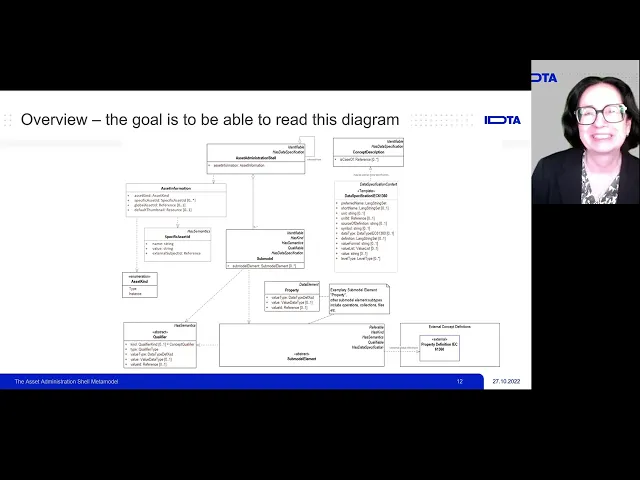
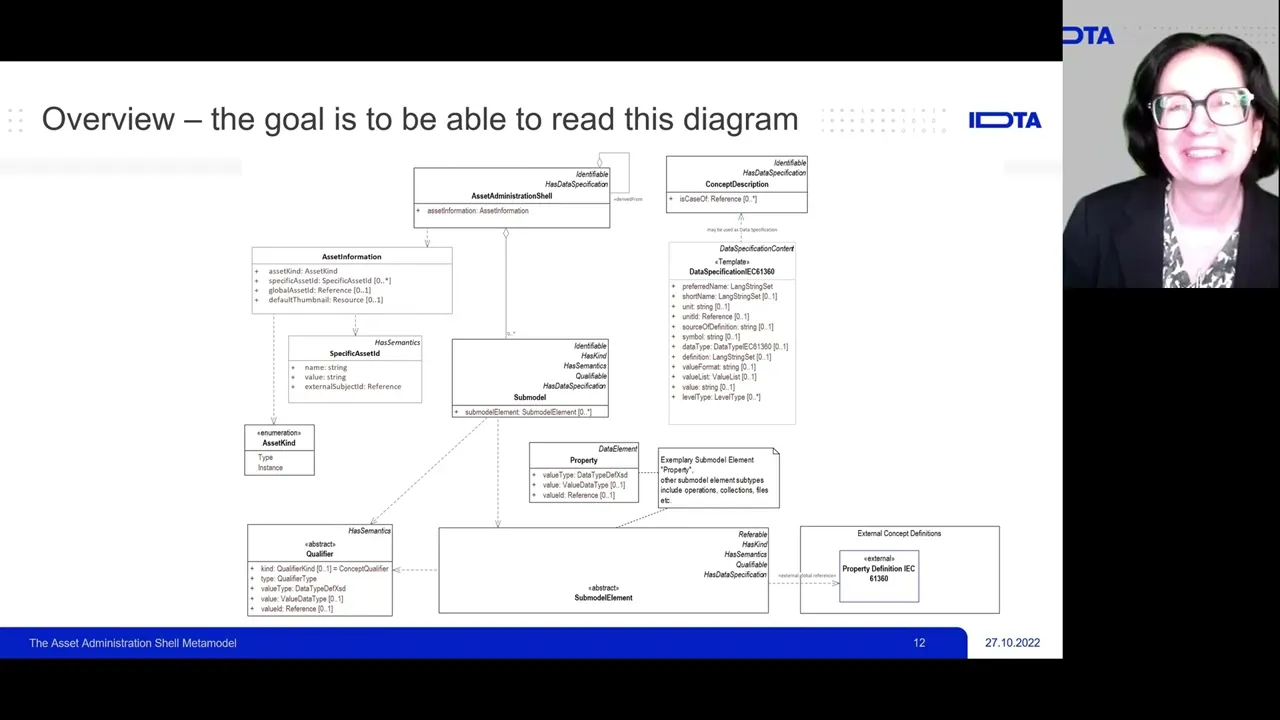
or this is so what is the goal of this expert Target that you can read this diagram and not only read but understand it uh have a little bit of background know how why is it like like this and what do you need to know when implementing this and so if you are familiar with the asset Administration shell and have a little bit and also a little bit familiar with uml it's quite easy to read so you have the asset Administration shell the asset Administration shell is consisting of sub models and the sub model again
is consisting out of submodel elements so that's very easy one thing you already see on this diagram is that this is a shared aggregation so the sub model is an object a standalone object whereas a sub model element is just existing in the context of a sub model and in this case this kind of presentation is chosen and this is a dependency error just saying this is a type submodel element and then you have to look up this corresponding class submodel element then we do have a lot of different sub model elements in this diagram
only one of these is shown the property and what is also shown here is that a submool as well as a submodel element can have a qualifier I will explain it later what this means and what you can do with it and perhaps the most important thing with digital twins what is a digital twin and digital twin is a representation of an asset and here you have the information about the asset itself and we distinguish between asset types and is asset instances so product type and product instances and what is very important is that we
do have an identifier for the asset it's a global asset ID and we also support some additional asset IDs I will explain later and then what we also do have are so-called concept descriptions because for the asset Administration shell semantics is very important and so this is according conformance to the ic61360 we allow also to specify the semantics of properties now this is the overview and now I will go through the model and explain the most important aspects and what you should know about the yeah meta model but before coming to the main classes like
asset Administration share sub model and so on perhaps you already had a look when you see at this diagram you see there are a lot of different classes that are inherited so this is um how it is displayed in Enterprise architect but in other tools it might be displayed in a different way so this is not important for the meta model but all of these classes so these five classes are inherited by the sub model and you see here same classes has semantics for example I explained semantics is very important for the asset Administration shell
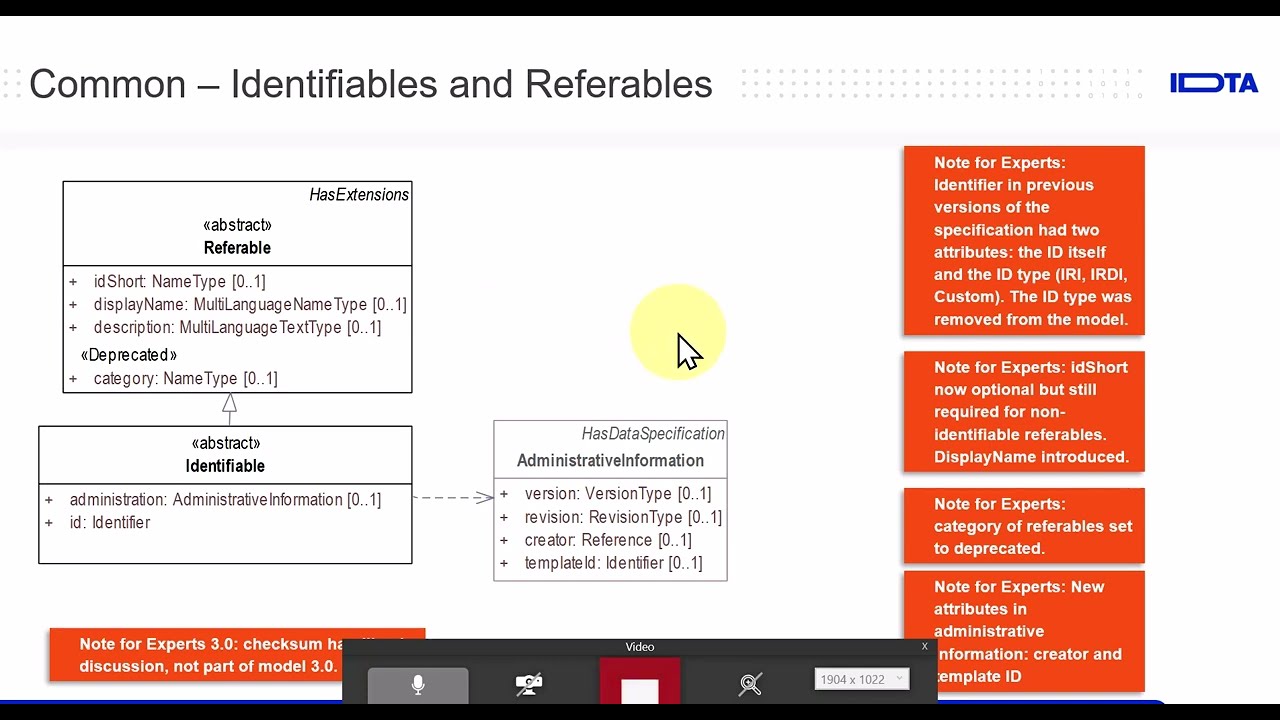
so this is by inheriting the abstract class has semantics and so all of these attributes that are inherited is part of the common attribute section so these are the attributes that are reused by a lot of different classes and are also extremely important to understand how the complete model is used in the end okay then we start with two terms referable and identifiable so identifiable here you see it it's like in a passport that's really an identifier um and so uh identifiable is really if you have a globally unique ID whereas a referable is just
unique in the context of an identifiable so it might be structured but in the end it's always an identifiable you need as I said the submodel elements are part of the sub model they are not existing in their own but nevertheless they are referable because they have an ID short that's the most important attribute here they have a name an ID short an identifiable has an ID it's only optional for an identifiable to also have an ID shot then of course we have descriptions and display names and so on but the main attribute is ID
short and ID so this is really important to understand when also talking about referencing and reusing stuff then and I think this is really now the core the heart of the asset Administration is how to deal with semantics perhaps I explained first this figure that's well known out of other representations on the asset Administration shell so here we have a property with a value 2000 and then of course what does it mean 2000 year Euro steps whatever and here you need the semantic ID and the semantic ID in this case it's a E-class property he
has again a unique ID and that's it and then but it has a definition what does it mean this definition is also provided in several languages and very important it has a unit a physical unit you need to know and you it also has a data type so after now resolving this semantic ID you know okay it's the maximum rotation speed of the corresponding product and this is exactly what is done here you have a semantic IDE and this is exactly a globally unique identifier explaining the semantics of the element we also support some additional
semantic IDs because there is not only one dictionary and sometimes there's also some relationships between different semantic Concepts but the main semantic ID is only this one it's exactly one and this is used for for matching and all kind of um yeah how to deal with semantics in the asset Administration shell so this is just optional that you can also add supplemental semantic IDs so semantic ID itself is also optional but really it's really recommended to to use it and it's also done like this because we also have in mind that the asset Administration shell
is built and at the beginning of engineering and asset Administration share you might not yet have all the information you need and that's why some attributes are optional also we strongly recommend that it has a semantic ID for example in this case at the end another one I promised that I also explained qualifiers so some of the elements submodels are qualifiable we are saying or also a sub model element is qualifiable and this means you can add additional qualifications to an element and here again you see in this case it's the IC CDD dictionary and
they are standardizing several different qualifiers one of them is a lifecycle qualifier or the lifecycle type it's it's called and so one quality qualifier would be for example for a sub model for a bill of material that this is the the build as built so if you have a look at this dictionary you will see um that this again the semantic ID of this qualifier has exactly the semantic it's a life cycle qualify and the value is built it has a lot of other values planned built whatever and also the values itself may have a
unique ID this is what is done also here because all of this is standardized in the corresponding dictionaries or we could also do it with our concept descriptions so this is um how to use qualifier and we also distinguish value concept and template qualifier but for today I think it's going too much into detail and so here I would like to refer to the specification for more details but that's the main thing to understand when dealing with qualifiers another important concept is the data has data specification it's more an option for extensibility of the specification
we have predefined data specifications especially for concept descriptions we don't have any others up to now so the only thing you need to understand is in a way the standardized data specifications we have so far and that's exactly the one for concept descriptions conformant to ic61360 I will come to this later so this is just an extension point the meter model provides but again for predefined and standardized extensions has kind I already explained the asset kind so type and instance but this shouldn't be mixed up with a modeling kind and we distinguish here between the
instances so these are real digital twins with values but also to really be interoperable or interoperable you of course need to Define how such a sub model is looking like and that's a template and if you go to the idta the industrial digital twin Association you will find a list a content in the content type you will find all the registered sub-model templates so for here for MTP for documentation for the digital nameplate and all of this and these are templates but they are modeled with the same meter model you will also find them in
the GitHub repository just it's very very important because one thing is to be interoperable we see as an Administration shell but if we do not have standardized submodel templates the interoperability is of course also not really given okay then we do have references so we distinguish between external references for example to a dictionary like E-class iccdd or to an asset a global asset ID something like this but we can also reference elements within the same asset Administration shell or another one and so we can really directly for example make a reference between a capability and
for example an operation so it's a reference to an element of an asset Administration shell we call it model reference so this is a referencing is probably a chapter you need to look into twice to really understand it it's not um there's also I I also have some examples with me we also have a text serialization of this and so we have several examples here for Global and for model references but just remember Global reference is something outside model reference is something when you reference something from an asset Administration shell another one another sub model
for example if you have a Bill of material you might want to reference in another asset in another asset Administration okay so these were the abstract classes so it's probably difficult to understand because they are all introduced to now makes the the real model understandable and using the same terminology and the same attributes and now here again we have this is the asset Administration shell the meter model of it and we do have the asset information as I said with the asset kind product type or product instance a global asset ID very important here again
it's only optional because at the beginning you might not yet have it but at the end you need to have a global asset IDE because otherwise you cannot find it in a registry or something so you wouldn't be able to find or or answer the question is there an asset Administration shell available for my asset and this is one of the important questions of course we also allow other queries here with specific asset IDs for example if you do have a specific customer part ID of your product you can search for it but you might
find because they are typically not globally unique you might find more than one asset Administration shell for it at least if it's a registry with more than one company in it it depends but this is the global meta model assumes there might be several asset Administration shares for an asset and it's not it's only if it's globally unique you can make a direct link between the asset and the asset Administration show and then of course it has several sub models and this is now the sub model this is from the figure from the very beginning
so for example technical data and the sub model would have maximum rotations the speed value the physical uh unit and so on and this is exactly what we have here but it's now more important to have a look at which kind of submallow elements we are supporting I already look at the time so I need to be a little bit faster so there are a lot of different sub model elements so here is a complete list of all the elements property I already explained but there are also relationships very important files blobs operations events and
also very important Collections and lists okay that is now a difference between collection and list a list is a set whereas a collection is more something like a record or struct or whatever as you see this is here the elements within for example here we have three properties all have a different semantics this is a mother this is the father this is a sun whereas here we would have a list with all the members so it's a different kind of modeling and different semantics between Collections and lists I mentioned this because it's new that we
really distinguish between Collections and list Informer versions We just have had connections um due to time I cannot go into detail here this is just an example how to use the asset Administration shell for composite assets so for complex assets consisting out of others I already mentioned simple of material and you can model it using the elements of the asset Administration show and this is I already explained it so I that we support concept descriptions conforming to IC 61 360 and this is exactly what is here if you look into E-class or iccdd you will
see these are exactly these attributes that you will also find there yeah and then uh yeah I what I always recommend um when wanting to learn the meter model is the best way to learn the meta model is to use the Asics package Explorer and to just write try to model something yourself yeah some sub model you have in mind some properties and then it's very very easy and a good way to learn how to use the asset Administration channel to also learn the meter model behind and what is also important we do have a
lot of different serializations for available for the asset Administration shell automation ml Json XML opcua rdf and for all of these uh um for XML Json and rdf you will find it here in the GitHub for opcoa it's maintained by the by the opcoa foundation and similar with the automation ml so we have several collaborations for really supporting these all these serializations the mapping rules are to be found how to do it from uml to the corresponding serialization format are found in the GitHub repository and here it's the eclipse data Eclipse project a top level
project Eclipse digital twin please have a look here so here you really will found a lot of Open Source support for building your own asset Administration so you are first digital twin and yeah so just use it and have a look at it and also follow it because we are just starting you know there are a lot more open source projects yeah and now uh yeah I would uh we could go into the question sessions thank you very good are there any questions please just raise your hand or put your question into the chat window
or some of your questions might also be answered that was not my last slide in these questions and answer sections but this is also a way to answer to question if you don't have it now and but later this is also a very good source for this one question is asking how are as implementations validated do you provide validation tools um yes I know in a way um of course XML validators there are and also so existing tools but then of course it's just the schemas but what we are doing in the industrial digital twin
Association we have a working group working exactly on on this so on certification validation so that in the end we can really say yes this solution this implementation is conformed to the specification or not it's not yet available we are working on this but it will be available quite soon just just last week I saw a prototype of testing environment so it's going to be available soon yes uh our next webcast will be not in two weeks uh because we're gonna be on the SPs show so if you are there please come by uh the
next webcast will be on the 17th of November so one week after the SPs show and we have Andreas zozke from Phoenix contact and he will introduce us to the AIS rest API accessing the digital twin so another tech talk uh on the topic of AES don't miss it thank you for today if you have any questions there was one question about the slides please just contact uh me I will provide you all the information you need thank you so much and see you in three weeks on the SPs show thank you very good thank
you bye bye bye