we looked at size exclusion chromatography in our last lesson let's look at some column chromatography techniques that are more effective at accomplishing protein separation affinity chromatography is very highly specialized and can provide a means of purifying a protein to a high degree in a single step in this method the column material or stationary phase is a solid bead with a substance linked to its surface we would choose a substance to which our target protein would bind and none or few of the other proteins in solution when the sample is applied to the column and the
mobile phase added almost all of the contaminating proteins would pass straight through and only our target protein would bind all that remains is to elude our protein from the column typically by adding a solution containing a soluble form of the substance to which it binds another powerful type of chromatography is referred to as ion exchange in this case molecules are separated based on net charge cation exchangers are resins that carry a net negative charge and only molecules carrying a net positive charge will bind an ion exchangers carry a net positive charge and will only bind
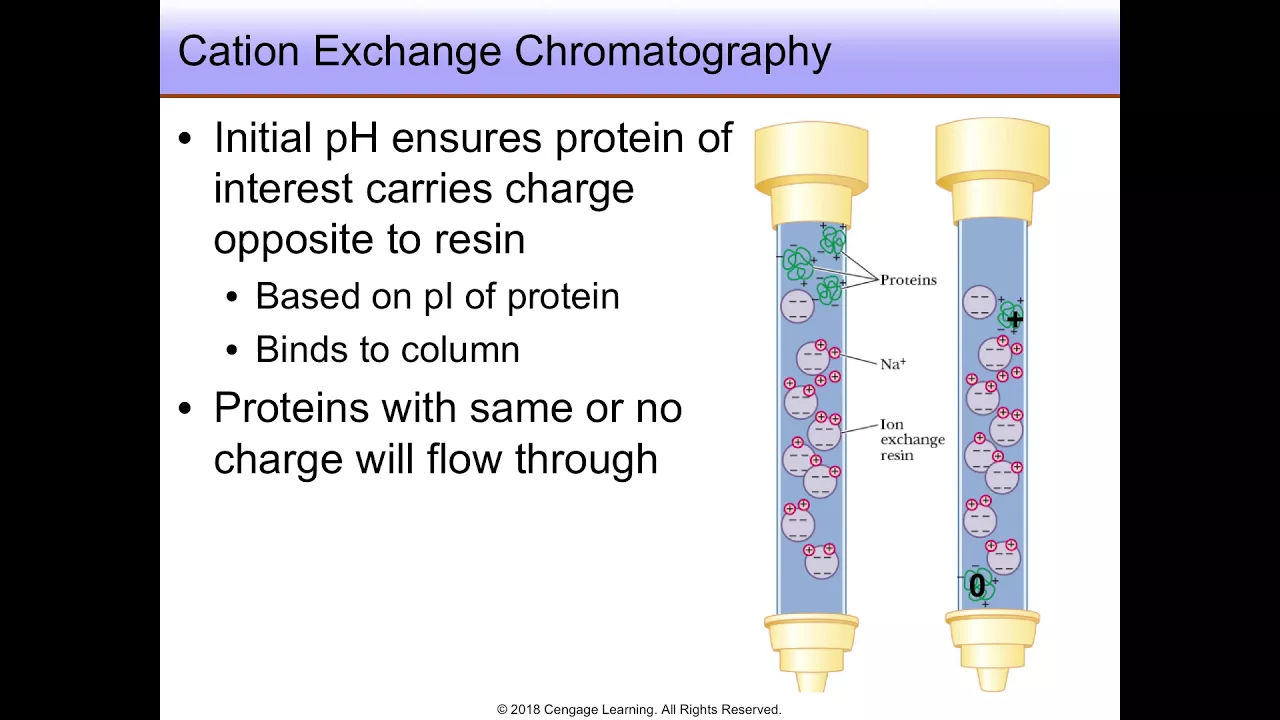
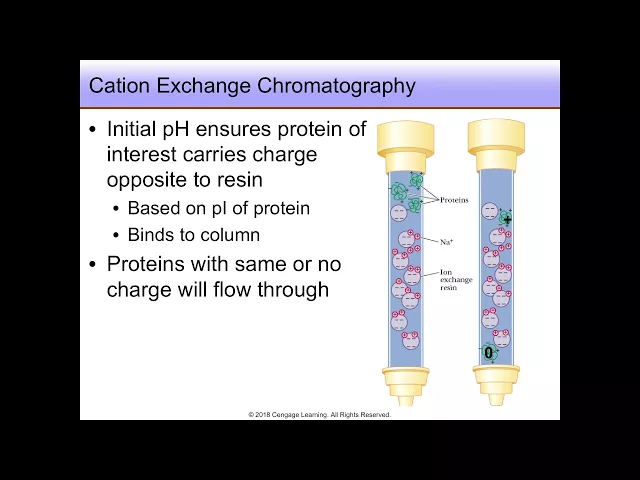
oppositely charged molecules note that in each case what is exchanged is the molecule bound to the column cations or positive particles in the first case and anions or negative molecules in the second let's look at an example of cation exchange we will choose an initial ph that ensures our target protein carries a net charge that is opposite to that of the resin for this purpose we need to know the pie or isoelectric point of our protein recall that this is the pH at which our protein has no net charge in which case it could not
bind to the column having properly selected our pH our protein will bind to the resin and proteins carrying the same charge as the resin or those that are neutral will remain in the mobile phase and flow through now that the contaminating proteins have been removed we need to displace our protein from the column the most common method is to add a high salt solution the abundance of ions of small size and opposite charge to that of the resin will readily bind the resin and thereby displace our protein let's look at an application of this technique
in separating a mixture of the amino acids aspartate serine and lysine recall that this is cation exchange so our resin carries a negative charge of these three the amino acid carrying the greatest positive charge will bind more tightly than the others and will elute last in this example aspartate has a net negative charge and doesn't bind at all and it will elute first next come serine since it has a net charge of zero at neutral pH lysine elutes last because it has a net positive charge due to its side chain another effective technique is HPLC
high-performance liquid chromatography this is a very fast and effective technique and separates based on polarity reverse phase hplc is a modification of HPLC that also separates based on polarity it has a non-polar stationary phase and a polar mobile things these are very high resolution columns and the separation can be accomplished in less time as you can see there are many different methods that can be employed to accomplish protein purification


![[The Body Regenerates After 14 Minutes] 🦴️ Healing with 432Hz + 528Hz Sound Therapy + Alpha Waves #2](https://img.youtube.com/vi/yaIjvVYsaOE/maxresdefault.jpg)