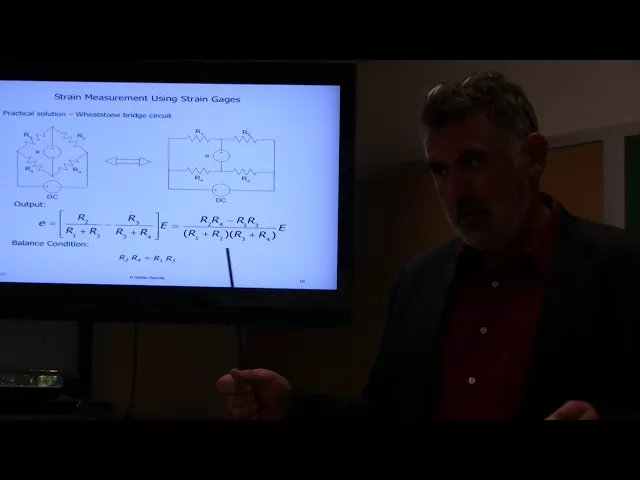
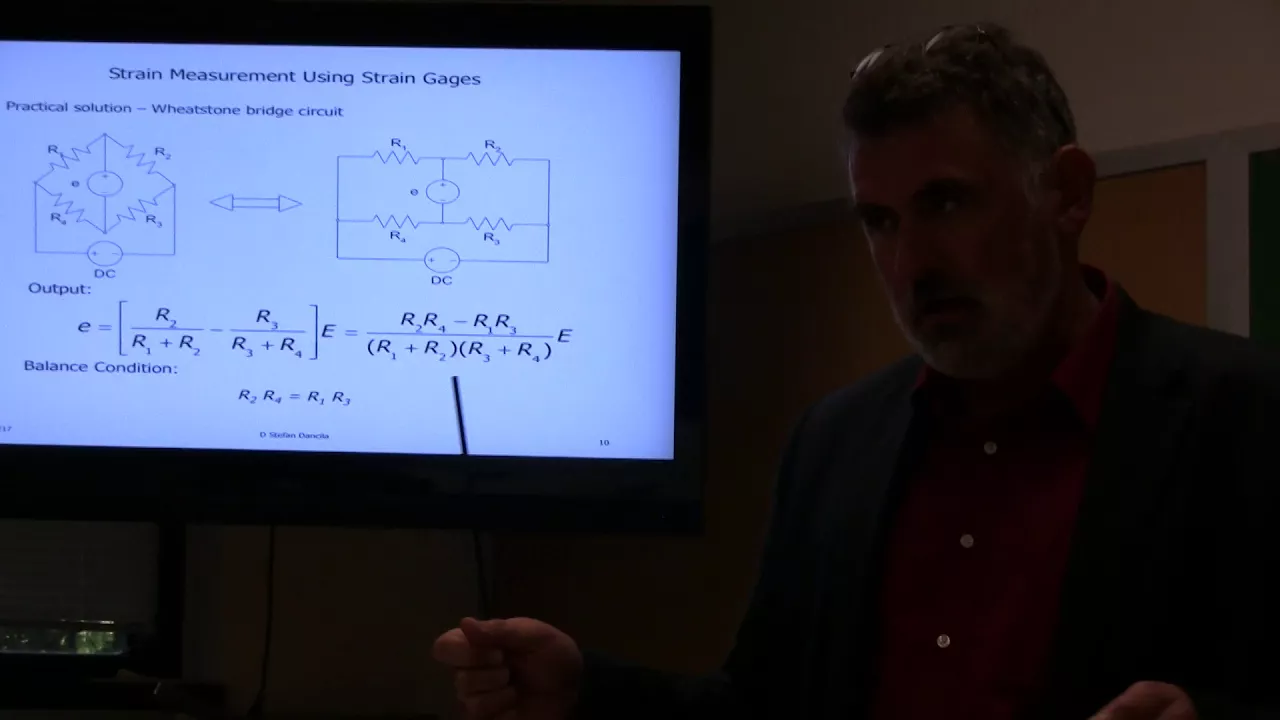
puns whereas if you only have to measure this small of an amount you start with a pharmacy scale a very fine very small scale and you have absolutely no problems in measuring a small amount starting from zero so let's go back to this equation the critical part here is that this form of the expression tells you that if if r2 r4 is equal to r1 r3 r2 times R 4 is equal to R 1 times R 3 then this numerator is equal to zero which means that no matter how much voltage you apply here as
the source the output is going to be equal to zero when that takes place this is called a balanced bridge so the Westone bridge is balanced when the condition are two lambs are four is equal to r1 times r3 and in that case again doesn't matter what role did you apply here 1 volts a million volts the output is going to be equal to precisely zero now please note that if you have a Western bridge with all four resistors being equal to R then R times R minus R times R is equal to zero so
a bridge consisting of four equal resistors represents a balanced Trajan's it doesn't matter what voltage you apply as input the output is going to be equal to zero right that's the important thing that's the benefit of the West Umbridge the fact that it allows you to have zero voltage to begin with the balanced bridge condition that's what the balanced bridge can now let's look at the following let's assume now that each of these resistors is actually the wire that changes its resistance as a result of the strain that we apply and if you do that
analysis you're going to get the following that the output voltage is going to be a function of the strain in each of the four wires and it's going to be gauge factor divided by four times epsilon 1 minus epsilon 2 plus epsilon 3 minus epsilon 4 times e now this generally the relationship between these trains in the general sense this is the expression for the tangent around zero the expression here is more generally non-vegan you have to substitute the fact that we have the original resistance plus the change in resistance and so on so the
important thing is that over this range you have a linearity between the output voltage and the strains in each of the four wires now here's how you can use the Westone bridge you can choose for example to have one of the wires be subject to strain whereas the other three resistors are just resistors wires that will not undergo any strain in which case you only have epsilon 1 and you have epsilon 2 is equal to 0 and it's from 3 is equal to 0 epsilon 4 is equal to 0 so in the case in which
only one resistor is actually subject to strain you call that the quarter bridge condition in fourth quarter bridge condition this is zero and this is zero zero so the outputs that you measure is gauge factor divided by 4 times the epsilon in that one single wire that is subject to strange times the applied voltage you can have a situation where you take two resistors it could be this one and that one or this one and that one depending upon what you are interested in doing there are a number of ways but two of these resistors
could be actually wires that are subject to strain so in that case depending upon which one you use in this expression you are going to have two strains epsilon 1 epsilon 3 or epsilon and epsilon 2 and thirdly the output voltage is going to be a function of those strains in those wires the other two being zero that situation where two arms of the dis West don't graduate are wires that undergo strain is called the half bridge condition so before it was a quarter bridge condition now it is a half bridge condition and then you
can have a situation where all four wires are subject to strain and in which case this expression applies as shown here and that represents a full bridge condition typically this expression is used in a quarter bridge condition in which one resistor represents a wire that is subject to strain in the other three resistors are fixed resistors that have nothing to do with the with strain and they're chosen to be not just simple resistors but there are high precision resistors that are very precisely of a given resistance value typically 120 and then they maintained their resistance
as current fascist group so they're not changing their resistance very much they're very stable in their resistance so typically strain measurement is performed more often I should say more frequently most often strain measurement is performed by having one of the resistors of the bridge being an active resistor that is subject to strain whereas the other three which are called the completion resistors being just some precision resistors a fixed value such that to begin with one of which one of which can be killed can be tweaked in order to meet this balanced condition to begin with
and start your measurements from zero voltage so one of these resistors is typically compensated is variable in order to be to allow the balanced bridge condition voltage equal to zero at the beginning of your measurement so that's the basic idea and with this device and with this particular solution we end up being able to measure a voltage and from the voltage we end up being able to measure strain because training in this case is the measured voltage the times four divided by the gage factor and divided by the applied voltage so that's that's the relationship
if I can write here and confused so you end up having that the measured strain from one single form of quarter bridge condition is going to be times four times the measured voltage divided by the applied voltage times the gage factor now fortunately you will not have to use this equation directly because all this is factored in into a device that implements the Western Branch so this westbound bridge circuit that is used for strain measurement is implemented typically in a unit in a circuitry circuit unit that is intended for strain measurement and I'm gonna come
back in a second but before we come back to the units that allows measurement of strain let's look at what the typical strain gauge looks like the typical strain gauge for electrical resistance measurement of strain looks like so and if I were to be able then I cannot assume this one but you can maybe zoom the image you just see this region here you're gonna see that an electrical resistance strain gauge consists of a number of elements a thin foil of polymeric material that is an insulator on top of which you have a wire that
instead of being straight is now going back and forth and back and forth and back and forth back performing a grid so this is a wire grid formed by taking the wire that we talked about so far and folding it to go back and forth and back and forth such that the elements of the wire are parallel to each other without touching right and they have corners they work with the wire turns and then at the ends of the wire you have these tabs that can be used for touch electrical connections so you have the
backing coil of the strain gauge and then you have on top of that deposited this wire wire grid and you have the tabs at which the wires the electrical connections to the strain gauge can be attached now unfortunately the wireless strain gauge is not only sensitive to strength in other words the resistance doesn't only change because of strength it also changes because of temperature it changes because of the virtual thermal expansion which means that the expansion the CT of the strain gauge material and of the backing sheet is different and yet when you glue this
to a part the the CTE of the material upon which you blew it is also different and as a consequence this being a very thin think of this as a stamp a very thin foil stamp that you can glue on to a part as the part of the forms with this part this strain gauge being so thin is forced to the form to undergo the same strain as the participant so there are number details of the use the application the use of strain gauges in performing accurate measurements they are beyond the scope of this lecture
and the beyond the scope of this course but if you are interested I certainly can point you come talk to me I will point you in the right direction I will point you to a source of information that will provide you a deeper understanding a more full and as a fuller understanding of strain gauge technology I will provide you with or email with links to three YouTube videos that come from the manufacturer of such strain gauges strain gauges are precision trans