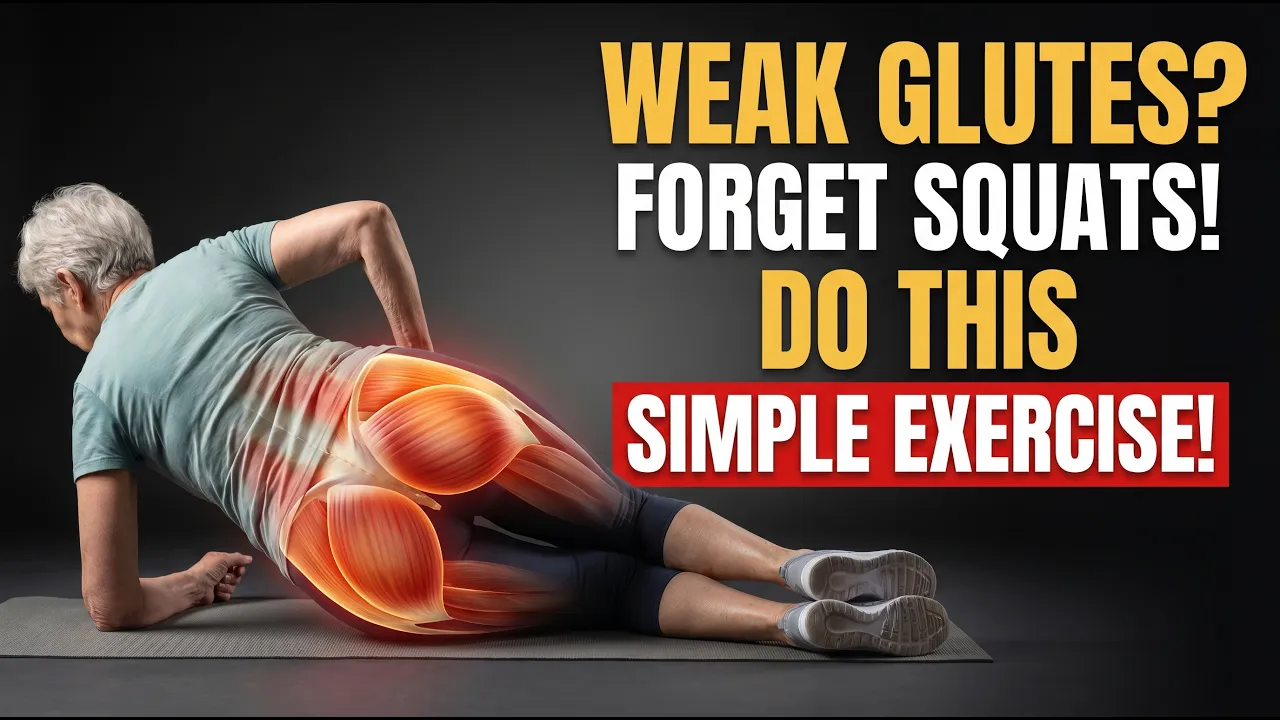
If you are over 60 and dealing with chronic lower back pain, aching knees, or a general sense of unsteadiness when you walk, stop whatever you are doing and listen closely. You are likely treating the wrong part of your body. Millions of older adults are unknowingly walking around with a dangerous mechanical failure clinically known as "gluteal amnesia.
" In simple terms, your glutes—the largest and most important muscle group in your entire body— have effectively gone to sleep. Because of decades of sitting and inactivity, your nervous system has literally forgotten how to contract these muscles. When this vital structural foundation collapses, the physical stress of your body weight does not just disappear.
Instead, it is violently transferred directly to your fragile lower back and your delicate, aging knee joints. This is a severe crisis. A landmark study published in the Journal of the American Geriatrics Society revealed that lower-body muscle weakness—specifically in the pelvic region— is a primary predictor of severe, life-altering falls in older adults.
It turns a simple everyday misstep into a catastrophic injury. The incredible news is that you can completely reverse this "dead muscle" syndrome. Today, we are walking through a precise, five-step sequence to reactivate these dormant muscles from the absolute safety of your own home, without heavy weights and without getting down on the floor.
In fact, our number one most effective movement requires zero joint movement at all. Before we dive into the first exercise, tell us in the comments below: which joint gives you the most daily trouble— your back, your hips, or your knees? Let us know, and please hit the like button and subscribe to the channel so you never miss our science-backed health guides.
Now, let us get straight to work. Coming in at number five is the Standing Hip Extension. We begin with this specific movement because it safely targets the gluteus maximus— your body's primary shock absorber—without forcing you to get down on your hands and knees.
Stand up tall facing your kitchen counter or the back of a heavy, sturdy chair. Place both hands lightly on the surface to lock in your balance and give your brain a sense of total security. Shift your body weight slightly onto your left leg.
It is crucial to keep a very slight, soft bend in that standing knee to protect the joint from locking out and bearing unnecessary skeletal pressure. Now, brace your stomach muscles slightly, and keeping your right leg perfectly straight, slowly push that foot backward behind you. The secret to making this work without pain is a tiny range of motion.
Only push your leg back a few inches until you feel a hard, distinct contraction in the back of your hip. Exhale as you push back, hold that squeeze tightly for two full seconds, and then slowly inhale as you return to the start taking three full seconds to lower the leg. Perform two to three sets of ten to twelve repetitions on each leg, resting for about thirty to forty-five seconds between sets.
The most common mistake is leaning the chest forward or allowing the lower back to arch to get the leg higher. Do not do this. A comprehensive electromyography study published in the Journal of Physical Therapy Science confirmed that this specific standing extension heavily activates the gluteal fibers while perfectly protecting your vulnerable lumbar spine from dangerous compression forces.
Number four on our countdown is the Standing Hip Abduction. We will remain standing right at the kitchen counter for this exercise, but we are going to shift our mechanical focus to the outer side of the hip. Stand tall with perfectly upright posture, looking straight ahead with your hands resting lightly on your support surface for absolute safety.
Slowly lift one leg directly out to the side. Again, do not try to swing your foot high into the air. Lift the leg just enough to feel the side of your buttocks engaging —usually just three to four inches off the floor.
Hold that lifted position for a solid second, and then slowly lower it down with strict control. You will want to perform two to three sets of ten to twelve repetitions on each side. The absolute most important rule for this exercise is to keep your torso perfectly still, like a marble statue.
Do not lean your upper body sideways to compensate for the weight of the lifting leg. If you find yourself leaning over the counter, you are lifting the leg too high and utilizing your lower back instead of your hip. This specific side-to-side movement is a literal lifesaver for your daily balance.
Clinical research from the Journal of Orthopaedic & Sports Physical Therapy demonstrates that this abduction exercise forces a deep, highly neglected stabilizing muscle called the gluteus medius to work overtime. Amazingly, it is not just the lifting leg that gets the workout. The glute muscle on your standing, supporting leg has to contract violently just to keep your pelvis level and stop your entire body from tipping over due to gravity.
This creates the exact mechanical stability you need to prevent your knees from buckling inward, which is the primary cause of knee pain when you walk up a flight of stairs or navigate an uneven sidewalk. For movement number three, we shift to the Side-Lying Hip Abduction. For this exercise, you will transition entirely away from the chair and onto a safe, firm surface like your mattress.
This completely removes any fear of falling or losing your balance, allowing your nervous system to relax and focus purely on the muscle contraction. Lie comfortably on your side and slightly bend your bottom knee to act as a heavy, secure anchor for your body. Keep your top leg perfectly straight, and pay close attention to this vital anatomical detail: rotate your entire top leg inward from the hip so your toes point slightly downward toward the mattress.
Now, taking two full seconds, slowly lift that straight leg toward the ceiling. Hold for a moment at the top of the movement, and take three seconds to lower it slowly back down. To build a resilient, shock-absorbing shield around your hips, complete two to three sets of ten to fifteen repetitions per leg, resting a full minute between sets.
That specific downward toe angle is not an accident. According to clinical data published in the International Journal of Sports Physical Therapy, pointing the toes downward effectively deactivates the dominant thigh muscles— which usually try to cheat and take over the movement— and forces the deep hip stabilizers to take on all the heavy lifting. It is clinically proven to be one of the strongest protectors against chronic knee deterioration, as it aligns the femur bone perfectly within the hip socket.
At number two, we have the Standard Glute Bridge. You can remain right there on your comfortable mattress for this movement, making it the perfect restorative exercise to perform right before you go to sleep or just before you get out of bed in the morning. Lie flat on your back, bend both of your knees, and place your feet flat on the mattress about hip-width apart.
Rest your arms comfortably down by your sides with your palms facing up to keep your shoulders relaxed. Before you initiate the movement, gently tuck your tailbone and flatten your lower back against the bed. This ensures your spine is in a neutral, perfectly safe starting position.
Now, press down heavily through your heels —you can even lift your toes slightly off the bed to ensure the weight is in your heels— and push your hips directly up toward the ceiling. Raise them until your body forms a straight, diagonal line from your knees down to your shoulders. Pause at the very top of the movement, squeeze your glute muscles together as hard as you possibly can for two full seconds, and then slowly lower your hips back down to the mattress.
Aim to complete two to three sets of ten to fifteen repetitions. Move slowly and intentionally, ensuring you feel the muscular work in your glutes and the back of your thighs, not your lower back. Clinical analysis shows this bridge movement recruits the deepest muscle fibers instantly, completely without creating any dangerous vertical compression on your lower back.
Because you are lying horizontally, gravity is not crushing your vertebrae. It protects your fragile spinal discs while building the exact type of functional power that helps you stand up from a low armchair effortlessly. And finally, we arrive at our number one most vital daily habit: The Isometric Glute Squeeze.
This requires absolutely zero equipment, zero balancing, and zero joint movement, making it completely accessible to everyone, regardless of age or physical limitation. It is the ultimate tool for combating muscle amnesia because it relies entirely on repairing the mind-muscle connection. Whether you are lying in bed, sitting on the couch watching television, or standing at the sink washing dishes, simply focus your mind entirely on your glute muscles.
Consciously clench them together as tightly as humanly possible. Squeeze them hard, hold that intense, burning tension for five to ten full seconds, and then completely relax. Because this exercise involves absolutely no joint strain or wear-and-tear, you should repeat this for ten consecutive repetitions, and make it a daily habit to do this three to four times throughout your entire day.
A pivotal study in the Journal of Physical Therapy Science proved that these isolated isometric contractions actively realign the pelvic bone and significantly reduce chronic lower back pain. It is the fastest, safest way to force your nervous system to remember how to use your muscles, sending a powerful electrical wake-up call from your brain straight to your hips without requiring a single step. The absolute key to making this entire protocol work is consistency over intensity.
You do not need to train until you are exhausted, sweating, or out of breath. Choose two or three of these movements and perform them every single day. Never push through sharp, stabbing joint pain; focus only on the warm, burning sensation of the muscles finally waking up.
If you practice these safe movements daily, you will steadily rebuild the stable, pain-free foundation of your youth. Your posture will improve, your joints will feel supported, and your confidence will return. Thank you for watching all the way to the end, commit to your daily movements, and stay healthy.