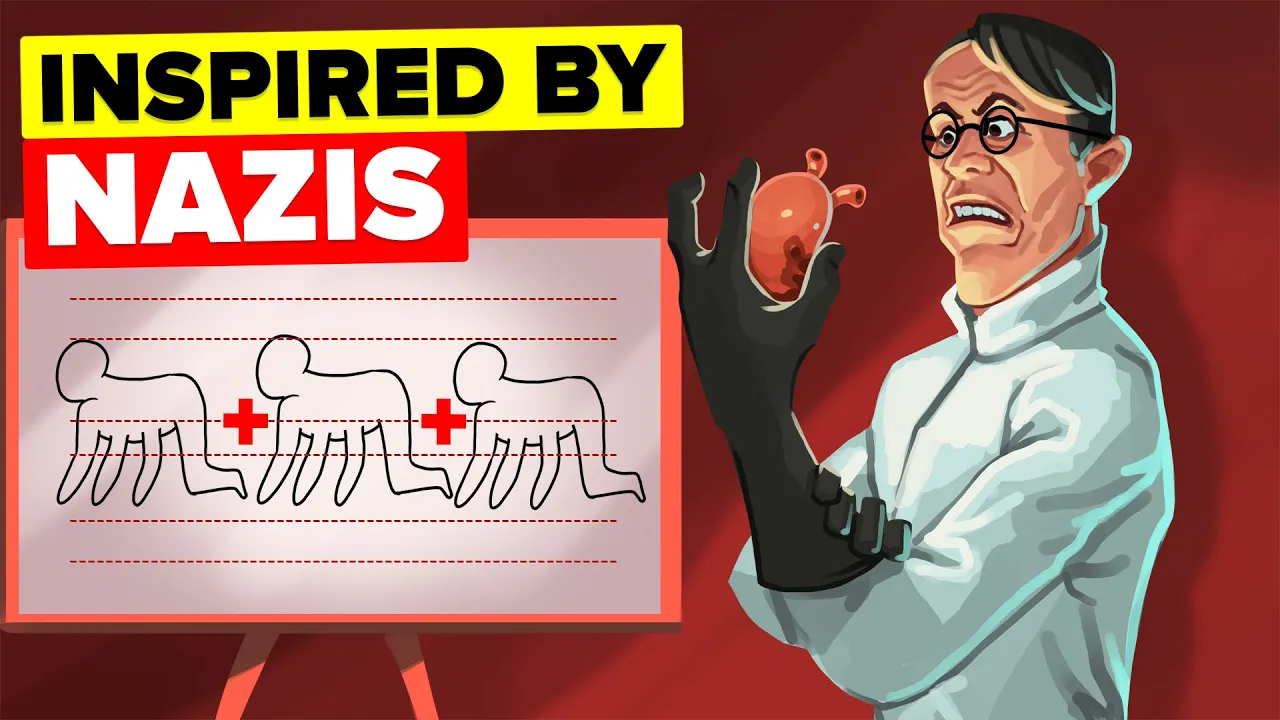
The Human Centipede is regarded by many as one of the most disgusting horror movies ever made. A film that the famous critic Roger Ebert was so horrified by, he refused to assign it a star rating, writing: "I am required to award stars to movies I review. This time, I refuse to do it.
The star rating system is unsuited to this film. Is the movie good? Is it bad?
Does it matter? It is what it is and occupies a world where the stars don't shine. " The film is based around one simple, deeply disturbing premise: a mad doctor abducts hapless tourists and sews them together in a, shall we say, particularly disgusting configuration intended to unify their digestive tracts.
He turns three people into, in his words, a human centipede. The film arose from several different places, including a joke between director Tom Six and a friend concerning the type of punishment the most heinous sex criminals might deserve. But the primary bit of historical inspiration was one of the worst atrocities in human history.
The mad German doctor at the center of the film, Dr Josef Heiter, was inspired by (and named after) Nazi doctor Josef Mengele. And we’re sorry to tell you in advance that the things the very real Josef Mengele did make the film look tame by comparison, and that Mengele was far from the only one. Josef Mengele was born on March 16, 1911, in the city of Gunzburg, Germany, the eldest son of a farming equipment manufacturer.
In 1935, he earned his PhD in physical anthropology from the University of Munich. In 1936, he passed his state medical exams. The following year, he began working at the Institute for Hereditary Biology and Racial Hygiene in Frankfurt, Germany, where he became assistant to the institute's director, Dr von Verschuer, a geneticist known for his research on twins.
When the Nazi Party first emerged in Germany, Mengele was not an active supporter. But then, in 1931, he joined a different right-wing party, the German National People's Party. By 1934, he was no longer actively participating, and the party had been absorbed into the Nazi Party.
It was during his time at university that Mengele first began to embrace the tenets of racial science, believing that Germans were biologically different from and superior to, all other races in the world. This inaccurate racial science was one of the dominant ideologies of the Nazi party, and in 1938, Mengele officially joined the party and the SS as well. This was only compounded by his mentor and employer's racism, and together the two men worked alongside higher-ups in the Nazi party, providing their expert opinion on whether or not certain individuals qualified as German in a racial sense.
If they did not qualify, they could be forcibly sterilized, or banned from marrying in order to prevent their supposedly "inferior" genes from being passed on. It was a pernicious ideology that would serve as the justification for some of the worst atrocities in human history. Mengele, and his commitment to race science, would only climb higher and higher through the ranks of the Nazi party.
In June of 1940, Mengele was drafted into the Wehrmacht, the German army. One month later, he volunteered to join the medical service of the military branch of the SS. There, he continued his work of evaluating the physical attributes of citizens, determining whether or not they counted as "real" Germans.
After being assigned to the eastern front, where Germany was battling the Soviet Union, he was promoted to SS captain and received the 2nd and first-class Iron Cross. Mengele returned to Germany in January of 1943 and resumed his work for Verschuer, now the director of the Kaiser Wilhelm Institute for Anthropology, Human Genetics, and Eugenics. Then, on May 30, 1943, the SS assigned Mengele to Auschwitz, where he became a camp physician at Auschwitz-Birkenau, the largest Auschwitz camp.
Among his responsibilities at Auschwitz was the "selection" process. When groups of Jewish prisoners arrived at the camp, medical staff, including Mengele, would sort them, picking out the people considered unable to work, including less physically strong adults and children. Anyone who wasn't selected for work would be massacred in the gas chambers.
Whenever a prisoner became ill or injured, they would be selected for execution by methods including lethal injection, and the gas chamber. Mengele was the most recognizable face amongst the staff responsible for the "selections," earning him the nickname "angel of death" amongst the prisoners. Gisella Perl, a Jewish gynecologist imprisoned at Birkenau, recounted in her memoir "I was a Doctor in Auschwitz" how the sight of Mengele in the women's infirmary was a source of terror.
In her words, "We feared these visits more than anything else, because. . .
we never knew whether we would be permitted to live. . .
He was free to do whatever he pleased with us. " As horrible as this work was, it was not what earned Mengele his reputation as one of medical history's greatest monsters. When he wasn't selecting innocent people for execution, condemning them to death on a whim, he was conducting authorized, deeply unethical, and frequently deadly human experiments on the concentration camp prisoners.
When it came to his research, one of Mengele's primary areas of interest was twins. Twins played a large role in eugenics-based research, and in the study of which human characteristics were genetic and which were environmental. To eugenicists, who were preoccupied with selecting for "ideal" genetic traits in human beings, twins were the perfect research subjects.
Mengele shared this perspective and fascination but had no consideration for ethics or human rights while conducting his studies. Whenever a set of twins came into the concentration camp, he would have them removed from the general population, and the research would begin. From 1943 to 1944, Mengele experimented on nearly 1,500 sets of twins.
Twins in the camp would be forced to strip naked and lie next to each other, examined thoroughly, and measured to compare all of their shared and different attributes. Blood would be removed from one twin and transferred to the other, and vice versa. Spinal taps and injections into the spine would be given without any anesthesia.
In some cases, diseases (including typhus and tuberculosis) would deliberately be given to one twin and not the other, in order to see what would happen. When the sick twin inevitably died, the healthy twin would be murdered as well so that both bodies could be autopsied and compared. One of the twins taken for experimentation, Eva Mozes Kor, survived her ordeal in the camps and was able to write about her experiences in a memoir entitled "The Twins of Auschwitz.
" She described the experience of life as one of Mengele's research subjects: "Three times a week we were marched to Auschwitz to a big brick building, sort of like a big gymnasium. They would keep us there for about six or eight hours at a time – most of the days. .
. . .
. We would have to sit naked in the large room where we first entered, and people in white jackets would observe us and write down notes. They also would study every part of our bodies.
They would photograph, measure our heads and arms and bodies, and compare the measurements of one twin to another. The process seemed to go on and on. .
. most of the time, they would take blood from one arm, and they gave us shots in the other. ” After she and her sister Miriam were taken from their mother, never to see her again, Eva witnessed the unspeakable horrors of some of Mengele's more extreme experiments.
In one particularly gruesome case, Mengele was said to have sewn a pair of twins together, back to back, connecting their blood vessels and organs together in an attempt to turn them into conjoined twins. This failed, resulting in nothing but horrible pain. The twins screamed in agony for days, before succumbing to gangrene and dying.
In another experiment, Mengele attempted to connect the urinary tract of a seven-year-old girl to her own colon. Other twins were castrated, had organs removed, or had limbs cut off, all without anything to dull the pain. Another area of interest for Mengele was eyes, particularly eye color.
He selected prisoners with heterochromia for study. Sometimes, he would conduct painful experiments on their eyes, but a lot of the time, he would simply have them killed, removing their eyes and sending them to a colleague at the Kaiser Wilhelm Institute that shared his interest. With living test subjects, often children, he would inject adrenaline directly into their eyeballs in an attempt to change their eye color.
When he wasn't doing that, he would apply eye drops that caused swelling of the eyelids and intense pain. Mengele targeted other specific groups for his tests, including dwarves and people with other physical abnormalities. He would X-ray and measure them, extract their teeth, draw blood, and inject them with various unnecessary drugs.
After a few weeks of testing, he would have them killed in the gas chambers, and send their skeletons to his colleagues in Berlin. Pregnant women would meet a similar fate. Men, women, and children, no one was safe from Mengele's experimentation.
In 1985, Moshe Ofer, a survivor of the camps and Mengele's experimentation, shared a memory: "He visited us as a good uncle, bringing us chocolate. Before applying the scalpel or a syringe, he would say: 'Don’t be afraid, nothing is going to happen to you…' . .
. he injected chemical substances, performed surgery on Tibi’s spine. After the experiments he would bring us gifts.
. . In the course of later experiments, he had pins inserted into our heads.
The puncture scars are still visible. One day he took Tibi away. My brother was gone for several days.
When he was brought back, his head was all dressed in bandages. He died in my arms. " Another survivor, whose name has been kept private, described her experience as a child test subject as well: "I was about five weeks in Auschwitz alone, separated from my family, my parents, two sisters and two brothers when Dr Mengele pulled me out of a queue as we were on the way from the c-lager to the gas chamber.
I was the only one picked that day personally by Mengele and his assistant. They took me to his [laboratory], where I met other children. They were screaming from pain.
Black and blue bodies covered with blood. I collapsed from horror and terror and fainted. A bucket of cold water was thrown on me to revive me.
As soon as I stood up I was whipped with a leather whip which broke my flesh, then I was told the whipping was a sample of what I would receive if I did not follow instructions and orders. I was used as a guinea pig for medical experiments. I was never ever given painkillers or anesthetics.
Every day I suffered excruciating pain. I was injected with drugs and chemicals. My body most of the time was connected to tubes which inserted some drugs in to my body.
Many days I was tied up for hours. Some days they made cuts in to my body and left the wounds open for them to study. Most of the time there was nothing to eat.
Every day my body was numb with pain. There was no more skin left on my body for them to put injections or tubes … One day we woke up and the place was empty. We were left with open infected wounds and no food.
We all were half dead with no energy or life left in us. [One] day … Russian soldiers tried to shake me to see if I was alone or dead. They felt a tiny beat in my heart and quickly picked me up and took me to a hospital.
” In 2009, a man named Yitzhak Ganon was rushed to a hospital near Tel Aviv by his family after a viral infection threatened his life. There, the doctors discovered that he only had one kidney. When Ganon woke up from his surgery, he explained why that was the case, and why he had avoided doctors for the last 65 years of his life.
He had been one of the prisoners at Auschwitz, and an unwilling test subject of Mengele. When he arrived at Auschwitz, he was taken to the hospital, forced to lie down on a table. When he did, he was tied down.
Next, Mengele cut him open, removing his kidney without any anesthesia. Ganon looked at the kidney in Mengele's hand and cried, screaming, begging to die, for anything that would stop the pain. His wish was not granted.
He was sent to work right away, forced to clean bloody medical instruments. He spent six and a half months in the hospital at Auschwitz, put through a gauntlet of experiments by Mengele following his horrific surgery. During one test, he was made to sit in a bath of ice-cold water for an entire night so that Mengele could study his lung function.
When they had no more use for him, the Nazis planned to send him to the gas chamber, but he just barely managed to survive, to see the liberation of Auschwitz by the Soviet army, and to live to tell his story. In January of 1945, as the Red Army crossed Western Poland, Mengele and the rest of Auschwitz's SS personnel fled the camp. At the end of the war, he dressed himself in a German army uniform and found a place in a unit, which then surrendered to the US military at the conclusion of the war.
Mengele pretended to be an ordinary German army officer, and was taken as a prisoner of war, but later released. All the while, his name was on a list of war criminals wanted for their crimes against humanity. He eluded justice, working under an assumed name on a farm in Bavaria from 1945 to spring of 1949.
US war crimes investigators attempted to track him down, but Mengele's family lied to protect him, convincing the United States officials that Mengele had died. Mengele assumed another fake name and new identity, fleeing Germany and traveling to Argentina. In 1956, he achieved Argentinian citizenship, living under the name Jose Mengele.
But West German officials were hot on the trail, and had tracked him to Argentina. In 1959, he immigrated to Paraguay, becoming a citizen there until he fled that country in order to avoid Israeli intelligence agents. He eventually settled in Brazil, where he lived until suffering a stroke in February of 1979 while swimming at a resort near Bertioga.
He drowned there, and his body was buried under the name Wolfgang Gerhard. In May of 1985, the German, Israeli, and United States governments worked together to track down Mengele once and for all. Unbeknownst to them, he was already dead.
German police searched the home of a Mengele family friend and discovered evidence of his death in Brazil. In June, 1985, Mengele's corpse was exhumed and positively identified. The Nazi doctor responsible for so much suffering and death had managed to live out the remainder of his life without ever being held accountable for his crimes.
Though Mengele was able to escape any kind of criminal justice, other Nazi doctors were forced to answer for what they had done. On December 9, 1946, 23 German physicians and administrators were brought before an American military tribunal in Nuremberg on trial for war crimes and crimes against humanity. Brigadier General Telford Taylor, the Chief of Counsel in the Doctors Trial, gave this opening statement by the prosecution: "The defendants in this case are charged with murders, tortures, and other atrocities committed in the name of medical science.
The victims of these crimes are numbered in the hundreds of thousands. A handful only are still alive; a few of the survivors will appear in this courtroom. But most of these miserable victims were slaughtered outright or died in the course of the tortures to which they were subjected.
For the most part they are nameless dead. To their murderers, these wretched people were not individuals at all. They came in wholesale lots and were treated worse than animals.
" After nearly 140 days, which included the submission of over 1,000 documents and the testimony of 85 witnesses, the judges announced their verdict on August 20, 1947. Sixteen doctors were found guilty, and seven were sentenced to death. These seven were executed on June 2, 1948.
Among the crimes that were uncovered during the course of the investigation and trial were stories of giving prisoners wounds without any anesthesia to test the effectiveness of various antibiotics and medications. In other cases, doctors would cut the limbs off of prisoners and attempt to sew them to others, looking to see if limb transplants could be done successfully. At Dachau, Nazi doctor Sigmund Rascher placed more than 200 prisoners into a low-pressure chamber one at a time to simulate the effects of high altitude on the human body.
Eighty subjects died from altitude sickness and lack of oxygen, and the rest were killed and dissected. At the same camp, Hans Eppinger performed an experiment in which he deprived ninety people of food and forced them to drink only seawater for days. Another Dachau experiment, one of the most infamous, involved the study of hypothermia.
Sigmund Rascher submerged hundreds of prisoners in ice baths for hours at a time, before attempting to resuscitate them via a variety of warming methods. Approximately one-third of the test subjects died of hypothermia during the process. During another study conducted at Dachau, several Nazi doctors deliberately infected over 1,000 prisoners with malaria.
They used either exposure to mosquitoes or injections of extracts from the mosquitoes' mucus glands to force them to contract the disease. Once they were sick, the doctors tested several drugs on them to monitor their efficacy. Many subjects died during the process, and others were left in severe pain or permanently disabled.
The history of human experimentation in Nazi Germany is an atrocity, to be sure, but it didn't only happen in Germany. Though the United States fought against Germany in World War II, the two enemies had some horrific practices in common, and unethical human experimentation occurred on US soil, too. Several doctors during the period from the 1940s to the 1960s believed that the greater good of scientific research and medical advancement mattered more than the autonomy and safety of prisoners, mental patients, and other marginalized groups.
In their pursuit of advancement, and uncovering cures for infectious diseases, the Hippocratic Oath was thrown out the window. In a series of federally-funded studies in the 1940s, researcher Dr W. Paul Havens Jr.
exposed men to hepatitis without their consent, using patients from mental institutions in Middletown and Norwich, Connecticut. No new understanding of the disease was gained, but eight healthy men were infected with hepatitis. In the mid-1940s, researchers attempted to study the transmission of a stomach illness by having young men at a New York State reformatory prison swallow unfiltered stool suspensions.
In 1957, during a flu pandemic, federal researchers infected 23 inmates at a Maryland prison, spraying the virus directly into their noses. There were other disturbing experiments performed on prisoners as well, beyond just the study of infectious disease. Around 1920, Dr L.
L. Stanley, resident physician at San Quentin prison, would implant testicles into older male prisoners. These testicles came from farm animals or sometimes even from recently executed prisoners.
After the Nuremberg Code was put in place in 1947, providing international protections to human test subjects, many doctors in the United States ignored them. After all, they didn't see their work as anything like the atrocities committed by the Nazi doctors. They believed that, and yet, in 1963, researchers injected cancer cells into patients at a Jewish Cronic Disease Hospital in Brooklyn to see what the impact would be.
The patients were not told that this was happening. Also, in New York, in Staten Island, from 1963 to 1966, a medical study was conducted at the WIllowbrook State School for mentally disabled children. These children were given hepatitis to test potential cures.
With time, the public attitude toward this sort of human experimentation turned toward disgust, and regulations were implemented to prevent similar ethical transgressions. But for several decades after the Nuremberg trials, doctors in the United States carried on the tradition of unethical human experimentation, all the while convinced they were still the good guys. No one wants to think of themselves as the villain, even when committing crimes against their fellow man.
It's easy to see how, with the right justification, even people who think of themselves as moral can commit atrocities.