[Music] Hello and welcome back to another episode of Fundamental Fridays. I'm Josh Ash. I'm going to be your host for this week's episode.
Big thanks to Tyler Edund for inviting me back on for this one. And today we're going to be talking about prop design. Now, props admittedly aren't as exciting as character designs or as eye-catching as big landscape paintings are, but they're an absolutely vital part of good world building.
In fact, all environments are full of props. And oftentimes, our characters are interacting with props or carrying props around with them all the time. And so today we're going to talk about how we can level up our prop designs from just being boring and mundane to being something that says something about the world that we're building and about the characters that we're creating.
If that sounds interesting to you, let's hop on over. All right, here we have a personal project that I've been working on called the Wartneck Brothers Fishing Company. And the boat is called the Toadboat.
And this project is at a point now where I'm designing a lot of props because I'm doing cutaways of the top floor, the first floor, and the below deck area of this boat. And I want to talk about my thought process as to how I choose props that go into my scenes. And then how I take those props and I add storytelling to them.
So for this project, I have my characters designed and I have the toadboat designed. And those are pretty well locked in. The interiors are still getting shifted around a little bit.
I'm still adding more story. Um, and I'm still got to work on some of the props. So, as far as the interiors go, I have the below deck engine room.
I have the first floor. And I have the top floor. And these are um just really loosely painted.
They're going to get painted up a lot nicer as I get time to do that. And then I have some prop designs that I've been working on. So, at this point, a lot of stuff is locked in.
The big picture things are there and I'm just looking at the smaller things and I'm asking myself, is the storytelling strong here? Could it be better? And I'm asking myself a lot of questions in order to get to something more interesting.
Take for instance this life jacket. You know, I could have just had a standard barebones life jacket as a prop. That would have worked.
um it would have served the function, but it's a lot more interesting if I add a little bit more storytelling on top of that and I have a giant bite mark taken out of the side of the the life jacket and I have scrapes and scratches all over it. Or take for instance um this jar where they are catching these mutated lightning bugs and they're using them as lamps because they're so bright. I could have just had this in a normal jar, but I think it describes the characters a bit more if I just take a few extra minutes to draw on a label on here and make it a pickle jar.
You know, really goofy storytelling, but it fits the world that I'm trying to build. And this applies to if you've got more serious props, if you have a more serious style, honing in and just adding these little bits of story here and there really add to the immersion um that our audiences will experience when they're looking at your images. Okay, so here we have the top floor again.
And I want to talk a little bit about how I think the storytelling could be better here. Now, I always start off a design by making lists. That way, I don't get lost.
I don't get um off on a tangent where I'm designing stuff that is way secondary and I don't need to be doing that yet. So, I make lists. I get my brainstorming done really quick and that will keep me from getting into any kind of art block.
I always have the list to turn to and I know what I need to do next. And I I write down all the props that need to go into the space, even if they're very general and obvious. And I start off with the functional things of the room.
I think about what is the purpose of the room? What's the function? If it's a kitchen, there's certain things that go into a kitchen that don't go into a bedroom.
And those specific things will tell our audience what that room is. So, it's really important that they go in there in a really clear way. So, if it's a bedroom, I'll write down there needs to be a bed in there, there needs to be nightstands, a closet, a dresser, a window, a door, a you know, whatever it may be.
And I'll go down the list and I'll I'll write it down. That'll keep me from forgetting things. Then once I get the general things out of the way and the space is starting to get filled up, then I take into consideration the characters and I think what specific things would these characters bring into the space to make it theirs and to really really describe these characters through just what's around them.
So these three frogs are fishers. They're really just tough old dudes and they live on this really rickety boat that they're barely keeping held together. It looks like it could fall apart and sink at any time.
So, that's three things that I want to get into this environment through my prop designs. So, I think the idea that they are fishers is sold pretty well here. They have the trophy fish up here, which describes what kind of fish they're after, which is these weird mutated fish that don't actually exist.
Some of their fishing gear is here, as well as a bucket full of hooks, and then also a topographic map of the lake that they are fishing on. So, I think that kind of sells the idea that these guys are fishers. Now, I want to describe um that the boat is really rickety and they take care of it in really unorthodox ways.
There's a crack on the window here with it just duct taped over. Once it gets more into the painting phase, there's going to be a lot of rust around. Um there's going to be probably some water damage around, but that's one area where maybe I could add even more storytelling in that department where I have more wear and tear that they've fixed in funny ways around in this room.
And then lastly, I want to show that these guys aren't exactly health nuts. I don't know if you could tell from this guy, but these guys are not health nuts. So, I need some stuff in the environment that sells that idea.
So, I have the ashtray here, and then I have a bucket down here that's full of ashes that's just overflowing. That's pretty silly. Um, but kind of sells that idea.
I have, um, a hook laying down here on the floor. I should probably get another one down so it's a little bit more obvious that you know they're just stepping all over these hooks and you know somehow not not getting them stuck in their foot, right? But that's really it.
So there's not a lot of strong storytelling that kind of describes that aspect of these guys. So I want to take one of these props and add that layer of story to it. So I think a fun prop to do that with is going to be this first aid kit.
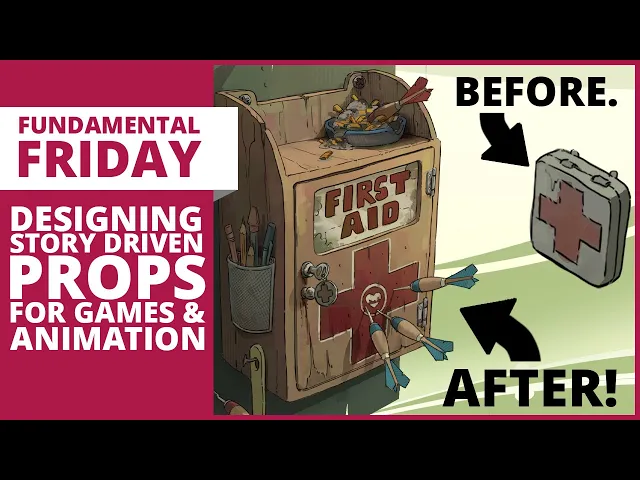
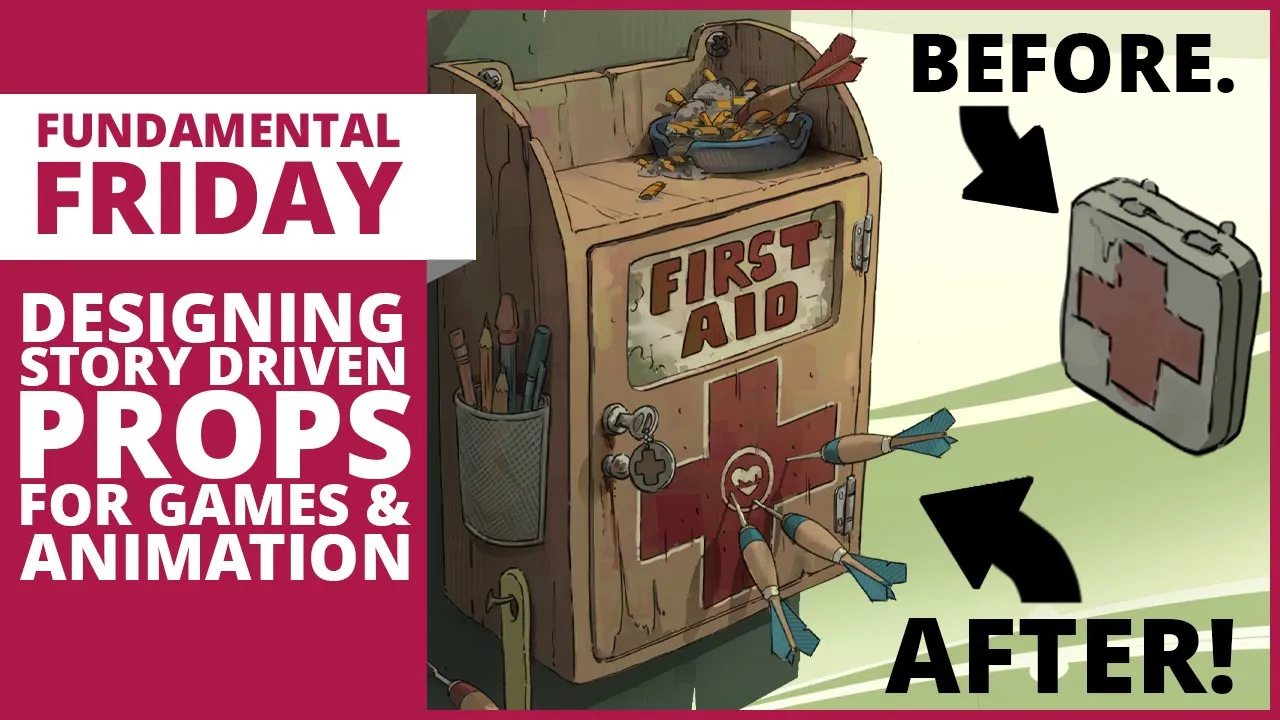
Now functionally this first a kit reads really well. You probably look at that and know it's some sort of first aid medical thing because the iconography is so recognizable and stuff like that, but there's absolutely no storytelling to this whatsoever. And you don't always need a heavy amount of storytelling in your props.
But since I'm trying to sell the idea that these guys are just tough old guys and don't deal with their injuries in conventional ways, I think I need to modify this in order to get that across. All right, so let's jump over to the time-lapse video. Um, I'm going to show you from start to finish how I design up a new prop to go in place of this one and I'm going to talk through some more of my thoughts.
Okay, so here we have our time-lapse video and this is sped up to approximately the speed that I wished I could work at. So quite a bit faster than normal. And you can see I have a bunch of references of just general first aid kits.
And I'm starting off here just doing some sketches based off of those. looking at some of the materials. Um, you know, some of these hang on the wall, some of them are more like a suitcase, some of them are more fabric.
You know, taking all that into consideration and then asking myself questions like who, what, when, where, why, how, um, and letting that kind of guide the decisions that I'm making with this prop because again, the goal is to describe um, and tell a story about these characters that interact with this prop. So, we want to ask those questions like um how do they take care of their stuff? Um why do they have this prop?
Why do they have this item? Where is it located? Is it located in an area where it can get water damage or it's in the sun so it's going to be faded?
Um when was this prop made? Was it handmade? Was it manufactured?
If you take all these things into consideration, you're going to come up with some really cool things that you can put into your designs. And I really think um that good prop design really boils down to this. Good props should serve the story by describing the world they come from, the characters who interact with them, and aid in immersing our audiences into the world we are building while being clear and understandable in function.
So, the prop that I had designed before for the space, just that really bare bones um first aid kit, it had it served the function pretty well. You could see exactly what it was and it was really clear and readable, but it didn't describe really the world that it came from and it didn't describe the characters who interact with it at all. So, that's what I'm trying to get here.
I'm trying to level up that prop to being something just a bit more than a total background prop. And that brings up a point that I think is really important. Um, you really need to determine what importance the prop is that you're designing to the overall story that you're trying to tell.
I categorize it as tertiary, secondary, and primary um, or hero props. So, there's three categories. And there's gray area in between and gray area on the outside.
I'm sure. But just like with character design where you don't want your background tertiary characters to outshine your hero character. Same thing with props.
I don't want my background props to outshine my hero props. The things that should be the focal point. So ask yourself, how important is this prop?
Am I designing it accordingly? Um, I've seen a lot of times where somebody is designing what's supposed to be the big epic focal point of a shot and it's just not designed enough. It's not taken to that next level that a hero prop has to be.
So, you can see here that I've determined what um what aesthetic I'm going with with this prop here. I'm going with the wooden first aid box um that really matches some of the themes and materials that I was seeing in the boat references that I was using. So, I think it's fitting for this prop.
And I've added a little bit of storytelling where they are throwing darts at it. They're using it as a dart board instead of, you know, keeping it nice and kept up and clear of any pointy objects in case you get hurt so you can access it. They're just throwing darts at it.
They've got their ashtray on top of it. And that's how they're treating it. So, I think that tells the story a lot better than what I had before already.
And this kind of stuff is just so fun when you can really um hone in on telling a story through simple things like this. It's really really engaging. Um these props are are kind of stressfree to design.
Um you're not having to worry about really complex anatomy or a bunch of different moving parts. Usually at least in this case you can just hone in on the drawing. It's a great place to practice um new skills, too.
If there's a new painting technique that you want to learn, um go and do a prop design and paint the prop using that new technique. Or if you're wanting to learn a 3D software, don't go and make a huge scene with multiple characters and spaceships right off the bat. You know, design something manageable that you can actually finish.
Um and props are great thing for that. So, I think it was Jeff Watts who I heard say um painting is part what you see, part what you know, and part what you wished you saw. And that every painter balances those three things out in different ratios.
So, somebody like a sergeant is going to be far on the what you see side of things and a Franketta is going to be way on the what you wished you saw side of things. And I find that to ring really true. And I I use different words.
I I like to think of it as personal experience, imagination, and real world reference. And I often think to myself when I'm designing something like this, do I have a little bit of all three of those things in this? Um, I think if you have all three in there, it's going to be way more interesting than if you just have two or one of those things.
If you just have imagination, then, you know, people might not understand what it is that you're trying to draw or paint. um if it's all real world reference, it might not be as compelling. So, be thinking about um when you're designing, do you have good reference pulled up?
Are you pulling from personal experience? With this, I'm pulling a lot from personal experience in that um I used to be a delivery driver and I would deliver to a lot of uh maintenance shops that were in varying levels of disrepair. And I would see a lot of funny things like, you know, first aid kits and, you know, the the first aid station just buried behind a mountain of, you know, maintenance things.
You'd never be able to get to it if you needed it. Um, I'm pulling from, you know, going to flea markets and swap meets as a kid. So, that's where the personal experience is coming in.
Um, then I'm adding in the imagination with the fact that they're frog characters and they're after, you know, they're trying to catch these crazy looking fish that don't exist. And then of course bringing it all back with some real world reference because I can't possibly remember what everything looks like um to tie it all down and make sure it's understandable for the audience. So, I end up painting a little bit more on this um after the time lapse.
I had some ideas that just came to me real quick and I tried them out and they worked and um I just happened to not be recording. Um and you're going to see that towards the end. So, if you don't have a story that you're really excited to tell, um, you know, start writing down ideas.
Um, I usually keep the last two pages of a sketchbook just for jotting down ideas that I don't have time to draw out. Um, if you can draw out your all your ideas, that's great. But, you know, sometimes you just get to where you don't have time or the ideas are coming so fast that you don't have, you know, you want to get it all down before you forget.
So, start writing them down. Even if you think it's stupid, write it down. It could lead to something more interesting.
It could lead to something that you really are passionate about. Um, and I really believe in observing the world around you. you know, just go into a just go to a walk around your neighborhood and really look at what people have in their yards and think, you know, what do those things say about that person and their personality?
You'll find some really interesting things. And if you can pull those into um your designs, I think you can make for more believable designs. In my neighborhood, there's um an older gentleman who has a a huge plot of a garden tilled up ready to be planted in and he's got some bird feeders and his yard is really wellmaintained, but he has this picnic table in the middle of the yard and one leg of it broke and he has it propped up with a 5gallon bucket.
And you know, it's such an interesting little detail and an insight into, you know, what's important to him. Um, that will probably find its way into a project of mine someday because it's just a fun little detail. So, you can see I'm doing the inside of the prop now, um, where they have a sign where they say, "Walk it off.
" And that's going to really describe how they care about their guests on their boat if they need first aid care. And I'm deciding what stuff goes into this because I could have um you know, a lot of different things. This is where making a list would come in again.
What would normally be in a first aid kit? Do I want any of that in there or do I just want their fishing supplies in there? You know, they're cramming every nook and cranny of this boat with fishing supplies because that's that's their whole life.
You can see sometimes I just get to detail in the wood and that's usually because I'm thinking about other things of what goes into this and I don't really have to think when I'm just drawing up, you know, a block of wood. All right. And here we have the final prop.
You can see that I've put um put in a little bit more work off camera for this. Um but the painting really wasn't the focus for this episode. It's really just getting yourself into the mindset of asking questions and trying to come up with stories and take your characters into consideration when it comes to props and see if you can design them in a way u that describes the world a lot more.
And hopefully you can see and that you agree that it's much more interesting than what it was before. Um, this, you know, red as a first aid kit, you know, it could have served its purpose just fine like that. But when you can add another layer of story to it, you know, why not, you know, even in the distribution of the darts that I had before?
Before they were scattered all over the place, but why not add even a little bit more story? And let's say whoever, you know, whichever frog is using um the blue darts is pretty good. And then whoever is using the red darts is just all over the place and he's been hitting the metal door frame and stuff, bending up all the needles on the uh the darts.
Um just a little bit extra to the story. And even in the interior here, I took into consideration that I've had some mice in some of the other interiors that I've done. Um so so why not get a, you know, a mouse trap in there.
I got the dart scorecard, you know, all the pens and pencils to keep that score and some of their fishing supplies. And then of course the sign that really kind of exemplifies how they treat injuries. So hopefully you can see now that you know you can have a simple prop and then add story to it and it becomes so much more.
All right. And with that we're going to wrap up. I really appreciate you guys tuning in to this week's episode of Fundamental Fridays.
I had a lot of fun making it because I just love prop design. I think it's so fun to take something that might be a little bit mundane, might be a little bit ordinary, and injecting some story into it and seeing if we can't make that prop say something about the world that we're building and the characters that are going to be interacting with it. Make sure you comment down below if you have any questions or suggestions for future episodes.
And thanks to Tyler for inviting me back on for this episode. Make sure you go check out all the other videos on this channel from him and some of the other people that he's had on the channel. There's great resources there, as well as go over to the Brush Sauce Academy website and the Patreon and the Gumroad.
There's tons of stuff there that I know you're going to love. All right, I appreciate it, guys. I'll catch you on the next one.