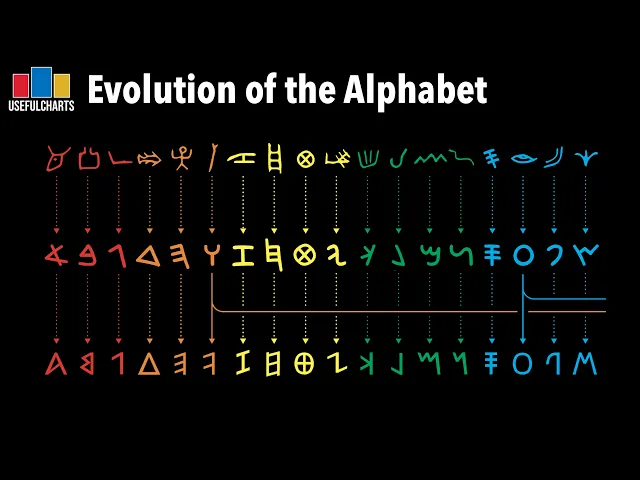
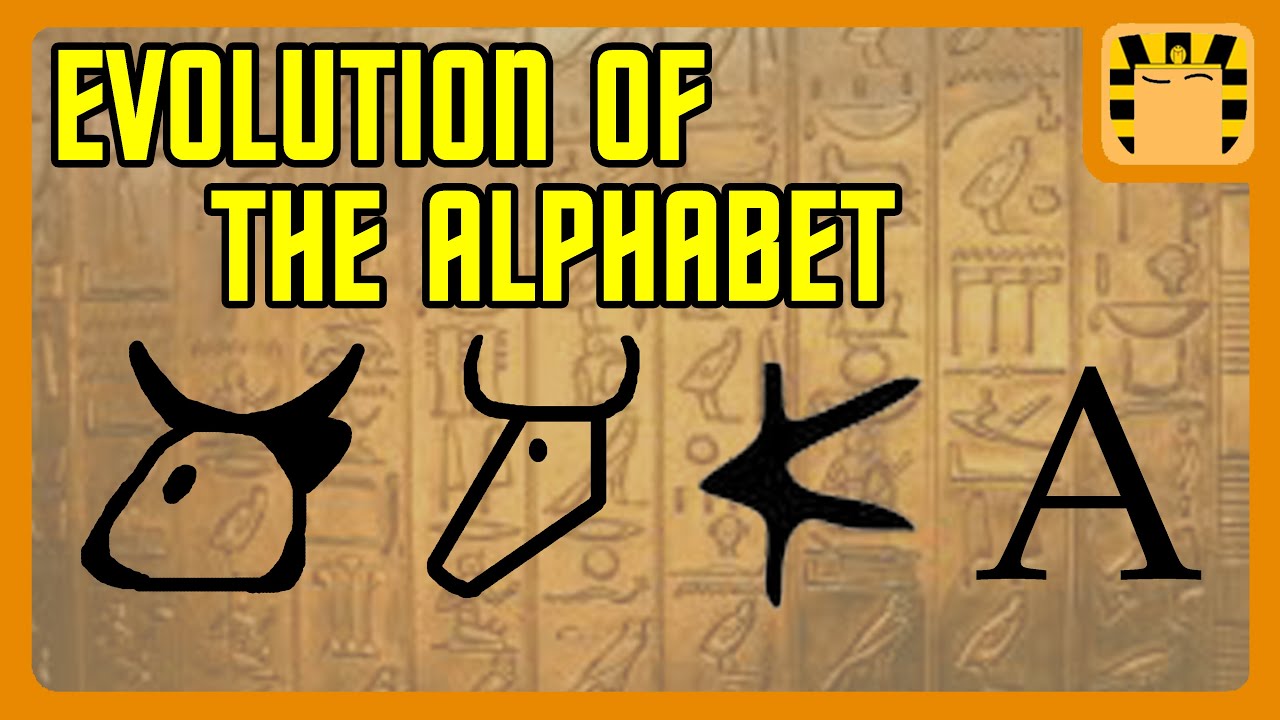
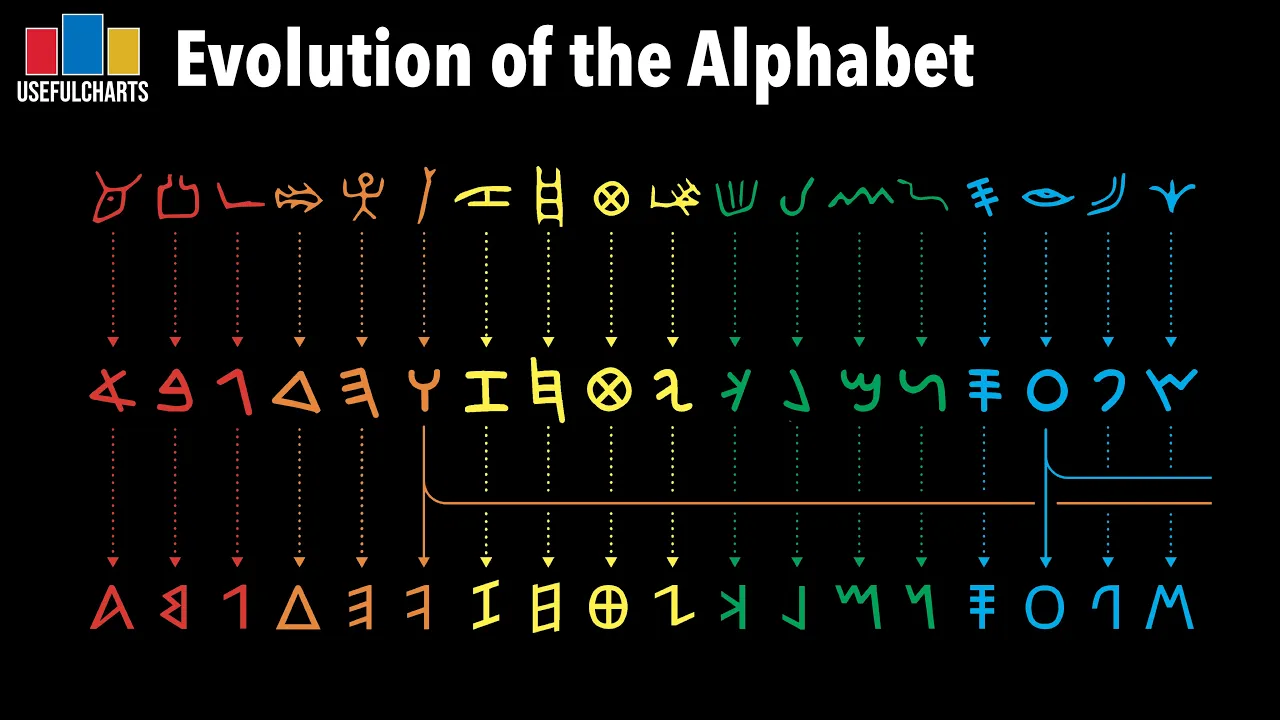
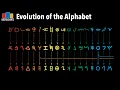
Today I’m going to show you how the alphabet has evolved over the last 4000 years, from its earliest forms to the modern Latin script - which is the alphabet that is used today to write English and many other languages. I’ll be using my recently updated “Evolution of the Alphabet” chart, which is available as a poster from my website UsefulCharts. com.
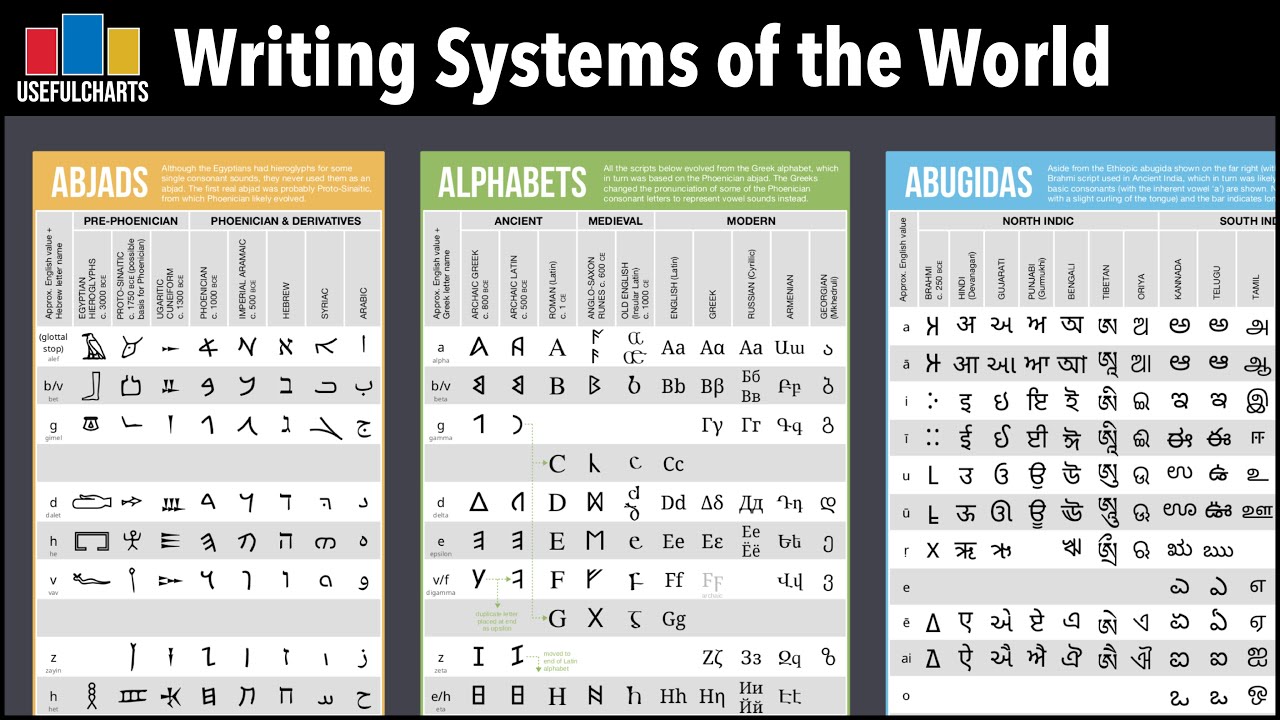
I’ll be starting by giving you a general overview of the various stages that the alphabet has gone through and then I’ll be taking a look at several of the individual letters, one by one. Intro So, the first thing you need to know is that not all writing systems are alphabets. In a previous video, which I’ll link to in the description, I talked about five main types of writing systems.
Of these five types, the earliest one to develop was the logosyllabary. A good example of a logosyllabary is Ancient Egyptian hieroglyphs. In most cases, a hieroglyphic symbol did not represent a single sound, like in an alphabet.
Instead, it represented an entire word or syllable. But at some point, approximately 4000 years ago, someone in Egypt had the idea to use hieroglyphs in a new way. They devised a system by which there was just one symbol for every one phonetic sound.
By doing so, they were able to reduce the total number of symbols needed for writing from several hundred to just 20 or 30. So, for example, this crude drawing of a house shown from above, like a floor plan, came to represent something like the sound “b” and this fish came to represent something like the sound “d”. So it was in this way that the alphabet was born.
The name given to this first version is “Proto-Sai-nee-it-ic”. It gets its name from the Sai-nai peninsula, which connects Egypt to what was once the Land of Canaan. It was here that the first inscriptions made using this script were found, although examples have since been found in both Egypt and the Southern Levant as well.
Because of this, there’s some debate over whether the invention of the alphabet took place in Egypt or Canaan. However, what we do know is that it was in Canaan that the idea of using an alphabetic form of writing really took hold, because by the year 1000 BCE and in the centuries that followed it, we have lots of examples of a stylized version of the script being used throughout the Levant, both by the Phoenicians and by the Ancient Israelites. Generally, this version of the alphabet is called Phoenician, although when found at Ancient Israelite sites, it is called Paleo-Hebrew.
But basically, they’re the same. Note that I’ve shown the more familiar square Hebrew letters below, for reference and so that we have names that we can use for these early symbols, like alef, bet, and gimel. It’s interesting to note that the earliest portions of the Hebrew Bible would have been written in this ancient script, not the square letters used by Jews today.
Those developed several hundred years later. But on this chart, we are concerned with the evolution of the Latin script, so instead of tracing the development of these early letters into later Middle Eastern scripts like Hebrew and Arabic, we are now going to turn our attention to the Greeks. I’ve labeled this third line Archaic Greek in order to distinguish it from the more familiar classical Greek letters which are still used today.
However, I’ve shown the modern ones below for reference so that, once again, we have names that we can use for each letter. I also want to point out that there was never a single Archaic Greek alphabet. There were actually many different versions with slight variations that were used throughout the Greek-speaking world.
So what you see here is a bit of a combined representation. The important thing I want to point out at this stage is that the sound value of several letters changed significantly. Prior to the Greeks, the alphabet was strictly a consonant alphabet, also known as an abjad.
This means that there were no symbols that stood for vowels. But the Greeks changed this. There were several Phoenician letters that they did not have a use for, such as the alef and he.
So they instead repurposed those symbols to stand in for vowel sounds. So “alef” became alpha, which is an A sound, and “he” became epsilon, which is an E sound. But the shapes of these letters basically stayed the same.
So keep in mind, that this entire chart is focused on the evolution on the letter shapes, even though those letters were often pronounced differently at different times and places. I’ll also point out that it is from the first two letters of the Greek alphabet, alpha and beta, that we get the word alphabet. Okay, so the next stage is Old Italic.
Again, there was no single Old Italic alphabet, Instead, there were many different versions, of which the most important was perhaps the Etruscan alphabet. But what I’ve shown here is kind of an amalgam of the different Old Italic scripts. The most important thing to point out at the Old Italic stage is that several letters were dropped.
This is because there were some sounds that Greek speakers made that Latin speakers did not. So, for example, the Greek letter Theta was not needed for ancient Latin so the ancient Latins simply dropped it from the alphabet. I’ll talk about some of the other changes in a bit but for now, take note that the actual letter shapes didn’t really change much between these two stages.
And many of the shapes are actually quite recognizable, even in these archaic forms. It was during the period of the Roman Empire that the Latin alphabet reached the form that we know today, although at this point, only the capital letters existed. It’s important to note that the ancient Romans did not distinguish between an uppercase and a lowercase.
It’s also important to note that they did not have 26 letters, like we do today. They had only 23. Missing were J, U and W.
So, during the lifetime of Julius Caesar, his name would have been written like this: IVLIVS I’ll say more about J and U in a moment. But the biggest question that most people have at this point on the chart is: Why did some of the letters flip? Well, originally, many of the letters, like B or K, could be written either way.
This was because, originally, the Greeks and Romans wrote both left to right as well as right to left and the direction of certain letters depended on the direction of the writing. But eventually, writing left to right became standard, perhaps because most people are right-handed and therefore less smudging takes place when you write from left to right. Of course, when it comes to alphabets like Hebrew and Arabic, they are written in the opposite direction: right to left.
Now, at the same time that the familiar Roman square capitals were being carved into stone, everyday writing, among those who were literate, was actually taking place in a slightly different script, known as cursive. The word cursive coming from the Latin root for “running” or doing something quickly. So, originally, Roman Cursive looked something like this – sort of a sloppy version of the capitals.
But eventually it evolved into what became known as New Cursive. So by the time that the Western Roman Empire fell, the emperors would have been writing out their various decrees using letters like these ones. You can see that many of them look quite similar to the lower case letters that we use today.
Of course, when the Western Empire fell in 476, much of Europe experienced a so-called “dark age” during which time there was far less writing going on. However, one of the places where a lot of writing did continue was in the Christian monasteries over in Ireland. There, a script developed known as Insular, which also ended up being adopted by the Anglo-Saxons over on the island of Great Britain.
Therefore, this style of writing is also sometimes called Old English. A little while later, over on the continent, a slightly different style of lettering developed called Carolingian. This version of the alphabet emerged during the reign of Charlemagne and by the year 1000, it had become standard throughout most of Europe.
But, remember, the printing press hadn’t yet been invented so all books were written by hand, which obviously took a long time. So, as literacy grew and the demand for books increased, scribes eventually developed a script which they could write more quickly. This style was known as Blackletter, or Gothic and it was the dominant style up until the time that Gutenberg developed his famous printing press in the 1400s.
At that point, the letter shapes quickly started to look like the lowercase letters we see in serif fonts today and were combined with the old Roman capitals, which were used at the start of sentences, in order to increase readability. So, now that we’ve done that overview, let’s go back and talk about some of the individual letters. In English, the first three letters of the alphabet are ABC.
But in the Hebrew & Greek alphabets, which are older, the first three letters are the equivalent of ABG, the third letter in both cases being a “G” sound. What happened is this. Sometime during the period of the Roman Republic, the third letter of the alphabet started playing double duty and was used for both a “g” sound and a “k” sound.
This led the Romans to make a major change to the alphabet. They kept the third letter where it was but dedicated it to the “k” sound and they created a new letter, which looked very similar, and placed it as the seventh letter. This new letter, which was basically just a “C” with an extra line, became “G” and was dedicated to the “g” sound.
But there was a problem. By this point, the order of the alphabet had become standard and each letter was associated with a number. So, when the Romans placed the letter “G” in the number 7 spot, they had to move the letter that had previously been at the number 7 spot.
That letter was the letter Z (also known as Zed). The Romans didn’t use that letter very much so they simply moved it all the way to the end. Which is why the alphabet today ends with the letter Z.
One of the most important letters in the alphabet, in terms of its evolution, is the sixth letter, which today is our letter F. That’s because there are 5 letters in our alphabet today that all trace their origin to this one letter. Originally, it was depicted as a walking stick or staff and was probably pronounced something like “W”.
In Hebrew, it is known as “vav”. But when the Greeks adopted the alphabet from the Phoenicians, they split this one letter into two. They called the original letter “digamma” because, for them, it looked similar to gamma but had an extra line.
Hence, it was a double gamma or “digamma”. It was eventually dropped from the Greek alphabet but it stayed on in the Latin alphabet and became our letter F. But the Greeks also added a slightly different version of the digamma to the end of their alphabet and called in “upsilon”.
Remember that the Greeks added vowels to the alphabet and this letter was one of their vowels, something close to what we call the vowel U. However, in the Latin version of the alphabet, this letter was split into V and Y and the letter V ended up playing several roles at once. Sometimes it was a vowel, like in Julius (IVLIVS) but sometimes it was a consonant like in the word VALENS, which means strong.
Eventually, the letter came to look like our U but it continued to do the work of both U and V, as well as sometimes W, all the way up until the invention of the printing press. At that point, it was split into U and V and then eventually a “double U” was added as well, which strangely actually often looks more like a “double V”. The other letter that we have today that wasn’t in the original Latin alphabet is the letter J.
Throughout most of history, the letter J was just a fancy version of the letter I, used whenever it came at the beginning of a word. But eventually, in many languages, it evolved as a unique sound and therefore the “fancy I” was eventually added to the alphabet as the letter “J”. Let’s now take a look at some of the letters that used to be in the alphabet but are no longer around.
As I mentioned earlier, the Romans dropped a lot of Greek letters because they simply didn’t need them. These included theta and sai but also a letter called san that the Greeks ended up dropping as well. I should also point out that the Greeks added several new letters that never made their way into the Latin alphabet.
These include phi, psi, and omega (which was based on the letter O) and also sampi, which the Greeks dropped as well. The only Greek-created letter that did make it into the Latin alphabet is the letter kai, which we call X. Finally, I want to point out two medieval letters that, once upon a time, were used to write English, but are no longer a part of our modern alphabet.
Anyone who has studied a bit of Old English is likely familiar with these. They are thorn and wynn, and in both cases, their letter shape was adopted from runic letters as opposed to directly from Latin. Thorn was a “th” sound and the wynn was a “w” sound.
But, like I say, these two letters were eventually dropped, although thorn still in Iceland today. So that was a look at how the alphabet has changed over the centuries. Like I say, if you would like to buy a copy of the chart as a poster, you can head over to my website UsefulCharts.
com or simply follow the link on the screen now, or in the description. Thanks for watching.