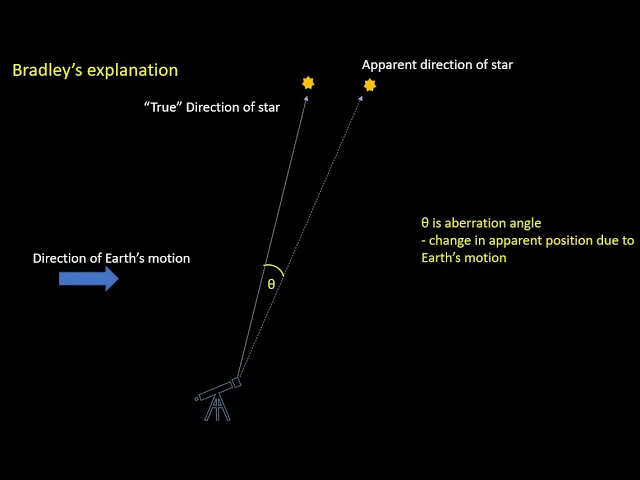
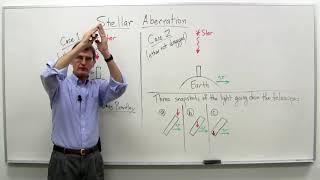
[Music] this video is about stellar aberration the apparent movement of the position of the stars in the sky as a result of the motion of the earth going around the sun it's an interesting case of the application of the scientific method observations were made to confirm a scientific theory in this case it was a heliocentric theory and to measure an effect in this case it was stellar parallax but unexpected results were found and these in turn led to new discoveries the story started back in 1727 when the english astronomer james bradley had been taking measurements of the position of el tannin the brightest star in the constellation of draco the dragon so what bradley was looking for was a small shift in the position of el tannen known as the parallax and that's what i'm going to talk you through briefly now so if we start in december the direction of the star is shown by the purple line and then if you go forward three months to march then the stars position has shifted and then if we go forward another three months to june then the apparent position of the star has shifted again and then once again to september you can see it has shifted again over the course of a year the star eltanin should trace out a small circle centered on its mean position in this diagram the position shift is greatly exaggerated of course the position shift bradley was looking for was very small which is why it hadn't been detected before and of course a star doesn't need to be at a right angle to the plane of the earth's orbit which is called the ecliptic to show a parallax any angle will do in bradley's time the heliocentric theory in which the earth and all the planets orbit the sun was generally accepted by pretty much all astronomers but even so it hadn't been accepted by the catholic church and many thinkers outside the field of astronomy still believed in the older geocentric theory in which the sun and planets orbit the earth finding the parallax of a star would confirm that the heliocentric theory was correct and it would also allow the distances to the stars to be calculated and this diagram shows how you do it just from simple trigonometry the distance to the star which i've given the symbol dss is equal to the distance between the earth and sun which was known in bradley's time divided by the tangent of the parallax angle which bradley hoped to measure so just to recap the position shift due to parallax which bradley expected as the earth goes around the sun is shown again however the position shift bradley observed is shown here and as you can see although eltanin did move in a circle its position shift was different than if parallax were the cause in trying to explain his observations bradley discovered an entirely different effect which became called stellar aberration and as i'll explain next bradley's discovery not only confirmed the heliocentric theory as being correct but also allowed an accurate measurement of the speed of light [Music] [Applause] [Music] to understand the cause of stellar aberration let's consider a rainy day where there's no wind rain falls vertically from the sky however if you're moving rain no longer appears to fall but but is tilted in your direction of travel and two common examples of this which will be familiar to most people are that if you're telling an umbrella and walking quickly then you need to tilt your umbrella in a forward direction to shield from the rain and also if you've been on a train when the train is moving looking at the window rain appears to streak down the window diagonally bradley reasoned that the change in the star's position which became known as stellar aberration was due to the speed of the earth's motion around the sun he believed that light consisted of small particles which traveled at a finite speed and these light particles appear displaced in the direction the earth was moving in the same way raindrops are when a person is moving bradley was able to show that to a very good approximation the aberration angle which we'll call theta for a star at an angle a to the earth's motion is given by the tangent of theta equals minus v over c times the sine a and observations have proven this formula to be correct the negative sign arises because the tsar is displaced towards the direction of the earth's motion a dash is smaller than a if you want to see any more information on how this formula was derived then have a look at the link on my explaining science blog page so as we've seen previously as the earth goes round its orbit the direction in which it's moving is continually changing and so the displacement of a star from its knee position due to aberration has to continually change too if we take an example let's consider a star which is at right angles to the earth's orbit we call this location the ecliptic pole and as you can see from the diagram the star is always at 90 degrees to the direction which the earth is moving around the sun so the angle a in the formula is always 90 degrees and because the sine of 90 degrees is 1 tan theta is simply minus v divided by the speed of light c which comes out as nine point nine four times ten to the minus five this means that theta is minus twenty point five arc seconds this is a very small angle roughly 1 90th diameter of how big the moon appears in the sky so stars should then move in a circle of radius 20. 5 arc seconds very small circles in reality they don't because the earth velocity around the sun varies a little it's faster when it's closer to the sun and slower when it's further away so bradley's remarkable observations not only confirmed the heliocentric theory as being correct but also allowed the determination of c the speed of light and if you look at this you see that tan theta is approximately equal to minus v over c sine a where theta is the aberration angle we've talked about this and that's what bradley measured v is the earth's velocity around the sun and that was known to bradley it varies between 29. 3 kilometers a second in july and 20 and 30.
3 kilometers per second in january when the earth is closest to the sun a is the angle between the star and the earth's direction of motion again that was known so with those three known quantities bradley was to work out from this equation that c the speed of light is 301 000 kilometers a second that's in today's units and this is actually remarkably within a half a percent of the correct value so far the examples we've talked about have been where the star is at right angles to the plane of the earth's orbit this diagram shows the stellar aberration of a star which lies in the same plane as the earth's orbit the ecliptic and in this case imagine we're looking down from above on the earth's orbit so if we start in december the earth is moving at 90 degrees to the direction of the star so the aberration is at its maximum minus v over c let's go forward a bit to early february the earth is now moving up 45 degrees to the direction of the star so the aberration is now smaller the star is displaced a smaller amount from its mean position moving forward again to march the earth is now moving directly towards the star so the aberration is now zero and the star isn't displaced at all in june the earth is moving at 90 degrees to the star's position so the star is has its maximum position shift minus v over c and in september the earth is now moving directly away from the star so the aberration is now zero and the star isn't displaced at all so as you can see the star traces out a straight line path over the course of a year [Music] bradley like many 18th century physicists believed in a particle theory of light in the 19th century however a wave theory of light became generally accepted the wave theory is better able to explain phenomena such as diffraction and interference patterns however when this theory was tried to apply to the aberration of starlight it ran into a couple of difficulties firstly the aberration angle theta varies with the speed of light c in the wave theory light travels more slowly in air than it does in vacuum but the difference is small in a denser medium the slowing is actually quite significant so when light passes through water for instance it travels 1. 3 times more slowly than it does in a vacuum so if we filled a telescope with water the aberration angle ought to be 1. 3 times larger than if it's filled with air this water-filled telescope experiment was first performed by george airy back in 1871 and no difference was observed secondly 19th century wave theory of light required that light travel in a medium which was given the name the ether this was an invisible material which had no interaction with any physical objects and the speed of light was measured with respect to this ether so for stellar aberration to work the sun would have to be stationary with respect to the ether which even to 19th century physicists seemed unlikely it's actually worth pointing out here also that bradley's theory although it matches observations perfectly well made with an airfield telescope the aberration angle would be different in this theory when viewed through a water-filled telescope today the generally accepted explanation of stellar aberration is by einstein's theory of special relativity in special relativity there's no absolute space as the earth moves round the sun we're observing the star in different reference frames and each of these reference frames the star has a slightly different position due to the difference in relative motion of the earth with respect to the star however the shift in position predicted by special relativity almost exactly matches bradley's theory the shift in position of a nearby star caused by parallax which bradley had been looking for is much smaller than that due to stellar aberration it wasn't successfully measured until 1838 when the german astronomer friedrich bessel found it for the star 61 cigna the parallax he measured was .







![How the Bizarre Path of Mars Reshaped Astronomy [Kepler's Laws Part 1]](https://img.youtube.com/vi/Phscjl0u6TI/mqdefault.jpg)