all right welcome to the narrated lecture version of chapter 20 in8 immunity let's go ahead and get started first thing I want to do is just um sort of define the role of the immune system and then talk about its organization so the immune system is there to protect us from microbes from toxins and even from our own cells that become abnormal for example tumor cells the immune system is divided into two main branches we have the innate non-specific Branch so the innate Branch includes physical and chemical barriers and cellular barriers as well uh that
are not very specific to what they keep out um to what they protect us against these barriers um include this things like the skin and mucous membranes uh they are present from the moment you are born and they have no memory component let's compare that to the Adaptive or acquired branch of the immune system this includes B cells and T cells and these cells once activated against a particular pathogen are very very specific against attacking more of that particular pathogen uh in addition there is a memory component meaning if you become infected with the same
pathogen down the line the B cells and t- cells have uh so-called memory cells that remember the original infection and will attack that pathogen um much easier and much faster so so they will launch this immune attack uh and it will be more severe so that the pathogen has a hard time taking hold in this subsequent infection all right let's look at some physical barriers uh as part of our innate immune system so this is kind of like our first barrier our first line of defense in in a immune system and this includes physical barriers
such as the skin like the epidermis and the dermis as well as mucous membranes such as those that line in the respiratory ngi tracts let's take the skin first so the epidermis is a great barrier it's rarely breached unless the skin is somehow damaged and this is because the epidermis is stratified uh consisting of many layers of densely packed flattened cells that are basically sacks of a protective protein called keratin um in addition it's a dry surface which a lot of microbes don't like and it's slightly acidic as well with a pH of four to
five and most microbes except for some fungi uh don't like those conditions especially bacteria they really don't like those acidic conditions mucus membranes um have obviously mucus to trap and prevent penetration from many microbes however there are always some exceptions and some microbes even like the mucus secretions one other method of preventing infection us just just to kind of wash the microb away and that's the role of the tears that lubricate the eye as well as saliva and the mouth okay as far as some chemical barriers again first line of defense here um on the
skin and also lubricating the hair we have sebum which is basically the oil from sebaceous glands and um this sebum contributes to the low pH of the skin and there are some anti microbial fatty acids that disrupt the cell wall and the cell membranes of some microbes uh in addition we have a class of a group of proteins called defensins which serve to sort of poke holes in the cell membrane of bacteria U therefore altering their permeability and hurting their chances of survival we also have lysine which we've talked about previously uh lysy physically hydes
the nag n bonds inog glycan of course keep in mind that the exposed PTO glycan is going to be on Grand positive cell walls because in gram negative cells the thin layer of poog glycan is kind of hidden by the outer membrane of the cell wall finally we have gastric juice that's present in the digestive system in the stomach in particular which has a very low ph and kills most pathogens okay up next we have our second line of defense in the innate immune system and this includes the form elements of blood so these aren't
necessarily all cells um so we have three major form elements in the blood we have erthrocytes which are red blood cells Lucy which are white blood cells and platelets so just to review uh iyes car oxygen and carbon dioxide in the blood and these are not true cells once they're mature um once they're mature they've lost their nucleus and organel so again they're not true cells just like platelets platelets are um just simply fragments of its progenitor cells so they don't count as cells either luuc coytes are the true cells in the blood and uh
these include several different types of white blood cells and you see many of them here uh and we'll be talking about them one by one shortly just to throw out a couple definitions for clinical purposes lytos is an increase in lucos site number and often indicates an infection whereas glucopenia is the opposite where we have a deficiency of lytes and this could be from an immuno deficiency disease or it could be from uh toxins uh it could be from um chemotherapy and radiation cancer treatment these kinds of things okay so just as a quick introduction
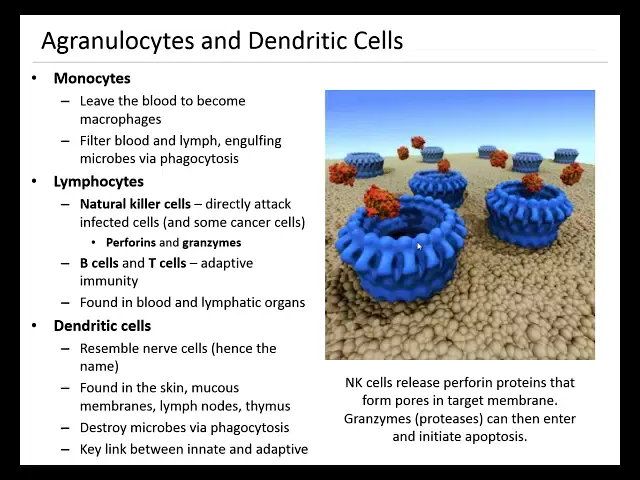
um to the the major types of lucos sites we have the granular sites and the a Granulos sites the granular sites include all the fills so neutral fills yosino fills and basil fills and they're based the these names are based after the stains that they take up and the charge of these stains you see that neutrals are the most abundant by far these all kind of have a grainy appearance as you can see in the picture and their nuclei tend to be loed with two or more loes the a granulocytes include monocytes and lymphocytes lymphocytes
have large circular nucleus that takes up almost the entire cell these include the B cells and the T cells as we'll be talking about in just a second and monoc Es are the largest uh these guys have kind of a kidney bean shaped nucleus these are a granulocytes because when they are stained even though they do have granules they just aren't visible uh very well finally dendritic cells also count as lucco sites but notice that there's no number in parenthesis as far as their abundance in the blood and this is because they're not actually in
the blood um they're in the tissues so they're found in the skin and mucous membranes uh kind of Sentinels guarding the door uh should those barriers those initial physical barriers be breached uh these guys because they're kind of right by the front door right by those portal of entry um they're often the first to encounter a breach a an infection and therefore uh will communicate that to other members of the immune system and so they are key link between the cells in innate immune system as well as the cells in the Adaptive immune system speaking
of communication between cells um I just want to throw out a couple definitions before we go on so communication between cells includes this group of chemicals that we can sort of Define as cyto kindes so these are are specific chemical signals there are huge variety of cyto out there um this is kind of an umbrella term so if we Define this even further so of classify it further we have chemokines which are cyto kindes that induce other cells to travel to that specific uh chemokine Source um as chemokines diffuse from their original Source uh it
creates a concentration gradient and so other lucco sites travel up that concentration gradient to the source often of infection uh we also have another term that refers to cyto kindes between lucites in particular and these are often called the inter lucans so you can see in the figure here we have maccrage be talking more about shortly and uh it's releasing several cyto kindes including some Incans il1 and il6 all right now let's define the granula sites in a little bit more detail the fills are first so um neutr fills are the highest in abundance um
during normal conditions these guys are first on scene and they are particularly effective against bacteria destroying bacteria they are really good at FOC cytosis um and they actually can also Kill by sort of committing suicide but not like apoptosis it's a different type uh of suicide where they explode and their DNA ENT traps surrounding microbes preventing their spread and it also serves as a danger signal for other luyt and this concept uh these nets are referred to as neutr extracellular traps eosinophils are particularly good at fighting parasites and also are involved with activ activating other
immune cells communicating between those cells and they're highly involved in allergic reactions as well basophils um are in low abundance in the blood uh they are involved with inflammation by releasing histamine which provides a lot of the symptoms that we experience during inflammation as well as allergies the a Granulos sites and dendritic cells are shown here or listed here um monocytes circulate the blood in within the blood and uh once they receive chemical signals indicating an infection they can leave the blood and become mature macrofagos these guys are very active ocytes who are going to
be very good at engulfing everything in sight the lymphocytes include the B cells and T cells that I've been referring to before these guys are involved with act the ad adaptive or acquired immune system um and have a variety of functions that we'll talk about later and the natural killer cells as well are here in this class of lympocytes natural killer cells don't need all the fancy comp uh comp licated activation steps that some of the other B cells and t- cells do natural killer cells can skip some of that activation notice when a cell
is infected or when a cell is abnormal like a tumor cell and go ahead and directly kill it and it does so through these proteins called perforin and granzymes you see in the picture on the right the perforin proteins can assemble these rings in the uh uh the plasma membrane of a bacterial cell and these Rings serve basically as pores Alters the permeability of these membranes so uncontrolled movement of ions and and water can can begin to travel as well as um the granzyme component of natural kill secretions uh these granzymes are basically protasis that
can enter the bacterial cell and eat it from the inside out finally we have dendritic cells again these guys are found in the tissues they're not circulating in the blood and these guys are really really good fos sites and a key link between innate and adaptive branches of immune system speaking of Phagocytosis let's go ahead and talk about this in a little bit more detail the term fosite is kind of a an umbrella term for many different types of cells so phagocytosis phocytes are cells that can undergo phagocytosis so of course there are many different
types of cell that can do this and uh the important ones in our body include um all the granular sites but mainly neutrophils again these guys are in the highest abundance anyway as well as monocytes that mature to macrofagos and dendritic cells these are the three neutr fils monocytes and dendritic cells the three um most popular or most important fos sites in the body and these fos sites recognize bad things they recognize pathogens by specific molecular patterns on the surface of the pathogen um when they recognize this molecular pattern on the surface of the pathogen
they can engulf it through fyos and we'll look at the details on the next slide and then they can release the cyto as a way to warn and alert the rest of the immune system should a response be necessary um anything else I want to say here okay um keep in mind that many of these fos sites are actually circulating in the blood the exception being the dendritic cells and so they need to leave the blood to enter the infection site and the tissues sometimes and so to do this they're um receiving chemical signals from
the endothelium which ultimately occur because of chemokines from the sight of infection so these cells that are circulating through the blood are able to start rolling along the endothelium kind of slowing themselves down changing shape and leaving the blood kind of squee squeezing through the endothelial cells the spaces between the cells and entering the tissue and then once they're in the tissue they can migrate crawl to the site of infection we'll talk a little bit more about this later when we go over inflammation some of these macrophages are not circulating through the body or crawling
through the body and they might just actually be fixed in place this includes the cuper cells in the liver the alv macrofagos in the lungs macral cells in the brain and spinal cord and the splenic macres in the spleen so here's the actual process of fos cytosis you see in panel a the maccrage um notices or recognizes these specific molecular tags that are associated with pathogens you see This Acronym here P pathogen Associated molecular pattern so that's that's the actual term for a group of molecules that are unique characteristic to pathogens such as lipid a
from lipopolysaccharide or maybe it's um maybe it's a a molecular tag on pilly or fella maybe it's Manos which is a particular sugar that's um not found in human bodies but instead on pathogens so anyways the maccrage identifies this uh microb as a pathogen as a bad thing so it reaches out with its cytoplasmic arms called pseudopods and these pseudopods can um merge to engulf the microbe in this case a bacterial cell into a vesicle basically called a fome so at this point the cell bacterial cell is still okay but you notice that there are
several lomes in the cell in maccrage that merge with the fome to make a fome and this is where the Los the lome is able to release several substances that kill the bacterial cell so enzymes like lysine um hydrogen oxide and some of these reactive oxygen radicals that's sometimes called the respiratory burst so we actually physically break down and digest this bacterial cell within the fago lysosome and then the macras can release all the debris but at the same time it's going to bind some of these microbial pieces and display them on its surface surface
once again a way to alert the rest of the imun system of what's going on now it's it's good to remember that the interaction between the immune system and microbes is like a sophisticated battle so there's almost always a Counterattack and over time microbes have evolved many many ways around our immune system and here's kind of a short list of five ways that microbes have evolved to evade phagocytosis now of course perhaps our immune system has other ways to deal with this but it's kind of interesting to see some of the creative ways that microbes
have come up with to survive I'll let you guys of course read through that rather than reading to you here okay um another component of the second line of defense here with the inate immune system so we had um our our lucco sites and the form elements of blood involved but uh here in this case it's concept called inflammation and this is a response to infection or even just trauma to tissues and the idea is uh we want to contain the infection uh destroy what's causing the infection in this case uh as you see it's
bacterial cells and then repair whatever was damaged in the first place now inflammation is intended to be brief it's intended to be short term um that's referred to as acute inflammation and this is something we see all the time when we get cut U chronic inflammation is bad news um inflammation is hard on the body especially if it's it's systemic it can really result in some serious diseases I we see later okay so the Hallmark symptoms of inflammation include redness swelling heat and pain so as we talk about the steps of inflammation I want you
to be thinking of what causes these specific symptoms okay so step one of inflammation is mobilization we want to get the troups to the site of infection so in this cartoon you see a splinter that has breached our physical barriers skin and also infected the tissue with foreign bacteria so right away um phocytes probably dendritic cells for example will engulf some of these bacteria and release cyto kindes um this will activate many cells and cause them to release their own chemical mediators their own chemicals uh as well as finding their way to the site of
infection so as you see here there are many things going on um there are some mass cells and what's not shown like basophils that are releasing chemical mediators that um signal vas of dilation such as hist um Bas of dilation is going to result in increased blood flow to the area it's also going to um increase the permeability of the endothelium so um by increasing blood flow to the area and by increasing permeability of the capillaries cells are going to be able to leave uh the blood that much easier as well as other antimicrobial proteins
like compliment proteins we'll talk about those later as well as antibodies and plotting proteins so all of this stuff is able to leave the blood easier now thanks to the increase in uh blood flow and increase in permeability keep in mind that I mentioned before that some of these gluc coytes perhaps maybe it's a neutr or a monoy um have to have a way to enter the tissues from the blood so they do that by a process called margination where they Roll Along the endothelium slowing themselves down and then finally they change shape they flatten
out and squeeze through the intracellular cracks this is referred to as diapedesis you see that here on this figure okay so now that we've mobilized the troops to the area we want to wall off the area thanks to some flying proteins like Fen being converted to fibrine that's what you see here in this picture we're going to wall off the area so that we can prevent further spread but right at the site where the battle is occurring we don't want that to form one giant clot so we have an anti-coagulant called Hein that is released
um in order to um prevent FBR Engen converting to fibrin at the actual battle sites this last Point here is kind of review from the previous slide but neutr continue to the area continue to the area and accumulate through this chemotaxis idea they're following the concentration gradient of chems at the same time they're activating all their buddies so in general we're going to see especially for a bacterial infection we're going to see neutrophils on site first they're also in highest number but they have a very short lifespan it's going to take the monocytes a little
bit longer to get there but soon they're going to be the dominant cell uh in highest abundance um and they also have a much longer lifespan okay so then the third and final step here is to repair the damaged tissue tissue and just kind of clean up the debris and you see on the right a typical acute example of acute inflammation perhaps that top picture is maybe a um an insect by or something some sort of puncture and then down below you see pus coming out of the fingernail and gr there so how can we
explain this well as we have brought in extra blood to the area increased permability of the capillaries that's going to result in more stuff leaving the blood than normal which is going to result in that swelling also bringing more blood to the area just by itself is going to cause it to appear red kind of a redish color um this swelling though back to the swelling for a second this swelling is going to put pressure on the veins which is going to inhibit some of the reabsorption but at the same time it's going to increase
lymphatic drainage because the lymphatic vessels have a different structure compared to blood vessels so we're going to increase the amount of lymph that's been formed and we'll talk about lymph later in the chapter but basically um this is a good thing and we're going to see why that would be good later also to to help explain maybe the pain that we experience in acute inflammations like this simply uh pain receptors are activated it is the pressure and some of the chemicals that are released in sple as well cause that pain and then finally the heat
is just from the extra blood flow to the area bringing heat to the area as well as the increased rate of metabolism in the cells that are actively trying to repair that area one last thing I want to mention here is something that should sound familiar if youve Tak 2011 202 uh pdgf plet derived growth factor secreted by platelets that are involved clotting that's occurring in the area and this stimulates fiberblast activity and repairing the actual tissue is damaged okay so just a real quick note here um I mentioned briefly before that inflammation is meant
to be shortterm um it's it's a way to sort of handle an infection contain it and handle it but chronic inflammation is no good play a major role in the development of several diseases that you see listed here like cancer diabetes heart disease Etc it damages the tissues in whatever areas inflame often it's systemic so body wide maybe it's the blood vessels maybe it's heart tissue Etc um and there's a whole bunch of causes for chronic inflammation something as simple as uh stress in your diet can put your body in body wide inflammatory State even
if this is kind of low grade inflammation it's still going to be that in the body of the time another line of defense here is fever fever is something we're all familiar with it's where our body temperature increases to abnormal levels sometimes frightening levels uh during infection most of the time moderate fever is a good thing uh it promot otes the activity of lucites it promotes the activity of antimicrobial proteins like interon it also stimulates the liver to hold on to kind of um remove guess iron and other minerals that microbes need for replication in
their life cycle so specifically how fever comes about is simply um by pyrogens chemicals called pyrogen often these are cyto or even little pieces of microbes that stimulate the hypothalamus to increase set point and they do that through prostate Landing um pge2 P E2 will cause the hypothalamus to reset the set point so normally our set point in the body temperature set point is about 37° cels perhaps it's 39° c as shown in this figure here in order to raise our body temperature often we're going to be shivering because muscle contraction generates a lot of
heat and so all that shivering all the breath contractions will warm us up pretty quickly yet another defense that just seem to keep coming here uh groups of different types of antimicrobial proteins and once again remember that these are non spefic defenses so interferon is a group of antimicrobial proteins that are released by virally infected cells and stimulate the surrounding cells to produce antii proteins and wait for an infection um themselves and if they should become infected the surrounding cells should become infected then they will halt all gene expression killing the the cells that was
just infected but also preventing the virus from replicating so this is a review from from the virus chapter compliment however is new to us uh compliment includes many many proteins more than 30 you see several of them here on the left um part of the figure a bunch of proteins C1 C2 C3 Etc that have a a variety of effects we're going to explore here in the next couple slides this slide does a good job this figure does a good job of summarizing the effects of compliment there are three different ways that they can be
activated this pathway can be activated and two of them are shown here starting at the top so on the top left we have the so-called classical pathway where an antibody binds to an antigen antigen is like a molecular tag on a cell okay so an antibody this this y shap protein binds to antigens associated with pathogens and that activates complement through the so-called classical pathway uh alternatively compliment could be active activated by the alternative pathway and this is where something on the surface of the microb directly activates complement okay so either way we're going to
we're going to have this Cascade of complt protein Activation so C1 activates C4 which activates C2 Etc and they merge at C3 C3 is going to cleave into Parts A and B and these are going to have a variety of effects as you see down below many of the complement proteins not worri that you know the exact numbers of course are going to promote inflammation and we've just talked about inflammation so this is going to bring in the troops this is going to increase vascular permeability um it's going to sort of wall off the area
and allow for the utrs and acres to Eng all the bad guys at the same time these complement proteins are also going to enhance phagocytosis through a process called opsonization opsonization is like sprinkling some salt or slathering the microb with a little bit of butter just kind of buttering it up uh so that the the fosite really really wants to eat this pathogen um so it's just enhancing the efficiency and and rate of phytosis and then finally we have destruction direct destruction of our microbes in this case bacteria through py is uh this is where
um hores poles are generated in the cell membrane and that affects permeability of the cell membrane so that we have kind of uncontrolled movement of electrolytes and water resulting often in the cell bursting so cell liis here's another way to summarize it except now we have all three activation pathways we have the classical pathway on the left which is activated complement is activated through the antigen antibody interaction we have the alternative pathway on the far right which is where surfaces of pathogens directly activate complement proteins and start the Cascade and the third activation pathway that
we haven't seen yet is in the middle the lectin pathway you see in the figure it's MB lectin pathway this is Manos binding El pathway this is where uh a protein called eltin binds a carbohydrate such as Manos Manos is characteristic of bacterial cell walls they're not found in our cells this lectin is going to activate compliment and the compliment Cascade now once we Converge on C3 we kind of uh have all possible effects that are going to happen often at the same time so we're going to initiate inflammation we're going to enhance fosis and
we're going to directly kill the pathogens by formation of the Mac complexus speaking of the Mac complexes here is another view we have all these complement proteins shown on the left c5b C6 C7 C C9 qu of C9 forming this pore so the compliment protein actually physically form a hole in the cell membrane which totally disrupts movement of fluids and electroly on the right side you see a bunch of mac complexes in an electron micrograph so looking at the real deal now as we have this unregulated movement of fluids the bacterial cell is often in
a hyponic environment therefore water will Rush In And cell will explod in case you hadn't had enough detail yet here it is one more time this one's straight from the book we see our pathway our activation Pathways at the top we see um the specific complement proteins that are activated and then activate the next one the next one the next one and then we finally see uh the three results at the bottom cytolysis phytosis through oxidization and inflammation so to put it all together another figure from your book kind of using this flowchart here uh
this would be a great way to sort of review everything we've talked about in this chapter so far we have the physical barriers including the skin nuc membranes we have chemical barriers including antimicrobial proteins um including DH Etc we also have cellular barriers like the cells that we talked about that we fulfill Etc um and one that we talked about in the last chapter our microbiome the bacteria in us and on us that help out compete pathogens okay so sort of to wrap up the idea of the innat and uh inam branch and get us
starting to think about its connection to the Adaptive branch Branch I wanted to show you this figure for a moment again from my book um there's cross talk between the two branches the innate immune system is responsible for activating the Adaptive immune system so if the defenses are overcome and even if they're not overcome um the Adaptive Branch will still know what's going on and this is done by communication between the two so here's a good example on the left we have some pathogens these little bacterial cells that are going to bind an a dendritic
cell okay we know that a dendritic cell is a fosy it is going to engulf these pathogens now it's going to do that by first binding to the pathogen surface with its receptor it's so-called toll like receptor these toll like receptors are good at recognizing those pathogen Associated molecular patterns I talked about several slides ago so basically toll like receptors are made to recognize uh molecular tags that are often associated with pathogens so tolik receptor binds the antigens on the pathogen surface that initiates phagocytosis you know the steps from here um we form a fos
form a fome we have digestion and breakdown of the cell and then the mic the um little fragments of the microb of the bacterial cell are displayed on the surface of the dendritic cell and so we see that here kind of in the middle we have antigen display there's a little microbial fragment uh pathogen fragment here it's being displayed I think that fragment looks purple uh and the Adaptive immune system the t- cells are going to see that and potentially get activated so back to the dendritic cell for a second when it is presenting antigen
like this it is referred to as an antigen presenting cell or APC and any fosy that does this is refer to as a antigen presenting cell dendritic cells are um known for this for being very effective at this but also macro fages and neutral fils as we discussed before okay so once the T cell receives the signal from the antigen presenting cell then it may become activated or it may not um this all depends on the cyto environments the Malo the soup of cyto kindes the environment the surrounding environment that this te- cell is is
in um we'll talk a little bit more about this later but we need basically a secondary signal to activate that t- cell but once it is activated it's going to go off and coordinate the Adaptive response including B cells and T cells okay so a little more detail about tolik receptors um they got their name toll after the word uh some means amazing or something like that uh the person who discovered these thought they were amazing so they're to like receptors they're found on a variety of antigen presenting cells like Maes mcrs dendritic cells and
they recognize molecular patterns associated with pathogens you see iety of those listed here in this table so on the left we have a list of total like receptor number in the middle we see the location of those receptors and then on the right we see what they recognize so some of them recognize let's say lipoprotein lipid a maybe it's pepal glycan maybe it's double spred RNA from a viral infection maybe it's a feller protein or um a proon ayus okay so you get the idea these are molecular tags associated with pathogens in other words P
pathogen Associated molecular patterns that are recognized I'm going to largely just skip this slide for the narrated lecture I'll talk more about this in uh in person but um there's kind of this traditional view of the body recognizing self versus nonself what is part of US versus what is not a part of us um however that sort of fundamental Theory that's been widely accepted is is being shaken up a bit by Dr matzinger she has an interesting history herself she is a brilliant scientist and she has come up with her Theory called a danger model
where um the Adaptive branch of the immune system does not necessarily distinguish between self and nonself but instead determines what's bad by environmental cures uh danger cures of socalled bad cell death rather than normal apoptosis again I will talk about this more in lectur per okay the last part of this chapter is just to introduce the lymphatic system in case you haven't had it yet in bio2 so the lymphatic system is associated with the circulatory system it's kind of an extension of the circulatory system and it includes a network of vessels that take interstitial fluid
um and transports that interstial fluid now called lymph through a series of vessels shown in Green in this figure and they pass through security checkpoints which are these lymph nodes so at the lymph nodes we have a bunch of lucco sites just hanging out monitoring the lymph and then that lymph ultimately dumps to the suabian veins so it becomes part of the blood again you see the pathway listed here all right as far as the forces that move the lymph just like blood lymph is formed and moves through the lymphatic system down a pressure gradient
so on the the figure at the left here this is a capillary bed where we have an arterial and a venal and then the capillaries in between we also have these lymphatic capillaries sort of interpers amongst the capillary bed as well so keep in mind from again from 202 on the arterial end of a capillary we have fluid moving out and then on the vual end of a capillary we have fluid moving back in and this is how Blood and Tissue the blood and tissues exchange nutrients and waste right this is how we feed our
body cells and this is how we get rid of their waste now some of that material that's filtered out in the tissue fluid is actually rather than going back into the blood is going to enter the lymphatic system and once it enters these lymphatic capillaries it's referred to as lymph and lymph is going to flow a unidirectional flow thanks to these little valves these infoldings of the endothelium and these valves are very much like the valves that we see in veins we're also relying a lot on surrounding skeleton muscle to kind of massage L along
but the point is we're going to end up passing through this lymph is going to end up passing through all of these lymph nodes so here's a l node shown on the upper right kind of this kidney bean shaped thing so lymph is entering this lymph node from the left and then leaves out the right and in the process we have all these areas where B cells and T cells are hanging out monitoring the composition of the lymph so this sort of is like a security checkpoint and then the lymph is going to move on
now if any of these cells recognize a danger signal if they recognize something B then they can start to multiply and leave the lymph node and enter enter the blood and travel to the site of infection here's an example of what happens when lymph flow is blocked so I mentioned that um lymph is there there's a very low pressure in the lymphatic system so there's not much impetus for lymph to move and so it's aided its movement is aided by our Movement by our physical Movement by our sceletal muscles Contracting relaxing uh kind of like
Venus blood is also coed along now um we can see some dramatic effects when this lymph flow is blocked and we end up getting severe swelling potentially severe swelling in this example uh this is a severe case of swelling virtu as elephantiasis and this is where parasitic worms have entered lymph nodes and taken up shot they uh begin replicating and kind of block uh block the pathway of lymph flow therefore lymph is not able to drain and it accumulates accumulates accumulates and have severe edema often times these limbs are going to have to be amputated
all right I think we made it um on to chapter 21 see you soon or talk to you soon