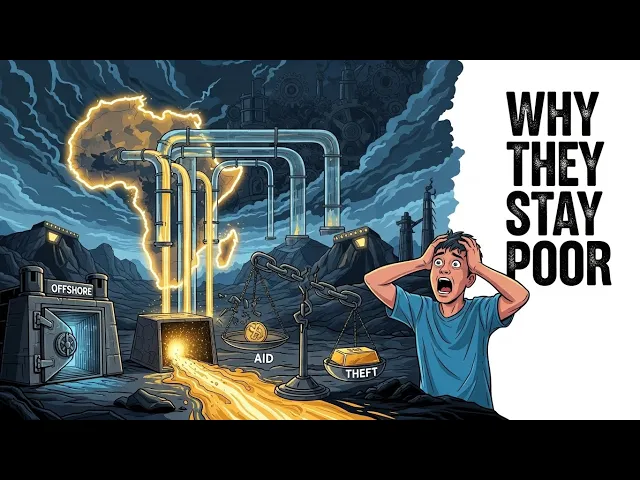
Imagine just for a second that you are sitting on a winning lottery ticket. Not just a $10 scratchoff, but the Power Ball, the Megaillions. We are talking about a ticket worth $2.
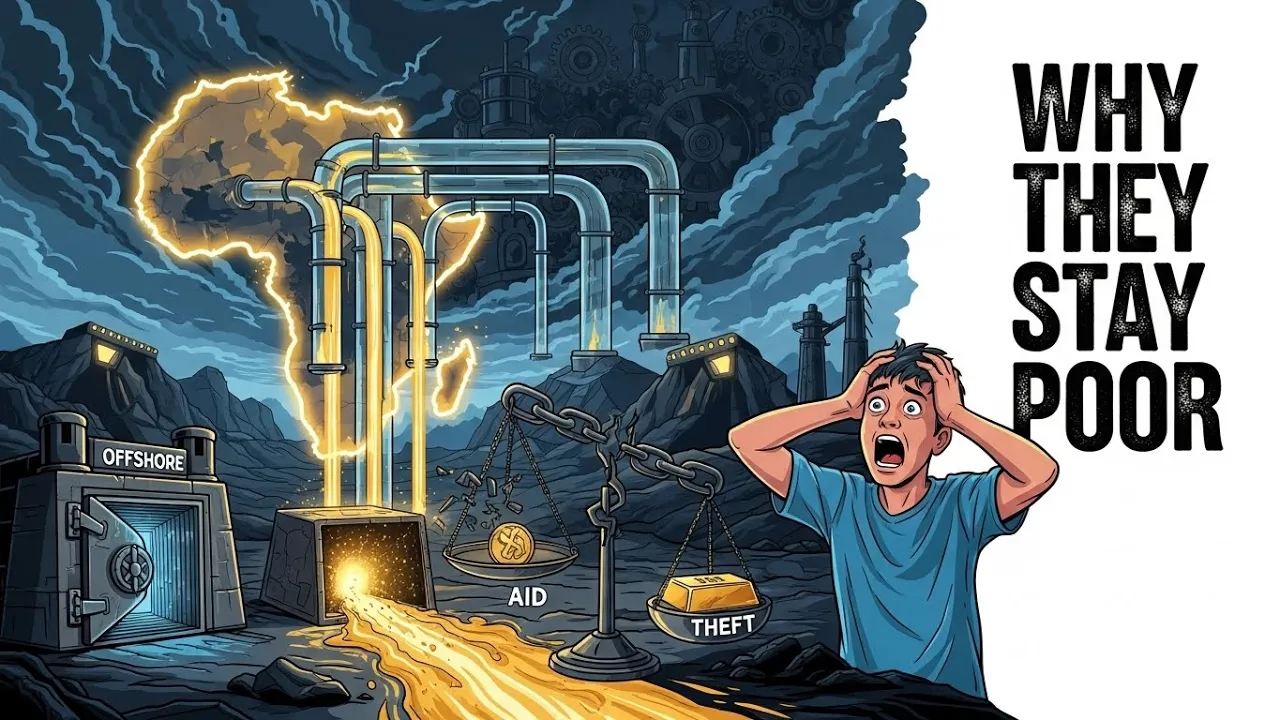
5 trillion. That is the estimated value of the known mineral reserves just sitting beneath the soil of the African continent. You have the cobalt that powers every single smartphone in Silicon Valley.
You have the uranium lighting up France. You have the gold stored in the vaults of Zurich and the diamonds sparkling on the fingers of Fifth Avenue brides. By all laws of economics, by every metric of capitalism, you should be the landlord of the world.
You should be the bank. But you're not. Instead, you're watching your children go hungry while foreign trucks cart away the dirt from your backyard.
You're told over and over again by the news, by politicians, and by international agencies that you [music] are poor because you are corrupt. because you lack infrastructure. Because you just need a little more foreign aid.
Well, I'm here to tell you that is a lie. A massive calculated multi-billion dollar lie. What if I told you that Africa isn't relying on the world's charity?
What if I told you that the world is actually relying on Africa's charity? Today, we're going to look at the ledger. We're going to ignore the sob stories and look at the cold, hard math of the global financial system.
We're going to rip apart the trade deals, the monetary policies, and the rigged logistics that keep the richest continent on Earth the poorest in the bank account. Buckle up. This isn't a history lesson.
This is a crime scene investigation. One, the great bank heist that no one talks about. Let's start with the biggest myth of them all.
The idea that the West is helping Africa with buckets of cash. You see the commercials. You see the rock stars hosting benefit concerts.
You assume that money flows from the global north to the global south. Here is the reality check that's going to make you spill your coffee. According to a report by Global Financial Integrity and a coalition of NOS's, when you tally up all the loans, all the foreign investment and all the aid going into Africa and then you subtract the money leaving Africa, the continent has a net loss.
We aren't talking about pocket change. We are talking about roughly $41 billion a year effectively vanishing from the continent. Africa is a net creditor to the rest of the world.
Let that sink in. The poorest countries are subsidizing the richest ones. But how?
They don't just load cash onto a plane and fly it out, right? Actually, it's much more sophisticated than that. It's boring.
It's bureaucratic and it's devastating. It's called trade misinvoicing. Here is how the scam works.
Imagine you are a massive multinational mining corporation. Let's call you Mega Corp. You set up a subsidiary in Zambia to mine copper.
Now Zambia has a corporate tax rate. If you make a profit there, you have to pay the Zambian government, which could use that money to build schools, hospitals, or roads. But you, the CEO of Mega Corp, didn't get into the mining business to build Zambian schools.
You got into it to buy a third yacht. So you use a trick called transfer pricing. You set up another shell company in a tax haven, let's say the Cayman Islands or Bermuda, where the tax rate is effectively zero.
Let's call this Shell Corp. Now, Mega Corp Zambia mines $100 million worth of copper. Instead of selling that copper directly to the market where the price is high, you sell it to your own company, Shell Corp, for a dirt cheap price, let's say $10 million on paper, Mega Corp Zambia, has barely made any money.
In fact, after paying for consulting fees, which you also pay to yourself, your Zambian company declares a loss. Result: You pay zero taxes to Zambia. Then Shell Cororp in the Cayman Islands takes that same copper and sells it to China or Germany for the full market value of $und00 million.
Result, you make 90 million in profit. And because it's in the Cayman Islands, you pay zero taxes there, too. This isn't a hypothetical scenario.
This is standard operating procedure. Historical context. Let's look at a real example.
Look at the copper industry in Zambia in the early 2000s. While copper prices were skyrocketing globally, reaching record highs, many mining companies operating in Zambia were reporting losses, the then president of Zambia, Levi Moana, once famously complained that the companies were taking out billions in copper, but leaving behind peanuts. He tried to introduce a windfall tax to capture some of that profit for his people.
The mining lobbyists descended on Lusaka like vultures. They threatened to leave. They threatened to sue.
The tax was eventually scrapped after his death. The United Nations Economic Commission for Africa estimates that illicit financial flows, IFFFs, cost the continent over $88 billion annually. That is more than the total amount of official development assistance, foreign aid, that Africa receives.
Think about that for [music] a second. For every $1 of aid given with a smile and a handshake, $3 are stolen through the back door [music] by corporate lawyers and accountants. It's like someone breaking into your house, stealing your TV, your laptop, and your jewelry, and then coming back the next day to hand you a sandwich while a camera crew films his generosity.
And then the world applauds him for feeding you, the tax haven web. This system relies entirely on the global network of tax havens. And who runs these tax havens?
Is it African dictators? No. The biggest enablers of financial secrecy are territories linked to the UK, the US, and Europe.
The British Virgin Islands, Jersey, Gernzi, Delaware. These legal vacuums allow companies to siphon wealth out of Africa without anyone seeing the paper trail. In 2015, a report leaks known as the Swiss leaks showed that clients from African countries had hundreds of millions hidden in HSBC accounts in Switzerland.
This is money that was extracted from the resources of the continent, bypassed the local tax collectors, and ended up sitting in a vault in Geneva. So, when someone asks why African governments can't afford to pave their roads or pay their doctors, tell them to check the balance sheets in London and Zurich. The money was there.
It just got moved. But wait, if you think corporate theft is bad, wait until you see how the actual money in your pocket is rigged. Because for 14 African countries, they don't even control their own currency.
And that brings us to point number two. Before we dive into the rabbit hole of monetary colonialism, which trust me is going to make your blood boil, do me a favor. If you want to understand how the global economy actually works, not just how they teach it in textbooks, hit that subscribe button.
We're digging up the truth that usually stays buried in PDF reports that no one reads. Also, leave a comment below. Do you think tax havens should be illegal?
Let's argue in the comments. All right, let's talk about the CFA Frank. Two, the currency that never left home, the CFA Frank.
Imagine you are 30 years old. You have a job, you have a house, and you have kids. But every time you get your paycheck, you're legally required to deposit half of it into your dad's bank account.
If you want to spend that money, you have to ask him. If you want to invest it, you need his permission. And just to be safe, your dad sits on the board of directors of your life with veto power over your decisions.
You'd call that abusive, right? In geopolitics, we call that the CFA Frank. For 14 African countries representing nearly 200 million people, colonialism didn't exactly end.
It just put on a suit and tie and moved into the central bank. These countries used the CFA franc. Originally back in 1945, CFA stood for colonies Frances Dafreak, French colonies of Africa.
Today, they've rebranded it to Financial Cooperation in Africa to sound nicer, but the mechanics remain terrifyingly similar. Here is [music] the kicker. For decades, these countries were required to keep 50% of their foreign currency reserves in the French Treasury in Paris, not in their own vaults, in France.
Think about the implications of that. If Seneagal wants to build a massive solar plant and needs to buy tech from China, it effectively has to go through Paris to access its own hard currency. France claims this guarantees stability.
And sure, the CFA Frank is stable. But sometimes stability is the enemy of growth. Because the currency is pegged to the euro, it is artificially strong.
Wait, [music] you say, isn't a strong currency good? Not if you are a developing nation trying to export goods. If you want to sell mangoes or textiles to the world, you want your currency to be slightly cheaper so your products are competitive.
But because the CFA is tied to the euro, a currency designed for economic powerhouses like Germany and France, African goods become too expensive for the global market. It's like trying to sell lemonade at a neighborhood stand, but you are forced to charge Starbucks prices because your dad says so. Nobody buys your lemonade.
You go out [music] of business. It gets darker. In the central banks of these regions, the BCAO and BEAC, France has historically held seats on the board.
They have had veto power. This means a former colonial master has had a direct say in the monetary policy of independent nations. In January 2019, an Italian official famously caused a diplomatic incident by saying France was impoverishing Africa through the CFA Frank and that without Africa, France would drop in rank to the 15th largest economy.
While the politics were messy, the economics struck a nerve. The eco transition. Now, you might have heard news that this is changing.
In late 2019, reforms were announced to rename the currency the eco and end the requirement to store reserves in Paris. But critics say this is just a facelift. The peg to the euro remains.
The guarantee by France remains. The fundamental economic leash is still there. It's just a little longer now.
If a country cannot control its own money, it cannot control its own destiny. Period. Three.
The chocolate box paradox. The value added trap. Let's step away from banking for a second and talk about breakfast or dessert.
Let's talk about the value chain. There is a reason why Switzerland is known for chocolate even though not a single cocoa tree grows in Zurich. There is a reason why Italy is known for coffee even though the climate in Milan would kill a coffee plant in a week.
This brings us to the third mechanism keeping Africa poor. The prevention of value addition. Here is the math.
The global chocolate industry is worth over hundred billion a year. Ghana and Ivory Coast produce roughly 60% to 70% of the world's cocoa. So how much of that hundred billion do they see?
About 6%. Why? Because the money isn't in growing the bean.
The money is in processing the bean. The money is in the branding, the marketing, and the packaging. So the logical question is why doesn't Africa just build its own chocolate factories?
Why sell the raw beans? Make the chocolate in Acra and sell it to London. Ah my friend, that is where tariff escalation comes in to punch you in the face.
Western nations, the EU, the US, etc. talk a big game about free trade, but their tax codes tell a different story. Here is how they rig the game.
If you want to import raw unwashed coffee beans into the EU, the tariff tax is often 0%. They let it in for free because they need the raw material. But if you roast that bean, package it, and try to sell it as premium African coffee, the tariff suddenly jumps to 7.
5%, 10% or even higher. This is tariff escalation. They're explicitly telling African industries, "We will buy your dirt cheap resources, but don't you dare try to process them.
Don't you dare try to become the manufacturer. Stay in your lane. Stay the farm, not the factory.
" This isn't new. This is the oldest trick in the colonial playbook. Under British rule, India was forced to export raw cotton to Manchester where it was turned into shirts and then sold back to India.
India wasn't allowed to build mills. Today, nobody sends soldiers to burn down the mills. They just use tariffs to make sure the mills go bankrupt.
It's not just high-end goods. Let's look at tomatoes in Ghana. Ghana has the perfect climate for growing tomatoes.
Yet, walk into a market in Ara and you will find cans of tomato paste from Italy and China. Why? Because the EU heavily subsidizes its own farmers.
They pay European farmers to produce so much milk, wheat, and tomatoes that they have a massive surplus. They then dump this surplus onto African markets at prices lower than the cost of production. A local Ghanaian farmer cannot compete with a heavily subsidized Italian aggra business.
So, the local canery shuts down. The local farmer goes bust and suddenly Ghana is importing food it could have grown itself. Africa holds 65% of the world's uncultivated arable land.
It should be the bread basket of the world. Instead, it spends $35 billion a year importing food. This isn't incompetence.
[music] This is a structural economic straight jacket designed to keep the continent as a supplier of raw materials and a consumer of finished goods. Until Africa can process its own resources, turn its oil into plastic, its borite into aluminum, its cotton into designer genes, it will remain poor. But every time it tries to make that jump, the free market suddenly gets very expensive.
But you know what's even harder than building a factory? Trying to drive a truck to it. Because the next reason on our list is going to make you rethink everything you know about maps.
If you're finding this frustrating, good. You should be. We're about to get into the logistics nightmare that makes it cheaper to ship a container from Shanghai to Tanzania than from Tanzania to its own neighbor.
But before we do, check the description below. I've linked the sources for the tariff data and the CFA Frank treaties, so you can read the fine print yourself. Knowledge is ammunition.
Ready for the infrastructure puzzle? Type continue and let's look at the map. Four.
The map was drawn wrong. Logistics of extraction. If you want to understand why Africa struggles to get rich, you don't need a degree in economics.
You just need to try to book a flight. Let's play a game. You're a businessman in Lagos, Nigeria, and you want to sign a deal with a partner in Kinshasa DRC.
Geographically, these cities aren't that far apart. But if you look for a flight, there is a very good chance the algorithm will route you from Lagos to Paris to Brussels and then back down to Kinshasa. You have to fly to [music] a different continent just to visit your neighbor.
Why? Because the continent was physically designed to be broken. This is the logistics of extraction.
When the British, French, and Belgians built the railways and roads in the late 1800s and early 1900s, they weren't trying to connect Africans to Africans, they didn't care if the Yoruba could trade with the Igbo. They had one goal, get the stuff out. Look at the map of the railways.
They are vertical lines. They start at a mine or a plantation and end at a port. They are suction tubes.
There are almost no horizontal lines connecting the countries together. The cost of not connecting. Fast forward to today.
Because of this legacy, shipping goods within Africa is a nightmare. It is often cheaper to ship a container of car parts from Shanghai, China to Darus Salam, [music] Tanzania, than it is to ship that same container from Darus Salam to Campala, Uganda, which is right next door. This kills intra-African trade.
In Europe, about 69% of all trade happens between European countries. In Asia, it's about 59%. In Africa, it's historically hovered around 15%.
If you make bicycles in Kenya, you can't sell them to Ethiopia because the road stops at the border or the tariffs are insane. Remember, the borders were drawn by Europeans who didn't care about local trade routes. So, you don't build a big factory.
You stay small. You stay poor. The Berlin Conference hangover.
We have to talk about the borders themselves. You know those straight lines on the map of Africa? The ones that look like they were drawn with a ruler.
That's because they were drawn with a ruler. In 1884, a bunch of European guys sat in a room in Berlin. Not a single African was invited, obviously, and carved up the continent like a Thanksgiving turkey.
They split ethnic groups in half. They lumped enemies together. They cut off trade routes that had existed for a thousand years.
Imagine if someone drew a line down the middle of the United States and suddenly the East Coast was a different country from the West Coast with a different currency, language, and legal system. And then they told you, "Good luck building an economy. " That is the baseline reality for African commerce.
It's an obstacle course designed by a ghost. Five, the credit card from hell. Predatory debt.
Now, let's talk about the thing that keeps you up at night. Debt. We've all heard the headlines, "Africa is drowning in debt.
China is taking over. The IMF is coming. " But the headlines miss the real scandal.
The scandal isn't that Africa borrows money, every country borrows money, the US government is nearly $35 trillion in debt, and nobody is repossessing the Statue of Liberty. The scandal is the price of that money. This is the Africa risk premium.
Let's say you are the finance minister of Ghana. You want to borrow money to build a hospital. You go to the international bond market.
The investors look at you and say, "Hm, Africa, scary, unstable. [music] We're going to charge you 10% interest. " Then the finance minister of France walks in.
He wants money to renovate the Louvre. The investors say, "Ah, Europe safe. We'll charge you 1% interest.
" This difference is everything. If Ghana borrows $1 billion at 10%, they are paying $100 million a year just in interest. That is $100 million that cannot be spent on medicine, books, or clean water.
France pays $10 million for the exact same loan. Why is the rate so high? Is Africa really that risky?
Studies show that African countries actually have a lower default rate on infrastructure projects than many other regions. But the credit rating agencies, the big three in New York and London, consistently rate African economies as junk or highly risky, often ignoring their actual growth potential. It's bias coded into the algorithm.
It's expensive to be poor. And if you think the banks are bad, meet the vulture funds. This is where the story gets truly villainous.
A vulture fund, yes, that's what we call them, is a hedge fund that scans the market for the debt of poor countries that are in crisis. Let's say Zambia is in trouble and can't pay its bonds. The bond price crashes.
A bond worth $100 is now selling for $5 on the secondary market. The Vulture Fund swoops in and buys the debt for $5. Do they want to help Zambia restructure?
No. They wait. They wait for Zambia to get a little bit of aid money or get back on its feet.
Then they sue the country in a London or New York court for the full 100 plus interest and legal fees. The case study. Look at what happened with Donagal International and Zambia in the 2000s.
Donnagal bought Zambian debt for about $3. 3 million. They then sued Zambia for roughly $55 million.
Zambia wanted to use that money to fight HIV AIDS and hire nurses. Instead, they had to spend years fighting a legal battle against guys in $5,000 suits. Eventually, the courts awarded the fund a massive payout, though less than the full amount.
But the damage was done. Millions of dollars meant for dying patients went into the pockets of investors who never set foot in Lusaka. This is legal.
It happens all the time. When people say African leaders are corrupt, and yes, some are. We'll get to that.
They forget to mention the international legal system that allows foreign billionaires to effectively garnish the wages of an entire starving nation. It's not just a loan, it's a shakeddown. But speaking of corrupt leaders, we can't let them off the hook.
[music] Because while the West built the prison, some local leaders are more than happy to be the wardens. We need to talk about the resource curse and the leaders who treat their national treasury like a personal piggy bank. Quick question.
If you could rewrite the borders of Africa, how would you do it? Based on language, geography, or would you leave them alone? This is a huge debate in political science.
Drp your take in the comments. And [music] hey, if you're learning something new about how the world actually works, hit that like button. It tells the YouTube algorithm that smart content deserves to be seen.
Now, let's talk about why having oil is actually a curse, not a blessing. Six, the trust fund kid syndrome. The resource curse.
Remember earlier when I said having $2. 5 trillion in the ground should make you rich? Well, paradoxically, it is often the quickest way to destroy a country.
Economists call this the resource curse. I call it the trust fund kid syndrome. Imagine a government is a business.
Usually, a government gets its money by taxing its citizens. If the government wants more money, it has to make the citizens richer so they can pay more tax. It has to build schools, roads, and keep the peace.
There is a contract. I pay you taxes. You give me services.
But what happens when the government finds a trillion dollars worth of oil in the ground? Suddenly, they don't need your taxes. They don't need you to be educated.
They don't need you to be healthy. They don't need you at all. All they need is a foreign company, Hexon Shell Total, [music] to come in, drill a hole, and cut them a check.
This destroys the democratic feedback loop. If the president of an oilrich nation steals money, the citizens can complain, but he doesn't care. His revenue stream is secure.
This is why some of the most resource- richch countries on Earth have the worst dictatorships. They are independent of their own people. Then there is the economic poison known as Dutch disease.
Fun fact, named after the Netherlands found gas in the 1950s, and their economy actually got worse. Here is how it kills African industry. When Nigeria exports billions of dollars of oil, foreign cash floods into the country to buy the local currency, the Naira.
This drives the value of the Naira up or keeps it artificially high relative to other sectors. This makes every other export like cocoa, textiles, or manufactured goods [music] too expensive for the rest of the world to buy. Meanwhile, imports become super cheap.
So, Nigerians stop making clothes and farming food because it's cheaper to just import everything using oil money. The result, the entire economy becomes a one-legged stool. The moment the price of oil crashes, like it did in 2014 or 2020, the stool falls over.
The economy collapses. The case study, Angola. Look at Lwanda.
Angola. For years, it was consistently ranked as the most expensive city in the world for expats. A burger cost $30.
Rent was $10,000 a month. Why? Because oil money flooded the top 1% driving up prices while the other 99% lived in shanty towns without running water.
The oil didn't fix the poverty, it financed [music] the inequality. So when you see a poor country with a rich president, don't just blame corruption. Blame the geology that allowed him to ignore his voters.
Seven, the great brain robbery, brain drain. Let's talk about the most valuable resource in Africa. It's not gold.
It's not oil. It's not diamonds. its people, specifically the doctors, engineers, scientists, and nurses.
We hear a lot about foreign aid going to Africa. But we never talk about the massive subsidy that Africa gives to the West. We call it brain [music] drain.
Let's look at the math of a doctor. It costs a developing nation like Kenya or Nigeria roughly $25,000 to $40,000 to train a doctor from primary school through medical school, subsidized tuition, government grants using local infrastructure. That is an investment by the African taxpayer.
But as soon as that doctor graduates, what happens? The UK, [music] the US, Canada, and Australia offer them a visa. They offer 10x the salary, safer working conditions, better equipment.
So the doctor leaves. The Mo Ibrahim Foundation estimated that simply by hiring African doctors, the West saves billions of dollars in training costs. The African country pays the bill.
The Western country gets the profit. In 2015, there were more Ethiopian doctors working in the city of Chicago than in the entire country of Ethiopia. Whether that specific stat is hyperbole or fact is debated, but the ratio is undeniably broken.
The World Health Organization warns that Africa has 25% of the global disease burden, but only 1. 3% of the global health workforce. This isn't just migration.
It is a transfer of wealth. When a structural engineer from Ghana moves to London to design bridges, Ghana loses 30 years of human capital development. London gets a skilled worker for zero development cost.
The visa trap and the irony. Western countries have strict anti-immigration policies for unskilled laborers. We don't want your poor, they say.
But for the skilled, for the cream of the crop, the doors are wide open. They actively recruit the best minds, stripping the continent of the very people capable of solving the problems we discussed in sections 1 through six. How can you build a manufacturing sector if your engineers are driving Ubers in New York or coding in Silicon Valley?
You can't. Africa is effectively running a free university system for the G7 nations. And until the conditions back home change, or until the West acknowledges this debt, the smartest minds will continue to be Africa's biggest export.
This one hits hard. I want to hear from the diaspora. Are you watching this from outside your home country?
Why did you leave? Was it the money, the safety, or the lack of opportunity? And for those back home, do you blame them for leaving?
>> [music] >> This is a complex emotional topic. Be respectful, but be honest in the comments below. We have one final piece of the puzzle, the one that ties it all together, the mechanism that keeps the lights off and the factories closed.
And then we talk about the solution. Because believe it or not, there is hope. 8.
The darkness paradox. Energy poverty. Do you hear that sound?
If you live in Nigeria, South Africa, or Ghana, that is the soundtrack of your life. It's the sound of a diesel generator. The I better finish this work before the fuel runs out alarm.
You cannot build a modern economy in the dark. It is physically impossible. You can't run a server farm.
You can't run an aluminum smelter. You can't even run a welding shop efficiently if the power cuts out for 6 hours a day. This is energy poverty.
And it is the final nail in the industrial coffin. Roughly 600 million people in Africa do not have access to electricity. That is nearly half the continent.
The entire installed generation capacity of the 48 countries of subsahara and Africa minus South Africa is roughly equivalent to the generation capacity of Spain. One country in Europe has as much power as 48 countries in Africa combined. But here is where the story gets twisted again.
It's not because Africa lacks energy sources. Let's look at Niger. Niger is one of the world's poorest countries.
It is also one of the world's largest producers of uranium. For decades, [music] French state-owned companies mined uranium in Niger to power nuclear power plants in France. Result: One out of every three light bulbs in France is lit by uranium from Niger.
Meanwhile, in Niger, less than 20% of the population has access to electricity. They're exporting the light and staying in the dark. Look at Nigeria, a massive oil and gas producer.
For decades, oil companies have been burning off natural gas, a process called flaring, because capturing it was considered too expensive compared to just pumping the oil. They are literally burning potential electricity into the sky, polluting the air, while the villages next to the flares use kerosene lamps to see at night. This energy gap creates a cost of business tax.
If you want to open a factory in Ethiopia or Nigeria, you have to buy your own power plant. That drives up your costs. That makes your products more expensive than products made in China where the government guarantees cheap power so you don't open the factory and the jobs never come.
Nine. The way out. Is there hope?
Okay, we've spent the last 20 minutes depressing you. We've talked about rigged trade, stolen taxes, fake money, and invisible borders. It looks hopeless.
The system is rigged. The house always wins. But the house is starting to shake because despite everything I just told you, despite the $80 billion stolen annually, despite the tariffs, despite the blackouts, Africa is rising.
Not because of aid, but because of defiance. Here are the three reasons why the 21st century might actually belong to Africa. One, the FCFA, breaking the map.
Remember those colonial borders that made trade impossible? Africa is finally erasing them. The African Continental Free Trade Area, FCFTA, is the largest free trade area since the creation of the World Trade Organization.
The goal to remove tariffs on 90% of goods traded between African countries. If this works, a factory in Ghana can finally sell to a market in Kenya without paying a penalty. This creates a market of 1.
3 billion people that is big enough to ignore the West if they have to. Two, the leaprog technology. Africa is skipping steps.
They didn't build landlines. They went straight to mobile. They aren't building thousands of bank branches.
They're going straight to fintech. Empisa in Kenya revolutionized mobile money before Apple Pay even existed. Cryptocurrency usage in Nigeria is among the highest in the world.
Not because they love board apes, but because they need a way to move money without asking permission from the global banking cartels. Three, the demographic dividend. The rest of the world is getting old.
Europe is aging. China is shrinking. Japan is a retirement home.
But Africa, the median age is 19. By 2050, one in four people on Earth will be African. This is a massive workforce.
It is a massive consumer base. If the West keeps locking Africa out, Africa will eventually just build its own room. 10.
The final verdict. So, let's go back to the original question. Why is Africa poor?
It's not because Africans are lazy. You've never seen hustle until you've been to a market in Lagos. It's not because they lack resources.
They have all the resources. It's not purely because of corruption, though that helps the thieves. Africa is poor because the global economic system was designed to keep it that way.
It was designed to be a gas station, a mine, and a farm for the rest of the world. The systems trade misinvoicing the CFA frank tariff escalation are working exactly as intended. But understanding the trap is the first step to escaping it.
The narrative is changing. The generation coming up now, the ones coding in Nairobi, the ones protesting in the streets, the ones building businesses despite the blackouts, they know the score. They aren't asking for charity.
They are demanding a seat at the table. And if the world doesn't give them one, they're going to flip the table over. If you learned something from this video that you didn't learn in school, share it.
The algorithm hates truth, but we can beat it. Don't just get angry, [music] get educated, because the only thing more dangerous than a resourcerich country is a knowledg. Thanks for watching.
I'll see you in the comments.