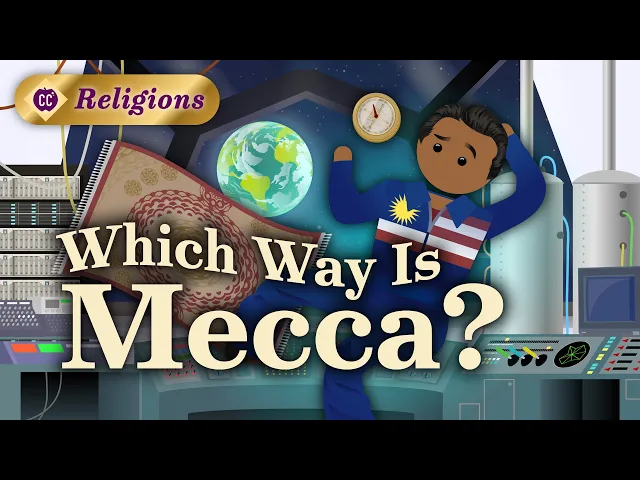
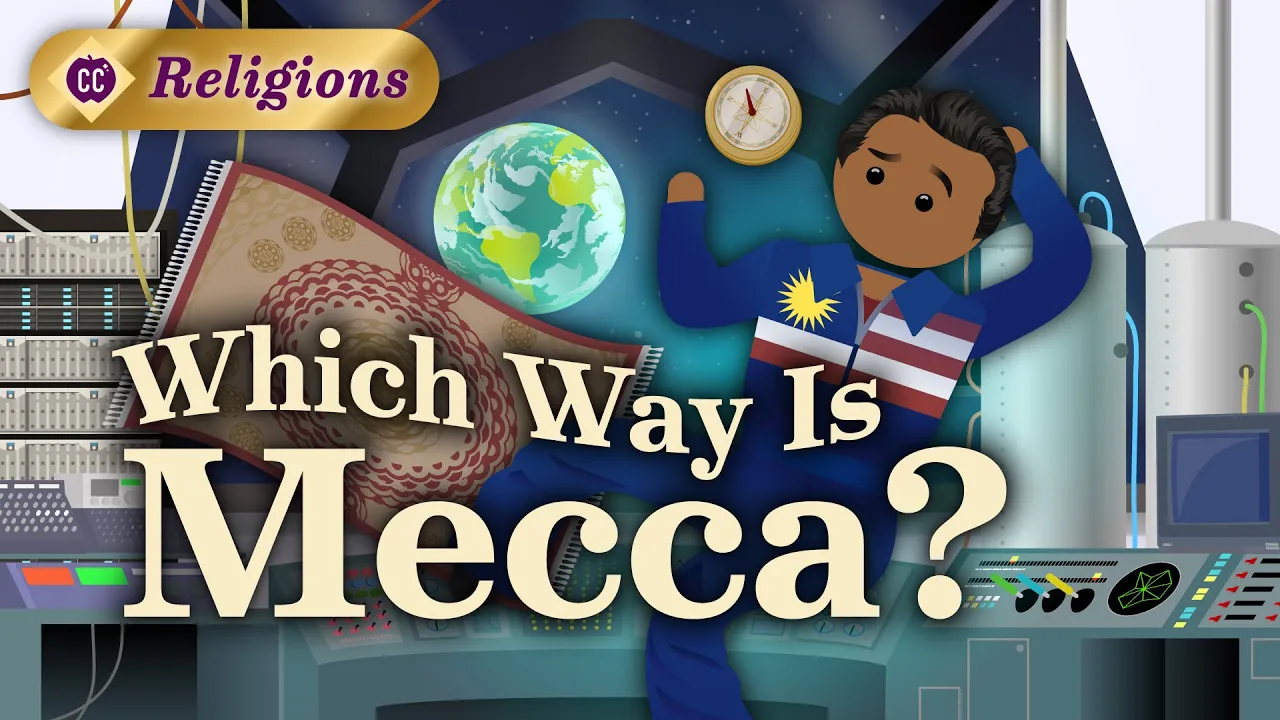
Hi, I’m John Green, and welcome to Crash Course Religions. So imagine you’re floating in space, 250 miles above Earth’s surface. Around you is seemingly endless emptiness.
Everything you know and love is down there—your friends, family, pets, religious community. Up here, you’re alone. But there’s a tradition connecting you to the world below and the heavens above.
A responsibility, really, though it seems impossible to fulfill in zero gravity. And yet you have to find a way—or else risk failing in your religious duty to God. [THEME MUSIC] When Malaysian astronaut Sheikh Muszaphar Shukor prepared for a Russian mission to the International Space Station in 2007, he faced all these challenges.
As a devout Muslim, he prayed five times a day in the direction of the Kaaba, the holiest site in Islam, located in Mecca, Saudi Arabia. But once you're in orbit around the Earth, “days” last only ninety minutes. And when you’re on the ISS, Mecca changes location in relation to you, moving at 17,400 miles per hour!
God, space is weird. Thankfully, Shukor didn’t have to figure out what to do on his own; a group of 150 experts in Islamic law and practice at the National Fatwa Council of Malaysia determined how he could adapt his prayer practices to life in space. He could project the Kaaba’s location into space mathematically, move his head instead of lying down–which is a bit difficult in zero gravity— and use his point of departure to calculate the time of day.
In the end, Shukor was able to maintain his ritual obligations, just a little differently. While this seems like an extraordinarily modern problem, this type of calculation has been a part of Muslim life for more than a thousand years. I mean, as early as 964 CE, Muslim astronomers were updating and translating maps of stars to better position themselves in relation to Mecca.
But of course, this is just one aspect of the expansive religion of Islam. With more than two billion practitioners globally, it’s the second largest religion in the world, after Christianity. And people have practiced Islam in tons of different ways and places for over 1400 years.
For example, unlike Shukor, not all Muslims pray five times a day, despite that being a pillar of the faith for many. So, what is it that unites these diverse peoples and practices? Well, let’s start with a big one: their reverence for the prophet Muhammad.
Muhammad lived in Mecca, and around 610 CE, he experienced something extraordinary. While contemplating in a mountain cave, he received a direct message from Allah, the Arabic word for God, through the angel Gabriel. While people of many languages practice Islam, Arabic remains important because it’s the language of this message, known as the Qur'an.
Muhammad preached the words of God to the people of Mecca. But many were not fans of what he had to say, especially the part about there being no other gods but Allah. Because of that, early Muslims faced harassment and persecution in Mecca.
Eventually, Muhammad and his followers fled the city, traveling over two hundred miles to Medina in a journey that would come to be known as the Hijrah. The journey, which occurred in 622 CE, would later be used to mark the beginning of the Islamic calendar. So, like, the year one in the Christian calendar is the year of Jesus’ birth (sorry globe).
The year one in the Islamic calendar is the year of the Hijrah. Eventually, the Qur'an was written down by Muhammad’s followers, and it remains the most well-known holy text of Islam. But there are others: Muhammad’s actions and teachings were gathered in a collection of reports, called the Hadith, which some – but not all – Muslims use today for legal and moral guidance.
Now, you may have noticed that we haven’t actually shown Muhammad yet (and we won’t), and that’s for a reason. Many Muslims choose not to visually depict Muhammad—and in some cases, any sentient beings at all—to avoid idol worship, or devoting themselves to something other than God. While Muhammad plays a central role in Islam, Muslims don’t worship him.
They worship God. Unlike other founder figures like Jesus or Siddhartha Gautama, Muhammad was both a religious figure and a political leader–he was the first head of the Ummah, or the Islamic community, and as such he conducted diplomatic and military affairs alongside religious leadership. And after he died in 632 CE, a major split forever changed the landscape of Islam.
So there was a dispute over who should become the caliph, or spiritual and political leader, of the Ummah. Some believed Abu Bakr, a close aide to Muhammad and his father-in-law, was the right fit, while others thought Muhammad’s cousin Ali was the better choice. This disagreement led to the branching of Sunni and Shia Muslims, which still exists today.
They developed different governing structures and ways to pray, and they honor different leaders and texts, though they have both Muhammad and the Qur’an in common. Within both Sunni and Shia traditions, smaller branches and communities began to form, too. Just as we’ve seen with other major world religions.
Like Sufism, is a particular approach to the faith that’s found across many different Muslim communities. It’s focused on personal and emotional religious experience. Like, you might recognize the whirling dervishes of Turkey, who are known for their spinning, trance-like dances and are mentioned in the poetry of the Sufi mystic, Rumi.
As Islam continued to spread, an era known as the Islamic Golden Age began, starting in the 8th century and lasting until the 13th. And with it came a surge of art, mathematics, and astronomy. Breathtaking feats of architecture such as the Dome of the Rock in Jerusalem were constructed during this period.
Astronomers like Abd al-Rahman al-Sufi were deepening our understanding of the cosmos, while mathematicians like Muḥammad ibn Mūsā al-Khwārizmī were discovering algebra. Which made solving for unknown variables a whole lot easier. I mean, not easier for me, but easier for, like, humanity.
I’ll be honest with you. On some level, x+2=8 will never make sense to me because x is a letter and the rest of them are numbers. Now when it comes to what Muslims believe, there’s no better place to start than with their pronouncement of faith, called the Shahada.
In English, it goes: “There is no deity but God, and Muhammad is the messenger of God. ” Shia Muslims add the phrase, "And Ali is the custodian of God. ” The Shahada unites more than two billion Muslims across the globe, and countless more from the past.
Muslims recite the Shahada during important milestones and in everyday life: it’s part of the Adhan, the daily call to prayer, and is sometimes spoken over people at birth. It’s also possibly the most common last words in human history, as people often repeat the prayer as they pass away. The Shahada sums up two of the main tenets of Islam.
First, there’s just one God, no more, no less. Islam is a monotheistic religion that really stresses the absolute oneness of God, a concept known as Tawhid. Second, the Shahada states that the prophet Muhammad is God’s messenger.
Now, those are just a couple of the central beliefs that guide Islamic theology. Others include a belief in angels, like the one who appeared to Muhammad, and the belief that the Qur'an is the actual words of God, not something Muhammad interpreted or edited. Muslims also typically believe in the idea of a final judgment, when humans will go to heaven or hell, and in divine predestination — the idea that God knows all things before and throughout history.
And all of these beliefs come together with that central devotion to the oneness of God. There’s no, like, business about the trinity where three people are also one God. No, it’s just one God.
So we’ve nailed down some of the things Muslims believe. But what do they… do? What does it look like to practice Islam?
Well, it can shape how you dress, eat, and interact with others. Muslim life is structured by a few different concepts that are common to some – but not all – practitioners. Like, many Muslims will only eat halal food, a dietary restriction that means abstaining from alcohol, blood, carnivorous animals, pork, and other meat that hasn’t been prepared under Islamic rites.
Many Muslims also participate in the weekly Jum’ah, or Friday prayer, at a mosque, or a place of worship. In many Muslim-majority countries, it marks the beginning of the week. The day itself was laid out in the Qu’ran, and in Arabic, the day is known as Yawm al-Jum’ah, or the day of assembly.
While only men are required to participate, women can and often do, too. The prayers are followed by a sermon led by an imam. Many mosques have a designated, professional imam, but anyone from the community that the congregation deems knowledgeable enough can serve in that role as well.
Then there are the Five Pillars of Islam, which are sort of like guidelines that many Muslims attempt to emulate in their daily lives. Their purpose is to cultivate Taqwa, or righteousness and consciousness of God. It encompasses ethical living but also a kind of ever-present connection to the divine.
The first pillar is Shahada, the declaration of faith we mentioned before. And the second is Salat, or worship and prayer—like what Shukor was doing on the space station. Zakat is the next pillar, also known as almsgiving.
It’s a donation to those in need, whether through Muslim-majority governments collecting and distributing the funds or individuals giving money directly. Sawm is fasting during Ramadan, a holy month when Muslims abstain from eating, drinking, smoking, and sexual activity during daylight hours. This is meant to create space for religious reflection and for family time and traditions.
The final pillar is a pilgrimage to the Kaaba called the hajj. This journey is meant to happen at least once in your lifetime as long as you’re physically and financially able. And so, every year, Mecca is filled with millions of pilgrims from all over the world.
And despite the incredible diversity of Islam, massive gatherings like this show how unifying it can be as well. Because wherever you came from — and wherever you are — it is always possible to turn toward Mecca. But I want to be clear that the five pillars aren’t an “official” framework for, like, all Muslims.
For example, Shia Muslims practice the Arba'een, a pilgrimage that typically has almost ten times more participants than the hajj. Millions make this nearly twenty-day pilgrimage to the city of Karbala, in Iraq, every year. In much of Western history, Islam has often been essentialized and monolith-isized, if that makes sense.
It's been turned into one thing, but Islamic expression is as diverse as any global religious tradition. And finding where you fit in the world may involve looking up to the stars, looking down at guiding texts, and looking to each other for guidance and connection. That’s the real heart of the experience of Islam or any other religious tradition.
Just as al-Sufi and other Muslim astronomers used the cosmos to orient themselves to their most sacred place, Muslims today look to their fixed stars, like the Qur'an and the Hadith, to maintain their traditions that connect them to the past and the future. The Ummah is vast—as vast as the cosmos itself. Join us in our next episode when we will explore another vast cosmos, the religions of Africa.
I’ll see you then. Thanks for watching this episode of Crash Course Religions, which was filmed here at our studio in Indianapolis, Indiana, and was made with the help of all these nice people. If you want to help keep Crash Course free for everyone, forever, you can join our community on Patreon.