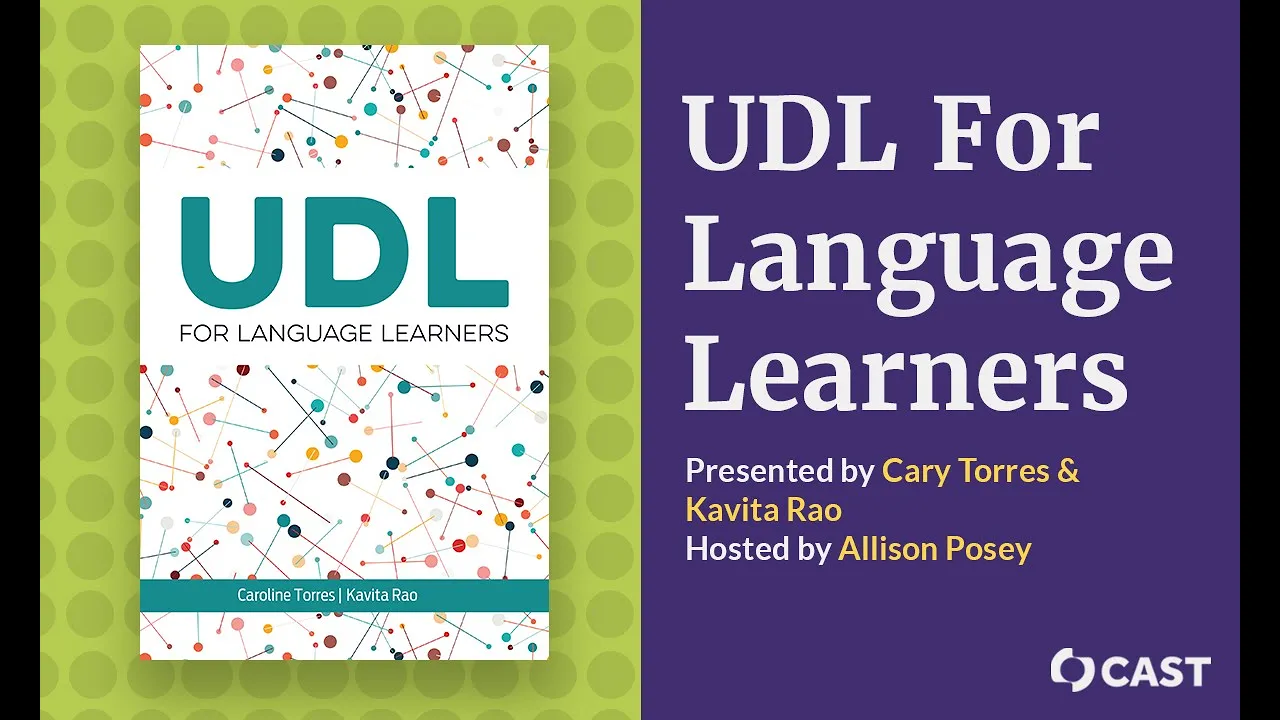
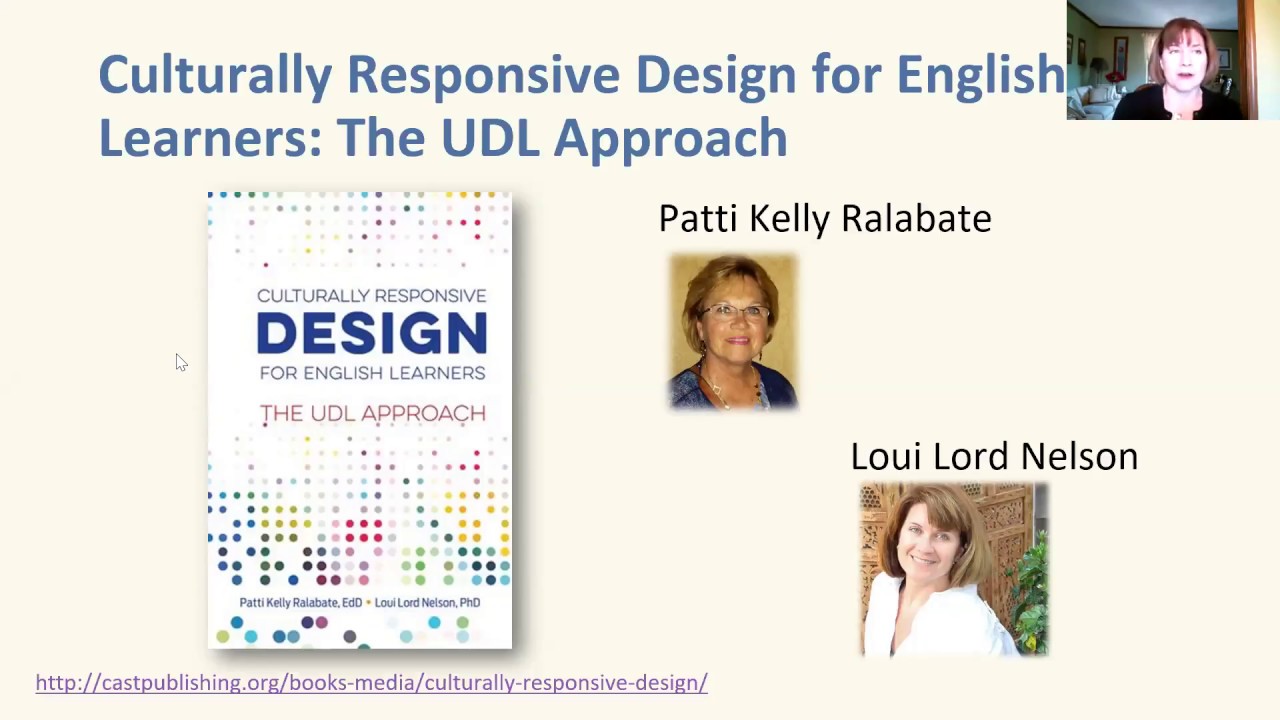
>>David Gordon: Should get started. Want to welcome everyone to this wonderful webinar we're going to have. And I'd just like to say a few things about the two presenters. So we have Cary Torres, Caroline Torres with us today. Cary is currently an associate professor at Kapi'olani Community College in Honolulu. And Kavita Rao is with us. And Kavita is a professor at the University of Hawaii. Cary's background is in second language studies and special education. Kavita has a background in educational technology and special education. And they've both worked in various settings with culturally and linguistically diverse
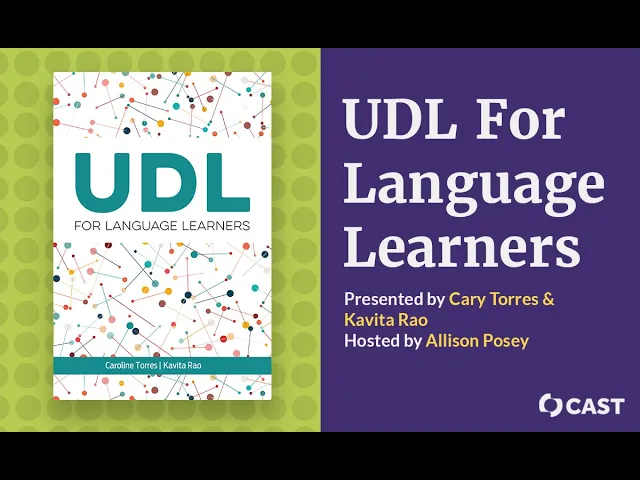
students. They met when Cary was a doctoral student. Cary enrolled in a seminar in UDL that was taught by Kavita, and in that course they often discuss the ways in which UDL could be used to support language learners. And used to joke with each other, apparently, that you know, someday they would write a book about this. And here they are, seven years later. The book is a reality, published by CAST Professional Publishing. We're so delighted to have their book in our catalog, and I hope that at the end of this webinar you'll look for the
notice about how to get that at a discount today. But Cary and Kavita completed the book that was recently published, and they're going to talk about some of the key principles today of that book. And I'd like to turn it over to my colleague, Allison Posey, who is a curriculum And design specialist at CAST, and familiar to many of you, I'm sure, through our work in professional learning and through the UDL Symposium over the years, And through her own publication through ASCD, "Engaging the Brain." So Allison, you want to take it from here? >> Allison
Posey: Hey, David, I'm thrilled to be here tonight. Kavita and Cary, thank you for joining us. I have the honor to get to have this conversation with you. We're going to focus on a couple of really interesting topics. The first is to think about our language learners. And I want to thank you for being mindful that this is not just English language learning, but we're talking about language learning that we all engage in, of all kinds. So it's really going to open our mind to thinking broadly About language learners student characteristics, learner variability. And importantly,
we're not just going to think about the theory, but we're going to think about how we can design for language learning, and what are some of the most effective classroom practices and culturally responsive strategies? And given that this is a UDL book, what - how can we leverage UDL to really help us address some of the language learning variability that we experience in our classrooms? So thank you for joining us today. And you know, it's interesting, almost, instead of introducing you all, we're going to now introduce a few individuals and hear their stories. Do you
want to kick off and tell us about Josie? >> Kavita Rao: Sure, thanks, Allison. Did you want to give them the links for the digital handouts? >> Yes, those will be coming - actually, thank you. So if you all take a look in your webinar chat box, you can - all of the links as we're going through will come up, and there are two options. We have a - the PowerPoint, but then we have - here it is, thank you -- all of the slides and the digital handout are available on that Bitly link. Excellent,
thank you. Good, good, good. Any other logistic questions? Everyone is finding the chat box all right? If you can't hear, there's a phone number that you can call into, To make sure you can hear the conversation; there it is. And please feel free at any point to post your questions in that chat box. We really want to hear from you. And if you're posting at a later time, if perhaps you're watching the recording later, we really hope that you contribute to the conversation also by using the hashtag CAST PL in your Twitter feed, so that
we can continue to have this conversation beyond the scope of this one hour window. Excellent. Any other logistic questions? All right, great. So Josie. Who is Josie? >> Kavita Rao: Thank you, Allison, for that introduction, and David. So we - to get a picture of what the diversity of language learners looks like, we're going to start today by introducing you to three language learners you might find in your classrooms. So first meet Josie. She's 16 years old, and as - she has moved to the U.S. about three years ago. Josie is a student who is
literate in her first language. She has strong schooling experiences where she came from. So she's got a good academic background, understands school expectations, and Josie is a really creative student. She loves creative writing. She loves theater. Those are the things that she really likes to do in school. So let's meet our next student, Eliana. Eliana is six years old. She was born in the U.S. and spent her whole life here in the U.S. However, she doesn't speak English at home. At school she speaks English, and she sounds like a native English speaker, but her academic
English skills are not at grade level. So she does get services as an English language learner. She's fluent in her home language, which is a good - which is a great skill of hers. Eliana is shy and quiet. She tends not to be - she's a very engaged student, but she doesn't jump out and talk a lot in class all - but she does thrive when she's working one-on-one with her teacher and her peers. There we go. And this is Manny. Manny is 14 years old. He arrived in the country two years ago, and he
is a student who has moved a lot in his schooling years. He's moved every - almost every year or year-and-a-half. He does not have a strong literacy background, because he's changed schools so much, been in different school systems. There have been times he's not even been in school. So he's had kind of an interrupted education. His teacher suspects that there might even be some trauma in the situation. His parents are migrant workers who move from place to place, so she's not sure what the - If he's had some traumatic situations in the past as he's
moved around. He seems disengaged sometimes in school, and not - unmotivated to be there. >> Allison: And as you hear these stories of these individuals, I'm sure it's bringing up for you, individual students that you all have, or maybe your own experience. So we do invite you to really take a journey with us through the course of this webinar, and take some of this content that Kavita and Cary are sharing, and really try to think about how it applies to you, and which students would you want us - would you want for us to be
able to meet? And what are some of the things that you would have to say? So in thinking that way, as we start to think about variability, how do you approach it in terms of language learning? >> Cary Torres: Thanks, Allison. We're going to introduce some of the variability among our language learners, and we're going to keep coming back to these three students, to have concrete examples. But as Allison mentioned, please bear in mind, and be thinking about the language learners in your classroom. And we're just going to introduce a little slice today. We could
talk about variability all day, and do a whole nother webinar just on that. So what we're going to do is not really comprehensives, but hopefully it's an introduction, or possibly a review of some of the ways in which our language learners vary, so that we can then think about how to best support that variability. So the three students we introduced you to, represent these three categories that you can see. So many of our language learners are new arrivals, and some of them may have a strong foundation with prior schooling, and others may not. Many language
learners can also be students with limited or interrupted formal education. And then we could also have language learners who are long term learners. So let's talk a little bit more about each of these aspects of variability. So new arrivals are typically students who have been in a country for less than five years. And as such, their English language is often still developing, particularly their academic language. Some of these students, however, as we just mentioned, have strong formal schooling and literacy in their first language. Students with limited and interrupted formal schooling have typically experienced two or
more years of interrupted or missed schooling. This is not necessarily consecutive. For example, they haven't necessarily missed a full year of school, or two full years of school, although in some cases that does happen. But many students with limited or interrupted formal schooling may go back and forth between the U.S. and their home countries, missing part of the school year on a regular basis -- in part, due to the transition, and in part, due to differing school calendars. Also some of these students come from refugee backgrounds, or as Kavita mentioned, may have parents who are
migrant workers, so they may have moved a lot during their childhoods. And this causes stretches of missed or interrupted schooling. For this reason, students with limited Or interrupted formal schooling often are missing foundational academic skills and knowledge, and this can often create a barrier to their success. They also may struggle with abstract academic tasks and proficiency-oriented tasks that they have to do individually, because these tasks are often very much - very different from what they experience in their homelives and in their communities, which are often much more collaborative and communal. The third category that we
want to highlight today is the long term language learners. These are students who have been educated in the country for seven or more years, yet are still identified as language learners. Many of these students exhibit poor study skills, and often struggle to persist with tasks and find motivation for academics. Some of the reason these students seem to be unmotivated and disinterested In school can often be related to the fact that they have spent so many years in schooling in the new country, and just not making the same kind of progress that many of their peers
are. And it can be really difficult to sustain motivation. So long term language learners weren't necessarily never motivated to be in school, but oftentimes after such a long period of struggling to be successful, that ability to persist and to come to school feeling really motivated and excited becomes much more of a challenge. >> Yeah, and I wonder how the expectations also, when you hear, "Oh, you've been here for eight years," subtly shifts then, that feeling, as well. >> Absolutely. So one thing that we often overlook, when we talk about these variabilities and we think about
the challenges that our learners face, is we sometimes forget That these students also bring a vast number of strengths and funds of knowledge with them to school. And as educators it's really important for us to recognize the barriers, but also to identify these strengths. Because our language learners can draw upon their strengths to support their success and to help mitigate some of their challenges. And as educators, we can try to tap into those strengths to support that. For example, in addition to her challenges, we can look back at Josie again. She's the 16-year-old who moved
to the U.S. three years ago. And she has a wealth of strengths. She's literate in her first language, and she has strong prior schooling experiences. And this has helped her to develop good study skills and understanding of academic tasks. She also loves creative writing and theater. And especially these days, finding a student in high school who is excited about writing and loves writing, is a rare gem. And that is definitely something about Josie and other students like her, that we would want to celebrate and tap into, to support some of the other areas where she
might face challenges. >> Allison: And I have to think, well, just as a quick aside, as I'm hearing this list, I'm getting excited as an educator, thinking of all the opportunities to get to know this individual more. So sorry, I'll let you keep going with these funds of knowledge. >> Cary: No apologies needed. I think it is exciting when we really get to know our students, and really look for those areas where they do have strengths. And they all do. Those give us, I think, ideas and platforms that we can use as a springboard to
really help them feel successful and feel valued in our classrooms. We can also take a look at Eliana. So while she only speaks English at school and doesn't speak English at home, because she was born in the U.S., she has a much better developed listening skill than many of her other language learning peers. Her spoken English is also nearly indistinguishable from native-speaking students. And oftentimes we think that not speaking English at home is a drawback to language learning. And this is a typically misunderstood fact, because it's also - it's actually a huge asset. So the
fact that she speaks her first language at home is a very important strength. In addition to that providing a strong foundation for her language development, as we can see in Josie, as well, her communication with her family, and the development as her - of her identity as it's connected to her culture, is actually really important for her development as a student and as a person. So this is a really positive strength that we want to support. And as she continues to maintain and develop her first language, that strong foundation will support her development of the
second language. >> Allison: Cary, that's a - I mean, I do just want to pause there and let that soak in for our viewers. What a powerful statement, to really think about the development of her identity with a connection to her culture being so important for her development. So thank you for emphasizing that, and I hope as some of these comments resonate with you all, That you share in the chat box, and let us hear. Because this is a very rich and important piece for us to consider. Thank you. >> Cary: Thank you, Allison. Another
thing we can think about with Eliana is that we see in her profile that she's shy, but it's not because she's uninterested. So sometimes when students don't participate, it doesn't mean they don't want to, and it doesn't mean they're not interested. But culturally, some students, some children don't speak up unless they are spoken to and asked a question. And in some cultures children don't share their opinions with adults very freely or very often. And so this could be a real big shift for some students, to be able to think About sharing their ideas in a
classroom with an adult. And so we can see with Eliana and many of our other students, if they feel safe and they have encouragement, they can thrive in academic settings. So when her anxiety is reduced and she feels safe, she's a very curious student. She loves learning, and she's a very good collaborator. So when we think about those aspects of culture, and we provide some of those support, it can really benefit with their development academically and their language learning specifically. >> Allison: What an important piece to consider. And there is a question here, just wondering,
do you cover adult language in your book, as well? >> Cary: Yes. So the overview covers language development in general. It's not specific to grade levels. And then we have a few vignettes in the book, and they're at all different grade levels. And one of them is postsecondary. >> Allison: Thank you, thank you. And just to get back to the previous point, too, that -- and the importance of that feeling of safety, and mitigating anxiety to really foster that learning, and that can really bring out that collaborations. They're really thinking about how that design or
that environment can be so important for the skills that we end up seeing in students. So thank you for really honing in on that piece. >> Cary: Absolutely, thank you. Our third and final student we're going to look at today is Mannie, our 14-year-old who's in his first year of high school. And he has limited and - has had limited and interrupted schooling his whole life. And although this creates challenges that we have discussed, he also brings many strengths to the classmate, like the other students that we looked at. Like many students who have moved
regularly or experienced trauma or displacement of some sort, he can be very adaptable and resourceful, because he's had to in many situations. He has also spent a lot of time helping his parents with work, taking care of younger siblings, and translating for older relatives at the doctor. And this has given him a maturity and problem-solving ability greater than many of his peers. But if we don't know this about Manny, and we don't provide him opportunities to tap into these skills, we may never see it. We may just see that he's struggling in school and doesn't
seem particularly motivated. But he does really well with practical real-world tasks as do many students with limited and interrupted formal schooling. And he also has an immense amount of nonacademic background knowledge. I often hear people refer to language learners and say, "Oh, the student has no background knowledge. And in reality, well everybody has background knowledge. And many of our language learners have a wealth of background knowledge. They just may not be directly and clearly related to the academic topics. But if we can tap into that we can help him use that as a foundation to
make connections to the content and to build his learning on that. >> Allison: And how empowering for him, to feel like that background is something that is useful and of value, and relevant and important for his learning. Amazing. Amazing. >> Cary: Absolutely. Especially for students in high school, or long term learners who have struggled for a long time, if we can help them to see value in their first language and in their experiences, and not always think of themselves as not enough, that's a huge step in the right direction towards motivating the students and getting
them engaged. >> Allison: Very powerful. >> Cary: So these are just some of the diversity factors of these students, but there are many more. And I imagine you see many of these characteristics in your language learners. And you can probably even think of a number of other variability factors. So I'd like to give you all just about 20 seconds to think about which Of these characteristics you see in your students, or other aspects of variability that you see in your students. So about 20 seconds, you can think to yourself, or you can share in the
chat box, and then we'll talk a little bit about supports. >> Allison: Fabulous, thank you. >> Allison: And please make sure that you enter "all panelists and attendees," so we can see your feedback and your words. >> Cary: Okay, hopefully you've had a chance to reflect and quickly share. This is my little wait time trick. When I need to give my students time to wait I just have a couple sips of water. So that was probably about 20 seconds. >> Allison: That's a very good strategy. >> Cary: Well I tend to talk a lot, so
it's hard to be quiet. So it's important for us to remember just how diverse our language learners are, and that there's not one magic strategy that's going to work for all of our language learners. >> Allison: Are you serious, Cary? You're not going to give us a box of one thing that we can do? >> Cary: I used all my magic dust, sorry. But we can think about where we have the most impact as educators, and then build in flexible supports in these areas to support our students. And it's almost as good as magic. >>
Allison: I was just thinking that actually that sounds incredibly powerful. Good, I can't wait to hear more. >> Cary: Well we're going to look at three main areas in which educators can have the most impact On supporting our language learners and developing language. So I'm going to go a little bit more into depth into making input comprehensible, providing support for language production and interaction, and providing feedback and opportunities to practice. So you may have heard of the phrase, "Making content comprehensible." But we are using the phrase, "making input comprehensible," because it encompasses a lot more
than just content. Input can include content, of course, like text and videos that you use in your classroom. But input also includes a lot of other input that students receive in the classroom, including your teacher talk. So our teacher talk includes everything we say to our students, including directions or instructions, which are also input that need to be made comprehensible. And our instructions or directions for activities often can include idioms and slang or other phrases that our students may not be familiar with. For example, how often - and you don't have to say - but
how often do your instructions start, "Step one; step 2." For some of our language learners, they may only know that word in connection to walking. They may not understand that that's a part of the process, meaning, "This is what you do first." We also throw out - throw around words like "brainstorm," or "Let's jump in and get started." And some of these make it sound more fun and exciting, but for our language learners, it can leave them completely confused and unable to participate, even if they do have the academic skills to participate. Other sources of
input we need to consider are any of the materials that we provide our students. For example, graphic organizers can be really helpful to supporting students to organize and analyze information. However, if we give students a graphic organizer without clearly explaining how it needs to be filled in, it can end up creating a barrier. I've seen students with a Venn diagram, who didn't understand that it's two overlapping circles, and you put the differences of two objects or two items in each side, and then the similarities in the middle. I've seen students just filling in the openings,
writing sentences, because they didn't understand there was some sort of pattern. Also for students, if they don't understand how that graphic organizer is supposed To be helpful, it can also cause a barrier, because they may not realize what they're supposed to be doing with it. A final part of input that I want to touch on is technology. We have so many students who are digital natives these days, that incorporating technology can be a great support. However, we have to also consider if our students are familiar with technology. Some of our language learners may come from
areas where they haven't had regular access to technology. So we just want to make sure we're not assuming, and that we are making even technology comprehensible for our students. >> Allison: Well you've already given such an opportunity, just by shifting the one word to be in [inaudible] you know, I even started thinking about the input in some Of our nonverbal communication, too, that we might not be as aware of. But certainly thinking about the language that we're using and those simple examples of - I say, "Jump right in," all the time. And the technology and
graphic order - so this is super interesting for us to be able to be very reflective on all the various sorts of inputs that there are. >> Cary: Thank you, Allison. And I would say, once we start listening to ourselves, don't beat yourself up too much if you [inaudible] "step one," and "Jump right in." But as you hear yourself, try to be mindful, and see, "Is this something I've taught my students? Do they understand?" >> Allison: Fabulous. >> Cary: Another area of support is, before we ask students to produce language or to interact. So as
we saw with Eliana, many language learners feel anxiety and stress when they're required to speak their second or third language. And this could be in front of the whole class, or even in small groups or partners. And if students feel anxiety, it's very hard for them to process the input that they're getting. And this will make their participation in language development a much bigger challenge. So for this reason, if we're going to ask students to discuss or to interact, if we can provide supports before we ask them to do that, they're going to feel more
confident and have a better chance at being successful. So a couple ways that we can do that is by teaching vocabulary or providing word banks. If you have resources posted in your classroom, even just highlighting for students which resource is helpful for which particular activity. Students may also need help with specific grammatical structures In order to participate appropriately. So for example, in history if you were going to have students discuss something that they've read, or they've watched a video on, a quick lesson on the past tense can support learners to feel more confident and more
able to discuss events that have occurred in the past. Also, cultural norms can be very different in regards to groupwork and collaboration. And in some cultures they don't really use groupwork at all, as a part of their schooling. So this can be a really new and confusing aspect of school for many of our language learners. So if we provide clear roles and responsibilities for the students, so they understand how to interact, this can be really helpful for them. We can also provide sentence starters, or frames, or phrases that teach them how to collaborate and how
to be in a group. For example, how do you ask your classmate to clarify? Or how do you agree or disagree appropriately and respectfully in a group? And this type of support and explicit instruction typically helps all of our students. >> Allison: I was just thinking that, yes, yes. >> Cary: Sometimes we all need a little coaching on how to agree and disagree respectfully [inaudible] together. >> Allison: Yes, and sentence starters, I don't have to start with a blank page. I have a few words to just get me going. Fabulous. >> Cary: Yes, sometimes just
having that to hold onto - many language learners may have the language, but they may not know where to start. So if they know where to start, they're often much more willing to try. So the last piece I want to talk about is feedback, as well. So with feedback, language will not develop. But feedback alone is not enough. Many times, and probably due to time constraints, or needing to get through material or standards, we often provide feedback on an assignment or on a student's language production, and then we move on to the next thing. However,
this isn't sufficient for language to develop. After receiving feedback, language learners really need an opportunity to use that feedback to practice, and then get more feedback on that new practice to see if they've done it correctly or if they've improved. This is the way that language can develop. If we just give feedback and move on, they will probably not be able to develop That feedback - develop that aspect of language. And we also have to remember that our feedback is a source of input. So we need to make sure that it is comprehensible, as well.
And one way to do this is to have a clear learning target aligned to our instruction, and then provide very specific and focused feedback on the learning target. So for example, that history example I gave a minute ago, if we do a minilesson on past tense, we have students produce the past tense. Then if we focus our feedback just on the past tense, the student will be able to connect that to the learning and to the instruction, and are going to be much more likely to be able to apply that and learn that aspect of
language. If we correct everything, which often is the temptation, because there are so many things our learners need to learn, but if we correct everything, Our students may be able to fix their errors in the moment, but they probably won't learn any of them. And so those errors will keep coming back. >> Allison: And just thinking about that affective piece, too, if you keep getting corrected for everything, I know I just want to stop talking then, or whatever it is. So that's really valuable to keep that goal in mind. >> Cary: Absolutely. And that actually,
that affective piece is connected to the last point that I want to make, is that we also want to remember that while we are typically very good at giving corrective feedback, we can't forget that we also need opportunities to provide our students with positive and supportive feedback. So our language learners also need to know what they're doing well And what they're doing correctly, and they need encouragement with that motivation. And as they struggle, they need to know that they are progressing, because sometimes they may not see their own progress. So those are some of the
areas where we can have the most impact as teachers. And Kavita is going to talk a little bit more about how we can be strategic about this. >> Kavita: Okay, thank you, Cary. As you can see, Cary knows a lot about language learning, and she could - it's wonderful listening to her, because I learn so much every time. And there's a lot more. So Cary mentioned these three large areas of language learning: making it comprehensible, providing support for language production in their action, and providing opportunities for feedback and practice. So those of you who work
with ELL's already know lots of strategies to do these things. So for example, you might know frameworks like SIOP, or [inaudible] or Project GLAD. Many of you are probably familiar with culturally responsive teaching strategies. All of those, those are strategies and ways that you can meet [inaudible] large areas that Cary has been talking about. So one of the things that Cary and I looked at together is, how - when these strategies meet UDL, what can we do to support all our learners? The beauty of UDL is that the focus is on learner variability. So we
realize that when you bring these students in and think about the variability of language learners, you can start building in these supports from the outset, to address the variability within language learners. And then again as we've been emphasizing, when you do that you're also still supporting all Of your learners, not just your language learners. So - >> Allison: That magic box is getting bigger and bigger. >> Kavita: So can we go to our next slide, Allison? Okay, so one of the things that we talk about in our book is using the UDL design cycle, which
is basically just a systematic process of thinking about how to design a lesson. I'm not going to go into too much depth about the cycle in this webinar, but I just want to say that the UDL design cycle is about looking at the goals of instruction, what assessments you'll do, and what methods and materials you will use, in a systematic way that also considers barriers and who your learners are. So it's a very proactive and intentional way of taking these strategies that Cary has talked about, and blending them into the lessons that you're doing. >>
Allison: And I will assure viewers, it is really well broken out in the book. So this image is one that you will come to own, and love, and be able to incorporate into your practice. >> Kavita: So one of the things about the UDL design cycle that for me, I think, is what - kind of the magic, if we're going to continue using that word, is that it allows you to think about your - the goals for whatever you're doing - a lesson, or a unit, or a course, or whatever you're doing, and then do
an analysis of where the barriers lie. And the important thing is that the barriers are not in the students. The barriers are in the curriculum. That is something that, you know, Dr. David Rose has said years ago, that, you know, as one of the cofounders of CAST, and this is something that I think CAST brings up in a lot of its work. But the UDL design cycle really lets us look at where the barriers lie In our curriculum instruction, and how to make what we do work for the students - how to put in the
scaffolds and support. So the very first steps of the UDL design cycle are, thinking about where the - thinking about what your goals are, what - and thinking about what students need to know or do to get to those goals, and then designing whatever you're doing with the students' strengths, needs, and preferences in mind. So in the book that Cary and I have worked on and that CAST has published, we present four classroom vignettes where we show the content and language development strategies meet UDL, and we go through a step-by-step process. And we give many,
many strategies. It's an explosion of strategies, actually, in the book. Today, since we don't have all day with you all, we will just kind of show a couple of - Well I'm going to talk about two strategies that a teacher can do, that illustrate what it means when content and language development meets UDL, to address language learner variability. >> Allison: And from a personal experience in reading the book, you're right, there are so many strategies, and it prompted me to think of others. So it really is a very exciting - you know, you'll have the
theory, but you will have strategies, as well. >> Kavita: Yeah, and the beauty is, a lot of these things, you all as teachers already know. These are things you do. The thing with UDL is, doing them systematically, intentionally, and proactively. So I think the beauty of UDL is, it brings in that - things that you already know how to do, doing it -- building it into the lesson from the outset with your learners, with all of your learners in mind. So I think that's the beauty of what UDL brings to this process. So let's look
at - one of our vignettes is Mis Takayama's classroom. Miss Takayama is not a real person, but she is a composite of many, many teachers that Carrie and I have worked with in our careers. Both -- Cary and I have worked both here in Hawaii, and all over the world with different teachers. So Miss Takayama represents a teacher in kind of a typical classroom. So she's a ninth-grade teacher teaching social studies. She has 28 students in her class with varied backgrounds. This includes - in this case, we'll say that Miss Takayama is in the U.S.,
so she's got English language learners. And they include students who are newly arrived To the U.S. Some have good schooling backgrounds or solid schooling backgrounds. Some have more interrupted backgrounds. Miss Takayama also has some long term English language learners who have been in the U.S. for more than seven years. She's got a couple of students with literacy learning disabilities. She's got a couple of students who just need more support on reading and writing; they're not identified for any services. And then she's got just the whole range of learners we have. So Miss Takayama has this
class in social studies, and what they are learning, they're working right now - she works with a ninth-grade social - the grade level team has decided that this quarter students are going to learn about the causes of the great wars in history. So the larger thing that they're studying for the whole quarter is what causes wars, and they're looking at the different wars over history. In the next two weeks Miss Takayama is going to focus just on World War I. So her lessons coming up are focused on World War I. Miss Takayama does follow -
she does do standards-based lessons. So Allison, yes, thank you. So Miss Takayama is in a state where they use the Common Core state standards, but this could relate to any standards. So if you're in a place that doesn't use the Common Core, this could be any state standards you use, or any curriculum standards that you're - that your school uses. So in this case the whole grade level team is working on having students write informative And explanatory text including the narration of historical events. And that is the Common Core standard that they happen to be
working on this quarter. So the first step in the UDL design cycle is to think about your goal. So Miss Takayama takes that - the larger goals that she has for the unit, and she comes up with clear and simple goals that she's going to work from for the UDL design process. So one of her goals is to have students understand what alliances and nationalism are, what those two concepts are. And her second goal is to have students write an informative essay describing the causes of World War I. Now you'll notice that she focuses on
"Write an informative essay." And that is because the grade-level team has decided that the students have To learn to do a written product. And you know this is a reality in secondary schools, especially; students do have to generate writing. And sometimes people think that with UDL we're just going to give multiple options: we'll let them write; we'll let them make a PowerPoint; we'll let them do different, you know, different formats, which is great. Giving different options is wonderful, but as many of you who are secondary teachers know, the end product sometimes has to be in
a particular format. So what Miss Takayama is going to do is think about how to put all those options in while she's teaching the students and getting them to the writing goal. So we're going to talk a little bit about that today. >> Allison: Well before we do, I do just want to say from the perspective of thinking about how you went From the overarching standard to really narrowing down and being super intentional about the fact that writing is required in this example, and we're going to get our students there. I think, you know, I
invite you all to listen to the recording, because that transition that you took from the standard to get to this goal is really challenging. That's hard work, to be able to get to the goal that way, so thank you for talking us through that. Very powerful. >> Kavita: Can you go back, Allison? Sorry. >> Allison: Sorry about that. >> Kavita: That's okay. I'm just going to give everybody about 20 seconds. Take - think about that question on the slide. What do students need to know and do, to achieve those two goals? You don't have to
speak out loud. Just kind of jot it down, or you can put it in the chat box. We'll take a little cognitive break like Cary did. Okay, let's go to the next slide. So I just kind of summarized the things that the students would need to know and do in the next two weeks to reach those goals. And I'm not going to read all of those, but in - basically, to be able to do those two things up there as the goal, students are going to need to be able to read and comprehend some complex
text. They're going to need to understand some complex vocabulary in context. They're going to need to be able to generate and organize ideas, and express those ideas in writing for this goal. And the other thing that they're going to have to do is engage and persist with the writing task, which can be challenging for many students. >> Allison: I'm so happy you hit on that affective - kind of that engagement category piece, as well, for thinking about that as one of the things they'll have to know and do, to be able to get through some
of this hard work. So as Miss Takayama is doing the UDL design cycle, the next thing that she's going to think about as she's designing her lessons is who her learners are. So in this case I'm putting two of the learners we've met before, Manny and Josie up. In general you - as a teacher you don't have to sit and think about your individual students. In fact, that is not the UDL approach. The UDL approach is thinking about all your learners. The beauty of learner variability is that it's systematic and predictable. So if you start
thinking about some of the needs of several students, and you start putting in supports, it will actually end up helping many of your students. So again, for the purposes of thinking about our language learners, let's take a look at Manny and Josie, and think about what supports they need. So we know Manny has an interrupted education. He's a new arrival. He - and then we know Josie is a relatively new arrival, but she has good schooling. So despite the fact that they have different profiles, they are both going to need some supports in reading that
complex information And comprehending that complex information. So Miss Takayama knows that she needs to think about how to make input comprehensible for them in different ways, potentially with different levels. They might need different levels of support for that. The second thing that Miss Takayama knows is that they are both going to need some supports for generation of information, for producing information and interacting. And she knows that, you know, Josie tends to persist more. She's just been in school for longer. She knows how to sit down and write for a while, or do tasks for a
while. She knows that Manny might be more distracted and might need some things that engage him a little bit more. And then finally for the practice and feedback, she thinks about the different ways That they both take feedback, the types of practice things that they'll need, and she comes up with two strategies, or actually, she comes up with many strategies, which you can read about in our vignette. But in this webinar I'm going to show you an example of two strategies that Miss Takayama puts into place for this two-week lesson. Again, imagine that she might
be - she'll be scaffolding them throughout the two weeks to get to their writing task, so these two strategies may be things that she does on different days, and we'll talk a little bit more about each one. So the first thing that Miss Takayama does is for students to be able to meet those goals. The first thing you have to do is understand information. So a lot of times in high school, students will have a textbook too read, or they might be able to go out on the internet and find information. Those are kind of
typical ways that students get information. What Miss Takayama does, knowing the variability in her class, is she decides to make a resource bank beforehand. So this is a little bit of a curated bank of information. She knows who her learners are, the kinds of informations they need. And this example that you see on screen, that's a Padlet. So if you all know how to use Padlet, you can use a Padlet to do this. You can use a Google Doc, if you know how to use Weebly... So you can make a resource bank using any online
systems. And what she does in the resource bank is she tries to - she finds different levels of information. She finds some texts that are simplified and accurate. She finds them at different levels, because she knows her learners have different learning - reading levels. And then she finds some videos. She makes sure that they're short and comprehensible, and again, accurate. She doesn't want the students going out on YouTube and looking up videos that may not be accurate, or may just be, just too boring to watch. She finds some infographics and tutorial maps that are accurate,
again. So beforehand, Miss Takayama goes ahead and makes this resource bank so that the students have different ways to navigate through the information. The nice thing with this also, it gives the students choices of finding the information, but it gives them some guided choices to find the information. Also in a situation if you're in a classroom where the students have access to computers On their own, or shared computers, and you could teach them how to use the text-to-speech option on a - on the browsers that are now free, the students can also listen as they
read the textual information. So you can pull up the assistive supports as you're reading, if you're going to - if you do something like a resource bank. So this is one way that the students have multimodal options to understand things. They're able to find, like, definition support for vocabulary easily. And then they're able to feel in control. It's not as boring as just having this enormous textbook, and you're reading Chapter 9. You could actually find things and get to click on them, and see which ones that you'd like to read. So that's - >> Allison:
And it may have taken her a little time at the beginning, to set that up, but she's able to then make it so that the experience is so well designed at the beginning, that students are able to get at it the first time, and she's not reteaching, and they aren't frustrated. So it can elevate that level, even though it may take a little more time at the onset. >> Kavita: Yes, and the nice thing also - thanks for mentioning that, Allison - sometimes teachers tell me, "Oh, this is way too time consuming." But once you
make it one time, you can use it every year, or you know, however often you want, and you can add to it. So it's a nice thing that yes, the first time you use a strategy like this, it might take a little time to make, but it - you can add to it; you can customize it as you go. The other thing, sometimes teachers will say, "You know, I can't do this, because I just don't have computers in my classroom." One thing we found is, even if you have a few shared computers or a few
devices, or you can go to a library for this part, and you can, you know, reserve, like, a mobile cart. So there's ways to do this without being in a one-to-one computer setting. So I just want to make it clear that this does not require every student to have a computer. So the second strategy that Mrs. Takayama does, addresses the second and third principles of language development, which is producing information and getting feedback, and getting practice. So the next strategy she uses once she gives them a few days to learn the information, and practice and
talk in class, is she assigns them to groups of three, and she has them create six slides. So she tries to make it not too huge. She says, "We're creating six slides." In this case Miss Takayama has technology, so they're using Google Slides. But they could use PowerPoint. If you don't have technology they could do this using poster board, or paper, or index cards. So this doesn't have to be high-tech, at all. But if you do have access to technology, the nice thing is, the students have a way that they can trunk information as they're
generating information. So what she has them - the - each group do is create six slides describing one cause of World War I. So what she's giving them is an opportunity to take the things that they've been reading and experiencing in their resource bank and during class discussions, And starting to organize and generate information on it. And this becomes a scaffold towards the writing task. So as the students start thinking about what they're learning, and being able to put words to it, if you have the technology, they can also put images. They might - they
can bring in a video. They could even audio record their voice, if you're using technology. And the nice thing about this for - in terms of feedback is, as the groups are working on this, Miss Takayama can go around and see who needs help. So some - one group might be stuck and not be generating anything. So for that group she can have - she can put in headers on their slides and say, "I want you to find information under each of these headers." She can really guide them. Another group might be writing a lot,
but they might be just cutting and pasting things, and not really comprehending. So she can give them feedback - might be immediate feedback, mastery-oriented feedback on what they should be doing. She might see another group putting in inaccurate information. So she can help redirect them to go look at another resource to get more accurate information. So this is wonderful, because the students are getting feedback, but it's not a grade. It's not punitive feedback. It's not more feedback that they cannot write. It's just kind of, feedback as they're developing the slides. And if you do a
strategy like this, the slides, they don't even have to present the slides. The slides are just something that the group is generating. It's a shared way to generate information, and talk, and negotiate things with a structure. So for a student who might need a little more structure on how to collaborate, it gives the students a way - something to talk about, the groups of three. And then it gives all of the students something to start their final culminating writing essay from. So they've all generated something on the way to the writing project. >> Allison: And
it seems to be very high level. I have to say, this doesn't seem like anyone is getting away with doing easy, you know, the easy way out. This seems very challenging, like they're really building their skills as a historian, to be able to gather this kind of information, and to collaborate in a team, And to be able to get that kind of iterative design. And there is a really nice note in the chat here, that talked about, just because the final piece that gets turned in is writing, the process along the way doesn't necessarily have
to only be about the writing. So thank you for highlighting a couple of the ways that you can be flexible, but to still get at that writing goal that you had set forth. >> Kavita: Yeah, and thank you, Allison. That comment just made me think that another thing I've seen teachers do is, when they grade that final writing piece, you can also give incremental, like, you can give them credit for doing the incremental piece, too. So for that student who's always feeling like, "Oh, I can never really excel at writing," if they get some points
for doing the slides well, That can build up to helping the student see that, "I can express myself, and I'm building myself into being able to write." So and this also gives them a way to kind of chunk out the writing task so it's not so huge. So thank you for that feedback, as well. >> Allison: Amazing, amazing. >> Kavita: So I'm looking at the time. We only have nine more minutes. I want to give you all time to ask us questions. So we're not going to go into the more strategies. If you are interested
in some of these things, again, the book has tons and tons of these. We have lots and lots of scaffolds and supports similar to this. The vignettes are elementary level, high school, And we also have a vignette in a college classroom. And Cary and I were, as we developed these vignettes, they're all based on real life, things that we've both done in all K through 12 and college classrooms ourselves. And we try to make sure that everything was scalable. So if you are a secondary teacher, you can read the vignettes, and you'll learn something from
all of them. Or if you're an elementary teacher, there's things that you can pull back from all the vignettes into the elementary school. >> Allison: And one of the things you've done, I think nicely in the book, is you've used UDL to design the book. So there are alternate representations of the information. So there are tables. So there are boldfaced words. If you do want to do - if you're focusing in one area but you want to take a quick skim of other areas, the book is really thoughtfully designed that way. And that could be
a whole other webinar. But we do want to give you all a chance now to ask some questions. And as you are - as you're sharing any questions or thoughts that you want to share with Carrie and Kavita, I'm going to invite them to share with us if there are any - this is my favorite part - if there are any behind-the-scenes stories, maybe something that didn't make it into the book, or something the two of you maybe really wrestled over, and maybe isn't, you know, you haven't quite resolved yet, or what might be your
next book? What is something behind the scenes that you can't get just from reading the book, But you get from having this conversation with us right now? >> Cary: Well, that could be a whole nother webinar, too. Kavita and I talk about these things all the time, and we're always coming up with new ideas, and talking through new problems. And we really, there were a lot more vignettes we brainstormed that we thought about, including different content areas, different levels, different student profiles. But we wanted to leave it sort of accessible and not overwhelming. So some
of that is on the cutting room floor, but I think what we're really thinking about, one of the things we're thinking a lot about now, and maybe as one of our next steps, is with this being such a 21st-century world, and so many of our students engaging with technology, and being really very captivated and connected to their technology and really learning differently through it, I think we're thinking of exploring more ways To find new and engaging, free digital tools that align with UDL and can support our language learners, language learners with disabilities and all of
our students in the classroom. And so we're actually going to do a presentation on free and low-cost digital tools that are aligned with UDL this summer. So stay tuned. >> Allison: And this - yeah, this sounds like a great call to action from the field, too. So those of you listening, you know, let's maybe collaborate on that together. And I just thought of another behind-the-scenes question that I have for both of you. In the seven years that it took for you to write the book, how many different countries in total have both of you been
to? And you don't have to answer right now, Because it might take you a little while to think about that. These two women have traveled all over the world, and so I will be curious at some point, for you to give me a number for over the time, how -- you know, how long it took you to write the book, how many different countries were you in total? And maybe the audience can put in their guesses. And so thank you so much for sharing with us, your process, your thinking, your strategies, and these insights on
how to be very intentional, and to really be able to design for the variability of our learners, all of our learners, including language learners around the world. And you have a final quote that I want to share. "Start small, and keep building." Do you want to share why this was a final quote that was selected? >> Cary: Kavita, do you want me to - I think, we feel like sometimes when you look at these UDL guidelines, they're 31 different checkpoints under these three guidelines. And there is a wealth of information and strategies, but it doesn't
mean that you have to include everything in every lesson. And if this is new to you, it's really better to pick something small, implement it in a lesson that you feel mostly confident about, and be successful with that. And once you've included a new strategy and it's gone well, and you feel good about it, then you can add in another strategy. We don't want you to feel compelled to throw everything in all at once. The teachers in our vignettes are skilled teachers, and they've been working with their students for a long time. But it's better
to do a few things really well, than to try to do a lot of strategies and overwhelm yourself and your students. So we just want you to know that even if you pick something small and implement it, every little support that you add in for your students is great, and is really beneficial for them. >> Allison: That's a fabulous way to end. And there was one question about trauma. Do you have separate strategies that are specific for thinking about trauma? So I know we don't have - again, that's another webinar. But is that something that
folks can find in this webinar - or in this book, as well? >> Cary: Absolutely. Yeah, one of the vignettes, we specifically included a focus On students who have been refugees. And we know that that's a growing population in many countries. And those students do often have very unique challenges, because of that trauma. And so we include a little bit of background research, and then some practical strategies for addressing that, as well. >> Allison: Amazing. Cary and Kavita, thank you so much for being with us today, and for sharing your expertise with us. >> Kavita:
Thank you so much, Allison. And I have a quick question to your country answer. Your country question. >> Allison: Yes. >> Kavita: I don't know how many countries Cary has been to. I know we've both traveled quite a bit. But the reality is, we live in Hawaii, which is like being in a place with, like, 50, 100 countries represented right here. So - >> Allison: Oh, my goodness. >> Kavita: We're lucky to live in a very diverse place, and the countries just come to us. >> Allison: I love that you said that. So you don't
need to travel anywhere. Amazing, amazing. So maybe add up the total of both of those. I can't even imagine. David, I'll turn it over to you. >> David: Well, thank you all. This has been such an exciting hour, and I have to say that Cary and Kavita, you've been amazing authors to work with. Your expertise, your passion, your knowledge just pops off the page. And I hope everyone can experience that. Go get your copy of "UDL for Language Learners." We have a nice discount for you. And also, share your thoughts through hashtag CAST PL, or
share something with us at CAST_UDL. I was supposed to say all this at the beginning, I think. But anyway, I'm saying it now. And just get in the conversation. These are brilliant authors. These are wonderful educators. Get the book. Let's talk about this, because this is such an important topic, and one that only is going to be more relevant as we move forward in the coming year. So thank you, Kavita. Thank you, Cary. Thank you all for joining us, too, at different times during your day. I know it's early in the day in Hawaii, late
in the day on the East Coast, even later in Europe. So thank you for joining us, and we'll see you next time at one of our CAST webinars. >> Cary: Thank you. >> Allison: We do hope that you, if you do want to learn more from CAST, we have a newsletter that you can sign up for. And we would love your feedback from this webinar. This is a short - take you less than five minutes - a short survey. We'd love to hear your feedback from this one, and ideas that you may want to have
for future webinars from CAST. So again, have a wonderful day, and thank you again for joining us. Goodbye. >> David: Thank you all.


![Upbeat Lofi - Power and Energize Your Workday - [R&B, Neo Soul, Lofi Hiphop]](https://img.youtube.com/vi/ONcY0BM5EAg/maxresdefault.jpg)




![Upbeat Lofi - Deep Focus & Energy for Work [R&B, Neo Soul, Lofi Hiphop]](https://img.youtube.com/vi/THh4fT0O7IY/maxresdefault.jpg)