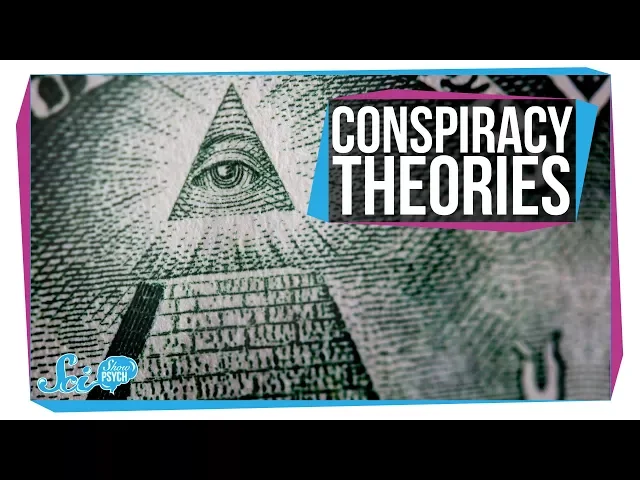
[INTRO ♪] You’d probably be surprised to find how many people actually think we have never been to the moon. They think a reflection on an astronaut’s visor or the American flag supposedly “blowing in the wind” prove that the 1969 moon landing was staged by NASA to win the Space Race. Which, to be clear, it was not.
But pretty much nothing you say is going to change a conspiracy theorist’s mind. A conspiracy theory is the allegation that a group of (usually powerful) people conspired to achieve some (usually evil) goal. To be fair, conspiracy theories aren’t always false.
Watergate, for instance, turned out to be real. The CIA really was giving LSD to people. But… a lot of them are pretty out there.
Like, the Earth is flat! The U. S.
government is hiding UFOs in Area 51! That kind of thing. With the internet spreading conspiracy theories faster than ever and making them more visible, more and more people are exposed to them.
And they can have a powerful effect on your behavior. Studies have shown that conspiracy theories can make people less likely to engage in politics, vaccinate their kids, or try to reduce their carbon footprint. So it’s pretty important to understand why people believe in these ideas even in the face of reasonable evidence to the contrary.
Fortunately, psychologists have done a lot of research on conspiracy theories in the past couple decades. Most recently, they’ve found a bunch of support for a hypothesis that’s been around for a while: illusory pattern perception, our tendency to see patterns that aren’t there. Pattern detection is hardwired into our brains.
Some researchers think it evolved as our ancestors foraged for resources that tended to clump together. It also helps us avoid danger: last time you smelled this funky odor, you got food poisoning, so maybe you shouldn’t eat that meat. But we might actually be too good at pattern detection.
If you’ve ever tried to memorize a bunch of digits of pi, you’ll know that random sequences often don’t look random to your brain. There’s plenty of research to back this up. We know that people see hot streaks in sports that aren’t there and that gamblers are more likely to see patterns in random sequences than other people.
And a study from 1997 found that subjects were more likely to rate strings of Xs and Os that were harder to split into patterns— and therefore harder to memorize—as being “more random,” even when they’d be considered less random in the mathematical sense. According to the researchers, that suggests that our sense of randomness is based more on how hard it is to mentally encode something, not how objectively random it is, and that something that’s easier to mentally process can stop feeling random. A 2017 study published in the European Journal of Social Psychology applied these ideas to conspiracy theories.
The researchers conducted five experiments, with 200-400 participants in each. In one experiment, people who saw patterns in a random series of coin flips were more likely to believe in an irrational experimenter-designed conspiracy theory. In another, they were asked to evaluate modern art paintings that were considered either “structured” or “chaotic.
” Those who saw patterns in the “structured” paintings— so, patterns that were actually there— weren’t more likely to believe in conspiracy theories. But people who saw non-existent patterns in the “chaotic” ones were. Looking for patterns that aren’t there might also affect your belief in conspiracy theories.
Subjects who were told to look for patterns in the random coin-flips were more likely to find them. Those who already believed in a conspiracy theory were more likely to see patterns in world events. And when subjects read an article that argued for a conspiracy theory, they were more likely to believe in other, unrelated, conspiracy theories.
So, illusory pattern perception might be the mechanism that causes people to believe in conspiracy theories, but why do they do it? It might be because we don’t like uncertainty. Studies have shown again and again that we’re more comfortable with events that are predictable and controllable.
So researchers think people use conspiracy theories to make sense of complex or upsetting events that don’t seem to have a good enough explanation. If something is too hard to process, you might look for other explanations. People are also more likely to form conspiracy theories in the wake of events that are impactful or threatening.
Your brain wants better explanations for things with bigger consequences. When the stakes are a beloved president’s death, it makes more sense to your brain for there to be some giant, elaborate explanation, like a Warren Commission cover-up, than something simple like a lone gunman. We’re all susceptible to illusory pattern perception, but there are some factors that predict whether someone is more likely to believe in conspiracy theories.
The biggest predictor for believing in a conspiracy theory is believing in another one. But there are more. One study found that subjects used their own sense of morality as a proxy for that of other people.
So they were more likely to believe that, like, scientists created AIDS, for example, if they thought that they themselves would have created AIDS. Political extremism is another factor. Researchers think it gives people a rigid perspective on societal change and makes them more likely to question the authority figures offering the explanations.
Having less education can also make people more likely to believe in conspiracy theories, but that’s at least partly because those with less education feel they have less control over their lives. This increases uncertainty, which in turn makes conspiracy theories more appealing. That might be something we can use to help defeat false conspiracy theories— by finding ways to help people achieve a sense of control over their lives.
Change is always hard, but reducing the uncertainty and fear it causes might mean people don’t need to search for better explanations where they don’t exist. Thanks for watching this episode of SciShow Psych. If you’re interested in learning more about why our weird human brains work the way they do, you can go to youtube.
com/scishowpsych to subscribe.