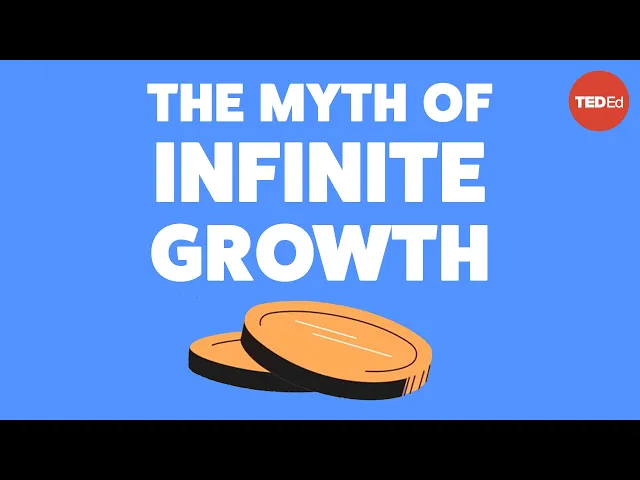
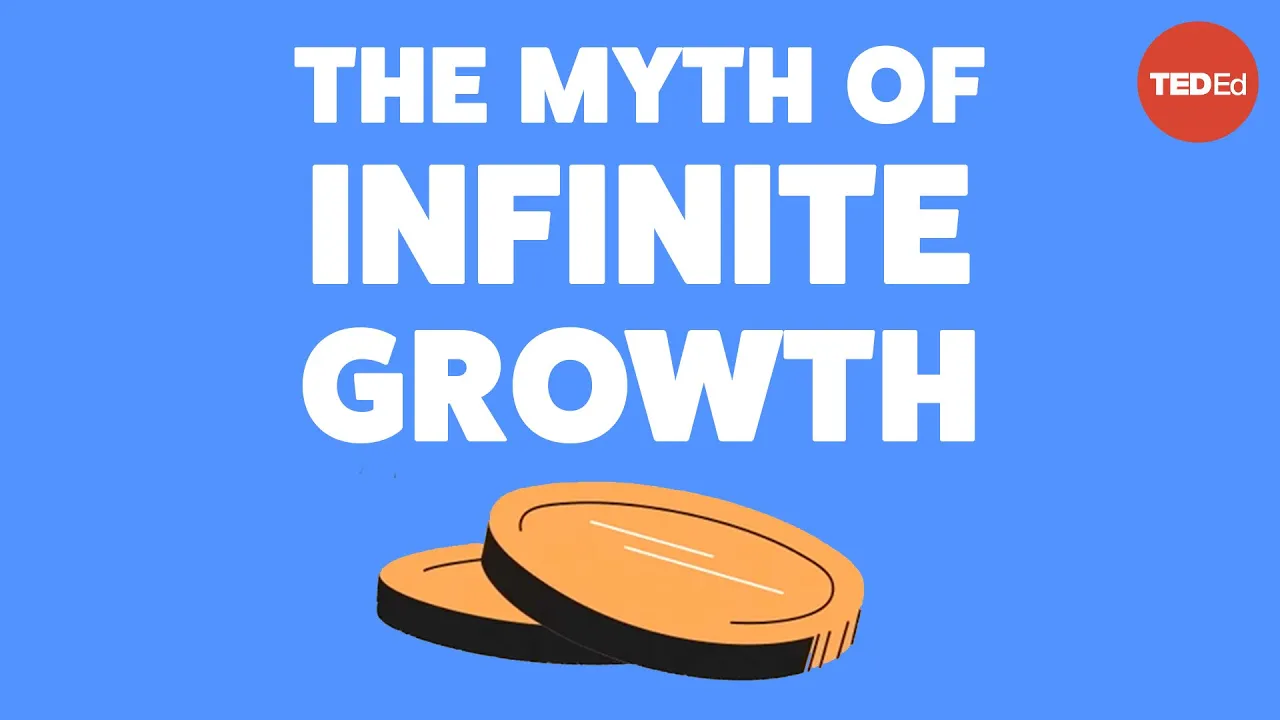
Let’s say you discover a magical gold coin that doubles every 25 years. 75 years later, you’d only have eight coins. But 1,000 years later, you’d have over a trillion.
And in just 4,600 years, your gold coins would outweigh the observable universe. This periodic doubling is an example of exponential growth, and while we’re not in any danger of discovering a real-life golden goose-coin, something almost as consequential has been growing like this for the past 200 or so years: the global economy. Many economists think that an eternally growing economy is necessary to keep improving people’s lives, and that if the global economy stops growing, people would fight more over the fixed amount of value that exists, rather than working to generate new value.
That raises the question: is infinite growth possible on a finite planet? We measure economic growth by tracking the total financial value of everything a country (or the world) produces and sells on the market. These products can help us meet basic needs or improve our individual and collective quality of life.
But they also, crucially, take resources to invent, build, or maintain. For example, this smartphone. It’s valuable in part because it contains aluminum, gallium, and silicon, all of which took energy and resources to mine, purify, and turn into a phone.
It’s also valuable because of all the effort that went into designing the hardware and writing the software. And it’s also valuable because a guy in a black turtleneck got up on stage and told you it was. So how do we grow the total financial value of all things?
One way is to make more things. Another way is to invent new things. However you do it, growing the economy requires resources and energy.
And eventually, won’t we just run out? To answer this question, let's consider what goes into the economy and what comes out of it: its inputs are labor, capital— which you can think of as money— and natural resources, like water or energy. Its output is value.
Over the past 200 years, economies have gotten exponentially more efficient at producing value. If we, as a species, are able to keep upgrading our economies so that they get ever-more efficient, we could theoretically pump out more and more value using the same— or, let’s be really ambitious here— fewer resources. So, how do we do that?
How do we increase efficiency? With new technologies. This is where we hit a snag.
New tech, in addition to making things more efficient, can also generate new demand, which ends up using more resources. We’re actually not in imminent danger of running out of most resources. But we have a much bigger and more immediate problem: the global economy, and in particular those of rich countries, is driving climate change and destroying valuable natural environments on which all of us depend— soil, forests, fisheries, and countless other resources that help keep our civilization running.
So, what should we do? This is where economists disagree. Most economists think that new ideas will be able to fix most of these problems.
They argue that, in the same way that exponentially increasing resource and energy use have fueled exponential economic growth, human ingenuity has also increased exponentially, and will rise to meet these challenges in ways that we simply can't predict. For example, between 2000 and 2014, Germany grew their GDP by 16%, while cutting CO2 emissions by 12%. That’s impressive, but it’s not cutting emissions fast enough to limit warming to 1.
5 degrees Celsius. For this reason and others, some economists think the solution is to reengineer our economies completely. They make the case that what we should really be doing is weaning ourselves from the addiction to growth and shifting to a post-growth economy.
What would that look like? A post-growth economy wouldn’t assume that the economy should grow; instead, it would require us to focus on improving what we really need— things like renewable energy, healthcare, and public transportation. To do that, post-growth economists suggest that rich countries should do things like guarantee living wages, reduce wealth and income inequality, and ensure universal access to public services, like healthcare.
In such an economy, people would be theoretically less dependent on their jobs to earn their living or get healthcare, so it might be more feasible to scale down production of things deemed less necessary. But this raises other questions: who gets to define what’s necessary? How would we resolve the inevitable disagreements?
Could we really do away with entire industries? The “we’ll come up with new ideas to solve these problems” approach can seem as realistic as, well, a magical gold coin. And the “we have to fundamentally change our economies” approach can seem politically daunting, particularly in rich countries.
One way or another, we have to find a way to benefit everyone while also taking care of our planet.