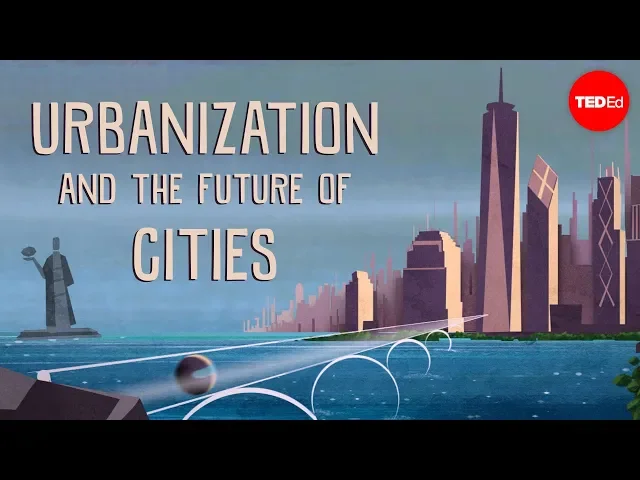
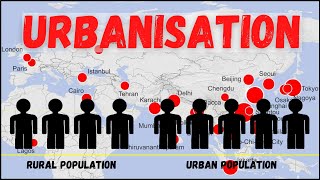
Today ,more than half of all people in the world live in an urban area. By mid-century, this will increase to 70%. But as recently as 100 years ago, only two out of ten people lived in a city, and before that, it was even less.
How have we reached such a high degree of urbanization, and what does it mean for our future? In the earliest days of human history, humans were hunter-gatherers, often moving from place to place in search of food. But about 10,000 years ago, our ancestors began to learn the secrets of selective breeding and early agricultural techniques.
For the first time, people could raise food rather than search for it, and this led to the development of semi-permanent villages for the first time in history. "Why only semi-permanent? " you might ask.
Well, at first, the villages still had to relocate every few years as the soil became depleted. It was only with the advent of techniques like irrigation and soil tilling about 5,000 years ago that people could rely on a steady and long-term supply of food, making permanent settlements possible. And with the food surpluses that these techniques produced, it was no longer necessary for everyone to farm.
This allowed the development of other specialized trades, and, by extension, cities. With cities now producing surplus food, as well as tools, crafts, and other goods, there was now the possibility of commerce and interaction over longer distances. And as trade flourished, so did technologies that facilitated it, like carts, ships, roads, and ports.
Of course, these things required even more labor to build and maintain, so more people were drawn from the countryside to the cities as more jobs and opportunities became available. If you think modern cities are overcrowded, you may be surprised to learn that some cities in 2000 B. C.
had population densities nearly twice as high as that of Shanghai or Calcutta. One reason for this was that transportation was not widely available, so everything had to be within walking distance, including the few sources of clean water that existed then. And the land area of the city was further restricted by the need for walls to defend against attacks.
The Roman Empire was able to develop infrastructure to overcome these limitations, but other than that, modern cities as we know them, didn't really get their start until the Industrial Revolution, when new technology deployed on a mass scale allowed cities to expand and integrate further, establishing police, fire, and sanitation departments, as well as road networks, and later electricity distribution. So, what is the future of cities? Global population is currently more than 7 billion and is predicted to top out around 10 billion.
Most of this growth will occur in the urban areas of the world's poorest countries. So, how will cities need to change to accommodate this growth? First, the world will need to seek ways to provide adequate food, sanitation, and education for all people.
Second, growth will need to happen in a way that does not damage the land that provides us with the goods and services that support the human population. Food production might move to vertical farms and skyscrapers, rooftop gardens, or vacant lots in city centers, while power will increasingly come from multiple sources of renewable energy. Instead of single-family homes, more residences will be built vertically.
We may see buildings that contain everything that people need for their daily life, as well as a smaller, self-sufficient cities focused on local and sustainable production. The future of cities is diverse, malleable, and creative, no longer built around a single industry, but reflecting an increasingly connected and global world.