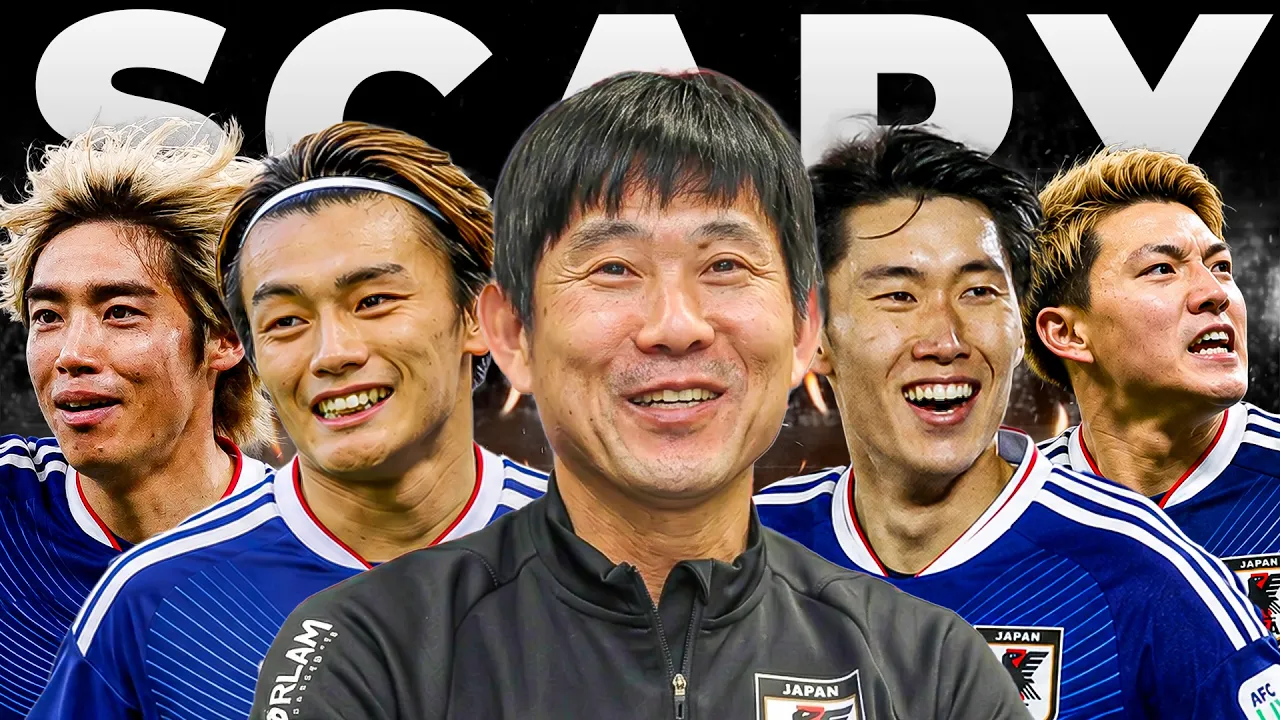
This Japan team is not just the greatest Japanese side of all time. It might be the greatest Asian team ever to play at a World Cup. And trust me, they've been sending warning signs for a long time.
Japan won all six matches in the first round of qualifying and then won seven of 10 in the next stage, losing only once. That's impressive enough on its own when you consider the travel, the different climates, and the variety of opponents they had to face across Asia. But being the best team in Asia is no longer enough for this generation.
What really turned heads was what happened afterwards. Japan put together a six-match winning streak in friendlies, including massive victories over England and Brazil. In many ways, those results mattered even more than qualifying with games to spare because they proved something important.
This team genuinely believes it can beat anyone. Japan has the potential to become the greatest team Asia has ever produced. They're one of the hottest and most informed teams in the world.
They have the greatest accumulation of talent that any Asian squad can offer. To me, Japan is the team. And a huge part of that belief comes from one man, Hajime Morasu.
Pay attention because he is the real genius behind this Japanese revolution. In 2022, Japan shocked the football world by beating both Germany and Spain at the World Cup. In 2023, they traveled to Germany and beat Germany again on their own soil.
In 2025, they defeated Brazil for the very first time in their history. And now, in 2026, they delivered a memorable performance against the Netherlands and recorded the biggest World Cup victory Japan has ever achieved. Morasu has done such an incredible job that he became the first manager in Japanese football history to earn a contract renewal from the Federation.
And when you look at the squad he has available, you start to understand why. Dai Kamada, one of the driving forces behind Crystal Palace's Conference League triumph, has been outstanding at this World Cup. He controls the rhythm, creates chances, and is deadly when arriving from deep positions.
Kato Nakamura has emerged as a fearless left winger, constantly attacking defenders and stretching back lines. He already has a goal and an assist in the tournament. Then there is Takafuza Kubo, the creative genius of this team and arguably the most dangerous one versus one player in the entire squad.
Ritsu Doan brings relentless verticality and attacking threat from the right wing while Ayasi Wa continues to prove why he is Japan's main striker. Already scoring twice at this World Cup and the defense is just as impressive. Takahhiro Tomyasu remains the defensive rock of the team.
Combining versatility with elite defensive instincts, Hiokiito gives Japan physical presence, composure on the ball, and the experience of playing for Bayern Munich. And at the heart of it all stands Ku Itakura, the captain and leader of the backline. And what makes this even more impressive is that Japan have been hit hard by injuries.
Captain Wataru Endo was forced to withdraw from the squad this week, while the loss of Kawaru Mtoma due to the hamstring injury he suffered playing for Brighton against Wolves in May was another massive blow. And if that wasn't enough, Takumi Minamino also went down with an ACL injury. For most national teams, losing players of that caliber would be devastating.
But the fact that none of those absences have completely derailed Japan's ambitions and that they have still looked like one of the most solid teams in the entire World Cup through the opening two match days says everything about how far Japanese football has come. So yes, when you look at the tactical structure, the quality of the squad, and the level Japan have shown so far in this World Cup, this is not a team that came here simply hoping to have a good tournament. This is a team that genuinely believes it can bring the World Cup to Tokyo for the very first time.
Don't believe me? Take a look at this. To understand why Japan can genuinely win the World Cup, we need to look at the journey that brought them here.
Because this didn't happen overnight, Japan's rise has been one of the most impressive football stories on the planet. Today they are considered one of the biggest powers in Asia, but it actually took them 10 attempts before they finally qualified for their first World Cup. And yet once they got there, they never missed another one.
Their first appearance came at France 1998 after FIFA expanded the number of qualification spots available for Asian nations. Japanese football had already been growing since the 1960s, but it took more than three decades before the Samurai Blue finally reached the biggest stage in the sport. France 1998 was a harsh introduction.
Japan competed bravely but couldn't get the results they needed. In their historic World Cup debut, they lost one to zero to Argentina thanks to a goal from Gabriel Batistuta. Against Croatia, they pushed hard for a result before Darvuka broke their hearts late on.
Then came a 2 to1 defeat against Jamaica in their final match. But even in defeat, there was history. Masashi Nakayyama scored Japan's first ever World Cup goal.
Four years later came Korea Japan 2002. As co-hosts and reigning Asian champions, expectations were sky-high and for the first time, Japan delivered. They earned their first World Cup point with a thrilling 2 to2 draw against Belgium.
Then Yunichi Inamoto scored the winner against Russia, giving Japan their first ever World Cup victory. A two to zero win over Tunisia secured top spot in the group and sent Japan into the knockout rounds for the first time in history. The dream ended in the round of 16 against Turkey, but Japanese football had taken a huge step forward.
Germany 2006 was supposed to be another leap. Instead, it became a disappointment. Japan started brilliantly against Australia, taking the lead through Shunke Nakamura, only to collapse late and lose 3 to1.
A goalless draw against Croatia followed and then Brazil crushed them 4 to1. The samurai blue were heading home after the group stage once again. Then came South Africa 2010 and once again, Japan responded.
KK Honda announced himself to the world by scoring the winner against Cameroon. Despite losing narrowly to the Netherlands, Japan bounced back with a huge 3 to1 victory over Denmark to reach the knockout stages against Paraguay. Japan battled through 120 minutes before the match went to penalties.
Unfortunately, Yuichi Kamano missed. Paraguay converted all five of theirs and Japan's dream ended in heartbreaking fashion. Brazil 2014 was a major setback.
After qualifying comfortably and arriving as Asian champions, Japan were expected to challenge for the knockout rounds again. Instead, they collapsed. A painful defeat to Ivory Coast after leading the match, a frustrating draw against Greece, and a heavy loss to Colombia saw Japan finish bottom of the group.
It was arguably their most disappointing World Cup campaign. Then came Russia 2018. Japan opened with a massive win over Colombia before drawing 2 to2 against Senagal thanks to another crucial contribution from KK Honda.
The final group match produced one of the strangest moments in World Cup history. Japan lost one to zero to Poland. in by Kuzawa.
Sagal lost one to zero to Colombia. Already taken and here's a header and both teams finished level on points, goal difference and goals scored. Japan advanced purely because they had received fewer yellow cards.
But the real drama came against Belgium. Japan shocked the world by taking a two to zero lead through Genki Haraguchi and Tekashi Inui. For a moment, the quarterfinals were within touching distance.
Then Belgium came roaring back three goals later, including a devastating winner in stoppage time. And Japan's dream was shattered once again. And then came Qar 2022, the tournament that changed everything.
For years, Japan followed the same pattern. A group stage exit followed by a round of 16 appearance. Qatar finally broke that cycle.
Drwn into one of the toughest groups imaginable. Japan produced two of the greatest results in their football history. First, they came from behind to beat Germany 2 to1.
Then after a shock defeat to Costa Rica, they somehow did it again against Spain. They trailed at Halime before producing another stunning comeback to win 2 to1 and finished top of the group ahead of both European giants. For the first time ever, Japan weren't just surviving at the World Cup.
They were beating world powers. The reward was a round of 16 clash against Croatia, the reigning runners up. Once again, Japan stood on the edge of history.
Daizen Maida gave them the lead. Croatia equalized through Ivan Perishic. Extra time couldn't separate the sides.
And then came penalties just like in 2010, just like against Paraguay. And once again, heartbreak. Croatia won the shootout and Japan's dream of reaching a World Cup quarterfinal remained unfinished.
But here's the thing. Every World Cup has brought Japan a little closer. From first goal to first point, from first win to first knockout qualification, from competing to beating Germany and Spain, from hoping to believing.
And now, for the first time ever, Japan arrive at a World Cup not as outsiders looking for a miracle. They arrive believing they can win the whole thing. The evolution of Morasu's Japan didn't stop after the 2022 World Cup, even with the disappointment of falling short in the Asian Cup.
In fact, that setback only seemed to make them stronger. Japan finished top of their World Cup qualifying group ahead of Australia and Saudi Arabia and then sent another warning to the football world by beating Germany and Brazil in friendlies. They even traveled to Britain and defeated both Scotland and England during the March international break.
At that point, it became impossible to ignore what was happening. Japan were no longer just Asia's best team. They were becoming a genuine threat on the world stage.
A huge reason for that is Hajime Morasu. Without a doubt, Japan are one of the best coached teams at this World Cup. Morasu has built a tactical system that has become absolutely deadly.
His biggest weapon is simple but brilliant. He constantly drags opponents out of position and punishes the spaces they leave behind. One of the most effective tools used by elite teams is pulling defenders away from the backline by dropping attackers deeper.
Japan do something slightly different. Instead of relying only on their forwards, they often use their midfielders dropping into deeper positions to lure opposition midfielders forward. That movement creates gaps in the middle of the pitch.
And once those gaps appear, Japan attack them mercilessly. The beauty of the system is that while one or two midfielders drop to receive the ball, the attacking players stay high and ready to exploit the spaces that open up. The result is a team that constantly creates passing lanes and overloads all over the pitch.
A perfect example came against Scotland. Watch how Ritsu Doan gradually drags his marker out of position. That movement creates space for Junior Itto to attack.
Suddenly, Japan are combining through the middle with Ayasi Weda, finding Kato Nakamura in space, switching play to Kubo, and then activating the overlapping run from the left back. Kubo spots the movement instantly, slides the ball into the box, and Japan do what they do best, find tiny pockets of space where nobody else can. The ball eventually reaches Junior Itto and he buries it.
Goal. And that's the scary part. These patterns completely destroy defensive blocks against England who tried pressing high.
Japan responded brilliantly. AO Tanaka won possession from Cole Palmer. But the important detail is what happened next.
Palmer was trapped by four Japanese players. Three quick passes later, England's midfield block was gone. Two more touches and Japan were already inside the English penalty area.
Goal simple, ruthless, devastating. These transitions are pure poison at a World Cup. Tunisia couldn't live with them.
Time and time again, Japan moved the ball from their own half into the opposition box with just two or three firsttime passes. And once they arrive in the final third, they become experts at finding those tiny spaces defenders struggle to protect. That's exactly how Dai Kamada scored.
The second goal came from the same principle. Kamada found UA between the lines and immediately Tanaka, Dan, and Nakamura burst forward to drag defenders away. Those movements bought UA the extra second he needed to unleash a brilliant long range finish.
It was executed perfectly. And if anyone still doubted them, just look at the third goal. Three touches.
Tanaka to Kamada. Kamada receives in the final third and without even looking releases Itto through on goal. One-on-one with the keeper.
Finish goal. But Japan are not just dangerous in transition. They have solutions for every situation.
Their aerial game is excellent. Their movement inside the box is outstanding. We saw it against Brazil, the Netherlands, and Tunisia.
Their positioning is almost flawless, and their longrange shooting is another major weapon. They punish teams with it throughout qualifying and both the Dutch and Tunisia have already suffered from it at this World Cup. That's why this might be the best coach team in the entire tournament.
Everything Japan do feels organized, rehearsed and incredibly efficient. What makes it even scarier is the level of talent they have available. Players like Takahhiro Tomyasu at Arsenal, Wataru Endo at Liverpool, Takafuza Kubo at Real Sociad and Dichi Kamada at Crystal Palace bring experience from the highest level of European football.
The numbers back it up as well. Japan average around 90% passing accuracy, allowing them to build attacks at speed without exposing themselves defensively. They have produced dominant results consistently, including a 6 to0 win over Indonesia, a 6 to1 victory against Hong Kong, and now a 4 to0 demolition of Tunisia at the 2026 World Cup.
Their opening matches in this tournament have shown exactly how mature this team has become. They came from behind to earn a brilliant 2-2 draw against the Netherlands and then dismantled Tunisia 4 to0. That extended their unbeaten run to eight consecutive matches.
And that's the biggest difference with this generation. Japan are no longer arriving at World Cups hoping to compete. They are arriving expecting to dictate games against the biggest nations on the planet.
The spirit, belief, and collective determination of this squad show that they are no longer playing to reach the knockout rounds. They are playing to challenge for the trophy itself.