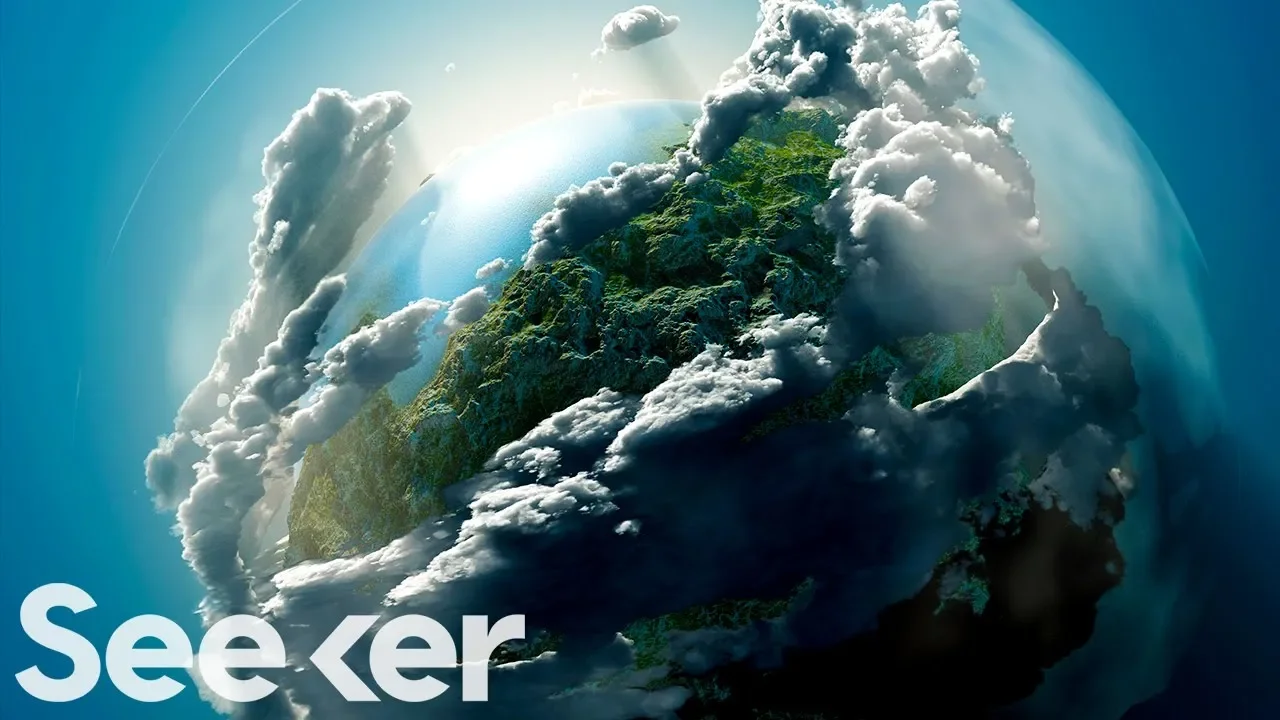
Through the history of space exploration so far, we’ve debated where the earth’s atmosphere ends, and space begins. And your surprise for the day is that according to newly unearthed observations, our atmosphere is way bigger than we ever thought. Like it goes past the moon.
We’ve mostly defined space as the vast expanse of the rest of the universe that exists past the Kármán Line, which exists roughly 100 kilometers above mean sea level. Now according to Federation Aeronautique Internationale—the organization officially in charge of determining these kinds of rules—after the Kármán line, you are in space. The reasoning behind this is after 100 kilometers, the earth’s atmosphere becomes too thin for a conventional aeronautic vehicle like an airplane to stay in flight without reaching orbital velocity—so you have to switch to more specialized astronautic vehicles.
But if you thought this was gonna be simple—it’s not. Even though the FAI’s Karman line designation is commonly recognized, there’s actually no official international consensus over where space technically begins. Some astrophysicists say it should actually be 80 kilometers above the mean sea level because of the way that orbital momentum acts on satellite objects.
NASA and the U. S. air force also define space as starting about 80 kilometers above the Earth’s surface, and those who cross that line officially become astronauts.
OK, so the definition of space is up in the air, but what even is the atmosphere? Yes, it’s the bubble of gases that shield and insulate the earth from the aggressive radiation of the sun and the cold dark depths of space, but like most complex things, it’s got layers: The troposphere, with all our fun weather and necessary gases for breathing and surviving; The stratosphere, where commercial airlines fly when possible because there’s usually less turbulence; the mesosphere, where most meteors burn up and the highest layer at which clouds can form; Then comes the thermosphere, which is where that tricky Kármán line lives—this is where astronauts begin to experience weightlessness, and is where the ISS orbits! That means that technically, our most commonly defined line of where space begins is still in Earth’s atmosphere.
And then finally, there’s the exosphere, the final layer between us and outer space, made up of super spaced out hydrogen and helium atoms slowly dissipating out to nothing up to 200,000 kilometers away from earth’s surface. . .
or so we thought. We actually haven’t previously really known where the exosphere ends and outer space begins, we just know that those extremely sparse gases gradually fade out into a vacuum. But a team of astronomers has recently dropped a total bombshell.
When the cloud of gases in the exosphere reflects the Sun’s UV light, it creates a luminosity, a glow that we can see, called the geocorona. These new observations of the geocorona indicate that the exosphere may extend up to 630,000 kilometers away from earth—a distance that includes the moon! So technically, the moon is in the Earth’s atmosphere!
This realization is thanks to an instrument called the Solar Wind Anisotropies Instrument, or SWAN. SWAN was able to measure and analyze the full extent of the geocorona, making us think about our atmosphere in a whole new way. See, sunlight interacts with the hydrogen atoms of the exosphere at a wavelength called Lyman-alpha radiation, which is something astrophysicists can measure when looking at cosmological structures in deep space.
Observing Lyman alpha radiation can tell us about the distribution of matter in space, and help us think about how the universe expanded. It’s also a wavelength that’s absorbed by the inner layers of our atmosphere, so we can’t see it from Earth. But from SWAN’s position in space, it was able to see and measure both--and it extended far beyond what we were expecting.
So while this discovery is remarkable in many ways, not the least of which is that technically no one has ever left earth’s atmosphere—it won’t change space travel for us in most practical ways. It’s far more important for informing the future of our observations of space. The new results also show that sunlight compresses the hydrogen atoms of the exosphere, producing pockets of denser geocorona, with the corresponding Lyman alpha radiation, depending on the sun’s position.
So space telescopes that make measurements from within the confines of the exosphere will need to take a new Lyman-alpha baseline level--and the bunching of the geocorona--into account when observing the night sky. . .
hopefully letting us peer further, and with greater accuracy. One last amazing thing about this piece of information is that this isn’t even new research—these observations were made by SWAN in the late 90’s, and were only JUST dug out of the archives for further analysis! !
What other startling discoveries could be lurking in a cupboard somewhere? Make sure to subscribe for all your space updates, like this video here. Thanks so much for watching and I’ll see you next time on Seeker.