So, let me uh let me show you guys real quick. Congrats everybody on that trade. Make sure you post your wins.
Let me show you the two ways to do a runner. And then Josh, maybe we can clip this or something. Clip it.
So, there's two ways to do a runner. First way is let's say that you are in four contracts. And what you do at the takerit is you take two.
So you're in four and you close two of your contracts right here. So you can just modify your your um entry. Just click on the number.
You can modify that. Okay. So you got two left.
The two ways to do it are number one, leave your stop loss where it is. Take profit when happy. Okay.
So, let's just say that we push up a little bit. Say we push up to here and you're looking at the profit and you're saying, "Yeah, I'm happy with that. " You just close the trade.
Does that make sense? Stop loss stays where it is. Okay.
The second way is to do this. You take your stop loss. You put your stop loss at break even or a hair above break even so that no matter what you win the trade and you do the same thing.
You take your profit when you're happy. This is not the same as a trailing stop. There's a big difference between what I just showed you and a trailing stop.
What I just showed you was how to take a runner or how to have a runner. Okay? You don't have to wait for hours and hours and hours.
You can get an extra 50 ticks, 80 ticks, 100 ticks, whatever. Whatever. Where's the order on the chart?
So, let me just show you just for the for shits and giggles. I'm just going to buy. And let's say your takerit is going to be right here.
This is how you do it. What you would do is if you wanted to have a runner, you would take this right here. You would change this to a one.
Okay, that's how you do it. And then make sure your stop loss is also the same as this number up here. That's how you do it.
So, I got into a trade. This says two. And then or or five or whatever.
And then you're going to close out some of them at take profit at that 100 tick. Does that make sense? Okay.
So, how this is not a TSL, a TSL, a trailing stop-loss is when you are, let's say this is the this is the price movement. What you're trying to do is you're trying to just like keep this behind it a little bit. this goes up and you go up a little bit more and then this goes up and then you move your stop loss a little bit more.
That's a trailing stop loss. Problem with that is that when price moves it does this. So you're always going to get stopped out.
So let's just look at any normal. Let's just look at this. Let's say that you were trying to trail during this.
Okay, we we go like this. Come on. Okay, we come down.
You would have hit your stop loss. Hit your stop loss. Hit your stop loss.
Hit your stop loss. You You would have hit your stop loss four or five times here if you were trying to trail this versus, you know, same thing versus like keeping your let's just say you have your stop down here. You just let it run and you take profit when you're happy.
Does that make sense, guys? >> Very good explanation, Jordan. >> Anybody not Does that not make sense for anybody?
>> Amy, you in here today? >> She was. I know she had to take a phone call.
>> No, probably just in time for us to go over this >> for trailing stop. Do you choose the tick trailing? >> I don't know what you mean.
do it just like I showed you. [snorts] So, I manually open my orders. Manually open my orders that I manually rightclick.
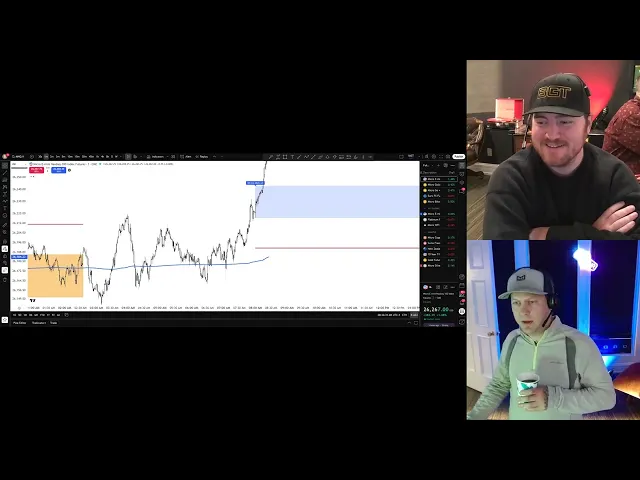
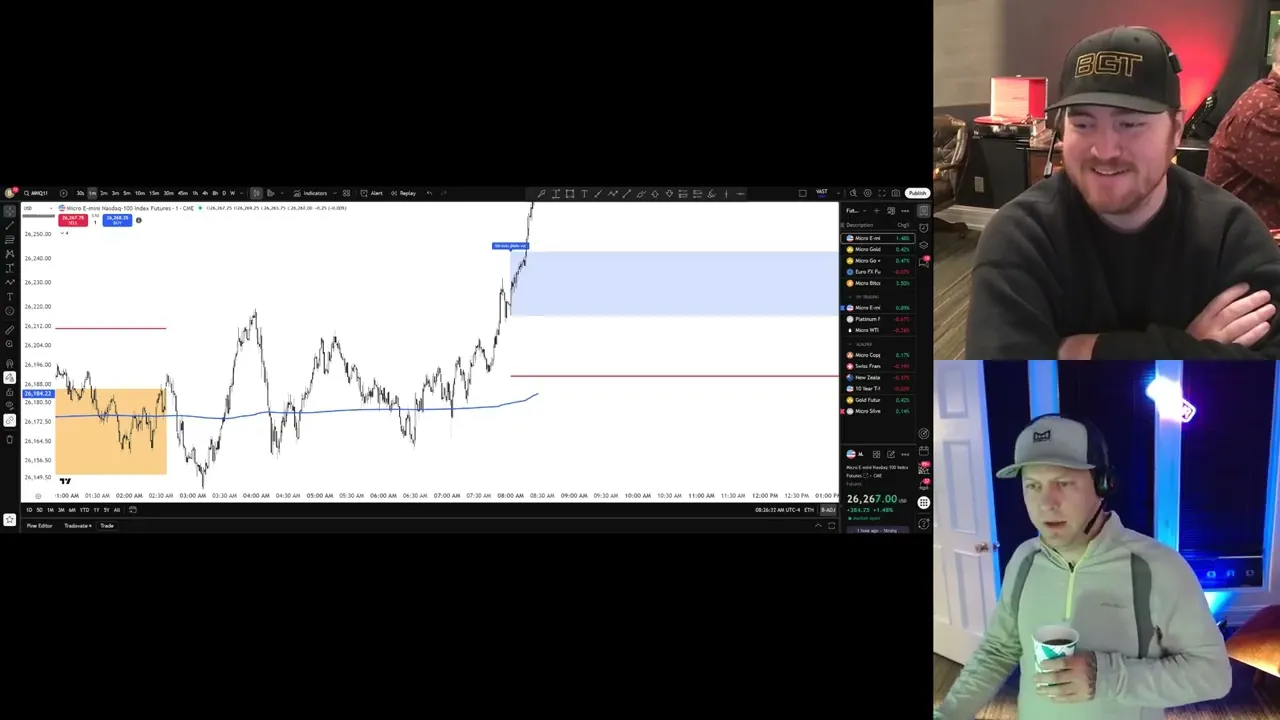
So, guys, if you were doing a runner right now, which maybe you are, your stop loss is either going to be down here or potentially you moved it to break even, which would been like right here. Your stop loss should not be up here. Cuz I bet you I bet you we're going to dip down, come up, dip down, come up.
That's just how price moves. Here's another good example of why you can't do a trailing stop. Okay, say you were going short.
This pullback, you get stopped out. This pullback, you get stopped out. This pullback, you get stopped out.
See what I'm saying? This is how price moves. So, runners and runners and trailing stop are are very different.
Yeah, I do. You can do it. I do do a TP manually typically.
Yeah. Uh he said I'd probably move the stop loss to break even. You can um I would encourage you to kind of back test a little bit because what you'll notice is that uh let me find a better example.
Here's a great example. Let's say you move your stop loss to break even. It's right here.
[snorts] Well, you're going to get stopped out. That's actually probably not a great example. H I don't see a great example on my screen yet.
Yeah. So, if you want to play it really safe, like let's say you're getting close to passing a prop, the closer you get, the safer you want to be. So, if you want to play it safe, then yes, you move your stop to break even.
But just understand that it's gonna it it retesting our box is very normal. So you probably will get stopped out a lot. I wouldn't So I'm not talking about entering a new trade, guys.
I'm not talking about entering a new one. So what I showed you a second ago was as follows. You entered with, let's just use five.
You enter with five and let's say that your takerit is three. The remainder is going to be two Wednesday. That's a good day to show this.
>> Yeah. Does this make sense though? >> Done in the past.
Price retest entry. Yep. That's why I I keep mine typically at the bottom.
Where would you enter a new trade after winning the first? Uh, we wouldn't. We wouldn't.
We typically do one and done. Um, I wouldn't enter until the next session, which should be at night. Wednesday, you say?
>> Yep. Wednesday. Wednesday morning.
>> Mhm. >> Let's just take a peek here. >> You talking about the lung?
You talking about? >> No. Are you on >> Wednesday 29th?
Oh, I'm looking at gold. That's what it is. >> Oh, what the heck, man?
Let's Let's take a peek at gold real quick. Gold loves to do a retest. It's Thursday.
Let's take a peek at Wednesday. Aha. All right.
So, here's a good example. You go short. >> [snorts] >> So, let's go short.
Come down. Say you go short here. Your stop loss is up here above this wick.
So, you're going to hit your profit down here at some point. There it is. Probably that probably wicked it.
>> That Yeah, that was that was TP. >> All right. So, here's your TP.
So, in this scenario, let's say that you peeled off five. So, your TP was five. You got five open still.
If you put your stop loss down here at break even, it'll it'll it would have hit it right there. Session. No, >> you mofo.
Let's just watch it play out, though. Of course, it disconnected. So, we're still in it.
We're still in it. This is where people panic. Now, I'm probably personally not in this trade this long, but it will come back down.
So, now you got an extra 100 ticks, guys. You know, now now you just close the trade. [snorts] How do I how how to do I protect my profits when using a runner?
Well, so there there's the two ways that I mentioned. Number one is you leave the stop loss where it is and you take your profits when you're happy. The second way that I showed you guys was moving the stop loss to break even.
That's how you protect your profits. So, if you are again, if you're getting closer to passing a prop, if you are closer to failing a prop, either or, you probably want to keep your stop loss at break even. If it's just a normal day, you know, you're good, you know, you're up on your account, you like the price action, you like the movement of the market, then leave it leave it up above.
Cool. Makes sense.