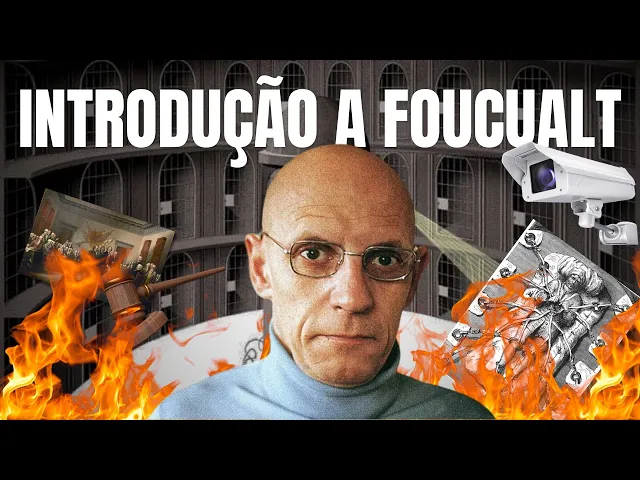
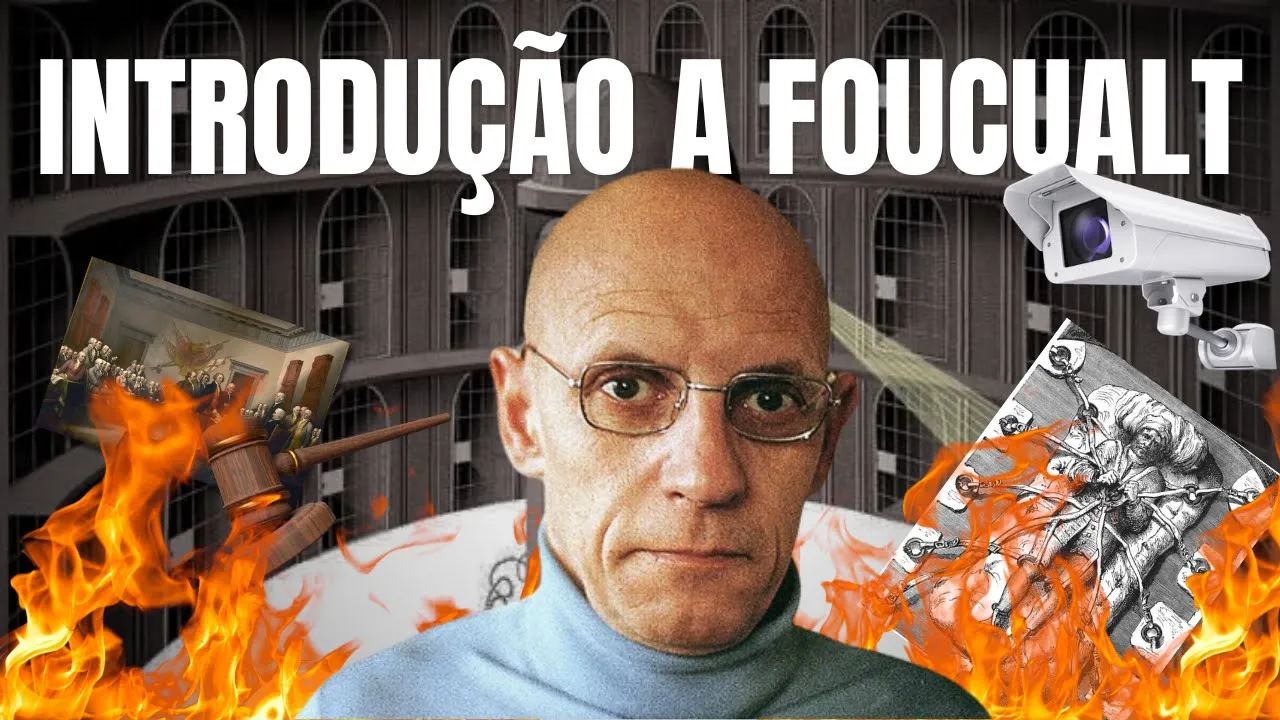
Let's talk about Michel Fou. Foucault was an heir to Niet in the 20th century . Foucault makes a radical interpretation of Niet.
Foucault takes the notion of power games, a dynamic of forces in individuals and society, and takes it to its ultimate consequence, attacking above all the institutions of Western society, showing that there are ways of coercion that are not very obvious and ways our lives are manipulated. by society. I am not here to endorse Fou's thinking, nor to reject it or bash it, as many people do , because his philosophy is naturally provocative, like many others, like philosophy itself.
And I don't believe Foucault wants these institutions to be abolished. Obviously not. He isn't saying there shouldn't be schools, there shouldn't be this, there shouldn't be that.
He is just showing how, even in the most everyday and important situations, we can find power dynamics. I can see that Foucault, even though I am not here to propagate his philosophy or promote it as a form of propaganda. That is not what I do with philosophers as an eclectic thinker.
I look in each of them for how I can learn. And in my day-to-day life, there are situations where I can also learn from Michel Fou. So I am going to share with you a clip from my lecture on Foucault from my Philosophical Education course, which is my main product, the project I made with the greatest care and which covers the entire history of philosophy.
If you like the lecture, consider signing up for the course, as it now costs R $ 297 , and you can pay in up to 12 installments of 24. 75. So, it is a very affordable opportunity that you won't find equal to ensure for your future an in-depth and high-quality guide to the entire history of philosophy.
whenever you want to study, with lifetime access and also with a 7-day guarantee, with the option to pay in up to 12 installments. So, watch a clip of the lecture, leave your opinion, and if you like it, take advantage of the fact that the month has turned and secure your philosophical education. Now we can talk about Michel Foucault, who was also another important French thinker, who will act as an activist, and will be quite militant throughout his life.
Homosexual, he dies of AIDS in 1984, at age 57. He had time, however, to write works and give lectures that would impact culture and continue to impact the human sciences, from philosophy to literature, to criminal law and beyond. He came to Brazil several times, including during the Medici administration, to give lectures on repression and control at PUC Rio, for example.
And Foucault will be a great son of Nietzsche, so to speak. He will also have a certain Marxist influence in his thought, but not in the traditional sense. Marx and Hegel believed that historical changes were promoted dialectically.
There was a meaning, a teleology there. Foucault will agree with Marx that there is no absolute spirit behind this, no metaphysics, but he will disagree with Marx by saying that these changes are not dialectically produced. In fact, they are the fruit of idiosyncratic, random, and complex curiosities that cause one era of thought, one paradigm of thought, to give way to another.
So, what we know as truth, as knowledge, was different in antiquity, different in the Middle Ages, different in the Enlightenment, and different in contemporary times. And like him, he also thinks that things are not absolute, there is no absolute, everything is in transformation. Being heavily influenced by Nietzsche, he will think that knowledge is not something neutral.
There is a relationship with impulses, with forces , with the will to power. He will provide a radical reading of Nietzsche, promoting the will to power as a fundamental engine of human actions. And he will criticize society based on this typically Nietzschean suspicion.
He will even borrow the term genealogy from Nietzsche, from The Genealogy of Morals, to create a genealogy of power, seeking to trace the roots of power relations. And Foucault, he releases the work History of Madness in '61, which gives him a certain prestige. We will return to it, but his most impactful work is The Order of Things from 1966.
In this work, The Order of Things, an archaeology of knowledge, Foucault argues that there are rules that fix our behavior and our way of thinking. And these rules are established by historical conditions. There is the influence of Marx in his thought too, not just Nietzsche.
And thus, the very notion of man, for example—he, performing his archaeological process, argues that it is a notion from the beginning of the 19th century, heavily influenced by the Kantian turn in philosophy with its emphasis on the subject, on free, autonomous subjectivity. Before that, this question wasn't even raised, right ? So man is created by the Enlightenment.
And he says more: man is close to ending, right? Man was not only created recently, but he is also on the verge of being surpassed, perhaps like a bridge. We can look at today's world and how the transformations with artificial intelligence studies and the very notion of subjectivity with new philosophies and new scientific research.
surrounding the very notion of science. The work of Bruno Latour, which we will see, speaks a lot about this, the boundaries of subjectivity, agency, consciousness, which were once so clearly demarcated like the one between nature and culture, are now also unraveling, becoming more complex. So, Foucault was already pointing to this and he would say: "Man is neither the oldest nor the most constant problem that has challenged human knowledge.
" So he says that doing the genealogy of power, now making the transition from the archaeology of knowledge to the genealogy of power, he will say that power incites resistance, which Foucault defends as a way of rising up against bourgeois domination. One of the most interesting concepts is the concept of biopolitics, of how there are government policies, for example, that seek to manage people's behavior and shape them to some extent, to administer them, to administer the biological life of people with public health policies and all that. The pandemic could be an example of this.
He also speaks of the microphysics of power. What is the microphysics of power? In History of Madness, back in 1961, he had already pointed out that the categories of insanity and sanity are not something natural, as he comes from this Nietzschean tradition that there are no absolute facts, everything is contextual.
So this is a construction, this is established at some point. And he says that the category of the insane, of the mad, was created as a way of coercing what was previously free. And it was not treated in that way.
The mad, those "mad" in quotation marks, were objects of curiosity, sometimes even humor, and were not as repressed, isolated, and controlled as they are in late modern society, which claims to be rehabilitating them, helping them, but Foucault will say that in reality, they are mistreating, controlling, abusing, and disciplining them, in a relationship that can be established with Erasmus in the Renaissance, when he writes his In Praise of Folly. Foucault described the existence of disciplinary micropowers, not only in a psychiatric asylum, which would be an institution of coercion, but also the school system can be a form of micropower, where teachers and coordinators exert control over students with their disciplines, assessments, and rules. Media and advertising exert micropowers by promoting specific beauty standards that shape our perception of our own bodies.
And that's where we get into another very influential work by Foucault, which is this one, Discipline and Punish, a 1975 work, Discipline and Punish: The Birth of the Prison, where Foucault addresses the modern and contemporary penitentiary institution, right? He begins in a very shocking way , talking about a public atrocity that happened in France in the 18th century, when the peasant Damiens was dismembered by six horses in a public square with many spectators after he tried to stab the king. The king, actually, they say the king protested against this, but he had no control because the clergy and many people around him said this was the only way to show what happens when someone challenges the idea that the king is divinely chosen.
This was decades before the French Revolution, right? So , Damiens, while still alive, had his whole body torn apart by horses. And Foucault uses this narrative to show how physical punishments were once public spectacles and people rejoiced in them.
He conducts a historical analysis that traces the shift, therefore, from punitive practices of torture and public execution to the emergence of prison institutions. There are even many stories about Foucault, how Camus and many other intellectuals were against the death penalty, which was still in effect in France in the 20th century, during their time. And Foucault was called upon to protest against the death penalty and he agreed .
Of course, let's protest against the death penalty. It's a great idea. And then he supposedly added, right?
And why don't we protest against all punishments? So, it shows you how his thinking goes in a direction that is very radical for many people. He explores how the prison, with its strict rules, isolation, and regular routines, aims not only to punish, but also to reform and control.
to shape the bodies of the prisoners and the way they think. It is a new form of social control, where power is exercised in a more subtle and disciplinary manner. So he talks about panopticism, which was a concept developed by Jeremy Bentham, an English thinker from the time of utilitarianism, and it worked more or less like this.
It was a very large circular prison. And the cells were all visible and there was a guard's booth, for the observer, but this booth was not transparent. So no, the prisoners who were always watched, who would always be on display to be watched, didn't know when they were actually being watched by the guard.
And this created another form of coercion, of self-discipline, of forcing them to discipline themselves. And Foucault is going to criticize this. I will now read some passages from the book " Discipline and Punish.
" Bentham's panopticon is the architectural figure of this composition. The principle is well known. At the periphery, a ring-shaped building; at the center, a tower.
This is pierced by wide windows that open onto the inner face of the ring. The peripheral building is divided into cells, each traversing the entire thickness of the building. They have two windows: one to the inside, corresponding to the tower windows, and another looking out to the exterior.
This allows light to pass through the cell from one side to the other. It is enough, then, to place a watchman in the central tower and, in each cell, lock up a madman, a patient, a convict, a worker, or a schoolchild. By the effect of backlighting, one can perceive from the tower, silhouetted exactly against the light, the small captive figures in the peripheral cells , so many cells, so many small theaters where each actor is alone, perfectly individualized and constantly visible.
The panoptic device organizes spatial units that allow for seeing without stopping and recognizing immediately. In short, the principle of the dungeon is inverted. Or rather, of its three functions—to lock up, to deprive of light, and to hide—only the first is retained, and the other two are suppressed.
Full light and the gaze of a watchman capture better than the shadow that, in the end, provided protection. Visibility is a trap. And further on, he says: hence the most important effect of the panopticon, to induce in the inmate a state of conscious and permanent visibility that ensures the automatic functioning of power.
To make surveillance permanent in its effects, even if it is discontinuous in its action. That the perfection of power tends to make the actual exercise of it unnecessary. That this architectural apparatus should be a machine to create and sustain a power relation independent of the person who exercises it.
In short, that the inmates should be caught up in a power situation of which they themselves are the bearers. If you are watching this video, it is probably because you are among those few who recognize the importance of studying philosophy for a more conscious and intellectually stimulating life. In the first part of my Philosophical Education course, you will learn the entire history of philosophy, and in the second part, you will learn to apply it to three areas of your life: emotional, relational, and professional.
If you want to broaden your thinking and make more assertive choices in your life with intention and awareness, click the button below this video and check out my course Philosophical Education, available for a limited time.