we mentioned in an earlier lesson that enzymes can be regulated by different means that is their activity can be increased or decreased according to the needs of the cell we will now turn our attention to reversible inhibitors which diminish the function of enzymes in various ways you'll want to keep in mind that the main types of inhibitors that we will consider are those that operate as a normal function of the cell these are reversible inhibitors and that they only bind temporarily and can alter an enzymes function only while bound once the inhibitor is released the
enzyme can resume its normal function all reversible inhibitors negatively affect an enzymes activity but they do so in various ways and this distinguishes the types of inhibition the first class will consider is perhaps the most straightforward competitive inhibitors these inhibitors compete for binding in the active site and we can therefore represent two possible situations with their mutually exclusive equations illustrated in the center of the slide the enzyme can bind either the substrate pictured on the left or the inhibitor pictured on the right but cannot bind both simultaneously since they bind to the same site if
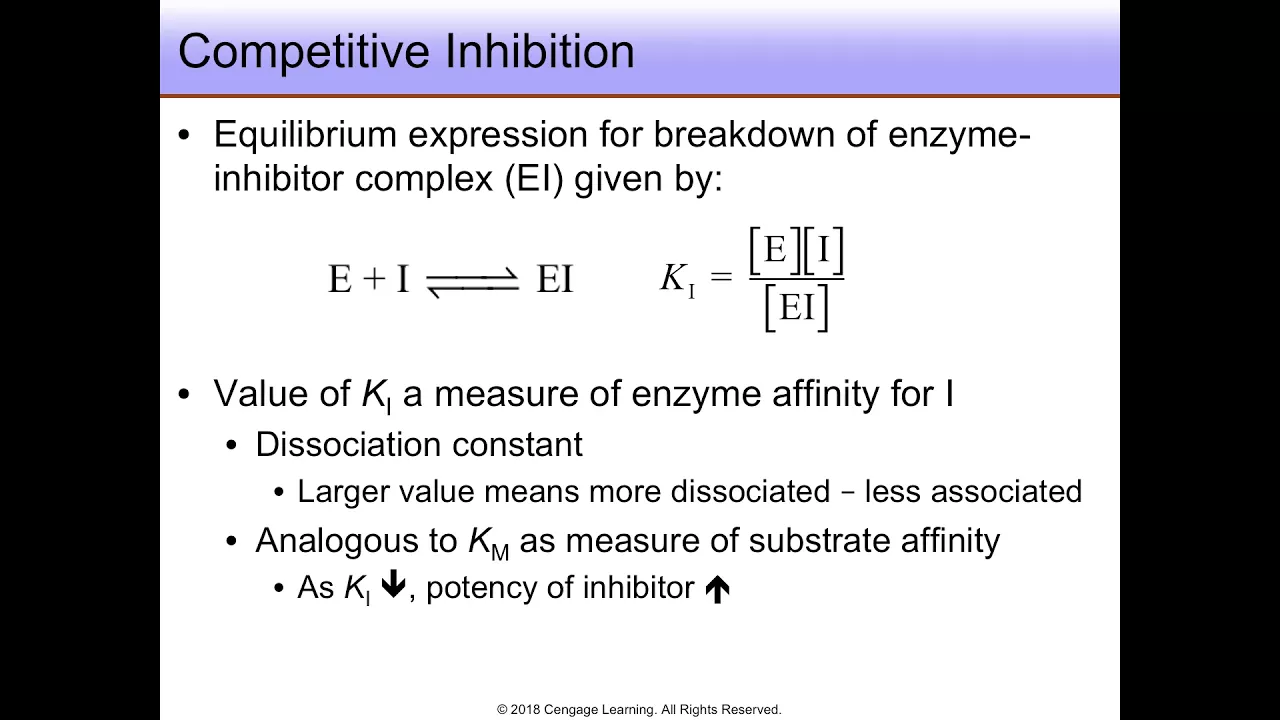
this is a true competition then the inhibition can be overcome by increasing the amount of substrate present we can illustrate the reversible binding of an inhibitor by the expression illustrated here since there is an equilibrium of binding we can derive an equilibrium dissociation constant for the inhibitor the ki shown on the right note that since this is a dissociation constant as its value gets smaller the enzyme is more likely to bind the inhibitor and its potency or effectiveness as an inhibitor increases let's see how the presence of the inhibitor alters the kinetic constants since the
inhibitor competes for substrate binding once the substrate binds the inhibitor can have no impact on the conversion to product the catalytic step this means that a competitive inhibitor cannot alter v-max on the other hand it does influence substrate binding so it lowers the effective affinity for substrate that is it raises the value of km derivation of rate expressions in the presence of a competitive inhibitor reveals that this value changes by a constant amount represented by the Greek letter alpha if you examine the expression for alpha you will see that it is directly related to inhibitor
concentration this only stands to reason the more inhibitor we add the greater the effect will be it is also inversely related to ki which means that as ki gets smaller alpha gets larger so the higher the affinity with which the enzyme binds the inhibitor the more it will perturb enzyme function this also stands to reason let's modify the lineweaver-burk equation to represent the reaction in the presence of a competitive inhibitor since the value of km increases by the Alpha factor we'll include that in the numerator of the expression for the slope re-examining the equation we
can see that it predicts that a competitive inhibitor will not alter the y-intercept but it will increase the slope as compared to the pattern observed in the absence of the inhibitor represented here our results typically observe her competitive inhibitor the blue curve represents activity in the absence of the inhibitor the green line is in the presence of a competitive inhibitor and the red line is the activity observed in the presence of twice the amount of inhibitor notice the pattern all of the lines intersect on the y axis so the v-max is indeed unaltered the slope
however is increasing as expected and the increase is even more exaggerated when we add double the amount of inhibitor notice that the x intercept equal to the value of negative 1 over km is decreasing since km increases in the presence of the competitive inhibitor then the x intercept will become a smaller negative number in other words it will move closer to the point of origin lineweaver-burk plot are an excellent way to distinguish between the different types of reversible inhibitors



![Kaffara Episode 60 - [Eng Sub] - Ali Ansari - Laiba Khan - Zoya Nasir - 23rd September 2024](https://img.youtube.com/vi/ihdFNyn-Z-4/maxresdefault.jpg)