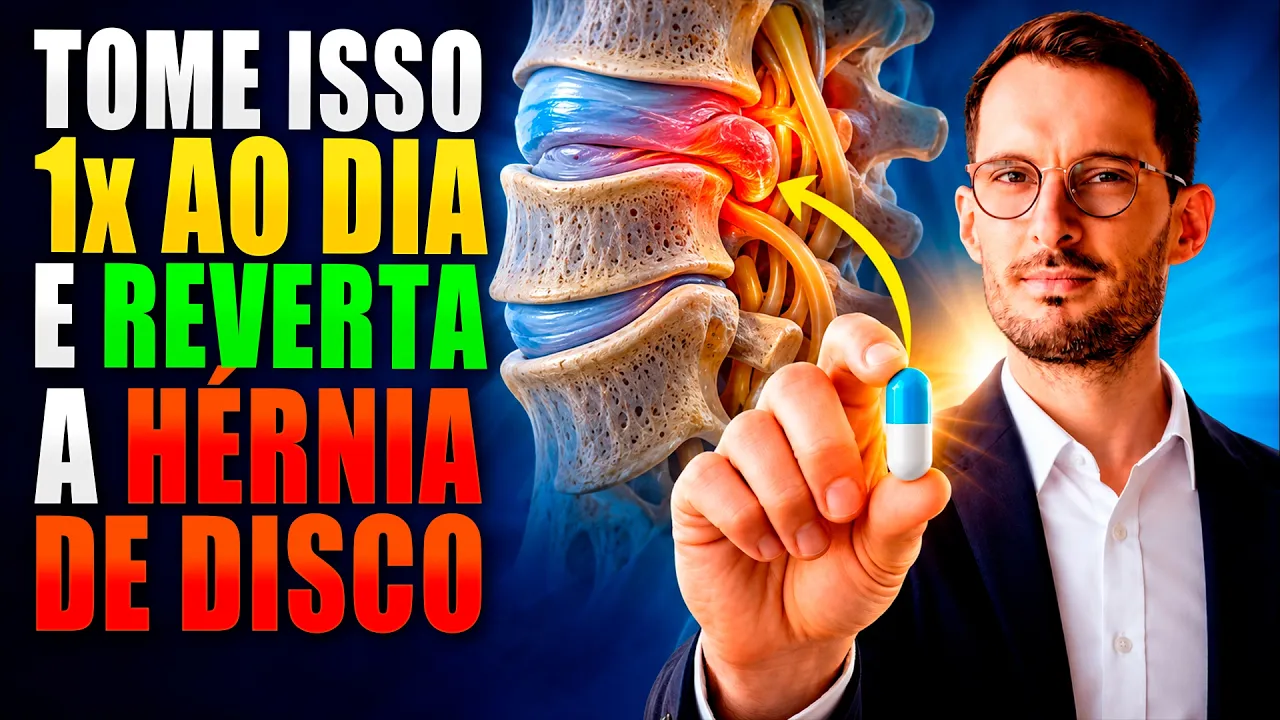
How I can reverse my herniated disc at home with simple, practical exercises. More than 70%of herniated discs aren't surgical; no intervention is needed. It’s about movement, the right therapy, and the right leverage in the right place for it to regress.
Yes, it goes back. That MRI image you saw with a protrusion, extrusion, bulge, or some discontinuity in the fibrous rings or the nucleus pulposus that has herniated —it is possible to accommodate or regress that herniation so you no longer have signs or symptoms. And this is not a promise.
In this video, I will teach you the practical, step-by-step process of how to identify your specific cause, which isn't the same for everyone. Everyone has a different cause. You need to see what yours is, the mechanism behind how it acts—in other words, how this led to your herniated disc—so you can stop that mechanism.
And what do you do right now in this video, in practice, to relieve the compression that causes neuropathic pain? That classic tingling pain behind the leg that goes to the foot, the calf , the anterior tibial region, or stays more in the spine and radiates to the buttocks—it depends on the grade of your hernia. Is the injury only in the lumbar region?
Does it reach the glute, the back of the thigh, the knee, or does it go all the way to the foot? So, regardless of the severity of your injury, if you have a herniated disc and don't know the cause, the mechanism , or what to do, you're like many people trying countless approaches in vain: physical therapy, massage, Pilates, stretching, RPG, cupping, not to mention the infinite number of tests you spent money on. This is the video where I will explain it to you.
And I'm not talking about an approach focused only on inflammation, degeneration, or just movement. I’m going to tell you about the mechanism behind your pain and the mechanism behind the hernia you have. It’s much deeper than that.
So this video will help you understand the context of the herniated disc you have and what you can do in practice. It’s invaluable content. So click the like button down below because you’re going to like the content, and it will help other people.
Don't hold onto this information, just give it a like down there, okay? And if you don't know me, if you're new around here, my name is Murilo José Tambe. I am a physical therapist specializing in osteopathy, with a postgraduate degree in integrative functional medicine.
And my main goal on my YouTube channel for several years now—there are over 500 videos here on the channel, right? At the time of this video, over 220,000 subscribers on the channel, okay? I talk about pain, exercise, and injury, but in a different way.
I talk about the real primary cause. And if you haven't even heard this factor, if you haven't even heard the term "real primary cause," and you're comfortable with what they tell you, "oh, it was your job, it was your posture, it's too much sitting. " Folks, I can tell you that I had patients—no, I recently had, rather—I discharged him a few days ago.
A patient who spends 10 hours driving a truck sitting with a surgical-level disc herniation and today has absolutely nothing left, in three or four sessions. We are not talking about treatment programs of 10, 20 sessions. We are not talking about the very expensive packages from franchises you've surely heard of.
There are several spine franchises in the country popularizing a way, a model of treating everyone the same. You are not like anyone else. No one is the same as anyone else.
Everyone has a cause. There are common causes, but the same cause in different individuals leads to different results. That's why we are so different.
Most people who are currently suffering from chronic lumbar disc herniation are limited in bending, sometimes limited in extending , even in breathing, coughing, laughing , being intimate, straining to go to the bathroom, to poop, right? To live. So, these very trivial difficulties, bending over to pick up an object, to tie your shoes, often unable to flex the leg to make any movement, to put on underwear.
All this trouble you have is only being seen through the lens of the hernia. So you go to the doctor, as many people here do, you go to the doctor, get an MRI, which is the gold standard exam to see this, and you just accept it. "Okay, I have a disc herniation, it's just like this now.
"" I'll do Pilates my whole life, I'll do physical therapy my whole life, I'll do physiotherapy my whole life. ""I'll take tons of anti-inflammatories. " And that is not true, my dear.
Your body has a mechanism to stabilize that hernia. If that nucleus pulposus, that disc has been ruptured, there is an imbalance in that region of the spine. There is an overload of structures and you are transferring the load to the wrong structure.
That's all it is. In the past it was believed, I always like to give an example. In the past, you believed that a vertebra, imagine this is a vertebra of your spine, imagine this is L5 and this is L4.
It was believed that the spine's support mechanism was this, one on top of the other with a disc in the middle, the disc would be my finger. And it was just this. And that is not the case.
This system is as if it were suspended, as if something floated it and balanced it here. And when you walk, there is a massage, literally a massage on the little shock absorber in the middle, which by the way is beneficial. So walking, running, jogging, exercising the right way, for proper disc health.
And you will understand this, health of the disc tissue, health of the bone tissue, ligamentous, muscular, fascial, all of that. I will explain this to you . This video could last an hour.
I will try to do it in 20 minutes. So there is a lot of information. That's why if you are used to watching videos at 2x, 1.
5 x speed, in my videos you won't be able to do that, okay? It is a lot of content for a short time, so I do the best I can and very quickly. Keep up, otherwise rewatch the video, okay?
So this system is balanced. When you lose this balance, there is a collapse and then there is wear and tear of the tissue. Or when you lose the quality of the disc or the quality of the bone, this massage that happens during movement, this homogeneous, linear, smooth, fluid transfer—that is the most correct term, fluid—doesn't happen.
Today, at this exact moment, if you have a herniated disc, the one paying the price is the disc, it's the cartilage there in the middle, it's this shock absorber that receives nutrients that come from the bone tissue, which most likely is also poor. So, if I have a brick that is rotten from being so malnourished, from so much lack of hydration, vitamins, coenzymes, amino acids, nutrients, and excessive inflammation. If this is happening, this bone does not have the condition to offer support to the disc underneath it, understand?
This disc doesn't have an artery, it doesn't have a vein; it receives this from the bone tissue itself. Rotten bone, in a crude way, is a rotten disc. Inflamed bone is inflamed tissue.
So, all of this is tissue. That is the first thing you need to understand. You can't straighten a wall if the brick is rotten, if the mortar is crumbling, the mortar is breaking in the middle.
Taking the load off the ligament, taking the load off the disc, is one of the first steps to saving it. And I will teach this with simple exercises, but thinking about tissue nutrition is just as important, if not more. Remember what I explained about this stability mechanism here?
We call this biotensegrity. When you have this system that holds things, imagine your vertebra is held by cords. These cords are the muscles, the fascia, and the ligaments.
But pay attention to the muscles and the fascia. The musculoskeletal and fascial system is highly adapted to any and every imbalance you may have. It can be emotional, and it changes the fascia.
It changes the fascia. Visceral, meaning an organ causing an alteration in this. And I mention in the video I cited at the beginning, I state which is the main organ that generates this type of problem.
So, if you are treating a disc only with exercise, thinking it will cure you, I’m sorry, but you're in deep trouble, to put it mildly, okay? You need to think about the mechanism as a whole. So, there are viscera, organs, there are neural tissues that can inhibit the biotensegrity system, generating overload and automatically causing your disc to collapse, dehydrating your disc , okay?
It won't help to do a world of sessions in packages at clinics or franchises—I won't name the franchise here because it sounds too harsh— spending a lot of funds, like many patients I've seen here. If you don't understand the mechanism, even massage —if your problem is only mechanical, musculoskeletal—a chiropractic or massage session might align that segment. But agree with me: aligning a position that was supposed to be like this but was like that.
. . aligning it while this here is rotten is useless.
And so I see people selling miracles on the internet for hip pain, knee pain, back pain to people who clearly have serious metabolic problems—diabetics, hypertensive, dyslipidemic, inflamed, with chronic hormonal disorders—it won't work. Your body isn't stupid; it doesn't focus on what you want. You can't just take a simple vitamin here, take a vitamin and have it go where you want it to.
It goes where your body wants it to. And you have to understand what it wants to help what it needs, and it will automatically fix what you want, which is your spine. Sorry for the lecture, but I can't see it any other way.
So, the first step, the first step to curing your herniated disc, is the cause of the imbalance. Whether it's emotional, traumatic, a bacterial agent, as I've seen many times, a visceral issue, or a joint problem, you understand? Identifying the cause is the first solution.
I teach this in my mini-course and, of course, I do it in my consultations. Second step, then comes tissue nutrition. And when I talk about nutrition, I'm going to give you practical tips.
For you to nourish a tissue, it cannot be toxic. So you need to work with some kind of toxin-chelating substance. I work with a product called Metal Cleaner.
I use it a lot, it's an easy and safe product to use. You cannot be inflamed, okay? If your body is inflamed, nutrients won't be available for the bone tissue mechanism, the disc mechanism, the ligament mechanism, or for building tissues.
So you cannot be inflamed. If you have inflammation in your large intestine, you need to heal it before fixing your spine. Again, I say, I will teach you practical exercises to reposition the hernia, but it won't hold.
You'll notice that the pain goes away, but in a week or two, the problem returns. Because you aren't understanding this. Your spinal tissue cannot be inflamed, it cannot be toxic, and it's important to have a minimum level of nutrition.
So your diet has to be good. The nutrients you eat, the protein you eat, the amount of protein you eat—if you do the basics well and are still in pain, okay, there is a major cause that isn't nutritional, and I teach in the mini-course how I treat that every day. You might have, for example, a wisdom tooth surgery you underwent.
This is a cause for you to understand, okay? A wisdom tooth extraction. Where you had the tooth extracted, a ligament fragment or even a piece of the tooth itself might have remained, or the extraction method was too aggressive.
Generating an inflammatory process in there. This inflammatory process sensitizes the trigeminal nerve, which is the nerve that passes through this region, innervating the entire cranial dura mater. This dura extends throughout the spine, going all the way down to the coccyx at S2, and you have pain, pain caused by dural shock, a compression of the dural sac on your cranial innervation that came from a tooth extraction.
Changing your diet, taking supplements, or exercising won't change your pain. Working to help this tissue regenerate does help. So, in any therapeutic process, there is nutrition , then biomechanics—treating the jaw region, the temporal bone, the upper cervical, the mid cervical, and moving down the entire spine.
This treatment can involve exercises, manual therapy, and movement, whether by a therapist's hands or through exercises. Now I will teach you in these few minutes of the video the sequence of movements I would use if I were to develop a disc issue right now, let's say, without an apparent cause. And I would want to stabilize it, to stop the radiating pain to the glutes, the leg, and the posterior.
I want you to do this at home for 1, 2, 3, or 4 days in a row and observe the results. Murilo, it provided relief. What is your conclusion?
Yes, you have a disc issue. Yes, you have compression. No, you don't know the cause; you need to investigate.
You can do this in an online consultation, and you can do this in the mini-course. You can follow all my free videos, and you will find out. Let's go to the exercises so I can truly help you.
The first thing is to have an idea of which side this disc is moving towards, which side it is compressing. To do this, I'm going to ask you to do a very simple test that will help a lot, okay? Stand up if you can; obviously, you might be a bit more limited than usual, so stand up and do the following test.
Imagine you are at rest, don't do anything for now, just like I am here. And observe if the pain is in the spine or if it is already radiating to one of your legs. "Oh, doctor, it radiates to both.
" Whoa. Only when sitting, only when standing? Yes, it radiates to both.
The injury is moving to the center. Extend your spine , the pain will increase. Observe for a few seconds, did the pain increase?
Now it radiated to your legs. No, it didn't radiate to the legs, no. It is only in the spine.
Great. Great. No, doctor, it feels like when I do this, it hurts in my spine and radiates.
One, so the L is a bit bigger, okay? Trust me. No, Murilo, I can't even do extension.
I'm locked in flexion and that gives me relief. If it relieves you that way, stay in flexion, the hernia is going backward, which is its physiological mechanism, and extension, despite the pain, will correct it. All right?
Pay close attention to this. A disclaimer. If you got an MRI and have a diagnosis of vertebral slippage, an anterolisthesis, extension exercises like the ones I'll teach here are dangerous.
In some cases you can't do them, but those are cases with grade two to three listhesis, which are more serious. Grade one listhesis, with the patient being well-managed, is no problem at all, okay? So, there are some caveats here.
Now, the most important part of this test, which way does it go? So, I'm standing here, I have lower back pain or I have no lower back pain at all. Let's imagine both scenarios.
I lean to the left, I leaned to the left. The pain increased in my right leg. In my right leg.
This hernia was pushed over there. The mechanism is , I have to push it the other way. Write this down.
Let's do it again. I fell to the left, the pain in my right leg increased. This was thrown over there.
I have to push it back, okay? The treatment is to push it back. Let's go to the second example now.
I fell this way, to the left, it didn't hurt at all. My left leg and the pain, sorry , the right leg and the pain I felt in my left leg have now subsided. So this hernia, it was going that way.
When I fell, it came back, so it relieved it. Look at how you have to think. Let's give an example again.
This is going that way, right? It's going in that direction. If I fall this way and the pain doesn't increase, it didn't increase the pain in my left leg.
It's a mild hernia, it's a small hernia. It didn't change the pain I had here at all. So I have pain in my left leg, the hernia is going that way, I fell to the right, the pain here didn't change at all, it's still about the same.
It's a small hernia, it's an internal hernia. Then I lean over onto the leg that's hurting, this one here, and the herniation moves back, the pain subsides. Wow, it's a relief.
So, the mechanism I need to perform is a tilt to the left. You need to identify which tilt mechanism is yours, otherwise you'll make it worse, you understand? Imagine a patient whose herniation is pushing that way, radiating into the right leg, and when they lean this way, it worsens the right leg pain, yet they do the exercise to this side.
That ruins everything, it'll make it all worse, you get it? They have to do the opposite, okay? So, that's the first thing.
And now, a more important point. When you do spine extension exercises, always focus on the leg that radiates, the one that hurts. So, if it hurts on my right, you'll leave that one more open, you see?
And the other one you leave neutral. If it hurts on the left, I'll open the left one and you leave it , you see? That's all there is to it.
An exercise for you to start doing while sitting just as you are. Imagine I'm feeling sciatic pain in my right leg and the hernia is pushing that way, right? That way.
So I'll lean over onto the right side, support my elbow, turn my torso, bring this hand behind my head, and here I just breathe. Breathe about five to ten times, okay, folks? After breathing, calmly extend the knee of your right leg and bring it back.
Extend the knee and bring it back. Go as far as you can. Don't move from the position.
See, look. 10, 20, 30 times. No need to count too much, alright, dear?
Just stretch, okay? And go back to the position. Do at least one more set.
In that example. Now let's try with that hernia that was pushing to the left, right? When I leaned to the right, it didn't really change anything .
It felt better when I went to the left. You go to the left here. Imagine that the pain is now gone, you're not feeling anything here.
Same position, same movement, breathe 5 to 10 times, extend the knee 20 to 30 times. Do two sets of this. Start with the tilt.
Take my word for it, it works much better with the tilt. If you have trouble with the tilt while sitting, you can do the tilt lying down. Look how interesting this is.
You lie on your side with your knees off the bed, feet off the bed, and let them drop. Okay? What am I doing here, folks?
I'm opening the right side and closing the left side. I'm tilting to the left side. And here you move it, see.
Foot up, foot down. Look how I’m going to force the foot down hard, folks. Look, observe, I even get a bit of traction, see.
Look at this. I’m leaning to the left, but I’m using the hip lever and not the trunk lever. OK?
The same rule applies to the other side. I want to lean to the right, so I lied down on this side here. Then, see, same thing.
So, this is a very cool mechanism for you to be able to stabilize. You’ll notice it in your spine, see, leaning to the right side, but using hip leverage instead of trunk leverage. Just that.
OK? That’s the first movement, inclination. The axis of rotation is a bit difficult to do, so I won’t teach it in the video, okay?
You would need to do it, but at first, it’s a bit dangerous for you to try. It depends on the leverage you have. So now I’m going to combine a simple flexion and extension exercise with you.
In my opinion, the safest one for you to do, okay? You’re going to get into a four-point position here. Be careful not to have your lumbar spine in flexion.
Keep it in extension with your butt pushed out. And in this movement here, folks, what are you going to do? Imagine you’re feeling sciatic pain in your right leg, right?
Right leg. You’re going to extend your right leg as far as you can. This is the second exercise.
And when you return, you bring your knee a little toward your left elbow. Just a little bit. And go way up.
Look how I’m going to exaggerate, folks. Look. I’ll exaggerate so you can see it up at the elbow, way up there.
Look, look at the focus with which I’m doing this, okay ? So that you extend the herniation. And this part is important.
Remember I said always keep the leg a bit wider? Remember what I said at the start of the video? I’m not extending the leg straight; it’s a bit more open.
Why? When I make this opening, I tilt the spine. So I’m extending and tilting at the same time.
I won’t teach you rotation, okay? There’s a certain risk there. So open your leg a little, don’t keep it perfectly straight, okay?
And the same goes for the left, in that second example, I leaned here, and the pain subsided. It means it was going there and I brought it back. Perform the movement, extend with your left leg, sort of diagonally to the left side and bring it back toward your elbow.
Here you are working on the active flexion of the spine, and here you are working on the active extension of the spine. Yes, you need to work on spinal flexion, even though it often pushes the disc posteriorly, but if it is an active flexion, which is the case in this exercise, and not passive, which would be like this, okay? You are not at risk of injuring this spine.
So much more could be said, so many more exercises could be taught, and I could ramble much more here about high-risk areas. This is a subject that never ends, okay? But what you need to understand is that there are two paths.
Either you evaluate yourself through our mini-course in a single class where you will learn about every problem you might have. And then in each class, out of the 13 classes there are, there are only 13 causes for pain. Pain as a general term, okay?
Not just for the spine, but shoulder pain, neck pain, trapezius pain, knee pain. You investigate these 13 causes that will be there, and for each cause, I teach how to treat it. So you see the cause, see if it’s yours, and treat it.
See the cause, see if it’s yours, treat it, and so on. This is a more accessible way for you to do it. Less than 1/3 of the cost of a consultation today.
So you can do this on your own. Now, if you say "No, Muro, I can't, I'm in unbearable pain, I can't handle it anymore. ""I've already done the exercises, I've watched all your videos , and I can't find a cure.
""I want a high-level consultation, I want to have the best access to content to resolve my back issues. " The only way is to book an appointment with me, which can be in-person or online. The diagnosis is the same, absolutely nothing changes , the approach is the same, okay?
You won't have my hands on you, but you will have tools, techniques, and concepts to resolve your pain just the same. And what matters is the pain going away, that you get cured and it doesn't come back, because that is the most critical part, right? That it doesn't return.
I hope from the bottom of my heart that this video reaches you and reaches other people. So don't forget to share the video, click on the share button here, and I hope it truly transforms your life. Otherwise, I'll see you in next week's video.
M.