Hi! I'm John Green. Welcome to Crash Course Religions.
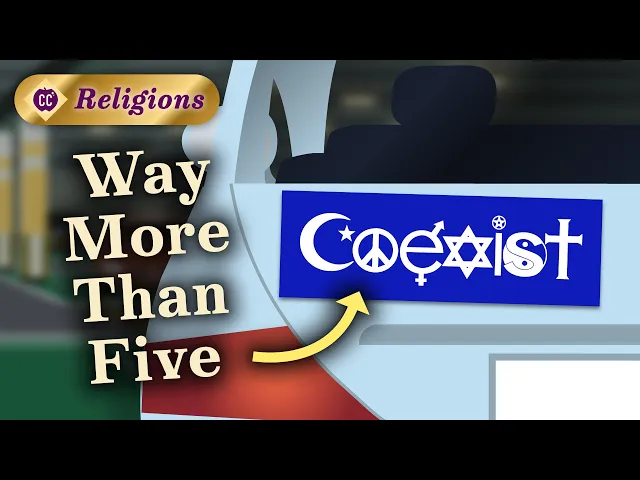
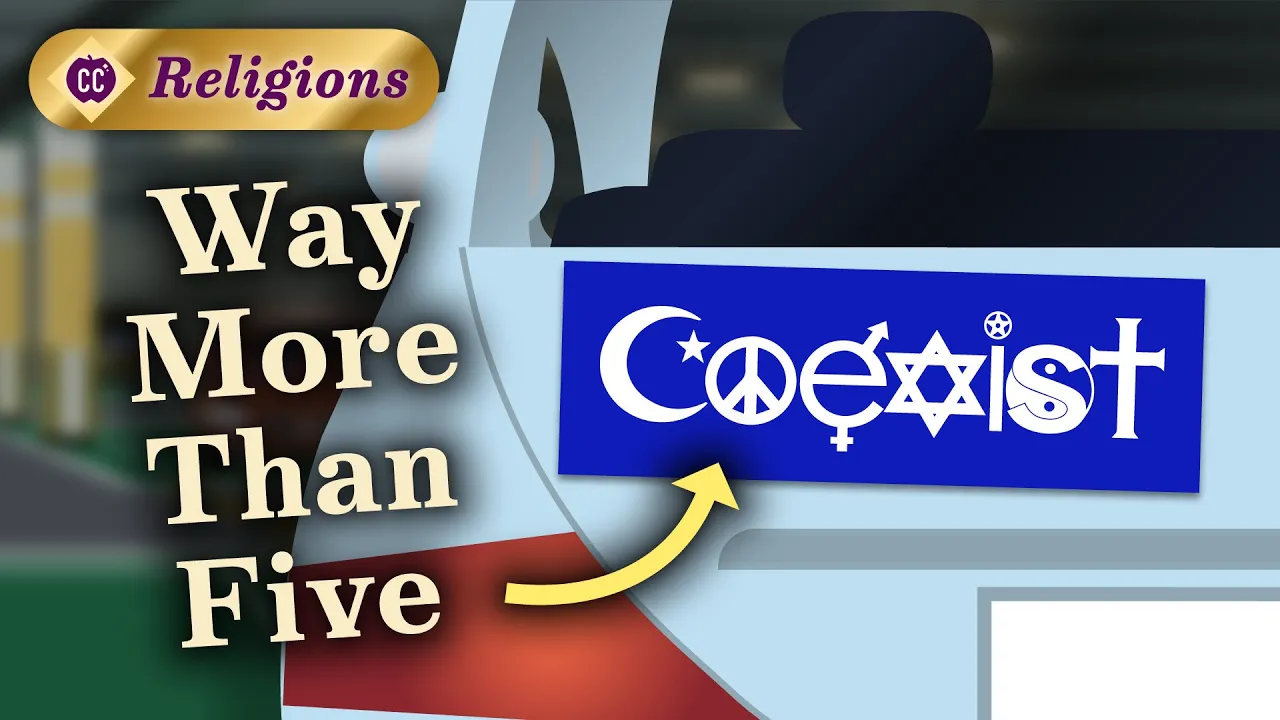
Does this look familiar? You probably know it as the “Coexist” design— a smattering of symbols that come together to spell the word. This is just one of thousands of car bumpers that uses its design to proclaim a desire for peace and religious tolerance to… other drivers I guess?
Now, viewers might see the “Coexist” symbol as a representation of the world’s religions, right? You’ve got a crescent moon for Islam, the Jewish Star of David, a cross symbolizing Christianity, even a little Wiccan pentagram to dot the “i. ” But the thing is, it doesn’t cover all the religions practiced in the world—not even close.
And what it leaves out tells you a lot more about the history of religion than you might think. [THEME MUSIC] So if you’re going by what’s typically covered in the news, which holidays are listed on calendars, or how bright your neighbor’s seasonal lights are, you’d think only a handful of religions are practiced in the world. Scholars of religion have used the framework of the “big five” major world religions for decades: Islam, Christianity, Judaism, Hinduism, and Buddhism.
But those aren’t even the most widely practiced religions. Like, there are more followers of Sikhism worldwide than there are followers of Judaism. And Shintō is practiced by millions of people and yet… zero representation on the COEXIST bumper sticker.
So what’s the point of having a category like the “big five”? And why do we hear about only a few religions, while ignoring tons of others? Let’s go back in time to figure this out.
As we saw in episode one, what counts as a “religion” is actually pretty complicated. The idea of “religion” as this special category, set apart from other stuff people think, believe, and do…well, that’s only a few hundred years old. It came about in 16th-century Western Europe, during the Protestant Reformation.
Christians used the “religion” label for traditions that had a founder, sacred texts, clergy, and particular times and places for doing religious stuff. In short, to be a religion, it had to look kinda like Christianity–which Islam and Judaism kinda do, and Buddhism slightly does, and worshiping at the altar of a particular economic system doesn’t, even if the invisible hand of the market works in mysterious ways. During the colonial era, as Europeans encountered cultures in Asia, Africa, and the Americas, they looked for signs of “religion” with their own Christianity-shaped mold in mind.
But it turns out, people have a lot of ways of making sense of their lives, of organizing community, and relating to otherworldly forces. And many of them didn’t look like what European colonizers understood as religion. Like, in 1553, Richard Eden wrote that Indigenous people on what’s now the Canary Islands “went naked, without shame, religion, or knowledge of God.
” Paintings of Christopher Columbus’s arrival in the Americas kept this narrative going, showing colonizers looming large, with a priest along for the ride, heroically bringing religion to people assumed to have none. At the time, many Europeans assumed “religion” was a natural category that could be recognized on-sight. People either had religion or they didn’t, and if they didn’t, y’know, they needed it.
Specifically, to borrow a line from my grandmother, they needed Jesus. According to this logic, a lack of religion implied a lack of civilization. So, like, Muslims might have the wrong religion, thereby necessitating Crusades and whatnot, but at least they had a religion, and were therefore civilized.
People in the Americas and much of sub-Saharan Africa were seen as without religion, which meant without civilization, which was used to justify colonialism as necessary or even noble. Of course, Muslim and Buddhist and Jewish communities were also colonized, because the logic of colonialism was never particularly logical. By the 19th century, Christianity was everywhere on Earth, but it’s not as simple as saying that Christianity came to the colonized world–the colonized world also came to Christianity, with indigenous beliefs and practices helping to shape the religion.
Think of dia de los muertos, which was integrated into Christanity during colonization. Or to take it further back, what’s up with Christmas trees? Jesus never mentioned them.
By the 20th century, scholars started recognizing other traditions as “religions,” too. They lumped them into opposing categories like Western versus Eastern, “great” versus “little,” and “major” versus “minor. ” I’ll let you take a guess for which religions got the “good” labels.
Texts from Buddhism, Hinduism, and other Asian traditions were translated into English, which helped cement the idea that sacred written texts were a universal feature of a, quote, “world religion. ” Meanwhile, those with oral traditions were seen as “primitive,” or “minor. ” Although for the record, this crash course video is happening in the oral tradition, and I don’t think that lessens the learning.
By the mid-20th century, a vibes-based approach had emerged that really crystallized how Europeans defined religion. Scholars started thinking in terms of family resemblance. Like, okay, maybe world religions don’t share a single common feature, but they do have overlapping similarities.
Based on those similarities, you can tell what’s a religion and what’s not, sort of like how you know Pokémon and Call of Duty are both video games, even though they don’t have a ton in common at first glance. Anyway, that family resemblance method is still directly informed by that Christianity-shaped mold of what a “religion” should look like. It tends to leave out groups that don’t match the vibe, like those that don’t focus on sacred texts, such as the Yezidis of Iraq.
So, the idea of what counts as a “major religion” was decided mostly by people who thought Christianity was the ultimate model of religion. But these arbitrary choices about which religions “matter” have had significant consequences—ones that are way worse than being left off a bumper sticker. For example, Sikhism is one of the most practiced religions in the world, but one that often gets left out of conversations about major religions.
It originated in 16th-century India, from the teachings of Guru Nanak, who preached about the oneness of God and the equality of all people. But Sikhs are in the minority in India, where they’ve faced harassment, persecution, and violence. And in the United States, misunderstandings and prejudice have also led to attacks on members of the Sikh community.
For example, just days after the September 11th attacks, a Sikh man named Balbir Singh Sodhi was murdered in an anti-Muslim hate crime. He was mistakenly targeted for his beard and turban, which Sikh men customarily wear as an expression of their faith. Being known and understood by the public is a matter of life and death for people of any religion.
And the less you’re understood, the more that’s a risk. In response to discrimination, harassment, and violence in the U. S.
, Sikhs have advocated for basic knowledge of their religion to be taught in schools — just like the so-called “Big Five. ” Religions have often been misunderstood as, fixed ideas that get passed down, perfectly preserved from generation to generation. But that’s absurd.
The idea that religions are stable, unchanging systems can foster essentialism, or thinking that groups of people share a core quality. And that can lead to false stereotypes like, “All Buddhists are peaceful” or “All Muslims are terrorists. ” Or “All Episcopalians marry an abundance of Catherines and execute two of their wives.
” That’s only true of our founder. Cultures are internally diverse and always changing, so we can’t generalize about what all members of a religion think and do. And in most traditions, we can’t draw a straight line from how early members did stuff to how people do it now.
My way of being Christian isn’t like how the Romans did it – which is good news for me, as I lack the moral courage to face off against a lion in a coliseum. But my way of being Christian is also different from the Southern Baptist or Ukrainian Orthodox way of being Christian. There’s vast diversity within traditions as well as across them.
Beyond stereotypes, this focus on continuity also allows certain groups within religions to claim authority by asserting their belief system is the true one, or even, the only true one, because it’s the closest to the original. It’s like only being a fan of Taylor Swift’s country music, because that’s the original and true Taylor Swift, the Southern one who grew up in – let me just check my notes here – Pennsylvania. Linking a religion’s current interpretation to the far-off past becomes a way of excluding and controlling other people’s interpretations, which, in my opinion, just isn’t cool.
Taylor Swift is both country and pop, and also everything else, the one true guiding light of our time…wait, am I turning Taylorism into a religion? Actually, we’re gonna get into that in a later episode. Okay.
So we often see this with religious nationalism — where governments or politicians claim their interpretation of a tradition is correct, and use it to organize and control certain groups of people. In Saudi Arabia and Iran, conservative interpretations of Sunni Islam and Shi’a Islam, respectively, have been encoded as national laws, restricting what women can wear and do. In Myanmar, Buddhist nationalism has been invoked to persecute religious minorities, especially Muslims.
And in the United States, some Christian groups have organized politically to restrict access to abortion and the rights of LGBTQ people for religious reasons. And it’s not just that religions are always changing, but there are also no firm boundaries walling them off from each other. In the United States, many people of Jewish background embrace Buddhist practices.
At the Odero Lal temple in Pakistan, both Hindus and Muslims have long worshiped in the same space. And in Brazil, adherents of Candomblé have been blending African and Catholic traditions for centuries, but doing so in secret to protect themselves from persecution. Another thing to consider is the way the “major religion” label presents some traditions with more nuance than others.
Like, even though Judaism, Christianity, and Islam share many of the same stories and central figures, they’re treated with more complexity and viewed as distinct, separate traditions. Meanwhile, diverse communities get uniformly labeled as Buddhist, even though groups vary in their interpretations, texts, and central figures. So, where do we go from here?
I mean, humans make up categories to understand the world: that’s what we do. But, part of being human is also interrogating those categories — questioning how they can serve us better, and more equitably. To really understand all the ways people do religion, we have to unpack the boxes we’ve created – where they came from, what they do in society, and whose interests they’re serving.
And that unpacking shows us that a list of “major religions” isn’t a map of a pre-existing system. It’s an idea that creates a system, one that reflects and reinforces power, while obscuring the criteria for what counts. But the cool thing is, the more we expand our understanding of religion, the more we begin to recognize these systems and their flaws as they operate in the world all around us.
And if we’re lucky, we’ll also catch a glimpse of commonalities across these divisive constructed categories, and find shared values that can serve to bind us together more closely. We’ll keep exploring that theme in our next episode, as we ask not just “What is a cult? ” but “Who gets to decide what a cult is?
” I’ll see you then. Thanks for watching this episode of Crash Course Religions, which was filmed in Indianapolis, Indiana, and was made with the help of all these nice people. If you want to help keep Crash Course free for everyone, forever, you can join our community on Patreon.