All right, guys. Let's uh let's roll. So, welcome to the strategy overview section.
Really excited about this, guys. It's going to be it's going to be an eye openener, and I think you guys are going to learn a lot from it. So, first and foremost, we'll spend a couple minutes here.
the the trader trap. And you guys maybe let me know if you can relate to any of this, but why why consistency with retail traders is so elusive? Meaning, why is it so hard for retail traders to succeed?
So, starting on kind of the top left, operational failures. So, complexity overload. So, you're trying to implement strategies that have way too many different variables.
So, it makes consistency and consistently executing almost impossible. Um, I'm going to give you an example, and this is not me talking down on this strategy. This is simply an example.
Um, there's over 50 different versions of ICT. There's over hundred variations of uh OB. So imagine you're you're a trader and you're trying to figure out a strategy and there's 50 different variations in a hundred different spin-offs.
That complexity, that overwhelming, man, I don't know if I should trust this guy because he told me to do it one way, then another guy told me to do it a different way. Okay. And they contradict a little bit.
Next up would be the strategy myth. So strategy issues with account for almost 0% of the reasons. So here's here's what this is really saying.
It's really not the strategy. You know, you could take any you could take the simplest strategy on the planet and technically you could probably get it to succeed. you could probably get it to work.
For most of you guys, it's not necessarily the strategy. Another big one is KPI blindness. Most traders are failing because they do not track the key performance indicator KPI for their variables.
So, I I'm just going to ask it and if you guys are comfortable, let me know in the chat. Does anybody here know all their metrics? their win rate, their their their P&L per this, P&L per that, their metrics, like all of that, the risk-to-reward ratios, like there's about 20 different metrics that could be tracked.
So, with people that are trying to succeed and people that are trying to get better as traders, without knowing the KPIs, there's no way I can I could even help you. So if somebody was to come to me and say, "Hey man, um I I want you to mentor me. " I'd say, "Cool.
Well, let's look at your data. I don't have any data. " Okay.
So how how are we how are we making decisions and how are we formulating whether we should do X, Y, and Z? How would we know if we're on track or not? You guys get the idea.
Here's a big one. Strategy hopping. Success is hindered by jumping from one methodology to another without mastery.
So that means that you'll start something, you know, maybe maybe you take some trades, maybe you see a little bit of success, but you never master it. Then you go to another one, start it, take some trades, never master it, and another one. And another one, right?
Strategy hopping. Another big one all the way on the right is overtrading. Excessive trading volume.
It erodess capital. It undermines a clear trading path which leads right into lack of a clear path. So without a defined road map, traders remain stuck in a cycle of inconsistency.
So, one of the things that we exist to do and one of the things that's made us very unique in the marketplace is our strategy is very black and white. There's no variation. There's no 55 people lost and 55 people won.
We all win or we all lose every trade because there's no variation. There's no here's a word from yesterday. There's no discernment.
So when I say that we've never had a losing month and very rarely do we have a losing week, I'm not talking about necessarily myself or Josh or Michelle or anybody on staff. A lot of times you'll follow, let's just say you follow a guru and they win but you lose, right? like it it almost seems like they're teaching you a strategy and it works for them but it's not working for you.
Well, there's there's maybe some discernment that that trader has or that that guru has which is allowing them to win while you're failing. Does that make sense? So, we really exist to kind of have the opposite approach there.
Same page. Can you guys relate to this? It's not just you.
There's obviously hundreds of thousands of tra traders that are stuck in this trap. So, I want to be very very explicit here, guys. If nothing changes, nothing changes.
And if you want radical change, you have to have radical change. Here's another one. I know these are all cliche.
Um, if you always do what you've always done, you'll always get what you've always had. A lot of you guys don't like quote unquote what you have. So, if you're going to change that, you're going to have to do something completely different.
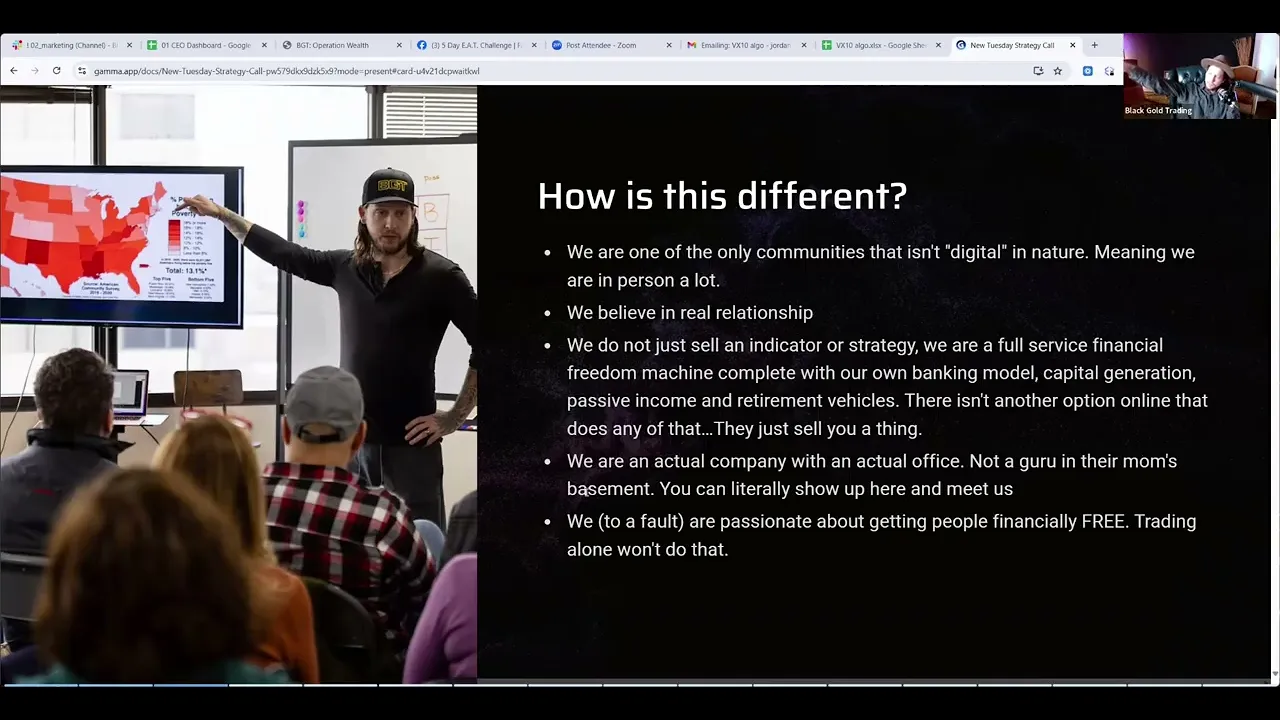
You you need to do a 180. So, how how is this different? Number one, we're we're one of the only communities out there that we're not digital.
So many of these guys, they're they're they're just digital. You'll never meet them. You know, you'll never go out to dinner with them.
You'll never shake their hand. You'll never go to their house. We're kind of the opposite on this spectrum.
We're we're not necessarily a digital community. We're a physical community. Uh we're in person all the time.
The picture on your screen is from actually when we were on the sixth floor from a mastermind with a bunch of people that flew in from all over the world. The guy uh not the guy in the hat, the guy to the left flew in from Sweden. So, we see these people and we interact with the people that we work with in person all the time, which is very unique in this space.
We believe in real relationship. We will not sell an indicator or a strategy in solidarity. We're full service financial freedom as a machine with, you know, we have our own banking model.
We have our own capital generation, passive income, and retirement vehicles. So, there's not an option out there that that does any of that. It's just here's an indicator.
I hope you do well. I don't believe in that. We're an actual company with an actual office, not a guru in their mom's basement.
Literally, show up here and meet us. And that's an open invitation to anybody here. If you guys are here or close to here or want to come here, let me know.
I'd love to meet you. In fact, um on the other side of the building, um Josh is trading with all sorts of people in person. And finally, to a fault, you know, we're we're passionate about helping get it free.
Free, not just trading, get free. Okay, let's keep on moving. We good.
So, why eat? The trading world is deliberately over complicated. It is designed to keep you confused, distracted, and dependent on the next magical indicator or maybe a complex system.
Both beginners and even some experienced traders fall into this trap. They add more and more and more layers of analysis until eventually nothing makes sense at all. So, our mission is is brutally simple.
provide you guys with one straightforward repeatable strategy that delivers consistency, not complexity, not confusion, just results. And 99% of the rubbish out there is solely to keep you spinning your wheels. We are different.
We're going to focus on one thing. Cool. Amen.
So this is the part where I really need you guys to focus in. Really focus in here. This concept will answer 99% of the questions that you have.
Retail traders fixate on 9:30 a. m. which is the the New York open.
They fixate on that. Maybe you're familiar with the opening range OB strategies. 9:30 is technically when New York is beginning and it's honestly it's where amateurs congregate.
But what you probably don't know is that major institutions are not waiting around for the market to open before they place their orders. That would be incredibly reactive. Reactive is the exact opposite of what institutions do.
But reactive is what a lot of retail traders do. Professional institutions are proactive. They're positioning themselves well before the market opens, making calculated decisions while everyone else is still waking up.
So, I want you to and and you don't have to you don't have to say this in the chat, but I want you guys to think about, you know, if you've traded before, say that 9:30 rolls around and the candles start going crazy and you react to that, right? So, that's reactive. That's not what institutions are doing.
Most of what happens at 9:30 is in is uh retail, not institution. So the 8 a. m.
window is where the real players start to show their hand. This is when serious money starts moving. When algorithms begin processing overnight information from the Asian and the London session is when smart traders gain their edge.
So this concept here will answer a lot of your questions. Like somebody said, well, you know, can we trade at 9:30? Well, that's not what the institutions are doing, right?
So we're we're not looking to necessarily be retail traders. We're we're looking to be Black Rockck or, you know, JP Morgan or like any of these any of these guys. Correct.
8 a. m. Eastern.
Let's keep on moving. So, people ask me this every single challenge, so I want to I want to just address it. How is this different than orb?
Who's familiar with orb, which is opening range break? Who's familiar with that? What's the guy's name?
big big daddy max or big max. Uh he's one of the big OB guys. Okay.
So, how is this different than that? First and foremost, this is not an opening range. This is, you know, an hour and a half before open.
So, it's not an opening range. We want to see what happens before the crowd arrives. So, I want you to think about like there's a big restaurant about to open and you get to go, let's say they open at 9:30 and you get to go an hour early and check out the restaurant, look at the menu, you know, maybe meet some of the staff, check out the facilities, maybe even get to order before the door opens.
When the door opens, that is orb. So, we're we're not that at all. Second thing is there's just completely different rules.
The entry criteria, the time frame, the ex execution methodology. It it's fundamentally distinct from standard orb strategies that you might have encountered. And then um it's all about order flow, not consolidation.
A lot of times with orb the focus is on the consolidation. We want to look at the order flow. So traditional range breaks look for consolidation periods followed by breakouts.
We're doing something smarter in my opinion. We're viewing pending and processed institutional orders and followed smart money. Joel always traded New York open using orb.
Is it working? You feel like it's it's going well? Some people do really good with that strategy.
And then the last my last point here, if you were to look at any chart, and I'm happy to do this with you, if you look at any chart, the RB, the range break, it happens like hundreds of times a day. So there's nothing unique about orb because range breaks are constant. Consolidate, break, consolidate, break.
If you look at the minute chart, the 30-second chart, even the 5-minute chart, you will see constant consolidation and breaking. I do well with it. But what you are saying about premarket is interesting.
Yeah. And guys, if you have a strategy that is working and if you're profitable, you know, if you're not blowing accounts, if you're profitable, if you're getting payouts, etc. , Like I don't I'm going to go back.
Well, I don't want to go back. I don't want to contribute to the bouncing around from strategy to strategy. I don't want to contribute to that.
Like I want you guys to stick with one thing. If it's what I'm doing, cool. If it's orb and it's working, phenomenal.
So, what really happens at 8? Couple things. So understanding this window is crucial to executing the strategy effectively.
It's not an arbitrary timing. It's very specific. It's when market dynamics create our edge.
So increased market activity trading volume surges as more participants enter ahead the regular session. So this is peak pre-market liquidity. Number two, there's a news impact window pretty often.
Traders digest overnight news, economic reports, and global events. Market sentiment uh crystallizes during this period. Price discovery.
Uh these early trades establish potential opening prices. Smart money shows where they believe the value exists. And then ECN is starting.
So, electronic communication networks, ECN, it's where they start to turn on, they start to facilitate their trading digitally, matching institutional blah blah blah blah blah. But this is what is actually happening at 8:00 a. m.
really important. The short version is institutions are getting ready for the day, placing orders, and making strategic decisions well before 9:30. The early activity is representing genuine liquidity that we're going to follow for the rest of the session.
Any questions on this so far? We good? Cool.
He's Gucci. So simplicity is what's powerful. Okay, simplicity is what powerful.
So asset selection. Um this says gold, NASDAQ and ES. Now these are the three instruments that we would look at.
We typically are NASDAQ though. Okay. Um, this works on way more than just gold, NASDAQ, and ES.
So, it it works I I don't think I've seen anything that it doesn't work on. The biggest difference is we we really want assets that have adequate liquidity. So, if you look at something that really really moves slowly, that's not going to be what we're after.
NASDAQ is, you know, lot of liquidity. Dow Jones, a lot of liquidity. You guys get the idea.
Got to have liquidity in order to have a market move. Um, time frame structure, five or 15 minute. U, we're going to be starting with the 5minut.
There's only a a very few scenarios where we would go to the 15. For us, it's going to be the 5m minute and then we're going to drop down to the 1 minute to actually execute the trade. So the higher time frame is going to be for the range and for the box that we're going to draw.
Drp down to the 1 minute time frame for the precise entry. So the core tactic is we are boxing the 8 a. m.
Eastern candle, the 5minut candle. We do have evening and London trades available as well for people that um are not able to trade at 8 a. m.
Eastern. We do have a London session and a um evening session as well. We'll probably talk about those later on in the week.
So, we're going to identify the high and the low of the 8:00 a. m. 5inut candle.
Not the 8:00 a. m. 1 minute candle, the 5m minute.
It's from 8:00 a. m. to 8:05.
That candle. Okay. Same page.
Cool. So, this is how simple it is. Pretend that this is a five-minute candle.
The red part is the wick. The green part is the body of the candle. Our box goes from the top wick to the bottom wick.
Okay. So, we're going to box the 8 a. m.
candle, top wick, bottom wick. We're also going to be adding a buffer. I'll show you guys this here in just a second more in depth.
But the image here is a is a pretty good example. So, that blue box is the 5m minute 8 a. m.
candle. And then we have a 30 tick buffer on top and a 30 tick buffer on the bottom. So, we're looking for a close that is outside of the blue box, but within the 30 tick buffer on either side.
If the candle closes outside of the buffer zone, we will wait for a qualifying candle. So, it can go up, it can go down. We want a break outside of that blue box on my image here.
But we want a break and a close within the 30 tick buffer. Does that make sense? Man, you guys are so smart.
So, here's an example. Um, everything's the same on here. The only difference is is slightly different colors.
So, we've got this is a five minute 105 tick. You guys can see my mouse. I'm not sure if you guys can.
Can you see my mouse moving around? Okay. Right here.
5 minute 105 tick. That is the size of this kind of purple box. You guys will see this gray area here is buffer and the gray area here is buffer.
Now guys, did we close to the top or did we close to the bottom with a qualifying candle bottom. So where this green arrow is, this was this red candle is our qualifying candle. It broke out of the purple box, but it closed within the 30 tick buffer.
Okay, there's a couple exceptions here. So, our stop loss, so we went short in this scenario right where my mouse is. Our stop loss is always on the opposite side of the box.
So where the green arrow is would be our stop loss. So if we are going short, our stop loss goes on the top. If we are going long, our stop loss goes at the bottom.
Does that make sense? There's a couple exceptions though. This is really the only potential complexity period is this one part.
Everything else is black and white except for there's this one little thing. The exception is if there are recent wicks outside of the box. Now, when I say box, I'm talking about this blue 105 tick blue area.
So, if there are wicks within the 30 tick buffer, we would potentially move our stop loss there. I'm going to give you as an example. Do you guys see how these two wicks right here are within our 30 tick buffer?
You see this where my mouse is circling? If we have recent wicks that are within the 30 tick, we would put our stop loss right below or potentially right above those wicks. That's the only exception.
It's the only thing that's not technically black and white is right here. Now, the wicks have to be within the buffer zone. Okay.
Now guys, um I've told you that we've never had a losing month and very very very rarely do we have a losing week. I I can't even remember the last time we had a losing week. This is a big part of it.
We abide by a two strike policy. If we get stopped out twice, we are done for the day. This is really important.
And also you need to position yourself in a way that you can survive to take two strikes. A lot of people, you know, they go into their position so hot and heavy that if they lose two times, it's devastating. I just lost 50% of my account.
If you lose two times in a row and it's devastating, your position sizing is way too big. For those of our members that trade both like the New York and the Asian session, you also need to take in account the Asian session. So, two strikes were out.
It it happens. It's normal for us to have one strike. Two strikes a little bit more rare.
You know, that'll happen maybe once a week. But because we manage our position sizes accordingly, it's not devastating. Now, our take profit is take profit one.
I want to be specific here. It is always 100 ticks from the top or the bottom of the box. This is important, guys.
If you're taking notes, write this down. Circle it. Underline it.
Highlight it. It's not 100 ticks from your entry. It's 100 ticks from either the top or the bottom of the box.
Um, yeah. So, help me. So, the question was, help me understand two strikes will happen.
Um, yeah. So, let's just say that like if you guys look at my mouse, let's just say that we had gone long and we get stopped out like right here. That's strike one.
Let's say we take the next qualifying candle. We get stopped out again. That's two strikes.
Jordan, do you look at the higher time frame for a trend? No. Nope.
Can you please let me in on my iPhone? Yes. Which one?
Which Who are you? What's the I got Antwanette, Sharon, Daniel, and Winston. >> What's up, buddy?
Good. You guys want to say hi to Josh really quick? What's up, guys?
>> Josh is one of our main traders. He runs the EAT program. had a great trade this morning and about 15 minutes back to back.
>> 15 minutes back, but nothing wrong with that. >> You guys had a heck of a trade yesterday, too. >> Good start to the month.
>> Josh is the man. >> Yeah, guys, >> we're uh we're about halfway through explaining the strategy. We're on the uh take profit side of it right now.
>> Yeah. >> Yep. Got a good crowd in here.
These guys are doing really good. asking great questions. >> Awesome.
Well, keep showing up, guys. I'm excited to uh work with you here in the near future. >> Somebody said that that means I have more to learn about the system.
Yeah, it's only day two. You're good. Go, man.
Kicking that guy out. All right, sounds good, man. So, what Josh is referencing here is um he was just trading with the community.
We do it we do it live every day. They had a great great trade. Um okay.
So, it's 100 ticks from the top or bottom of the box. It's not 100 ticks from your entry. Okay.
Remember, we can always add more. You can't peel it off. It's not as easy.
Okay. So, here's our takeprofit one. By the way, what we're looking at here on the screen is the indicator.
So, it'll do the five 105 ticks for you. Mid risk, it'll show you the TP1. It'll show you a TP2.
So, our TP1 is 100 ticks from the box. So, I'm going to move my mouse. If you follow my mouse here, it's from right here, not from the entry down here.
It is from the bottom of the box. 100 ticks. If we had gone long, it'd be from right here, the top of the box, not from your entry.
This is one of those things that people often forget and then it kind of messes messes with the metrics a little bit. So, just again, if you guys are taking notes, just make sure you really write that down. It's from the top or the bottom of the box, not the entry.
Now, this is take profit one. We'll go over a little bit more here. Take profit two.
It is the Yes. Close of the qualifying candle. Yes.
Candle's got to close. A wick does not count. Take profit too.
This is really where we make the majority of our money. So, in this image here, I've got the arrow to where the 100 tick TP1 would be, but this one actually went like 348 ticks. So, I will be showing you guys a lot more tomorrow how we do the runner.
And there's one thing that I want you guys to also write down and note here. A runner is not necessarily the same thing as a trailing stop-loss. One more time, a runner is not necessarily the same thing as a trailing stop-loss.
If I have any extra time here in a second, I'll show you why. So, our TP2 is normally at minimum 200 ticks, but a lot of times we'll get 3 4 500 ticks. Okay, the candle needs to close outside of the blue zone, but inside of the buffer.
So, if we go back here, this is the qualifying candle right where my mouse is, right next to where it says risk, mid, and yellow. It's got to close outside of the blue, purple, whatever color this is, but within the buffer. Kendra, correct?
Yep. from the upper bottom of the box. At minimum, TP2 is 200 ticks.
Um, we talked about this a little bit yesterday. Um, but I want to go over it one more time. NASDAQ is 50 cents per tick.
If it's a 100 tick box, what's the risk, guys? What's the risk per micro on a 100 tick box at 50 cents per tick? What is the risk for a 100 tick box?
50 bucks per micro because you're trading two micros. Obviously, it's twice that. So, it's the range of the box divided by two.
Every morning before we trade, we identify what is the potential risk on this trade. That is how we determine how many contracts. A lot of people they want like a always use two contracts or always use five contracts.
It's not that fluid. We need the box to paint and then we're going to look at, you know, based on 50 cents per tick, what's our risk for this trade? Another thing that I will go over here really quickly is guys, if you just win, if you focus on winning the day, will you win the week?
True or false? And if you focus on winning the week, will you win the month? Next question.
As you get towards the end of the week, should your risk increase or discre decrease towards the end of the week? Decrease. Correct.
So, let me give you an example. Like uh on Friday, we were significantly up for the week. We did not like the trade.
We decided not to take a trade on Friday. We're already up for the week and we made a decision to win the week. No matter what, we won the week.
Pretty sign I mean several several several thousand dollars. Most people as they get closer to their goal, their risk is increasing. That is how you blow an account.
Most likely that's why a lot of you have blown accounts if you've blown an account. So, as we get closer to our goal, our risk needs to decrease. So, if we're at, you know, Thursday and we're winning the week, I'm probably going to be going lighter on contracts.
I'm not going to be going up on contracts. I will go down on contracts towards the end of the month, which again was last week. You know, I told you we've never had a losing month.
our our risk decreases as we get closer to the end of the month. I know that some of this sounds kind of childish, but guys, we're not blowing accounts. We're not blowing props.
We're not losing. So, something's working here. Here's a a rhyme that will help you guys with your position sizing.
If it starts with a one, have some fun. Okay, so zero ticks to 199 ticks. Have a little bit of fun.
You know, if it starts with a two, trade a few. So that' be 200 to 299 ticks. If it starts with a three, we leave it be.
So this is a big part of our rules. We do not trade if the box is bigger than 300 ticks. Now, obviously, like I said, as we get closer to the end of the week, as we get closer to the end of the month, we might even go less than this.
But this is just an out of the box. If you're like just where should I start? If the box starts with a one, 0 to 199, you know, you're good.
Starts with a two, create a few. It's the entire box. So, here is the full list of rules.
And I will post this in the Facebook group. That way you guys can print this if you'd like to print it. Number one, we take the trade on the candle close, not the wick.
That's one minute. Number two, it's the first candle to close outside the box, up or down. Number three, take profit one is always 100 ticks from the box, not from your entry.
Number four, the stop loss is always on the other end of the box. If there are recent wicks within 30 ticks of the box, you can move your stop loss above or below those wicks. number five.
If the box is too big, you drop down. In contracts, you don't change the stop loss. Okay, let's just say that the box is 250 ticks.
You know, we're still good to trade it, but you wouldn't change your stop loss. You never change your stop loss. What we would do is we would drop down in contracts if the box is too big.
Does that make sense? If you get stopped out, you can re-enter on the next qualifying candle. See rule number two.
Number seven, we never go past two strikes. A strike is a losing trade. Make sure your stop loss can withstand two losses.
Number eight, you do not have to supposed to say scale. There's a typo. do not have to scale or take more than one trade.
A lot of people think, well, I've got two strikes. I have to take two two trades, guys. That's false.
You do not have to take two trades. You could do one and done. Now, the caveat here is is we normally do win our second trade.
So, just keep that in mind. Number nine is we are done for the day as soon as possible. We do not keep on trading.
The people that are struggling, guys, are people that will they'll win a trade with us and they'll just keep on trading. They'll keep on going. I'm on a hot streak and they'll give back everything that they that they made.
How long after the 8 a. m. candle can you still look for qualifying entries?
Do you avoid 9:30? So, I think Rick, there's only been I'm trying to think back here. I think there's only been maybe one or two times that I've seen a trade, the first trade not be in by 9:30.
Very very very very very rare rare. We start to get into 9:30. It's no longer eat.
So we we get into 8 we get into 9:30. It's no longer an ET trade. It's something completely different.
Do you trade NQ or MNQ? MNQ, it's micro. Um, number 10.
If we get a qualifying trade before news in your prop, if you're trading a prop, caveat, if you're trading a prop, if they allow it, stay in the trade. If we are within five minutes of news and we are not in a trade, we're either going to wait or we're not going to trade at all. This is important.
8:30 news is pretty often, guys. Even 8:15, we might get that a couple times um a month. So, don't ask me if your prop allows it or not.
You got you need to look at their website. Most of them will email you or they will have a calendar on their website and they'll be very explicit about if you can trade the news or not. So, let's just assume that they do allow it.
If we're in a trade before 8:30, leave it. If we are not in a trade before five minutes, we're going to wait or we're not going to trade at all. Tom asked if the goal is a cash account where you won't affect your trading.
I think that should be everybody's goal. Not everybody can start there. I think that should be everybody's goal.
Any questions on these rules before we move on? I know in Trading View we can replay the market from previous days. Do you suggest that we do that?
Absolutely. Absolutely. 100%.
I want you guys doing this on replay mode. Get familiar with it. In fact, let's look at one.
I think I've got one here. So, this next slide, guys, is going to be a video showing you exactly how the strategy works. Ready?
So, here we go. I'm going to click play. So, here we are at 8 a.
m. We're on the 1 minute. We're about to get our box drawn here in just a second.
Let's see if I can pause this. Okay, here is me pausing the video. So, we have 105 tick and we're looking for a qualifying candle.
qualifying candle is a break outside of this blue looking box but within the gray buffer. So I'm going to click play now guys. Is this a qualifying candle?
It is. So you'll see me take a trade right here. Now, I'm about to drag my TP and my stop loss.
The reason for that is because this is replay mode. You're going to want to do it the way I showed you yesterday where you actually physically rightclick to do a sell stop, sell limit, all of that. Okay.
I think in this example, I think I do drag it. Just know that when you're trading with us live, we're not going to be dragging it. We'll right click.
So, who can tell me where the stop loss is going to go? Where's our stop loss go, guys? Now, here's a pop quiz.
Do we have any recent wicks? So, here's one one thing, one point of clarity, and I don't think I said it earlier, so I'll make sure I say it now. The recent wicks don't necessarily have to be You guys can see my mouse.
Is that correct? You see me circling? Okay.
So, perfect. It doesn't necessarily mean that the wicks are inside this gray box. Well, we call we we call this looking left.
So you can also look left. So if I look left, right here is a recent wick. Even right here is a recent recent wick.
Now guys, riddle me this. Is this right here qualify? Right where my mouse is, this green wick, does this qualify?
It does not qualify because this wick is above the buffer zone. So, the recent wicks have to be within this 30 tick. This is too high.
So, let's just take a peek at where I put my stop loss. TP1 obviously goes here. And guys, the indicator will always show you where TP1 goes.
So, TP1 goes right here. And I'm I might be like a tick below or I'm sorry, a tick above, but it's right there. Let's look where I put my stop loss.
Right above the recent wicks right there. Now, let me ask you guys another question. to calculate our risk.
Do we also need to include the because right now it's 105, right? But we're also we're above this, right? So, do we need to calculate this extra distance that's within the buffer zone for our risk?
Yay or nay? True or false? So, the correct answer is yes.
So if we're 105 and let's just say that this is 25. So 105 + 25 is 130 / 2 would be our total risk. So we need to add these.
Okay. So we're set up for this trade and it is from where you enter correct Rick. So you're going to measure from here to here to get your true final risk from entry up to where the stop loss is.
So it will be more than 125. So that measure tool, price range tool I should say, and I normally have it handy measure the whole thing. Let's move forward on this one.
Okay, we entered the box, came back down. Enter the box again. We're pushing up.
We do not move our stop loss. A lot of times we're like, "Oh my gosh, the trade's moving against me. " Everybody panic.
We move our stop loss. Do not move the stop loss. Do you guys Do you guys know why?
Why? Why would we not ever move our stop loss? There's one thing that it will affect.
It starts with a D. I can't stress how important data is. Okay.
Um, now we have a dashboard that will give you, it'll do all the data for you if you're inputting, you know, the the correct information. It'll tell you your win rate, your win rate per size of box. It'll show you your win rate and your profitability per session.
Um, it will there's a ton of data that we collect on our dashboard. Um, but if you guys are are mo if you start to move stuff, you now have what we call dirty data. Dirty data means we don't know what the the actual data is.
Therefore, we can't make an informed decision. And when we can't make an informed decision, we're literally just gambling. I've worked way too hard.
You guys probably have, too. I've worked way too hard to gamble. So, we never move the stop loss, even if this trade's moving against us.
So, it kind of consolidated. See, this green one came all the way to the top of the box. In fact, it came right to this area right here, which is why we we don't move this.
Why this is above the recent wicks? Because this green candle went almost all the way to that recent wick. That's why we're above that recent wick just a hair.
Price likes to revisit um iPhone. We I'm going to teach you guys this in more in more depth tomorrow. It's not that we don't use a trailing stop, but we need to use a trailing spot at the appropriate time.
I'll I'll show you here in just a second. There we go. TP1.
Now TP1 might only be part of our position. So here's a madeup example. Let's say that we were in four contracts.
So when we got into our trade right here where my mouse is, let's say we got into four contracts. And let's say our TP2 was for three contracts. How many contracts would we still have open?
We got into four. TP1 would be three. We have one contract left and that's what we would call a runner.
Now that runner, here's another question. If this runner gets stopped out, are we still in profit? Yay or nay?
So, same example. I'll walk you through it one more time. We started with three.
I'm sorry. We started with four. Three contracts hit TP1.
We now have one. If that one comes up and hits our stop loss, are we still in profit? Looks like everybody's in agreement.
I agree with you because we took three profit and only one hit the stop loss. Now, this this trade could go 500 more ticks in our direction. It's great.
In fact, I think this one does come down quite a bit. I think this one hit a couple hundred ticks. Is that helpful to see?
How do I get to the next slide? Here we go. Okay.
So, who is this working for? I think a lot of you guys are probably thinking like, well, you know, would this work for me? So, we have it's actually closer to 5,000 testimonials right now from people implementing this.
Um, I'll keep on saying it. You know, we haven't had a losing month. So, this is not working for people that cannot focus.
It's not working for people that are serial quitters. I talked about this on the opening call as well. This is not for people that won't put in the necessary time.
So, here's the gig, guys. I don't care if it's CIS strategy. I don't care if it's orb.
I don't care if it's ICT. I don't care. I I don't care what it is.
If you won't put in the necessary time, there's not a strategy on the planet that will work for you. It's very strange to me how many people quit within a couple weeks. Let's just say it's going to take you I'm going to use an arbitrary number.
Now, we do this faster. Let's just say it's going to take you a year. I'm curious, guys.
If it took you a year, and after that year, you were a consistent, profitable trader, would that be worth it to you? And it's okay if you say no. Like there's no judgment here.
A lot of people say yes, but they they quit after a week, two weeks, three weeks. Even people that join Black Gold, spoiler alert, you guys will have an opportunity if you want to to join us and trade with us live. But there's people that literally they sign up and they quit two weeks later even though we're having every single week is a winning week.
Does that make any sense? It's going to take work. It's going to take some time.
And you guys need to make sure that, you know, you might blow a prop. That's just part of the journey. You know, you might have a bad week.
I've already told you guys we've had losing weeks. Not very often, but we do have losing weeks. What's important is consistency.
And if we continuously quit or if we continuously bounce around, you're not going to have consistency because you're going to go to the next thing and have to start all over again. Start back at square zero. You know, you get a month into it, if you quit again, you find something new, you got to start at square zero.
Pretty wild. Mohammed said, "I think my quitting happens if there's been some losing weeks or losing streaks. But that's going to happen no matter the strategy, right?
Tony asked, "Is there any adjustment to the strategy needed if we take the London or the Asian session because of less volatility? " So, I will go over that with you guys um hopefully tomorrow. Um there there's a little bit there's a little bit of a a change in the TP1.
Um sometimes for the Asian session, the London session, we really don't change it much. Tony, we trade the Asian session live. We do not trade the London session live.
We do have people that trade the London session and they'll they'll often talk through the trade in in real time, but um no. All right. So, I'm going to show you guys a couple things on the chart.
I wanted to hit the trailing stop-loss question. As you guys can see, here's our trade this morning. So, here's our trade.
I'm on the five minute. Let me drop down to the one minute. Here's our trade this morning.
Really quick entry. Um 2 minutes after the box got our entry. Three, four, five, six, about I think probably 7 minutes is where they hit TP1.
It was a seven minute trade. Even if let's say they didn't hit TP1 here, it would have been a I don't know 25 minute trade. TP2 only four or five minutes later.
So this trade actually went from entry. This trade actually went almost 400 ticks. And my guess is there's a lot of people still in the trade.
This is how we win. Got 145 ticks worth of risk and we have a 400 tick trade. Now, I want to show you something.
This is very specific to trailing stops. So, I'm going to use a different tool that you guys probably don't need to use, but I'll use it just for a second. So, let's look at the market.
Let's just start here. Up, down, up, down, up, down, up, down, up, down. So, here's the problem.
Most people when they trail would have gotten stopped out here or stopped out here or stopped out here or stopped out here. The reason for that is the market is constantly doing as follows. When the market moves, the market moves like this.
That is moving down. Here's moving up. Now you guys look at anything.
I mean look look at look at this. Here's a great example. Up, down, up, down, up, down, up, down.
Big up. So, you would have gotten stopped out if you were trying trying to do a trailing stop. Here, here, here, here, here, here, here, here, here.
You would have gotten stopped out here, here, here, here, here, here. That make sense? That is not the way to do it.
That is why we don't do a trailing stop. So, I'm going to teach you guys the appropriate way to do this that will maximize profit. Like I said, our people are probably still in a runner, at least one contract.
TIFF, I have not told you the time yet for the Asian session. How to draw a box with a gray buffer. The indicator will do it for you, but exactly I'll show you how to do it.
Let's pretend that this is our candle. So, here's our rectangle tool to draw 30 tick. Here is 30 ticks.
So, if you guys were just trying to do this, and you guys can do a lot of this before the trade even happens, you can get this set up. Just duplicate this. You can right click on it.
Come on, baby. You just duplicate this and there you're set up. So without the indicator, you can get these 30 ticks like ready to roll ahead of time.
Just do two of them. Just one duplicate it. You can get that ready ahead of time.
That way the only thing you need to do is just, you know, adjust this. And you can do this in real time. you know, you can just draw it and then just update it as we get closer to the 5m minute because some of these trades do happen quickly.
That's a 200 EMA. It has nothing to do with our trade or how we make any decisions at all. The only thing you guys need is the EAT indicator.
Made 350 bucks. Love to see that. How do you determine the TP2?
So our TP2 is typically if stagnant it's at 200 ticks. So if I'm to measure this here, here it is right here. TP2 200 ticks.
That is if stagnant. If we're going to be doing a runner, I will show you guys tomorrow. EAT stands for the 8 a.
m. trade.