Ah, meanwhile making giant progress though. A lot of cool stuff going on in the AI field. Um, the most important thing going on at the moment. Oh, we were going to look at what the indexes are doing. Got distracted right away. So, down 50 on the half a point on the S&P, half a point on the NASDAQ. Oh, the NASDAQ finally got 1.5% on the Russell. Ouch. But, you know, look, this is what we thought was going to happen. It's just that we thought um it would happen sooner. I mean, the consumers are completely screwed.
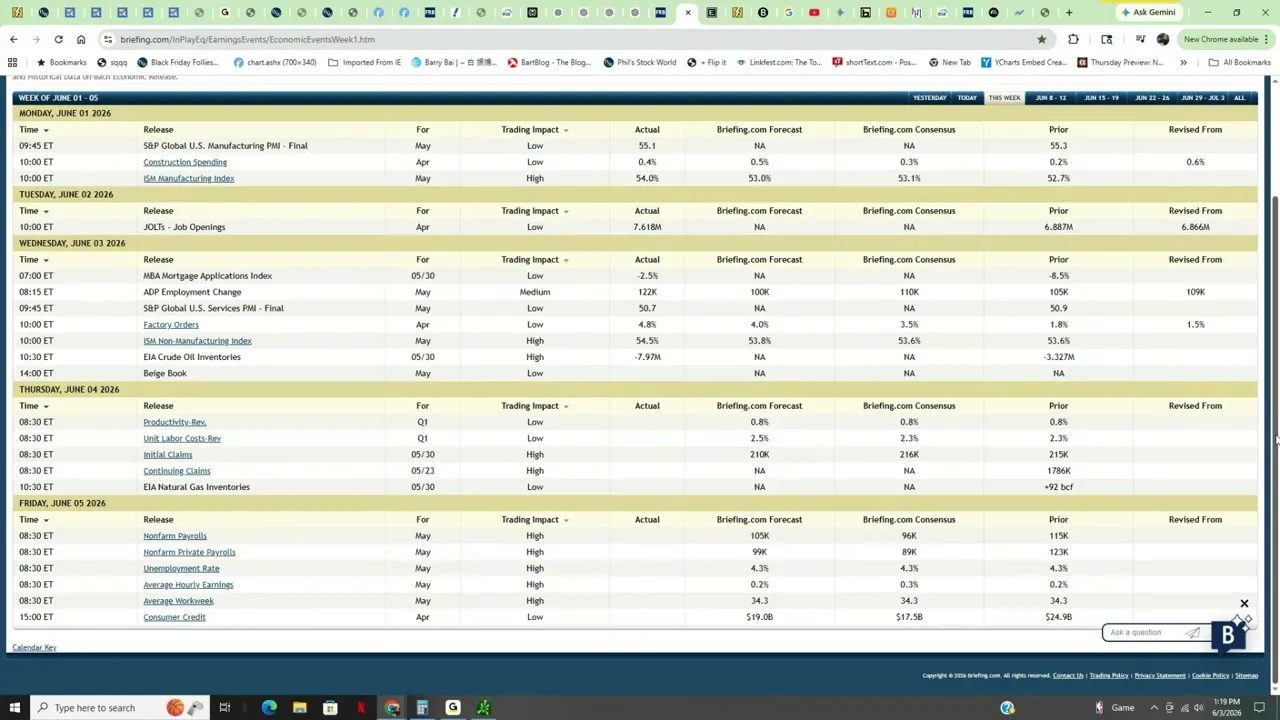
It's just horrifying. Where's briefing.com? Briefing. Economic calendar. Oh, for God's sakes. Hello. [snorts] What are you are you going to let me in? So exhausting. I'm still not a robot. Log me in. Thank you. So today's Wednesday. We have some data. We had a Oh, we have to look at the oil inventories. See, it's hard to get my head together. Um, yeah, this was way less than they thought it was going to be. So, mortgage applications down two and a half%. They just keep going down. They were down 8.5. Remember, this accumulates. So, it was
down 8.5% last week. Now, it's down 2.5%. Before that, it was down again. It's going very badly for mortgage applications. But, of course, that's true because um [snorts] the rates are going up. So they the the houses get more and more expensive and more and more people get priced out of the market every time the rates tick up. Another whole section of people can't afford homes anymore. And also how are you going to save up for a house when you're spending $100 to fill up your gas tank? That's also a problem. You know, see people
here here's the problem. all these analysts and all these um investment bankers and people like that, they they mostly are upper middle class people and a lot of them never never knew what it was like to be poor. They went to you know they went to because think about the selection process. This is this is part of the reason society is so messed up cuz the people running things are the people who never had to, you know, live Paycheck to paycheck and never had to worry about the rents and the taxes and the this and
the that. You know, you just write, you know, when you got money, you just write a check. It's like you might go, "Oh, that's ridiculous." But you write a check because it's because there's more money coming in. You know, it's like you don't know what it's like to have a checking account and to have to sit there and say to somebody, um, you know, I know my rent's due Wednesday, but can you wait until Friday to cash the check because it might not clear if I don't, you know, if you don't give me a couple
of days. Um, that's how that's how more than half the people in this country live. That's probably how 70% of the people in this country live. What they call paycheck to paycheck. They are juggling their credit cards. They are stretching out their payments. They're getting payday loans at 18 20% interest or whatever the hell they charge these days. Um, you know, and and and god forbid the, you know, they god forbid they get laid off or whatever. They can't there's no room, there's no budget. And the analysts don't think that way because if you're on
TV and you're an analyst, because you know this from applying for jobs, if you want to be an analyst on TV or if god forbid you want to be a Wall Street analyst, you better have gone to a freaking Ivy League school. And if you went to an Ivy League school in the in the last 30 years, you are you are either on a scholarship, which means you're a freaking real genius and you probably, you know, haven't been poor in a long time. Uh or It means that you uh were rich in the first place
and and your dad was like, "Yeah, sure. Harvard, 80,000 a year, no problem." Boom. Boom. Um it's, you know, [laughter] it's getting really crazy. And uh so these are the people who are telling you that the housing market isn't so bad, the retail isn't so bad, blahy blah. But the thing is, oh, I was going to say this. I forgot to say this today. It was an important point. We were talking about power plants and I was I was saying the problem is it takes longer to build a a power plant than it does to
build a data center. So for sure not maybe for sure demand will outpace supply of power for quite a long time as they build these data centers one by one by one they need more and more power blah blah blah blah blah. So energy is going to get expensive. There is a finite amount of power and they're going to use a lot more of it and especially they're going to use a lot more of it. Here's the thing. Uh households, you know what a brownout is, right? Everybody's had a brown out at some point or
or you know like in the summer when it's too hot they have a brownout. The electric the electric company has to roll lower amounts of electricity. They actually they actually throttle the amount of electricity that goes to areas. So, some of your heavy Devices may not work or whatever when there's a brown out because there's just not enough electricity to go around. So, they're basically saying, "We don't have enough energy to power your uh your outside air conditioner or whatever." Um, and and that's obviously very inconvenient. Um, so that's peak demand in the summer, but
you can't tell a data center that between 11:00 and 2:00 on a on a 100 degree heat day that they're going to get deprioritized, that they're not going to get their power. They have to have their power all the time. They're running at full capacity all the time. They're serving people who live in America, who live in Japan, who live in China, who live in wherever in Europe. you know, they've got customers all over the world. They are constantly running their data centers. They're not just running it from one country. So, and that and that
of course is weird, right? Because at night they're running it, too. Um, so there's so there's a couple of problems. And problem number one is they're they're competing with you, the homeowner, the existing customer of the power company, when they build a big giant data center. uh as Bod ran the numbers today, you know, it could be it could be using as much energy as half a million homes and the biggest electric company in in America, um the one the one in Virginia, they just bought the other one. Um they they serve 10 million people.
That's the biggest in America. So So it's 500,000 homes and one data center is very significant, But it's not it's but it's misleading because it's not just 500,000 homes. 500,000 homes constantly using peak energy. They don't go to sleep at night. They don't shut down. They don't take holidays. They don't go on vacation. It is constant peak use of 500,000 homes. So, it's very understated how much power they're going to draw off the system. And that's a big problem. And um so you know you and so getting back to the housing number um you know
people are just getting nickel and dime to death by this stuff. And the problem is that the these data centers they can afford it because let's say electricity is 5% of their total operating cost right. So if electricity becomes 10% of their total operating cost all that's only a 5% increase. All they have to do is raise their price by percent which would go from like $19 a month to $20 a month for your bill at from data center. But for the homeowners who are also going to pay the same increase, it's doubling their bills
and their bill goes from 195 a month to 200 a month. So the customer of the data center will get hit with a 5% increase while the people who actually live where the data center is get a 100% increase on their bill. $20 a month for all of the data cent's customers, $200 a month for the people who live where the data center is. That's not fair. And they are building hundreds of data centers around this country. So almost everybody in America will be affected by this. And what does that mean? That means effectively you're
going to pay ChatGP 20 bucks for your monthly Chat GPT and you're going to pay 200 bucks to the electric company for the electricity being used by Chat GPT. That's fun. [laughter] I don't mean 200 total. I'm talking 200 extra dollars a month because that's how much it's going to run up your bill. So the true cost of your Chat GPT subscription is 220 a month. That's That's really insane, right? Oh, and not only that though, but they're now um Anthropic already announced that they are going to start um they're no longer going to sell
monthly plans. They're going to sell you're going to be metered for that. So, they're going to basically effectively double, triple, quadruple their fees. Um you're not going to get away with like $20 and it's all you can eat. it's going to be $20 for x amount of computing time and then you got to pay more. And what does this do? This now creates this now makes uh AI a resource that will then have to be now you have to compete against companies that can afford to spend much more on AI than you can. Now, of
course, the solution to that is stop using AI so much and that's fine. I agree. I frankly agree with that. I think people are really the amount of wasteful crap that is done on AI because it's so cheap right now. But it's like a drug, you know, when they start, you know, when the drug dealer moves into Town um and they're handing out cocaine, they don't they don't tell you that. They don't give you like a little gram of cocaine and say, you know, it's 200 bucks. They say, "No, no, here's a gram of cocaine.
Here's 50 bucks. Go try it out. Tell me if you like it. Come back." They get you hooked on the coke first. Then they start charging you 200 bucks. Once you're hooked, that's when they start charging you. So that's what's going on. I mean, they've been they've been getting everybody hooked on AI and now they're going to take now they're going to say, "Oh, now you're going to pay for it." So you're going to pay with a bigger electric bill. You're going to pay with a bigger water bill. We don't talk about the water consumption
of AI. I mean, that's horrific. That's a whole another thing. If we don't, you know, we we in this country are blessed to have a really good water supply for the most part. This is going to suck it dry. Um, so you know, electric costs will go up, water costs will go up, treatment costs will go up because you got to treat the water that gets recycled out out through their their plant. Doesn't matter whether it goes to your pipe or their pipe, it's still going through a pipe and it has to be recycled back
through the waste treatment plants. Um, so you know, you're you're talking about just such a massive tax on the consumers and nobody has ever said to these people, "How about stopping for a minute?" Okay, so for one thing, let's put it this way. Does everybody in America need to have Uh Open AI, Anthropic, Google, Facebook, whatever the crap they've got, uh Microsoft's thing that they've got, which is terrible. Um, [laughter] does everybody need to have 10 different flavors of AI? And do all those AI companies need to build data centers that compete with each other?
This is this goes back to the telephone company days. Remember they they they came to agreements because it was insane to say to the telephone companies, "Okay, you're all going to lay cable everywhere [laughter] and you're all going to crisscross and create just this whole cluster [ __ ] of wires in every neighborhood." You know, that's how it was for a while when they first put phones in. It was horrifying. I mean, it you know, you like New York. Um here, let me show you. Um uh New York telephone lines Chris Cross. Hopefully I'll get
this image. Oh, these are Oh, here you go. Look. There you go. That's a That's exactly what I was thinking of. Oh, look at that one, too. Hello. [snorts] Yeah, look at this. This is what it used to look like When they first started putting phones in because there was no rhyme or reason to what they were doing. That's a p That's a drawing. Oh my god, this is so slow. What is this? So anyway, so they they just had these towers and they put up the lines and one went to the other one to
the other. There's no planning and no nothing. It was just a big mess and wasteful, hugely wasteful. And that's what we're doing now. We're, you know, we're we know that we're going to put this tremendous strain on the power grid. We know we're going to put tremendous strains on the water systems. We know that we're going to have to build all this infrastructure to support it and yet we're putting in five times redundant systems all over the country. That doesn't make any sense. [clears throat] It's all being done like in a crazy haphazard manner that
that you know there's no no urban planning whatsoever. And that's, you know, of course, that's because the AI companies spent a lot of money to put the Republicans back in power to deregulate everything so they could do whatever they want. They want no rules. They want to be able to to to Just, you know, you know, roll over all these places and get everything done the way they want. And uh it's crazy. But what are they also doing though? also crowding out the competition because if you create the the environment they're creating of shortages, there
are no chips left. All the chips are being bought for the next two years. Um it's the same thing as trying to start a new airline. You can't start a new airline if Boeing is seven years backlogged on planes. The only way to buy a new airline, the only way to start a new airline is to buy an old airline that's going bust because there's no you can't get new planes. You go to Boeing and say, "Hey, I want new planes." like seven years and and you know and you like oh I was going to
start an airline this year and they're like well good luck have fun and Airbus has the same backlog. Um this is the same thing if you want to start a competing AI company. So let's say you know let's say I have better AIs than Microsoft or Facebook or or or any of them frankly. Um, so that's fine and it's fine for my little ecosystem, but if I want to to produce to put it out on servers and sell it to people, I need billions of dollars. You can't even compete in this market without billions of
dollars. you know, we we can use our and that's why we built the AGI round table because we have a consulting company because we can we can make a niche use for the AIS That are that are superior to what's on the market, but we can't uh we can't go head-to-head with Microsoft. They they're building a hundred billion. They're spending $200 billion on infrastructure this year. How you going to compete with that? And um so that that's what's going on everywhere right now. That's it's a complete disaster. Uh where were we? Economic calendar, right? H
I remembered that. That was pretty good. No, not that one. There it is. So we got past the NBA. All right. So bottom line is people. So the analyst, that's what I was saying. the analysts, again, rich [ __ ] that don't know anything, um, they'll sit there and say, "Well, you know, it's about the rates and blah blah blah." It's not about the rates. You know, the the rate, take my word for it. I'm not going to do the math, but the difference between a 5% rate and a 6% rate on a $300,000 home
loan is going to be 50 bucks a month, maybe, right? But the difference between having, you know, the difference between having a uh a $100,000 deposit for the $400,000 home so that you can Get a mortgage, that's a whole different ballgame, right? People don't have that part. And it's not just that part. The mover got expensive. The um [clears throat] the mover got expensive. the furniture people got expensive. Um the the appliance people got expensive. Inflation is kicking everything up. So the entire cost of moving and changing your home and going to a new place
and getting the deposit together and so on and so forth, it's killing people. They don't have it. They can barely pay their rent. If you can barely pay your rent, how are you going to get out of paying your rent to go buy a house? and and and of course, you know, health care is up, every, you know, food costs are up, everything's up. So, 70% of the population flat out just doesn't have the freaking money to buy a house. And that means that the the 6 million uh unit supply of homes is just flip-flopping
through not and that's the thing because usually you do the home calculation is based on the fact that 110 million people are homeowners and therefore you have 110 million potential people to buy a home every year and every 20 years let's say somebody flips a home that means five million people a year should be buying homes right Um, so you know if 20 if one out of 20 People one out of 20 home owners flips their home every year 5 million homes should flip over. We're nowhere near that. We're like three. And you know why?
Because you the mistake is that most people who have a home have no possible way to get out of that home. They can barely afford to stay in the home they're in now. They can't afford to leave it. They can't afford to move. They can't afford to get a new mortgage. they can't afford to put down a new deposit. That's where they're at. So, you only have 30% of the homeowners, which is 30 something million people, and they only move once every 20 years, and now you've only got 1.5 million people who are actually able
to buy a new home every year. But then they've got to find somebody who's going to buy their home to change it. So, now you need three million people, which is uh 10%. all of a sudden you're into unrealistic numbers for how fast homes are going to turn over and that's where we are. So no, it's not about whether the Fed raises or lowers the interest rate by a quarter of a point. That's not what the problem is. The problem is a systemic problem of homes are unaffordable and it's and that's not the real problem.
The real problem is well also a car payment is now eight the average car payment is now $800 a month. I couldn't believe that. I I still I still see like advertise $300 a month for like a Kia or something like that. I don't know. I don't know why the average is $800, but I guess I guess the problem is there are people who are just paying god knows how much for cars these days. Um I haven't shot for a car in a long time. Um but whatever they are, I mean I I just was
blown away by that number. So meanwhile, ADP employment came in strong. People are getting hired. That's what's really saving. So everybody's people have jobs. So they're not unemployed and living paycheck to paycheck and waiting for those checks. They're they're getting regular job checks and they're living paycheck to paycheck. But it doesn't take much because these people, see, that's the thing. When you're living paycheck to paycheck and you're getting, let's say, uh $10,000 a month, right? Um, if you become unemployed, you can't live on unemployment, which is $1,000 a month or something like that. Uh, you
can't go from how are you going to pay your bills? But a guy making $10,000 a month, the average American making $10,000 a month, that's not enough freaking money to live. They're living paycheck to paycheck. That is really sick. You got to be making quite a lot of money in America not to be uh struggling. Um, here's a service PMI 50.7 a little bit down from 50.9. So, that's not that's not healthy. Going down. Factory orders were up uh 4.8%. And we can do a chart on this one maybe. Oh, come on. Can you believe
this crap? Yeah, he doesn't remember what I was doing. Wow. Factory orders. There we go. Oh, why does it say durable goods? Oh, is that is that also here? Durable goods down. non-durable goods, non-defense goods. Oh yeah, defense. That's why. Okay. So, so defense obviously is included in factory orders and there's that story. So, factory orders came in strong because we're bombing the [ __ ] out of people. Uh ISM manufacturing also obviously getting stronger because of the war. This is April after the war started. This is May after the war started. is non-manufacturing, but
you know, people need services, too. They need bomb polishers or whatever the hell they have over there, [laughter] you know, hallebertton and stuff like that. Um, here's the oil inventory, and we're about to get the beige book. We'll see how that looks. So, now we can take a look at the petroleum status report. And here we're seeing cutbacks because there is demand destruction. Wow. Tiny tiny. Okay. So, we got um May 29th is correct. Um Okay. Oil inventories decreased by eight, but but um gasoline inventories increased by 3.4 4 million barrels. What? And um [laughter]
that's funny. I never I never say what. I was just thinking of that girl said Amber said what. [laughter] I was thinking of the stupid sketch and I just said what? U so then distillates increased by 1.5 million also and propane increased by 2 million. So oil in the SPR, look at all the oil they took out of the SPR from 365 to 357. 8 million barrels went out of the SPR. But if it wasn't for 8 million barrels coming out of the SPR, we would have our inventory would be uh pretty much where it
is now. This would be Yeah, this would be 182. Um, and also if you look, it's interesting because even with the war last year, we had 436 million barrels excluding the SPR of commercial inventory. We have 433 now. So, we've barely been touched by this war. [clears throat] We had 228 last year of gasoline. They're 215. Distillus were 107, now they're 102. All other oils are actually higher than they were last year. And the SPR is down. We use we use uh what is that? 43 we used 43 44 million barrels of oil. So 10%
of the SPR has been withdrawn. But look at this [ __ ] though. Last year we exported 5 million which is still sick. We exported 5 million barrels of oil a day. We're a country. We don't. Now, well, I've done this math before, but I'll do it real quick. Look, if we're exporting six million barrels a day, that means we're not using 20 million barrels. We're using 14 million barrels. The other the other six million we're exporting. That's not using, that's not what America uses. So, we're we're using 14 million barrels a day. Um, and
we've increased our exports by a million barrels a day. So 1 divided by 14 is 7%. We've increased our export output by 7%. And if you take that 1 million barrels a day times how many Days? I mean what what day? What are we what day are we into this year? So let's say it's 100 150 days. So 150 days into the year. Is that right? Yeah. So 150 days into the year, we have depleted 150 million barrels from our inventory because we're exporting 150 million extra barrels. That's kind of crazy. During a war, when
when there are shortages and when American prices are going up and up and up, we are exporting more and more oil. What the freak kind of policy is that? Last year, oil was 61, now it's 91. Gasoline was 192, now it's 319. Now, notice this is up 50%, this is up like 60%. That's interesting, right? But everything's going up. But the bottom line is last year they produced more. No, I'm sorry. Here's last year. Last year, I'm sorry. They produced less last year and now they're producing more. 600,000 barrels a day more, but they're exporting
more. That's why we have these draws. We have these draws because we're shipping an extra million million barrels a day out of the country. We found new customers to ship oil to that we didn't have before. And and the crazy thing about that though is also if you're exporting six million barrels times 365 days a year, that's 2.1 billion barrels. So now here comes the bad part. Uh hello Google. How many barrels of proven reserves of proven oil reserves? Oil reserves. Does the US have? The United States has 46 B billion barrels of oil. Okay.
So, of our 46 billion barrels of oil, we're exporting two billion barrels. That's just the exported. We're exporting two billion barrels out of the country of our 46 billion barrels of oil. But we are we are uh extracting 20 bill 20 million barrels a day. So that's 20 million barrels a day times 365 days 7.3 billion. So if you take 46 / 7.3, we have 6 years worth of oil left in America before we have no US production, before there is nothing left. And yes, they count shale when they're counting our total reserves. So in
six years, this is why Biden thought it would be very important for us to get off oil because when Biden was president, we had 10 years and they cared about that and they said, "You know what we got to do? Drill baby drill is not the answer when you only have 10 years worth of oil left. What you should be doing is cutting your usage in half so that then you have 20 years of oil left because you cut your usage in half and putting everybody on alternative energy that's not oilbased so we don't have
to put ourselves in a situation where we can be choked out by foreign countries. But we're doing the opposite. We killed the programs to create clean energy. We don't have an alternate energy program. We have a drill baby drill program that is sucking up 8 billion barrels of oil a year from our 40 billion barrel reserve of oil. Not strategic reserve total oil in America gone. We will have sucked up all the oil. And by the way, proven reserves are not necessarily recoverable reserves. Here, that's a good follow-up question. Uh when it says proven reserves,
does that mean uh recoverable Uh or will some [snorts] remain in The ground pending technology improvements proven reserves is oil is already technically an econom. Oh, okay. All right. So, it is all right. So, that's 46 mill. So, we have six years. That's two years of Trump and then four years. So, whoever the next president is, unless they do something incredibly drastic during that person's term, we will run out of oil. We will become we will go from being an exporter of oil to a 100% importer of oil in six years thanks to the current
policies. We will be the world's [ __ ] when that happens. And this is nobody talks about this. It drives me crazy. It's like it's not even a it's you know why cuz look how much time I have to spend explaining it. It is not a an easy conversation and it's hard to convince people it's even true because they just don't understand it. But we do not have a huge amount of reserves. Um and we we're acting like we're Saudi Arabia. Okay. So uh world oil reserves Okay, here's a good one. [snorts] So that's us.
45 billion barrels. Oh, I wonder why we attacked Venezuela. [laughter] [snorts] It's It's an economic necessity. They They're the ones that have the oil. Here's uh Iran. Oh, we attacked Iran, too. Isn't that interesting? We attacked Iraq. We attacked Iran. The Saudis we made friends with. They've got 300 million also. So, basically, all the oil in the world, Canada, Trump doesn't like Canada either. He's just itching to go there. So Canada has 171 billion. But again, it doesn't matter how much all these people together, we're still going to all run out of oil at some
point. [clears throat] But the most important thing is we America only have 45 billion barrels of oil and we're sending and we're pumping 8 billion a year out. We that is the most disastrous foreign policy we could possibly pursue. It is a suicidal foreign policy. There is basically no way in hell in the next six years that we are going to have an alternative at the pace we're going. We're not going to have any alternative to our own oil. We are addicted to our own oil and and Trump has pushed us the exact opposite way.
He has undone the progress that was done under Biden and he is now pushing it the other way. [clears throat] And by the way, keep that in mind when you're thinking of investing in Exxon and Chevron and whoever. Uh that's why they that's why these guys are all heading over to Venezuela again. This was all in his old plan. They're not stupid. They see it coming. We invaded Venezuela. So, Exxon and Chevron, all the companies that they kicked out, Venezuela kicked those companies out of the country for exploiting their people and and and ransacking the
wealth of the country, which is obviously 300 million barrels of oil. Venezuela should be like Saudi Arabia. Everybody in the country should be should be rich. But no, it was corrupt and poorly run and poorly organized and so on and so forth. But Venezuela should be a huge prosperous nation with all this oil and and so but they they kicked out the American companies and from that point forward we're at economic war with them and now we have forced our way back in. I mean it's sick stuff going on. It's in our name. Oh by
the way Russia only has 80 million. They're in better they're in better shape than us but not for long. I mean, you know, 20 years from now, we're both going to be bone dry for oil. [clears throat] And of course, it's a cascading effect, right? Because the world uses 100 million barrels of oil. There is uh three, four, five, count that. So, five and three is eight and 10 and uh let's say 15. Let's say it's 15 overall million barrels of oil. I'm sorry. 15 trillion barrels of oil, right? So it's [snorts] So 15,000 billion.
Wait, 100 million barrels a day times 365 days is 36 billion. So 15,000 billion is 15 trillion barrels of oil. And I hope I did that right. [snorts] Seems wrong. Right. It was 1.5. I mean, 1500. It wasn't 15,000. It can't be. So, it's only 1,500. So, 1,500. Oh, got the other number now. 36. Okay. So it's 1 1,500 billion divided by 36.5 40 years. In 40 years, we will use up all of the oil in the world. So climate change solved. No more oil. [laughter] There won't be any more oil to burn. That's mean.
So I guess maybe that's their plan. Maybe that's how they're fixing climate change. They're going to burn all the oil now and then There'll be no more oil left and then the climate will fix itself hopefully because we'll stop burning fossil fuels. Um I don't know. I really but so the whole world grinds to a halt in 40 years if we don't get the world off of solar. So should we wait 20 years and then start or should we do something now? So the previous administration's logic was we better do something now. Most of the
world is actually doing something about it. We're not doing obviously anything about it. We're fighting people who do something about it. Um but from a policy standpoint, at the rate we consume oil and the rate that we send it out of the country as well, we're committing suicide. We are going to be beholden to this country and this country and these countries. They are going to be our bosses because at any time, just like Iran's doing right now, at any time they can say, "Hey, guess what? I'm going to flip a switch and you get
no oil. Have a nice day." This war is a preview of the situation we'll be in on a daily basis as the first major country to run completely out of oil. And we are the country most addicted to oil because the whole world with 8 billion people wait there. The whole world with 8 billion people consumes [laughter] 100 billion barrels. But we consume 20 Billion barrels and we only have that many people. So we can [laughter] That's really crazy. So So 300 So 5% We're 5% of the world. So 5% of the world consumes 20%
of the oil and we're the ones running out. Well, of course, we're running out because we consume all the oil. I guess that was pretty obvious that was going to happen, but it's happening in in such a short period of time that nobody's really pricing this in. Nobody's got this modeled. So, that's insane. [laughter] And we're going to get the Beige book any minute, so we'll find out what they have to say about people's situation. But anyway, so now we're lined up on that. What else are we going to talk about? Um, oh, let's see
if we have any questions. Where's the question thing? Here it is. And Brad says, "Hi, Phil. I think you saw the Jeff Bezos interview a couple of weeks ago, and you might have made a quick mention that you disagreed with him on his views on AI. How do you see it differently than him? Where do you agree and disagree with his other parts of the interview?" I'm sorry, but I only vaguely saw it and I don't even remember what the hell he was talking about. So, if you can remind me what he's talking about, I'll
tell you Whether I agree with it or not. But in general and again as we know from movie stars and baseball players, right? Even if you had humble beginnings and even if you seemed like a normal person for 20some years, becoming incredibly wealthy and being surrounded by people who take care of you all the time very very quickly corrupts like they say power corrupts, right? it power corrupts and absolute power corrupts absolutely and I think that's Makaveli or something like that. Um so even with the best intentions you see what happens to movie stars and
athletes and whatever they become completely out of touch with what normal human beings go through. Okay. [clears throat] Now imagine being Jeff Bezos or Mark Zuckerberg or whatever. These are people who work and build a company and they are work. They've got a million employees, hundreds of thousands of employees. Um, so their day doesn't matter how rich you are. You don't see these guys out very much. They go to their conferences. They'll go to Davos or something like that, but they don't they're not out and about on a regular basis. Um, the I think the
guy who has the guy who has the best is Jensen from Nvidia. He seems to like have all the time in the world. He doesn't I don't think he puts a day in the office that guy. He's always somewhere talking to people. Um, but not Bezos. He's working. Zuckerberg's working. You know, um, you know, it's they're they're incredibly wealthy, but they're very out of touch because they live in this incredible offices and they've got security guards and they've got layers of people. You can't just walk up to these guys. You got to go through like
eight layers before you get to them. Well, those same eight layers are the eight layers they need to go through to have a real conversation with a human being who's not one of their workers. So they get out of touch. You know, Jeff Bezos doesn't think it's weird to charge people, I don't know, 20 million, whatever the hell he charges. You know, I like how much he charge, I don't even know. Um, some huge amount of money, right? um what does it cost to ride a rocket? Well, there you go. 450 to 5. Okay. So,
450 to 50 55 million. It's a big spread, man. That's Virgin. All right. Blue Origin 1 million plus initial maiden flight sanction. [snorts] It's 28 million. Jesus Christ. [laughter] Now see, it's confusing what what they what they say they'll charge to what they're actually charging. But anyway, a million a half a million. What's the difference? It's just an insane number. Uh it it's the same thing with going on a plane. They've got these and it's not just Jeff Bezos. There's a lot of people that rich. You know, there are first class cabins on planes that
have showers and bedrooms. Like they have an actual bed in the in the cabin or whatever the hell you I don't even know what you call it. You go to the front of the plane and there's a freaking apartment in the front of the plane for super rich people and they pay $100,000 to fly to Europe on, you know, and and it's only an eight hour flight. You really need all that? I mean, I I get it if you I went to um Thailand a few years ago and I had a one of those layown
sleeper seats. I had a first class seat with a lay down sleeping thing. Um I I frankly I don't know. I I could not Have made that flight if I didn't take a first get a first class seat because I mean I 17 freaking hours in a plane. But even even with all that luxury, it's not um [clears throat] it's still unbearable to be on a plane for that long. Um but that thing laid flat and whatever. So it was like a bed, but that's that right there was great. Do would I have been better
off with a mattress on the floor or a bed or whatever the hell they had and and and a refrigerator and a shower? I mean, I would have been a little bit better off, but not not $100,000 better off. Yet, there are people who do this. Um, there are people who pay $10,000 a night for hotel rooms. That's why these things are around because people do it. Um, what was $400,000? Um, [ __ ] There's just an event where Oh, the the the the the Kentucky Derby. $400,000 for a box seat. Not a box seat.
I'm sure you get the whole suite or something, but there was like a, you know, the suite at the Kentucky Derby. 400,000 bucks for one for horse racing in the last three minutes. I mean, I know it's a whole event, but you know, [laughter] seriously. Oh my god. That that to me cracks me up. I mean, it's a horse race. It's not like you're, you know, you're seeing the best horses of that year, but that doesn't mean you're seeing the greatest horse of all time. It doesn't mean you, you know, it's like you can't possibly
be the home team for the Kentucky Derby. You didn't grow up watching the horse. The horse is only three years old. It's like, you probably didn't know the horse's name until like a week or two before. Um, and it's just crazy. But everything's crazy. Prices are out of control. Things are out of control. Consumers are getting squashed. That's what I was trying to say. And then the other part of the topic that we were going to talk about was Oh [ __ ] that's right. We got a lot of stuff. We had this whole agenda.
What is that? [clears throat] Oh, now I'm screwed. Um, [laughter] now I have no idea what the webinar is about. Um, oh wait, Maddie does a thing. Good job, Maddie. She puts this the title of what it is. See, and she always asks me and I'm like, I don't know. Um, the beige book just about to come out. Portfolio review and top trades, right? All right. So, let's talk about that. Recent top trades. That's a good topic for right now. Then we'll get to portfolio review after hopefully. I don't think the beige book will take
too long, he said confidently. All right. So, top trades. Um, so in the last since since May 1st, in the last month, we've had four top trade alerts. We had SoFi Financial, love them. We had uh Medronic, MDT. Let's take a look. Sofi, what is Oh, don't do that. Now includes They do. There's like a moon symbol somewhere. Damn it. I really don't like this mode. What's that? So annoy. Oh, there it is. Theme bastards. Thank you. So, SoFi Financial, which we picked up early. That was the first one we did. like May 1st or
something. So, it was down here. It's back down here. So, you can get back in again. Um I know the short looks kind of scary, but that's where we picked it up is we decided this was cheap enough and we and we grabbed it when See, we didn't buy it before. When this drop happened, I like SoFi for a long time, but when this drop happened, we said, "Oh, let's get back into it now. It's a top trade. That's Too cheap." Um, so that's SoFi. Then we got Medronic. So, I'm not going to go over
the trades because you can look them up. We'll just talk about [clears throat] SoFi's got phenomenal growth, great bank, so on and so forth. Here's Metronic. Um, [clears throat] and again, that was on the 18th. So, you can see how it works because what just close that window. [clears throat] So on the 18th of May, we decided to pick up Metronic. And I like their medical devices. They're growing fast. They're the population's aging. I mean, all you know, people are falling apart. They need spare parts. So that's what I like about these guys. For whatever
reason, they drifted down into earnings and then they shot back up. But that's great because we got everything filled and uh we're happy. Then we go to Macy's, who we just put on the other day. So now we go from Medron to just the M. [clears throat] So at this line, we decided to go for Macy's. They had uh they had good earnings, but nobody seems to care. [laughter] So, the gap EPS 500% up, but anyway. So, uh 324% [laughter] beat of earnings. Um revenue is up 1.5%. So, anyway, they're they're they're doing well in
turning things around. And what does it say here? Let's see what it says. Macy's Beats raises their sales, raises their EPS, uh but guides their Q2 consensus. Um, I I don't care if they if if they raise their sales outlook and they raise their estimates and they raise their EPS outlook, why for the year, why do I care if they say Q2 won't be that great? So, I you believe that Q2 won't be that great, but you don't want to believe that Q3 and Q4 are obviously going to make up for it because they raise
guidance for the year. That's foolish. So, um, fiscal revenues 4.7 billion, up 2% year-over-year. Second quarter EPS set at 29 to 34, but it was set at 36. Company maintained full year, but the full year is still going to be uh 7.7 margin and their fullear sales and earnings forecast blah blah blah. So, not bad. So anyway, I like Macy's. It's still completely playable obviously at that level. And the next one was which we just did yesterday was Alcoa and I love Alcoa. Um the the the aluminum thing it's aluminum is constricted in the Gulf.
But the more important thing though is aluminum is extremely critical metal for cooling all these data centers. That's what they use to cool everything. They use aluminum. They they you know it's like your refrigerator, right? your refrigerator has aluminum. It's you make the aluminum very cold and it quickly conducts the heat away from whatever is um so heavy heavy industrial use for aluminum. Uh there's there's there's no again it's it's like a power plant. There there are aluminum miners but they can't just like double they can't you know they can't get an order for twice
as much aluminum and say sure right away. It doesn't work like that. It's incredibly difficult to start a new mine and get everything going and so on and so forth. So, it's not going to happen. So, aluminum is going to be heavily constrained for a long time. Plus, I make airplanes out of it, too. Um, and tin cans. Um, so we like alcohol also. All right. So, we liked it yesterday and it popped and now it came back a bit, but still long-term story. We love it. So, four really good top trades in the past
month. And uh at the end of June, we'll do a top trade report for the second quarter. Um if you go back in time, we always do top, you know, we do a uh When would we have done one? Top trade alert. Top trade alert. Top trade alert. Top trade alert. Nope. I guess the last one we did was January. I think we do them every six months. Here's Barclays is really taking off. Best Buy is doing well. Google of course is doing great. Konagra not so great. Nike terrible last couple of days. Holy crap.
They really fell apart. They were getting better and then they crashed. Look at that. They were all the way up to 4750 and now they collapsed back to 43. That's That's 10%. That's really bad. This is a giant company losing 10 10% is$6 billion dollars just going up in smoke. But, you know, if you look over the longer term, I mean, this is where they are. They're kind of stuck in this sort of range down here. Um, because they're not cheap. 23 times earnings times forward earnings, 28 times current earnings. They're not cheap. They are
they're a company that's eroding. Um, here's earnings like super erratic, right? Um, here's sales not no longer growing. They're barely hanging on to their sales. Um, they've done some share buybacks, but not enough to offset this damage. Look at And look at this. Downgrade, downgrade, downgrade, downgrade, downgrade, downgrade. That's not good. And and and the last couple of guys have given him $45 targets. So, people don't even think they're going to escape this area. Nike is a mess. So, I apologize for that one. It's not our not our best. Oh, no. Son of a [
__ ] I closed that window to You are kidding me. Oh, there's one. Put this back. Oh, we're going to look at top trades. [snorts] So, here's Signature Bank, UPS, I said Nike, Cleveland Cliff is also taking off. Um, HPQ is taking off. Owl is fluctuating. Gio is taking off. And there's our other review. So you can go back there and check it out. So uh it's not going to be like, you know, we have to finish the month and then I'll do the review. So maybe sometime July I'll get it done. But this review
is very helpful because it tells you everything that happened before that. Oh, look at that. Oh, it's 10 10 trade ideas for 2026. Oh, look at all the nice stuff we give you guys. Holy cow. GNRC is really popping. Generator Company HPQ is really popping. It's very good. All right, so where's GNRC? Did I lose that thing, too? No. There it is. Maybe if I stick to touching the top of these things. Ah, what is that? Oh no, you're kidding me. I just made that disappear, too. What is going on? Oh, that's awful. I think
there's a way to stop that, like to lock these things so they don't get easily hit. Or you can not have 50 tabs open. That would be good, too. Uh GNRC is a company I was banging and banging the table on for a couple of Years, and finally they taken off. um like all down here I was like this is a great company why aren't people buying it um still great still doing good now obviously generat backup generators who needs backup generators power plants yay you know and and data centers um so fantastic for them
they're they're leaning they're getting much more commercial business than they used to get and they've ga they're going to be backorded for years so even even though it's gotten a little bit expensive it's still a great So that we were going to look at. Let me go back to Phil Stock World and we Oh, we did our portfolio, right? So, the um $700 month portfolio. Wow, that's hard to see, huh? Um there's no pluses here. Oh, here you go. That's not going to work. And let's sign in. Nope. Hello. There we go. Oh, now the
beook is out. Okay, [laughter] we'll get a rundown on that in a minute. It won't take long. Um, $700 a month portfolio. We have Kagra, Helen, Helen of Troy, iPath, um, SQ is a hedge. We have Owl, which we just talked about. Cliss we just talked about doing well. Natural gas, I'm very confident that'll hold $11. Barrett Gold energy transfer. So anyway, so the bottom line is we did a whole review and you can read it here. I'm not going to sit there and make everybody squint at it now. And we get into real big
detail. Um here's the here's the prior 12 months worth of reviews. Um we're up 289%. Which is pretty good. [laughter] And uh and obviously in each one we said how much money of upside potential. So you know when you look at a position you say oh do I want this position? This one's going to make 31%. So no. Um this is a downside. This one will make 90%. This one will make um I didn't Oh I didn't do the math on that one. UNNG we pay 1250. All right. So, 1250 is almost 100% on that
one. Uh, this one has 122% upside. So, you know, it's not hard to decide if you want to have a trade. This one's got 126% upside. This one's got 69% upside. And and you know, we write these numbers down and you know, it's it's like, oh, that sounds like a lot. But you know what? Realistically, we're up 300 Freaking% in three years. In in four years, sorry. So, it's almost four years. cuz we're up 400%. That's 75% a year. That's our average. [snorts] So when you see that we're telling you a trade is going to
make 69% 100% whatever. Yeah. Because we use options to leverage the plays, but we're not using any margin. So it's low-level options trading. And that's how we do that. [snorts] So, Mr. Google, what am I looking for? Beige book. Find me the beige book. Okay. Got to pick the right one. Fantastic. Oh, I don't want all that. No, that's it. It's not very long, is it? [sighs and gasps] That's really shitty information. Um, now we go to Mr. Warren. Where are you, man? Facebook time. When was the last one we did? [snorts] Okay, this is
so that's right, I think. April. Yep. Okay, good. Uh, okay. Here's the new one. Uh, give us a rundown including what changed and what are war effects and what are deeper economic concerns. And why All right. So, this page book is not recessionary, but is clearly more uncomfortable than the last one. Uh, one note, the prior upload file appears to have expired. I'm comparing mainly against the last page Book discussion plus the new text that you pasted. Okay. Um the economy is still growing but the quality of growth is deteriorating. Growth is still positive across
most regions. 10 of 12 districts and we see this in the manufacturing data. It was getting better. 10 of 12 Fed districts reported a slight to moderate growth with one flat one down. That is not a collapse. But underneath that consumers are more strained which we just talked about. Inflation is broader, margins are tighter and hiring is frozen in place. The report is basically saying war shock on top of late cycle consumer fatigue. What has changed? And by the way, good point. [snorts] He's there's there's an economic term for what this is late cycle consumer
fatigue because economies have cycles. So, um, economic [clears throat] what? That's weird. Economic cycle. Expansion, contraction, business peak, recessionary trough. These are the elements of a economic cycle. So expansion information technology financials communications consumer discretionary outperformers financial energy materials contraction healthcare consumer staples and utilities and in the in the next recovery stage you'll do real estate and industrials. So, it's normal for uh uh the economy to expand and contract and expand and contract. That's just normal stages of a cycle that have been going on for a thousand years. Yet, people act surprised every time it
happens, which is crazy. [clears throat] What changed? Growth improved a bit but became more uneven. The prior setup was more slow but stable. This one shows more manufacturing strength tied to defense, data centers, and industrial demand. No kidding. Everything's being driven by the same narrow little ban that was driving everything before. Manufacturing increased modestly to uh uh too strongly in nine districts, which is a real positive, but that strength is not flowing evenly through the consumer spending uh the economy. Consumer spending is described as mixed and increasingly bifurcated with higher inome households resilient middle- inome
households stretching dollars and lower income consum consumers under visible strain. Inflation worsened prices increased at moderate to strong pace and most districts reported higher inflation than the previous report. That is a key Fed change. The April book was already dealing with energy pressure. This one says the pressure broaden shipping, packaging, groceries, and fertilizer. So widening, spreading, worsening inflation is a big big deal. Labor is stuck, not weak. Um, this is a late cycle condition. Uh, low, higher, low fire. We hear this constantly. You hear it so often is it's probably true because it's all anybody
ever says. Low hiring, low firing. People are just everybody's just sort of like holding in place, waiting to see what happens. Right now, employment showed little or no change in 11 districts and hiring is mostly limited to critical roles, retrition replacement. That means we are not seeing mass layoffs yet, but we're not seeing any kind of labor demand yet either. Workers are reluctant to switch jobs and we talked about that because there's 7.6 6 million open jobs, but only 110,000 people got hired last month for 7.6 million jobs. That means it will take us 76
months to go through the open jobs. So for the people who want to hire people, they're going to wait 76 months to hire the people they want to hire. The people who are looking for jobs, it'll take 76 months for them to all find jobs. That's insane. Those numbers are crazy. And what is that telling you? It tells you that the that the the apparatus for uh uh for hiring and find the the the the the labor employment apparatus is broken. And I can tell you that from my daughter because my daughter, and it wasn't
just her, it was her friends, too. My daughter went to Stevens Institute of Technology in Hoboken, which is nice techy stuff. Um they were a bunch of smart kids. They were all go-getters and qualified and all that stuff. And um she had four she had five people in her house including herself. Um and and they all had trouble getting jobs out of college. It was just crazy. In New York, you know, basically in New York City for for people graduating with with technology engineering degrees, they had trouble finding work. And I mean for months like
they they were getting really pissed off and very frustrated for the whole summer trying to get jobs and stuff and um you know one by one they found them but they they would send out hundreds of resumes. I've never sent out hundreds of resumes. I say you know we remember all right I have I haven't worked for anybody else in like 30 something years so I'm not a good example probably but 30 years ago we used to open up the newspaper. there was a help wanted section and when you needed a job you would look
at the jobs and say I want to work at that place and you would then go down to that place or you might fax in and call them or whatever but mostly you would go down to the place give them your resume you know where you wear a nice suit go down to the place give them your resume and say I'd like to come work for you and they'd say sure here's An appointment with our HR person and and and and five times maybe you would do that and you would get a job you'd be
you know a lot of times Well, it depends on who you are, I guess, but you know, generally it wouldn't take that long for you to get a job. Somebody was going to hire you because they had an ad in the paper. It said they wanted to hire you. They're paying money to tell you they want to hire you. Um, now they're you get first of all, when you want a job, you like see every job in America, which is stupid. I mean, I obviously you can narrow the search down, but realistically, why do I
care about every job in America? I mean, I mean, guess some people like to relocate, but again, look at the look at the cost of relocating. It's like if I do I have 5,000 bucks to uproot my life and go to California to get a job. What What if it doesn't work out? What if I got to fly back and forth for a,000 bucks to go do just an interview? It's crazy. Um, but depends where you live, depends what you're trying to do. But somehow the the job market has gone national. And that means though
that if you live in New York, now people from California and Texas and so on and so forth are freaking applying for the job. And instead of having uh 50 résumés to go through, they've got 5,000 résumés to go through because 5,000 people around them the country applied for the job. So yeah, of course the HR departments are overwhelmed and of course uh the the students are getting constantly rejected from job after job after job because you no longer have to be the best person in your area. You have to be the best person in
the country for the job. And and and the problem with that is well first of all it's ridiculous. [laughter] Second of all, um, second of all, the problem with that is that the employers have that attitude where they're like, "If you don't check every single freaking box we have, we will bite our time because we still have 4,800 resumes to go through before and they're running them through AIS and you're running it. You're you're putting it out through AIS and it's just insane. So, it's broken. The system is broken. So, nobody ends up getting hired.
[clears throat] I I I've never seen anything like it. And what does that do? That means if you lose your job, you could be in for a prolonged period of unemployment. And [clears throat] and uh and obviously, like I said, $120,000 person loses a job, it's pretty traumatic if they can't get another one. It, you know, working in McDonald's for a few weeks is not going to cut it to pay your rent. You're sitting in a new That's the thing. you relocate yourself. These people from all over the country, they relocate to New York City
to get a hundred, you know, $120,000 job. They're making $10,000 a month, but half of it go, you know, half of it goes to taxes and um and they're paying 4,000 a month for the apartment. So, they're broke. Just the apartment is $4,000. So, how they, you know, how you going to live? You're only taking home, let's say, 6,000. Let's say you're taking home 6,000 bucks a month and 4,000 goes on the apartment. The only good thing about New York is you don't need a car, but you still need to get around. You're paying for
transportation. You're paying for food. Um, you might want to wear some clothes [laughter] and you don't have a washer and dryer. See, if you're in New York, you got to go do your laundry somewhere else. So things are nuts. Uh, so that means we're not seeing mass layoffs yet, but we are seeing a strong labor demand. We're not seeing strong labor demand workers. We'll see. Well, we'll find out tomorrow for non-parm payrolls work not tomorrow, Thursday, Friday. Um, workers reluctant to switch jobs because the uncertainty is rising. That's not a recession signal by itself, but
it's a competent signal. And that means if people are not willing to leave their jobs, they're not getting uh raises. And if you're not getting raises, then you're falling behind to inflation. Um, what is war related? Energy inflation. The report directly says energy costs tied to the Middle East conflict are the primary driver of inflation pressure. But see this is how they get off the hook because they they blame the war for the inflation and they say well the war ends so therefore the inflation is Transitory. But it's not going to it doesn't work that
way. It's going to take a long time to get back to normal on the things that are locked up in the straight of horses like like more than a month. So it hits all these things. Consumer pressure from fuel. Consumers are not necessarily un not necessarily unemployed. They're being squeezed by affordability. Auto dealers reported soft and new vehicles. Uh demand tied to affordability and fuel costs. Customers shifting towards used and hybrid vehicles. This is a and you see that's the interesting part. That's why uh people are switching to hybrids and switching to electric cars to
save on the gas. And that's uh that's then hurting the demand for oil that these guys were counting on. And that's why we're shipping it all out of the country because we're not actually using it here. Uh that is a more transmission channel, higher oil, higher gas, less spending, weaker weaker water, restaurants and retail. Uh agriculture is taking a hit from fertilizer. The report says a conditions were unchanged or decline in most district. This matters because uh it can keep food inflation sticky. So even after oil goes down, the fact that we had this fertilizer
disruption during the Planting season is over. Doesn't do you any good if the war ends when they already didn't have the fertilizer they needed to plant the crops. It's over. The planting season doesn't wait for the water to end. So that's a whole year of of lo not lost crops but you know lesser crops. You will not be able you you will not scientifically be able to grow as much crops if you didn't put the fertilizer down in the first place. You will have weaker crops. Um so that that's there's no way to stop that.
That's going to show up in the fall in harvest season. If we have poor harvest, which is almost locked in now, then that's going to cause big problems down the road. Also, um business uncertainty, St. Louis and Dallas flag uncertainty, supply chain disruption, fuel cost, transportation costs, blah blah blah. That means the war is delaying capex and expansion decisions. What are the deeper concerns? Um consumer bifurcation. This is deeper than oil. The report says higher income consumers are are resilient, middle-income households are getting squeezed and the low-income households are basically screwed. Um structural affordability issue
and cumulative inflation event uh insurance payments, credit card blah blah blah. Uh war makes it worse that didn't create it. These are all things that are happening anyway. Rising delinquencies, banking conditions were uh mostly stable, but delinquencies are rising. Residential mortgages, people can't afford their house payments. Consumer loans can't afford their loan payments and agricultural loans. And again, this is going to get much worse because the the farmers didn't have money. There wasn't the fertilizer costs went up. They couldn't afford the fertilizer. There wasn't enough fertilizer. They couldn't make it up with uh getting a
new tractors or things like that. They to do other things to improve their crop handling. So, they just basically are struggling through this season with halfass uh plantings of crops. and we're going to pay for that badly in the fall. And there's no way to fix it. There's nothing they can do now in June to fix the fact that in March and April they didn't plant the crops. Uh margin compression, non- labor input costs are rising faster than selling prices. Uh consumer financing firms have mixed ability to pass through costs. Uh there's a profit problem.
Companies can't pass through cost. The earnings estimates get cut. If they do pay, no, but frankly, I don't I don't want to get into an argument with Warren about it, but frankly, it doesn't matter. Doesn't matter what anybody earns other than the the 10 or 12 companies in the Magnificent Seven's orbit that make all the money. over 50% of all S&P profits are just the Magnificent 7. Then when you take into account their ecosystem of other companies that are feeding off them, it's getting getting towards like 70% of the S&P is just, you know, let's
say two dozen companies or 70% of the S&P's profits. That is messed up. There's 480 Other companies I mean, that's just a really sick number. Um, so, so 480 of the S&P 500 make essentially no money. And no money, by the way, is a billion. A billion dollars now is like no money. It's like, so what? Who cares? You know, we used to be, you know, somebody used to make a billion dollars. We like, "Holy [ __ ] you know, now now it's like uh, you know, you got companies like Apple and Microsoft and whatever,
they make every every few days they make a billion dollars. They make a hundred billion a year these companies. HH H um real estate softness Atlanta reported commercial and residential real estate flats down. San Francisco agricultural and residential real estate weakened slightly. Uh more about rates and affordability than the war. So these are non-war items of course, right? So it doesn't matter if the war ends, those are still problems. Um the beige book is hawkish not because growth is too hot but because inflation is too sticky. The Fed sees growth is still positive. Labor is
not collapsing, prices are accelerating. Only the these are not in the these are these are not things that make the Fed ease uh business financing facing pass through uh cost pressures. Consumer stream is still spending selectively. The combination does not give them an easy excuse to cut. The war gives [clears throat and cough] the Fed a dilemma. Energy shocks can hurt growth, but they can also push inflation higher. If the Fed cuts into that, it risks inval it risks validating another inflation wave. This supports a barbell. On one side, companies tied to real demand, defense,
power, data centers, industrial uh services, manufacturing. On the other, avoidably cautious with the consumer discretionary like Nike just got trashed, low-end retail, auto financing, restaurants, and highly liquid real estate. We don't have any restaurants right now. Um, we don't have we don't really have any real estate. We don't have any restaurants. Uh, we're nowhere near auto financing. Um, we have a couple of consumer discretionaries. Um and uh low-end retail. We just did we just like look at Dollar General somebody. Um the big message is this is not a demand boom. This is a cost shock
economy with pockets of industrial strength. And the pockets of industrial strength though are coming from building data centers and blowing things up in the war. That's not a good thing to base your economy on. That means we should not chase everything. We want companies with pricing power, balance sheet strength and exposure and to durable capex, not businesses relying on stretch consumers. [snorts] Yeah. And there you go. I mean, that's a that's a good summary of our position, right? We're that's what we have this portfolio for. So, here's Gio, that's a locking people up company. Uh
Kagra is a food company, commercial food, and they're they're doing okay. I mean, you know, we we think they bought them at HP. I just said we doing phenomenal. It's probably doing too good. Uh Novo. Do we still have it? I thought we cut it. I always think we cut it, but we don't. So, maybe we still have it. Um [laughter] Nova Novo. Um here's Owl. I like them. Here's uh Perian Resources. Forget that. They're fantastic. So, they're going to be exploding. Uh, Sofi, we just talked about uh the SQ hedge. Um, ULCC. What? What
the freak? It's 422. Oh. Oh. Oh, I have Wait, I have two of these open. That's why. That was really confusing. I was like, we don't have that anymore. There you go. So, UU uranium, they just took off also. Um, Sofi, Sofi, Fizer. Yep. Fiser drugs. Drugs are good. Novo we still have. Drugs are good. Uh, Macy's. There you go. Took a chance with Macy's because we like Macy's as a real estate play. Macy's is way, way down. And at the price they're at now, which is $5.7 billion, I would say. Um, at this price,
they make sense as a real estate play because they have just this building in Manhattan, right? You know, Miracle on 34th Street. They've owned the building forever. It's it's their block in Manhattan. So, they own a whole block in Manhattan. That building alone is probably worth what the whole company is being priced at, just one real estate. and Macy's. Obviously, anybody who lives in America, um Macy's is the anchor store of most malls. Macy's is also, if you live in a in a more of a city kind of place, like a midsize city, um instead
of a mall, it might be like a big store in the middle of your town, like in prime real estate. And again, they own it. They've been there forever. They own it. They paid it off 20, 30 years ago. They paid these places off. and it's just a a an unrealized asset for the company. All these all these uh buildings that they're in and a lot of times they are leasing like you don't realize it but you know 50 years ago the Macy's was the big building in your town and they uh had a big
piece of land and they have over time uh let that land be developed around them and they are the they are the landlord for the buildings around they make a lot of money just being a landlord all over the country. So they've got these big things in malls and they got and a lot of times in the malls they have special arrangements also because they were the store the mall was built around. You know Sears is gone. So it used to be it was either Macy's or Sears. Um I think Sears used to be Gimbals.
I think I think that's where Gimbals came. I think gimbals turned into Sears or something like that. But it used to be you know forever it was Macy's. And um and so basically back in the day Macy's and Sears were like every mall in America was Macy's and Sears and sometimes JC Penney or something like that but it was basically Macy's and Sears and Macy's owns Bloomingdales too. So when you see a Bloomingdales that's also Macy's. Um and they they they own all this land. It's a gigantic portfolio of real estate that's worth much more
than the whole company. Uh, and they've got a company and the kind and the the company makes money. It's not a it's not a non-m nonprofitable company. Um, Hila Packard, we talked about GEO, we talked about that's where they lock all of Trump's prisoners up. Um, energy transfer, obviously pipeline, you know, natural gas pipeline is a great business. Uh, Barrett Gold, gold is still a good business. Uh, UNNG is natural gas. Cleveland cliffs. Uh, Blue Owl again. What? Oh, no. That was from the that was because we uh mixed it up with the old portfolio.
Uh SQ IPF uh Helen of Troy is a retailer their gadgets and stuff and Kagra the the [snorts] the the food that's having The the agriculture that's having a hard time but that's not really Kagra. Kagra is more like you know chickens and things like that. Um but what don't we have? There's none of the chip companies in here. This is a chipless portfolio. The 700 a month portfolio, the long-term portfolio, we have gambles. Oh, here you go. So, in the long-term portfolio, we've got some gamles on things. We have um AGNC is a is
a REIT. Um Barrack again, Best Buy for consumers. Barkclay is obviously the huge bank. Kagra is here too. Um uh CEG is a energy company, Electrics. Um Cleveland Cliff is again doing great. Comcast. Notice notice the variety, but also notice a lack. You won't see a lot of big tech names here. Uh, Coinbase is a bet on the uh crypto markets. Um, Crocs is Crocs. We always like Crocs. Um, Cisco, uh, EPD. Uh, what does EPD stand for? EP [clears throat] D. Enterprise Products Partners. I wonder I could remember what they stand for. [laughter] That's
where we left off first solar because because believe it or not, people are buying solar still. You know, regardless of what the government tries To do, they're not letting them. Uh Gap Jeans, of course, Geo again, uh GFI is another gold company. Google, there's a first. So, we went all the way down the portfolio. This is the first Magnificent 7 company is Google. And it's and it's always been the only one I liked. Um, now I know I don't understand Apple. Obviously Apple, too. Why don't we Wait, don't we have Apple, huh? I guess we
don't have any Apple. Okay, I thought we did. Here's HP just took went flying. Helen of Troy. Uh, H&R Block. IBM. I always like IBM. Uh, oh. Oh, oh, very important. Not IBM, it's Microsoft. Microsoft just came out with uh a a much improved quantum chip, a thousand time improvement over the previous quantum chips. Uh that's the problem with crypto right now. It is now probably less than three years before quantum computers will be able to crack uh the crypto all the crypto codes. So, the blockchain that is supposedly the impenetrable wall that protects crypto
and allows it to be transferred is now open season for quantum computers. And they're saying, "Oh, well, now we'll just uh we'll take quantum computers and we're going to redo the blockchains." But what are you going to do? You going to tell they're going to turn in their crypto for something else? The crypto is worthless if it isn't secure. So, the people who make this is this is the [ __ ] of the whole thing. The people who made crypto, there's 21 million bitcoins, right? Total total. It's a mathematical formula that gets harder and harder
to to to figure out the more bitcoins you make, but there can only possibly be 21 million of them. That's that's the the limit of bitcoins. [clears throat and cough] and encoding them and decoding them is how the transactions work. So, I have a wallet with a crypto coin in it. I know what the crypto coin's number is, what the what the key is. So, I then um I then um uh [ __ ] what's the word? Um encode. I encode the key and I send it to you along with instructions to decode it in
between. They're two separate things in between. If somebody intercepts a key without the decoding, they have no idea how to how to translate it. So, it's no use to them. So, it is fairly secure for transmissions that you have these coins and you can securely transmit them from point A to point B. You transmit the code and you transmit the decryption key and that's how you do a Bitcoin transaction. Um, unfortunately though, a quantum computer is able to look at the crypto key and Say, "Oh, not I'm sorry." They're able to look at the encoded
the encoded Bitcoin identifier, right? And they and the quantum computer says, "I don't need the key. I can figure this out." And it tries every possible combination in the universe. And it says, "There's one. I found it." And that all takes like 10 seconds. Whereas theoretically it would take infinity time. And that's why encryptions work because it takes longer to do it than it would be worth it to steal it. Not with a quantum computer. With a quantum computer, it's going to steal a hundred thousand $100,000 Bitcoin in 30 seconds. Um, that's not good. And
that goes for most of the encryption systems that they have in in in crypto. Well, not only cryptocurrency, but your bank account, your credit card, everything is going to be open season with these AIs. Uh, not the AIS with the quantum computers. Now, the funny thing is though, the AIs are going to be able to use the quantum computers, and there's no point to uh pretending that anything is going to be unrackable. And and we only have two or three years to fix this before it becomes a ridiculous problem. before every every single encrypted file
that you've ever seen is going to be open. Um, so that's fun. So IBM, uh, Levis's, obviously, Jeans, Loheed Martin, can't go wrong with Defense. Um, McDonald's is coming out with a high-end line. They're coming out with like more gourmet food at McDonald's. They're gonna have fancy stuff. That's interesting. Uh, Micron is The uh, one of the one of the big winners for the tech stuff. Um, Nike big crash. Look at that. We're still ahead. Interesting. But boy, did they crash out. Uh, Novo again. I don't understand why we still have this stock. I don't
like it anymore. I don't know why it persists in our portfolios. Um, on semiconductors, Oracle coming back. Um, Owl, we like them. Uh, Oxy, uh, Buffett just got rid of his, but I think we're still in it. Um, Fizer again, PA, well, Fiser is our stock of the year, so yeah, Fizer, obviously. Um, uh, PY Homes. Hey, PY just took over National Security. [laughter] There's a winner. Uh, Pinterest. Why do we still have Pinterest? I mean, they're coming back, but not sure I like them anymore. Qualcomm. I love Qualcomm. Uh, who the hell is this?
Oh, Slumber, they're they're also winning from the war. Uh SoFi again, Stellantis, uh you know, Chrysler, uh Signature Bank, like them. AT&T like them. Target, uh doing very well actually. Um Toyota again, love Toyota. I'm losing at the moment. Absolutely. One I would stick with and put more money into. Uh Toll Brothers, another builder and and horrible performing terribly. Jesus. What on earth? That's interesting. When did we get in? We got in February. So, oh, it says weekly one year. So, we got in in February and now they're down here and we are taking a
big bath on this one. Look at that. Yuck. We have the 150s and they're Oh, no, no, no, no, no. Wait. We have the 150 calls and we sold the 120 calls. That makes no sense. I bet these are backwards. Ah, I got to find out. Okay, this doesn't make any sense. Why would we We would not We would never have done this. We would never have bought the 150s and sold the 120s and here's the puts and here's the puts. That makes sense. That I would know. But how? That doesn't sound right at all.
Uh Uber, we all know who Uber is. Uh UPS and Whirlpool. I I'm sorry. I can't I I can't let go of Whirlpool. I just think they're just so stupidly cheap. [laughter] But [snorts] but you see it's like we don't have a lot of these um We don't have a lot of the magnificent seven or that kind of group. We have a few of the top blue chippy ones but not you know we're not chasing that that block. We have better things to do with our money and and the proof is in the pudding. We
started this portfolio with B $500,000 June of last year. Oh, one year anniversary right now. So, one year ago, we started with $500,000 and now we have $2 million. So, that's up 400 300%. And this is not updated, by the way. So, it's actually better than this. But, um, so that's one year. So, you know, so yeah, could we could we have maybe made more money if we had put all our money in Nvidia? Sure. you know, but it it was risky. We did this in a much less risky way. We had great diversification and
pick lots of different stocks. Um, and that's the way you got to play these things. You can't sit there and just chase, you know, whatever crap is popular because you can get really burned like that. These are comfortable positions. They're all every single stock I name there. There only a couple where I said, "Why do we still have that?" But mostly they're all stocks that we really like a lot. Uh, do. Now, what am I doing? There was there was nothing else to cover, was there? I did such a good job. Beige book portfolio review,
top trades. Holy crap, that was a great webinar. I think I've done enough. [laughter] I think we've covered all our bases. Uh oh. Oh, did Brad follow up? Wait, what? No. Okay. No, there were no other questions, so that's good. I think there are no other questions. Let me see. Oh no. Oh, you bastards. I didn't know there were all these other questions. [laughter] So, Marco says, "Isn't that good on Nike? The price drop since we are collecting premiums our positions for January 28." The price drop is to the point now though where I I
seriously wonder if the company is even gonna gonna ever recover. Um Brad says on the Acoa top trade ignoring the short-term calls. Um the naked puts you use 20 lots versus 30 on the bull call spread. Often you use half the loss half the loss. So I'm just curious on your thought process slightly release the amount of short put slightly to increase the amount of short puts. No, I don't like to overdo it unless we unless we like super love something. I always want to leave room where we can roll the short puts and double
down in case it goes off. Um, so it's we're not going to always match it up. The the real question is how much Alcoa do I really want to own? And and the answer to that is no more than one half of what I ultimately want to own, what I want to be assigned. So if you leave room I don't know which alcoa but in other words um aa okay so let's say in Alcoa um for whatever reason Alcoa is at 81 the $55 puts are more than $9. So, if I sell the $55 puts
for, let's say, just nine bucks. If I sell them for nine bucks, that means my net cost is 46. If I get assigned, I get assigned at 55. I got nine in my pocket. I'm netting in for 46. Alco is at $82. So, that's like almost 50% off if I get assigned. To me, that's free money because what's the question? Do you want to own Alcoa for uh for for $46? Of course I do. It's at $80 something dollars and I think that there's a strong long-term story there. So, I'll sell 20 of those and
I consider it free money. I'm going to collect $18,000 and it's essentially free money. Um in fact, I mean, in fact, here I'll do it. It's if you want to look at the trade 455. So what we do is go like that and we say sell and we say we're going to sell single and we're going to go for 8.95 950. Let's say 925. Yeah, 925 sounds fair. Good to cancel. Uh and we do 20. And I look at that and I say, "How much margin is this going to be?" 10,000. I'm going to collect
18,000 bucks. It's going to cost me 10,000 11,000 in margin. So, it's an efficient trade. May fill, may not fill, whatever. Okay. Um, and so [snorts] to me, that's free money. I got $18,000 for promising it. It's like if you go into a Mercedes dealership and you look at a a brand new $100,000 Mercedes and the dealer says, "I tell you what, I'll I'll pay you now $10,000 if you agree to buy this Mercedes for $55,000 if it goes on sale." And you got you're going to sit there and you're gonna go, "What are you
talking about? Why would why would you do that? What do you mean?" He goes, "If it doesn't go on sale, you keep the money. You keep the $10,000 if it doesn't go on sale. But if it does go on sale, you have to come and buy it for for $55,000 instead of a hundred. What are you going to do? You're going to say, "Okay, you wouldn't be in the Mercedes dealership if you couldn't afford it." So the point is the guy's telling you It's like if you want to buy it, I'm going to pay you
to promise to buy it if it goes on sale. That's what shortp put selling is. So So why would I turn this down? I like Alcoa. I'd like to buy them. They're 80. They're 80 $82. But if you tell me I can buy it for 46, yes, I will make room in my portfolio for Alcoa. So, that's how that one works. Um, oh, and again, I'm sorry. I forgot the other point. If something goes wrong, all I have to do now is look the these I'm selling for nine, these guys are going to be these
these are 450. So, I can roll my 20 short 55s to 40 short 40s. That's without going out in time, but you know, if it's 2029, I can probably go lower. But I can roll these and as long as I'm willing to buy, so if I'm willing to buy 4,000 shares at at $40 minus five at 35, then there's really no reason not to sell the 55s because I can roll to that level. And that's where I start though. I start by already imagining something goes terribly wrong and I have to roll and I'm going
to double down. And that's how I pick my amount. So owning 4,000 shares at $35 is what? $120,000. Owning 2,000 shares at 55 is $110,000. So obviously either way is fine with me. It doesn't really drastically change the equation, but it does give us a much lower strike. We get another we we get to drop our strike by another 30%. So, that's how that decision is made. It's made by looking at your worst case and deciding on what you're willing to live with and what will fit in your portfolio. And if I and again, if
I own $4,000 shares of Alcoa at um $35 each is $140,000, right? What's my margin requirement? 70,000 bucks. How much is an allocation block in the long-term portfolio? $100,000. $200,000, actually. So I mean it's not even an allocation block if I get assigned. [clears throat] So Gabbor is saying uh how much would you pay for AA in the $700 a month portfolio? I wouldn't. It's too expensive. It doesn't fit. So I would not buy Alcoa in the $700 a month portfolio. it is too expensive of a stock to play in that portfolio. You can't just,
you know, when you [snorts] allocation blocks, right? Generally, If you have a $100,000 portfolio or less, you should be dividing your allocation blocks into 10. So, that means you have 10 $10,000 blocks. And anything you do should fit inside that $10,000 block. So therefore, um, if you get assigned one share of Alcoa, it's 80 bucks. So it's $8,000 to get assigned one share. So you can only play with one contract. And if you can only play with one contract, you can't double down because you're going to break your allocation block. You can't roll. You're going
to break break your allocation rock block. You can't sell it. You you can't have two contracts because you'll break your allocation block. So effectively, you're completely straight jacketed into whatever position you pick. That's no way to play. Therefore, don't play. You can't make money. You can't generate an income. You can't be flexible. It's insane to buy a position like that. You are, you know, when you only have $100,000, you can't play with $80 stocks. Really, if you have $100,000, you the most stock that you should possibly be putting into your portfolio is maybe maybe a
couple at 40 bucks, but really you want to stick in the 20s. If you have a million-doll portfolio, you're going to have $2 million of buying power and then you divide that by 20 and you have $100,000 allocation blocks. You should you should divide by you should have more positions in a bigger portfolio. So once you get up to a couple, you know, once you get up to a couple hundred thousand, a million dollars, now you divide it by 20 allocation blocks, uh, and then decide how much you can afford. And like I said, if
we get assigned 4,000 shares of Alcoa at net 35, which is so ridiculous anyway, it's like I'd be thrilled to own them. But if you get assigned 4,000 shares at 35, that's $140,000. $140,000 of a stock requires 50% of that margin. And that's conservative, not even a portfolio account, but it would require 50% margin. So $70,000. So that means if I have if I have a $100,000 to $200,000 allocation block, $70,000 I can easily double down on. So that's not even a full allocation block. So I have no worries at all about being assigned. And
again, again, we're talking about being assigned an $82 stock at $35. It's like, please assign me this stock anytime you can. Larry says, "In terms of hedging, you have SQ uh and TNA, which uh which index does that portfolio correlate to?" It it's really uh Oh, and Spy. So, yeah, really, we're we're pretty diversified. So, it's really more of an S&P thing. We're not heavily in the NASDAQ, but the trick is I think if the market's going to collapse, it's going to be a NASDAQ collapse. So, I don't want to be all in on the
spy side. I think the NASDAQ is going to take a massive hit. So, we gave up on on uh on well, we gave up on TZA because the math wasn't working on TZA anymore, but TNA is obviously the corary. TNA is a good short. So, what do I think is going to go wrong with the Market? I think that I think the consumers are going to collapse and that's going to kill the Russell for sure. That's problem number one. Problem number two is I think that the [clears throat and cough] the sheer size of the
IPOs that are coming out the entire NASDAQ is like 40 something trillion dollars and 70% of that is the magnificent seven and company. I mean, including Qualcomm and AVgo and things like that, you know, Qualcomm, Broadcom, um, and Micron, you know, when you include those other guys that are attached to that group, you're, you know, the NASDAQ is almost entirely those companies. Um, [clears throat] Nvidia, uh, a four trillion dollar company can't, um, they can't keep charging 200% markups on their chips. other people will start making chips and [clears throat] and the price of chips
will come down and their margins will collapse and then everybody's going to say I can't own Nvidia for 200 times earnings and boom the whole thing falls apart. But the other problem is you've got SpaceX, Anthropic and Open AI uh effectively almost $4 trillion between them of market cap. So they are demanding A market cap of 10% of the entire NASDAQ is going to be added to the NASDAQ and and they are going to require about let's say $200 billion of cash to go into them. Where is this money going to come from? So either
the IPOs will fail causing a cascading failure in the NASDAQ and this is all happening soon. Elon Musk is insane asking for 1.75 trillion. It is almost certainly uh going to go down after that. Somebody is going to realize this stock is no good. In fact, they just arrested the the the short seller, right? Um whatever his name was. Um they just arrested the short seller guy right before Elon Musk IPO. The timing was very interesting because he's exactly the guy who would have looked at Elon Musk IPO and said that's just insane. Nobody should
be buying that thing. And they arrested him. Uh did they arrest him for good reasons? Yeah, probably. I think it was a Citron guy. I don't want to say the wrong person. um you know [laughter] so so they arrested the me the the guy most likely to criticize Elon Musk has been arrested right before Elon Musk does the world's largest IPO but there's no you can't get to where he is there's there's no getting to his valuation in any rational measure and so either money is just jammed into his company from god Knows where or
the IPO will fail I mean, not fail, he'll get his money. Oh, there goes we got our Phil. Um, so either the IPO will fail or collapse after he goes public. So, it will go public at 135 and it'll be down to like, you know, 125 or 110 and all of a sudden everybody's going to question all valuations. Everyone's going to go home and go, "Oh my god, that IPO didn't do so good because he's overpricing it. He's pricing it." You know, mostly people do an IPO, they price it at a level where the people
who come in early are rewarded. Elon Musk is coming in at a level where the people who come in early are going to get punished. But you know why? Because he knows how many idiots are out there. He knows how many people put a deposit on his self-driving system five years ago, 10 years ago, and still wait for it. You people gave him $10,000 five years ago for full self-driving and it's still not there. and they haven't sued him yet. These are the same idiots that have been g getting money for SpaceX. So, he knows
they're out there, but it's it's it's definitely a situation in which the market could actually this can cause the collapse. It's like the ped stock com. It's like the one thing that causes everything else to fall apart is a sudden realization that the whole thing is [ __ ] And Elon Musk may be the one who who points it out. So, I don't know if that answers the question, but that's where I said, [laughter] um, last one. JC, I gotta get out of here. Um, T is way down today due to a downgrade. Do you
still like it? Of course, I still like it. It's still AT&T. Um, I mean, for God's sake, they're the phone company. It's It may be It may be like 120 years later, but they're still the freaking phone company. Wow. That's awful though, isn't it? [laughter] But they've been deteriorating for a while. But yeah, we we play AT&T to be in this range. It's like 25 to 30 is really where we expected to be. This is a little bit below. But look, they're trading at nine times Ford earnings. I mean, yeah, next year, this year is
better than next year. Uh they're, you know, but they but they're they vary a lot based on what their capex spending is and such, but uh last time into earnings, they sold off these earning. Look, their earnings are beats anyway. Why? Why are people on their case, man? [laughter] But yeah, they just crank out money. So, we're going to we're going to cash in the uh short calls that we sold and then we'll wait for the next bounce and we'll sell them again when they come back up. But, you know, behold, I mean, this is
what they do. This is their channel. So, they could get they could go all the way down to 18, but then I'll start buying. But, as far as this, I just watch and see what happens. love AT&T. I mean, it's such a great thing to hold on to. All right. In fact, Maddie, my lovely daughter, um, she owns two stocks. She owns Ford and she owns AT&T. Those are her first two stocks at Robin Hood. And, uh, but AT&T, she sold calls to cover, so she's good. And, uh, Ford is doing very well for her.
Ford, I think her target was much her target is much lower than this. She's already weighing the money. But for AT&T, so I know, you know, I remember that. and AT&T, she just bought the stock, sold the calls, and is collecting the dividends, which are four and a half%. Although I think on her basis, I think her basis are like 18 or something like that. So on her basis, she's collecting uh, you know, like 7% 8% dividends on it on top of that. So she's just hanging out and waiting and next year she'll, you know,
next year she'll get called away and she'll buy something else that gives her a good dividend, a nice boost. you know, whoever whoever is cheap. Like from when Maddie came in, AT&T was down here. And I was like, "You gotta buy AT&T below 20." And and so I think she bought like I think she bought it down around 18, sold the $20 calls for a couple of bucks. So her basis is like 16 and she's collecting um a buck in dividends. That's pretty good, right? Simple trade. She has a thousand I don't know. She has
a thousand shares, 100 share, whatever the hell she has. Um, but yeah, so yes, I like AT&T because That's my my daughter's my daughter's one of her two stocks is AT&T. So that's that's a good thing. But but not necessarily I wouldn't say jump into it here, but I would say I I have very full faith that it's going to hold up around 18 to 20 and come back. In fact, look how oversold it is already. It's down to 46. So it could go lower, but not too much lower because it makes too much money.
Once you're below 10, it's kind of silly, right? Anyway, thanks everybody for coming. It's been fun and we will do all this again next week. All right. Hopefully we learned something. Have a good day.