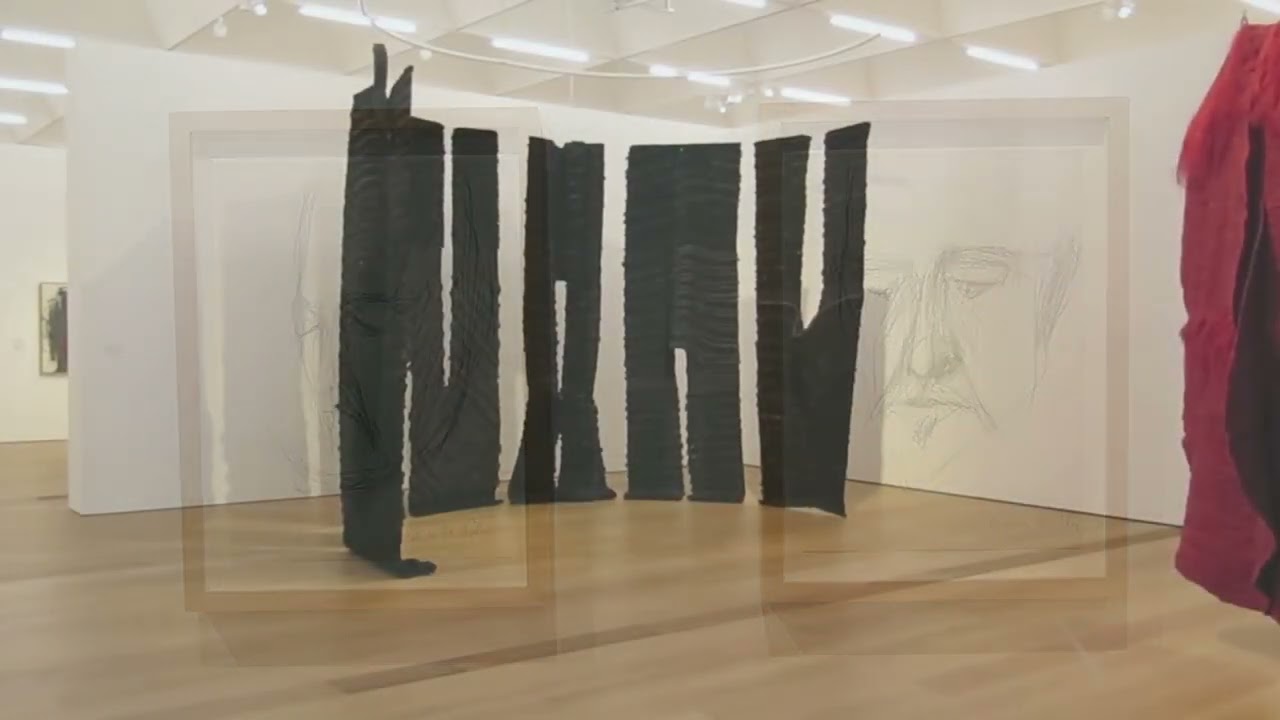
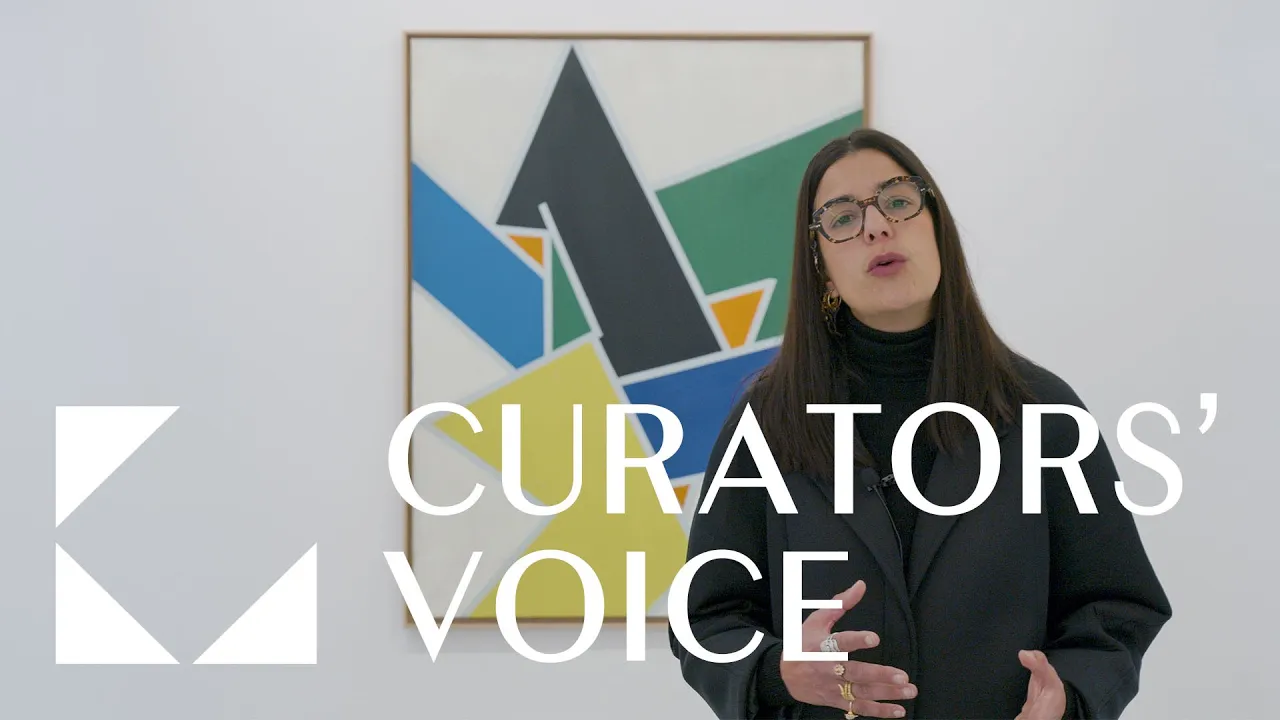
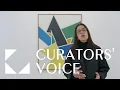
This fifth exhibition of the work of Gina Pane at Mennour gallery focuses on the 1960s, her first artistic period. Gina Pane came to France in 1961 to study at the École des Beaux-Arts de Paris. At the time, her pictorial and graphic investigations were mostly geometric, inspired by Constructivism and Russian Suprematism.
You can see the influence of Kandinsky, Malevich, and Paul Klee. Pane was very interested in Van Gogh’s investigations in colour as well as those of Johannes Itten. These influences would feed her own artistic investigations, leading to a period of geometric paintings in which she overlapped and juxtaposed coloured blocks with areas of solid colour, creating dynamic effects, with the cool colours appearing to recede and the warm colours appearing to advance from the canvas.
If you look closely, you can see faint lines through the paint layers. You can also see that she used masking tape or pieces of cut out paper in order to build up these coloured volumes. We are lucky enough to be exhibiting a collection of drawings and preparatory sketches from Gina Pane’s portfolios that have never been exhibited before and that have been taken from the artist’s sketchbooks.
In these works, she can be seen investigating the format itself, asking herself how to produce volume within a two-dimensional medium, how to make the presence of the borders felt, playing with angles. How to centre the shape or exclude it from the format altogether? In 1965, this desire of hers to tarry with the border, with the limit, lead to a sculptural period with a strong minimalist bent.
For Gina, what was important in these sculptures was to let the viewer’s body enter in them. She realised that the two-dimensional format, which is very reassuring, didn’t allow her to reflect the surrounding world. I think the important thing is that this body of work is the starting point for everything that would follow.
She would remain a powerful colourist, with an attention to composition that never diminished. Even the Constats d’action from the 1970s, which are figurative, are also geometrical compositions, including the way she placed and ordered the images that she produced during these events. 1968 was a decisive turning point.
Gina Pane decided that she no longer wanted to make art that was only to be seen, she wanted to make art that could be experienced. This would become one of her priorities, work with the world around her, repair injustices, and enter into communion with the other.


![[Visite privée] Exposition Louise d'Orléans au château de Chantilly](https://img.youtube.com/vi/0odTaQItmIE/maxresdefault.jpg)