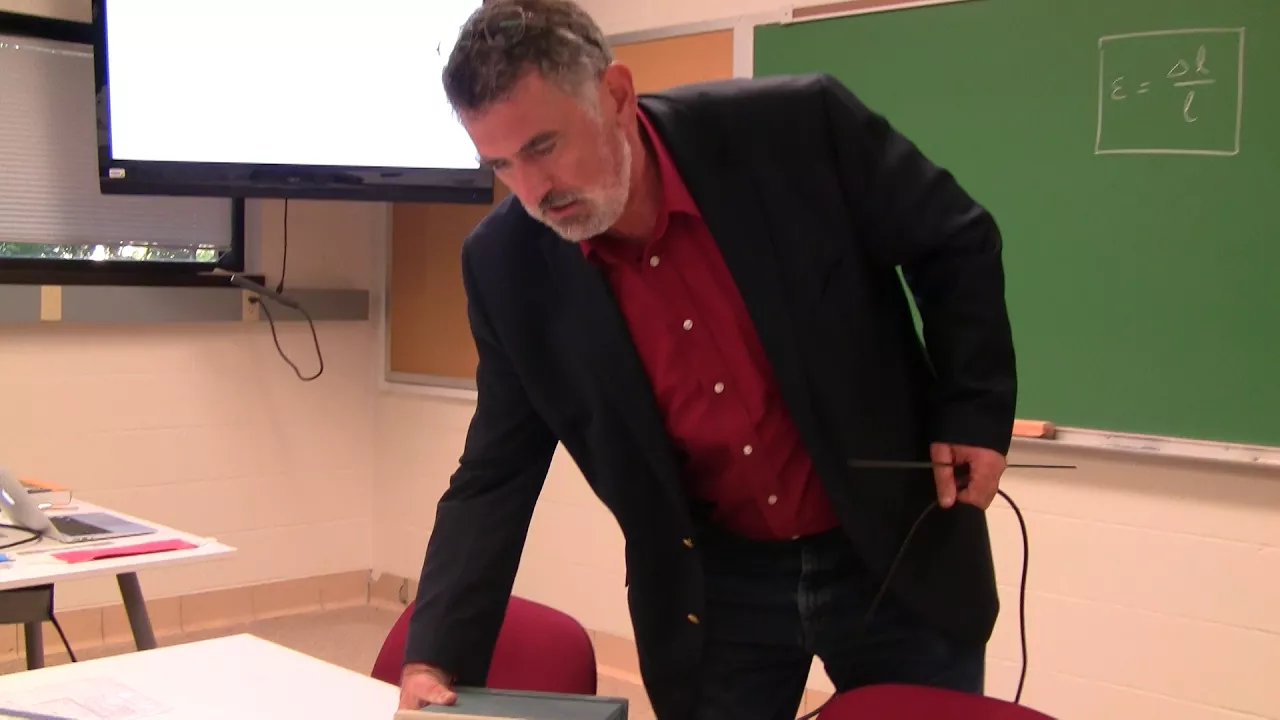
now this is not a simple circuit there are devices there are particular love pieces of equipment that as a constant curve current source you get dialed the current that you want in the electronics inside make sure that that is the current that is going to flow through the circuit irrespective of what the resistance here is by the way one simple device of this type is that the kind of power supply that is used for a LED whenever you have light sources that are lit based for all those cases you have a constant current being pushed
through the left because you cannot operate the led by by simply a light emitting diode but by simply applying it a direct voltage because the current is gonna jump very high and you can fry the delay so typically LED devices LED light enlightening devices are fed with a constant current from a constant current source so you may have some of those around what you may not be aware now if we want to measure this change in resistance the measurement of a voltage using a voltmeter that's fine that seems to be a good idea let's see
how good of an idea that is let's take that let's assume that we take some gauge that has a gauge factor of two you know two point one is the typical value for constant and one point six plus another point zero five so let's assume a gauge factor about two which is a typical value let's assume that the resistance of the wire to begin with is 120 ohms and let's assume that we take a piece of material and we subject it to five microstrain now five microstrain i want you to think about it represents five
parts per million you have changed the length of the wire by five parts per million now how much is that in terms of strain if you consider also young's modulus and the stress stress relationship in other words what stress would cause the strain of five micro strains so let's consider the case of aluminum aluminum has a modulus Young's modulus of ten MSI and then let's assume that we apply 50 psi as a stress now how much is 50 psi I'll give you a second to think about it obviously 50 psi stands for 50 pounds per
square inch right but intuitively is that large is that small is it a lot is it nothing so as you think about it I'm gonna invite you to think about the pressure inside the tires of your car or truck what is the typical pressure which we inflate your tire and the answer is going to be somewhere in the range of 30 something psi how much is the pressure the atmospheric pressure we all are surrounded by an atmosphere that applies pressure uniform static pressure in all directions how much is the atmospheric pressure at sea level the
standard atmospheric pressure at sea level I'm hoping that all of you remember that the answer is 14.7 PSI just about 14 points up so 50 psi stands for just about a little more than 3 atmospheres it's a little more than the pressure that we put in the tires of a car vehicle that you're driving which means that that 50 psi pressure representing stress would create in a material with the modulus of 10 ms:i or 10 to the power 10 times 10 to the power 6 the strain of about 5 microstrain 5 parts per million that's
what this train is so the gauge factor to point out where resistance of 120 ohms and the strain of five might restrain the change in resistance that we need to measure here is going to be the gauge factor times train times resistance which is two times five times ten to the minus six times 120 which is 0.001 two ohms so you want to actually measure a change of resistance of the wire from 120 ohms to 120 point zero zero one two which represents a change of point zero zero one percent one thousandth of 1% okay
so if the plant is to use a constant current source which again is an expensive device to run a constant current through the wire as we're stretching it and be respective of how you stretch it you run the same curve and then measure the voltage across the ends of the wire you're going to be able to measure the change in voltage of point zero zero one percent okay so here's a garden-variety break your chakra IV of a volt meter and I can set it to volt DC and here's what the display looks like it has
actually it shows it close to zero but it has four digits zero point zero one three there is no way that I can measure on this device on this display that small of a change in resistance so this is as I pointed out a four digit display and it is insufficient to actually measuring such a small change resistance work should small change in voltage so in principle it seemed to be that by converting the measurement of strain to a measurement of voltage we are getting a head turns out that the measurement they were very very
small strain comes down to the measurement of a very very small change in resistance so we still have a problem so the first answer to that would be a device and I'll be back in just a second a device of this dimension here a slice this light which you remember from the first movie which is the multimeter that this instrument rate that is lab quality which is a six and a half digit precision in so this kind of a device would indeed be useful in measuring the ten to the minus five change percent change 10
to the minus 5 change 10 to the minus 3 percent check so yes we could use an instrument of dis quality to measure directly the change in resistance of the wire and therefore measure strain so the idea is that this works as an approach but it requires this quality of an instrument and it requires this kind of a device to serve as the constant current or so now the question is is there a better way to do it and the answer is yes there is and I'm going to draw your attention to a circuit that
you probably recognize from your ee course which is the Westone bridge circuit the Westman bridge consists of four resistors labeled r1 r2 r3 and r4 connected as such and this representation is electrically equivalent to this representation now on the Westone bridge one can apply the known voltage on one diagonal so this is the DC source plus and minus applied on one diagonal of the bridge and then one can measure an output so this is the input on one diagonal and the output of the bridge is measured on the other diagram that's how Western bridge functions
and equivalent the circuit is equivalent to the you have r1 and r2 in series r3 and r4 in series as well and you measure the voltage in between the midpoint between r1 and r2 r3 and r4 and you apply voltage from your source the input voltage at this point and at this point and then for this circuit simple calculations show that if you want to relate the output voltage lowercase e as a function of the input voltage width which is capital e this capital e this is the input voltage that you apply whereas this is
the output voltage so the output voltage E is given by the input voltage times r2 divided by r1 plus r2 minus r3 divided by r3 plus r4 which can be further transformed into r2 r4 minus r1 r3 divided by r1 plus r2 times r3 plus r4 times e alright this looks complicated but here's the key part here's the easy part of all this circuit this relationships relationship here offers a great opportunity and let me explain the opportunity in the previous case what we ended up having to do is to start by measuring a resistance of
120 ohms which is the nominal resistance of the wire to begin with on top of which we need to be able to sense the change of point zero zero one two months you have a finite large quantity on top of which you need to sense a very very small change that's a difficult measurement it turns out that it's much easier to measure this change 0.001 to ohms if you start from zero so if to begin with you don't start with the large quantities like somebody giving you a thousand pounds the rice plus 0.001 pounds of
rice good luck measuring accurately on the same scale both 120 pounds end point zero zero one two












![[치유음악] 단 10분! 피로와 스트레스를 완전히 해소하는 힐링 명상 기치료 음악 (편안한 음악)](https://img.youtube.com/vi/1_x-kshnTZY/maxresdefault.jpg)