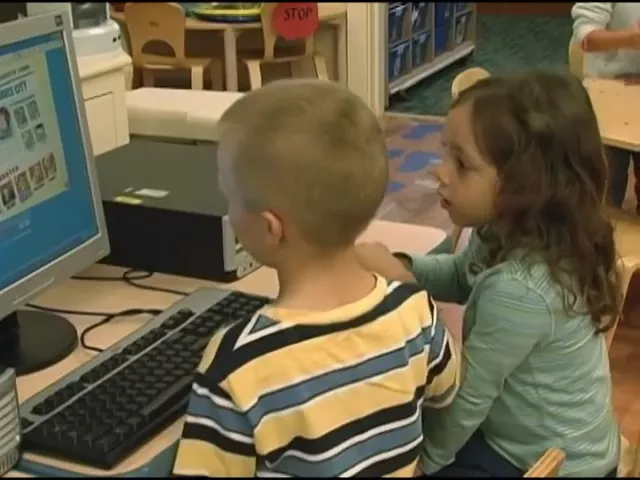
[Music] although introducing very young children to computers has become quite common sometimes we hesitate for a wide variety of reasons Dr Doug Clemens from the University of Buffalo and Dr suda swaminathan from Eastern Connecticut State University encourage us and give us the keys to [Music] success what we found uh lately in mathematics education and in technology education is that computers can really help kids Bridge the worlds between their concrete experience and Abstract mathematical thinking at a very young age n 10 sometimes when I so we know that young kids two three years old can abstract
very interesting ideas and can civilize them at least in spoken language and very soon in written language as well so where does the computer so where does technology fit in all this stff technology can put on the screen multiple representations of these kind of ideas and connecting those representations can help kids Bridge the world between concrete four blocks and the abstract idea of four but we now know that concrete is much more about meaningfulness than it is about physicality so that when kids see four objects and there's picture of four dogs on the screen that's
as meaningful to them as having four dogs and indeed the four dogs on the screen can be ordered and thought about and manipulated with much more control than four dogs running around your floor can be so that can help kids make the kind of connections between their concrete experience and this new abstract experience fours so where's the teacher the people that have feared oh if computers come in they'll replace teachers and everything will be mechanistic first of all the computer needs to be um embedded in a rich educational environment of which the computer is only
a small part the computer role in the classroom is to just be one more teaching Aid the teacher is the one that controls that she's the one that has to pick the educational experiences for the kids on the computer to make make sure they are receiving the Hands-On thing and see the connections between their Hands-On work uh on physical objects and their Hands-On work on these computer objects as well furthermore kids are more interested in computers more likely to learn from computers if a teacher's nearby and able to interact with them the teacher is wise
to be nearby not on the kids back all the time actually the research shows if you sit there too much kids don't learn as much but if you're available for that question when kids really do get stuck so you can go over and talk to them about it and engage them in the mathematics that's being presented it increases kids learning by by quite a bit if you give teachers less than 10 hours of professional development on technology total that the scores of their children actually decreased probably because teachers tried to use the computer but didn't
have quite enough information to use it effectively 10 was the cut off line and if you gave them more than 10 hours of professional development score significantly increased when we think about it from administrators to teachers who are might be asking for more professional development them than they had so far keep in mind that a kind of quick onshot thing may not be the most effective thing that we probably do have to commit a little more if we're really going to take computers seriously and do a good job Eastern Connecticut State University's early childhood facult
faculty member suda swam nanthan also researches and teaches Early Childhood professionals about successfully integrating technology into Early Childhood settings for teachers who new to this my first suggestion is to say don't forget the good teaching that you already do the principles of good teaching what really counts with young children being developmentally appropriate giving them open-ended activities though still hold strong when it comes to educational technology so if you have just one computer and a couple of software and you want to infuse that into your curriculum do go ahead and do that but remember that it's
not the computer is not going to replace the teacher you still need to bring in the objectives that you have for your children you still need to bring them to use it in an open-ended creative way you still need to be a integral part of that whole experience and I always say you know start with your comfort zone and then let's not forget your strength and keep adding to that then you can move your M [Music] and