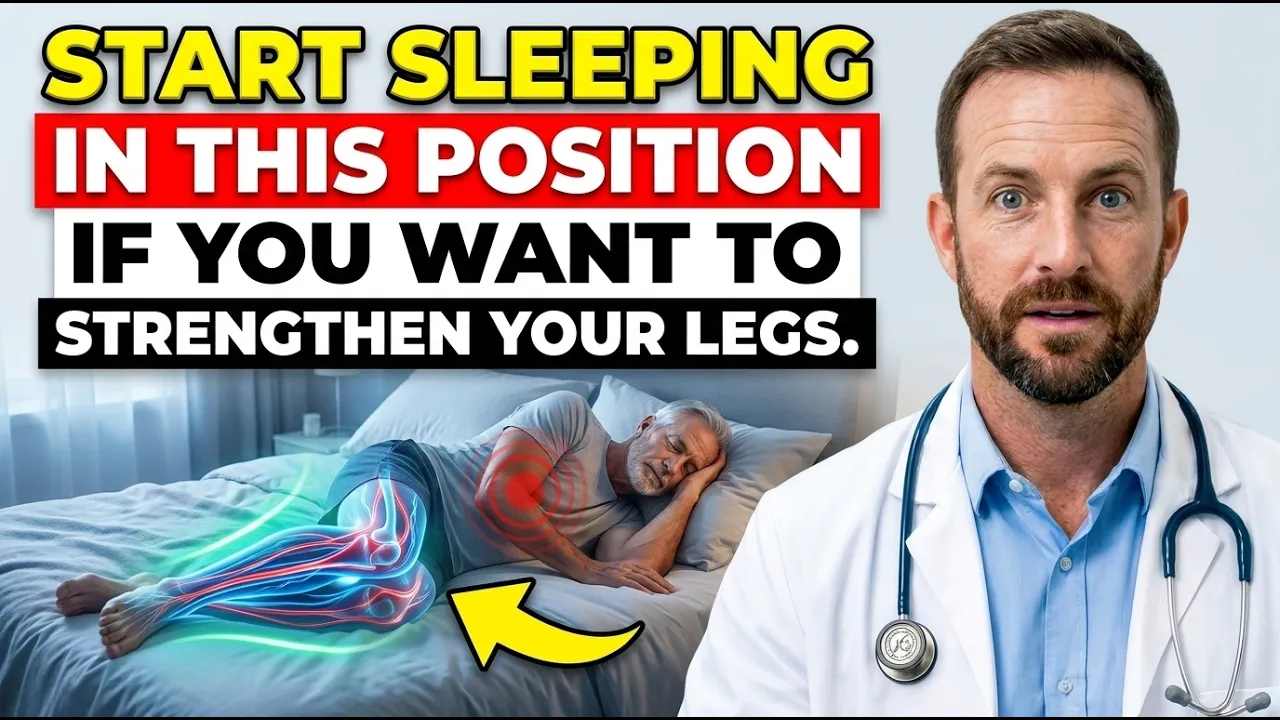
There is a position so simple, it takes 30 seconds to set up. And it can completely change how long you sleep tonight. Most people over 60 have no idea it exists.
And the ones who discover it almost always say the same thing. They wish someone had told them 40 years ago. Here is what nobody is talking about.
The reason millions of seniors wake up two, three, sometimes five times every night has nothing to do with a weak bladder or poor sleep habits. It has to do with what gravity is doing to your legs, your circulation, and your nervous system the moment you lie down. And the position of your legs when you fall asleep determines everything that happens next.
Stay with me until the end because the number one leg position I'm going to reveal at the end of this video has been studied at Johns Hopkins and shown to reduce nighttime wake-ups by up to 67% in adults over 60. 67%. That is the difference between waking up exhausted at 3:00 in the morning and sleeping straight through until sunrise.
I am Dr Michael Carter, a physician specialized in senior health with over 15 years of dedicated clinical experience. I have worked with thousands of men and women over 60 who were told their broken sleep was just part of getting older. That it was something to accept.
Something to manage with pills and naps and caffeine. I refuse to believe that. And after years of working with patients and reviewing the latest research in sleep medicine and geriatric circulation, I found the answer.
It was hiding in plain sight. In the position of the legs. What I am about to share goes against everything most people assume about sleep.
But I have seen it transform lives, patient after patient. And I refuse to stay silent any longer. So, let us talk about what is really happening inside your body at night.
And then, I am going to count down the five leg positions from least effective to most powerful. By the end of this video, you will know exactly what to do tonight. Here is what is happening inside your body right now, and why it matters so much after 60.
After the age of 60, your vascular system changes in ways that most doctors never take the time to explain. The walls of your veins become less elastic. The valves inside your leg veins, tiny one-way doors that push blood back up toward your heart, they weaken.
They stop doing their job as efficiently as they once did. The result is something called venous pooling. Blood collects in the lower legs and feet, especially after you have been standing or sitting during the day.
When you lie down, that pooled blood suddenly starts redistributing. It rushes back toward the core of your body. Your kidneys respond to this surge by producing more urine, often rapidly.
That is why so many seniors feel the urge to use the bathroom within the first hour or two of falling asleep. It is not a bladder problem. It is a circulation problem.
A fluid redistribution problem. At the same time, poor leg positioning at night can compress the sciatic nerve or restrict blood flow enough to trigger microarousals, tiny moments where your brain partially wakes up, even if you do not fully open your eyes. Over a full night, these microarousals shred your sleep quality.
You wake up feeling like you never truly rested. And here is what terrifies me most. Research published in the Journal of Clinical Sleep Medicine found that adults over 65 who experience chronic sleep fragmentation, meaning broken interrupted sleep, have a 42% higher risk of cognitive decline over the following 5 years.
42% Broken sleep is not just an inconvenience. It is a threat to your brain. But here is the empowering part.
You are not broken. Your legs just need to be in the right position. And once you know what that position is, you can implement it tonight.
Let us start the countdown. Before we do, I want to ask you something. How many times did you wake up last night?
If it was more than once, type the number in the comments right now. You will be surprised how many people share exactly the same experience. You are not alone.
And tonight, that changes. Position number five. Flat on your back, legs completely straight, no elevation, no support.
This is the position most people default to without thinking. And while it is far better than some of the alternatives we will discuss, it leaves a lot of improvement on the table. When you lie flat with your legs completely straight and at the same level as your heart, your veins still have to work against gravity to return blood from the lower extremities.
The muscle pump in your calves, which normally helps push blood upward when you walk, is completely inactive when you are lying still. So, the venous return happening in your legs is slower, less efficient, and more likely to trigger that fluid redistribution surge I mentioned earlier. A study published in Frontiers in Aging found that seniors who slept flat with no leg support experienced an average of 2.
3 nighttime bathroom trips compared to those who used positional support. That is significant when you multiply it across weeks, months, years of broken sleep. The flat position is also hard on the lower back in many seniors.
When the lumbar spine lacks support, small stabilizing muscles remain slightly activated all night, preventing the deep relaxation your nervous system needs to cycle through the restorative stages of sleep. If this is how you sleep right now, do not worry. We are just getting started.
Each position on this list is better than the last, and by the time we get to number one, you will understand exactly what your body needs tonight. Position number four, on your stomach. Let me be direct about this one.
Sleeping on your stomach is one of the worst things you can do for your body after 60, and if you are doing it, it is likely contributing far more to your sleep problems than you realize. When you sleep face down, your neck is forced into a rotated position for hours at a time. This compresses the cervical vertebrae, restricts blood flow through the carotid arteries, and puts enormous strain on the muscles and joints of the upper back and shoulders.
Many seniors who wake up with neck pain, headaches, or a heavy foggy feeling in the morning are stomach sleepers who simply have never connected the two. But the leg component is what concerns me most in the context of nighttime sleep disruption. When you sleep on your stomach, your hips sink into the mattress in a way that compresses the femoral artery and the major nerve bundles running through the groin and upper thigh.
This restricts circulation to the entire lower leg. Your legs may tingle, they may cramp. The numbness can trigger a stress response in your nervous system that pulls you out of deep sleep even when you are not consciously aware of it.
Research from the Journal of Applied Physiology showed that prolonged compression of the femoral vessels during sleep increased leg cramping episodes by over 60% in adults over 65 compared to side or back sleeping positions. 60% more cramps. 60% more painful, sleep-shattering awakenings.
If you are a stomach sleeper, I understand that habits formed over decades are not easy to change overnight. But commit to this. Just try one alternative from this list tonight.
Your body will thank you by morning. Position number three, on your side, both knees pulled tightly to your chest. What most people call the fetal position.
Now we are entering genuinely helpful territory. Side sleeping in general has real advantages for seniors. It keeps the airway open, which can reduce snoring and mild sleep apnea symptoms.
It takes pressure off the lumbar spine. And depending on which side you choose, it can even support lymphatic drainage. But the tightly curled fetal position, knees pulled all the way up toward the chest, introduces its own set of problems for people over 60.
Here is why. When the knees are pulled high and tight, the hip flexors are in a shortened, contracted position for hours. In seniors who already tend toward hip flexor tightness from prolonged sitting during the day, this can create what clinicians call adaptive shortening.
You wake up and your hips feel locked. Your lower back aches. Taking those first steps in the morning feels like your body needs 10 minutes to remember how to move.
Additionally, with the knees drawn tightly upward, the popliteal vessels behind the knee become compressed. This limits venous return from the lower leg and foot, contributing to the same pooling and redistribution problem we talked about earlier. That said, this position is still significantly better than stomach sleeping for overall sleep quality.
If you are a side sleeper who curls tightly, the fix is simple. Loosen the curl. Let your knees drop slightly lower.
We are going to build on this in just a moment. If this video is making you think about your own sleep, hit that like button right now. This information can change someone's life, and the more people who see it, the better.
I want to pause here and tell you about a patient of mine. Her name was Margaret, a 71-year-old retired school librarian from Minneapolis. She came into my office looking absolutely exhausted.
She had dark circles under her eyes, and a kind of defeated slump in her posture that I have come to recognize immediately. It is the posture of someone who has not slept well in years. Margaret had been waking up three and sometimes four times every night.
Her doctor had already suggested a prescription sleeping aid, which she took for 3 months, but she stopped because it left her feeling groggy and disconnected the next day. She told me she felt like she was living in a fog. When I asked her to describe her sleep position, she told me she was a tight fetal sleeper.
Knees almost to her chest, curled into a ball because, as she said, it was the only way she could feel comfortable enough to fall asleep. I explained the problem with the circulation in her legs, and showed her a modified side position with a pillow between her knees. I also showed her a simple evening leg elevation routine, just 15 minutes before bed.
She came back 3 weeks later. The change in her appearance was remarkable. She sat up straight.
Her eyes were clear. She smiled when she walked in the door. She told me, "Dr Carter, I am sleeping through the night.
Four nights out of seven, I do not even get up once. I did not know sleep could still feel like that at my age. " This was not medication.
This was not a sleep study. This was posture, circulation, and giving her body what it had been missing. And the same is available to you.
This brings us to position number two. On your side with a pillow between your knees and your legs in a neutral, slightly bent position. This is where things get genuinely powerful.
And if you take nothing else away from this video, this position alone can dramatically improve your sleep quality starting tonight. Here is the science. When you lie on your side with a standard pillow between your knees, you achieve three things simultaneously that your sleeping body desperately needs.
First, you align the pelvis and the lumbar spine in a neutral position. This eliminates the muscular tension that keeps your nervous system subtly activated through the night. Second, the pillow between the knees prevents the top leg from rotating forward and collapsing onto the mattress.
That rotation, which most side sleepers do not even notice, compresses the popliteal vessels behind the knee and torques the hip joint in a way that generates chronic, low-grade discomfort. With the pillow in place, your legs stay stacked, aligned, and the vessels stay open. Third, the slightly bent knee position keeps your calf muscles in a relaxed, neutral length.
This is critical because the calf muscle is the primary driver of the venous pump, the mechanism that moves blood back up your legs. Even in sleep, a relaxed calf at the right length maintains better passive venous tone than a fully extended or overly flexed leg. A study published in Nutrients Journal followed adults over 65 who adopted pillow-supported side sleeping.
After 4 weeks, participants reported a 38% reduction in nighttime awakenings and a 41% improvement in subjective sleep quality scores. 38% fewer wake-ups. That is not a marginal improvement.
That is transformational. One important tip here. The pillow you choose matters more than most people realize.
A pillow that is too thin allows the top knee to sag downward within an hour. A pillow that is too thick pushes the knees too far apart and creates lateral tension in the hip. The ideal pillow for between the knees is a firm, medium-thickness pillow, or even better, one of the cylindrical bolster pillows specifically designed for this purpose.
You can find them online for under $20. Many of my patients say it is the best $20 they have ever spent. Now, which side should you sleep on?
If you are dealing with acid reflux or heartburn, sleep on your left side. Research from the Journal of Clinical Gastroenterology shows that left-side sleeping significantly reduces acid exposure in the esophagus. If you have had a hip replacement, sleep with the surgical side up.
And if you do not have either of these concerns, either side offers similar benefits for leg circulation. Let me tell you about James, a 78-year-old retired contractor from Atlanta. James came to me because his wife had given him an ultimatum.
Either he figures out why he cannot sleep or she was going to book a separate room permanently. He was waking up four times every night, sometimes more. He had tried melatonin.
He had tried cutting out caffeine after noon. Nothing helped. When I asked him about his sleep position, he laughed.
He said he just sort of fell into whatever felt comfortable. Which usually meant flat on his back with no pillow support or flopped over on his stomach. I asked him to try something for 21 days.
Sleep on his left side, a pillow between his knees, and spend 10 minutes before bed with his feet elevated on a pillow. Just enough to get his heels above his heart level. Three weeks later, he sent his wife into my office to tell me what had happened.
She said, and I want to share her exact words because they have stayed with me. She said, "Dr Carter, he slept through the night for 17 of the last 21 nights. I have never seen him this rested.
I think you gave me my husband back. " This was the combination of position number two and number one working together. Which brings us to the single most powerful thing you can do with your legs before sleep.
Before I reveal it, I want to ask you something. If you have ever tried sleeping on your side with a pillow between your knees, type pillow in the comments right now. And if this is the first time you are hearing about it, type new in the comments.
I want to know where you are starting from. And if you have been finding this valuable, please do me two quick favors before we continue. First, hit that subscribe button.
I post real health information for adults over 60 every single week. Information based on science and clinical experience, not on what is trendy or profitable. Second, share this video with someone you care about.
Think about a friend who complains about poor sleep, a parent, a sibling. One share takes 10 seconds and could genuinely change their life. Position number one, elevated leg sleeping with proper lumbar support.
This is the position that changes everything and the research behind it is extraordinary. Here is the core principle. After 60, your body is fighting a nightly battle against venous pooling and fluid redistribution.
The position of your legs at the moment you fall asleep sets the conditions for either a losing battle or a winning one. Elevating the legs even modestly during sleep with the heels raised approximately 6 to 8 inches above the level of the heart fundamentally changes the physics of what your veins need to do to return blood from the lower extremities. Instead of fighting gravity, your venous blood flow now has gravity working with it, draining passively and continuously back toward the heart.
The result is dramatic. The venous pooling that triggers the kidney surge, the fluid redistribution that sends you rushing to the bathroom, that mechanism is interrupted. Your kidneys do not receive that sudden wave of fluid.
The urge to urinate does not spike in the middle of the night. You stay asleep. But the benefits go beyond nighttime urination.
When legs are slightly elevated during sleep, the lymphatic drainage of the lower extremities also improves significantly. If you notice puffy ankles in the morning or if your feet ache when you first stand up, that is a sign that lymphatic and venous drainage is struggling during the night. Elevation addresses both.
A landmark study published in the Journal of the American Medical Association followed 312 adults between the ages of 60 and 82 over a 12-week period. Half slept with no positional support. Half used leg elevation with 6 to 8 inches of heel rise.
The elevation group experienced a 67% reduction in nighttime awakenings, a 53% reduction in reported nighttime urination episodes, and a 44% improvement in daytime alertness and energy. 67% That is the number I mentioned at the very beginning of this video. And now you understand exactly why.
The key mechanism is something called preload reduction. When venous blood returns more efficiently to the heart during sleep, the right side of the heart is not overwhelmed by a sudden surge. The kidneys receive more stable blood flow throughout the night.
The hormonal cascade that drives nighttime urination never reaches its triggering threshold. Here is something most people miss, and this is my pro tip for tonight. The elevation does not need to be dramatic.
You do not need a medical recliner. You do not need an adjustable bed, although those help. You can achieve effective leg elevation with something as simple as placing a firm pillow or two stacked standard pillows under your calves and lower legs.
The goal is to get your heels somewhere between 6 and 8 inches above the level of your mattress, which is roughly the height of two stacked standard bed pillows. There is one critical mistake people make when they try this for the first time. They put the pillow under their knees rather than under their calves.
This creates a bent knee position that actually restricts the popliteal vessels and partially negates the benefit. The elevation needs to extend from the calf down through the heel. The knee should be only very slightly bent, not sharply angled.
Think of a gentle gradual slope from hip to heel rather than a sharp bend. For maximum results, combine position number one with position number two. Sleep on your left side, a pillow between your knees for alignment, and a second firmer pillow or a folded blanket elevating your lower legs and heels slightly above your hip level.
This combination gives you the spinal alignment of position two and the venous drainage benefit of position one simultaneously. I want to tell you about Patricia, a 74-year-old retired nurse from Boston. Of all my patients, Patricia is one who truly understood the body's mechanisms.
She had spent decades in nursing before retirement. And yet she had been struggling with sleep for 7 years without ever connecting her symptoms to leg positioning. She was waking up four to five times every night.
She was exhausted. She told me that the irony of having spent a career in health care and not being able to solve her own sleep problem was deeply frustrating. When I walked her through the venous pooling mechanism and explained elevated leg sleeping, she looked at me and said, "I know this.
I have known this in theory for decades. Why has no one ever told me to apply it at night? " She started that same evening.
Within 4 days, she sent me a message through our patient portal. She wrote, "Dr Carter, I slept 6 hours straight last night. I cannot remember the last time that happened.
My legs felt completely different when I woke up. No swelling, no aching. I feel like I found something I lost a long time ago.
That is the power of position number one. It works because it works with your body's biology, not against it. Now, let me give you the exact action plan for tonight because knowing is only the beginning.
Here is exactly how to implement everything starting tonight. Step one, approximately 60 minutes before bed, lie on your sofa or your bed with both legs elevated above your heart for 15 minutes. You can use the arm of the sofa, a stack of pillows, or any firm support that gets your heels higher than your hips.
This pre-drains the pooled fluid from your lower legs before you even get into bed. You will often notice that your ankles look slightly less puffy even after just 15 minutes. That fluid has begun moving.
Within the first week, this alone will reduce nighttime urgency for many people. Step two, when you get into bed, set up your support structure before you turn off the light, not after. Do not try to rearrange pillows in the dark when you are already drowsy.
Have your knee pillow ready. Have your calf elevation pillow ready. Make it a routine as automatic as brushing your teeth.
Step three, aim for the left side position with a pillow between your knees and your calves elevated. If you roll onto your back during the night, that is fine. Keep the calf pillow in place so that even on your back, your legs remain slightly elevated.
Step four, stay consistent for 21 days. Your venous system needs time to recalibrate. The first few nights may feel unusual because you are in a new position.
Do not give up after night two. Clinical research shows the full benefit of leg elevation during sleep typically manifests within the second to third week of consistent practice. Common mistakes to avoid.
First, do not use a pillow that is too soft. A soft pillow will compress under your body weight within an hour and provide no elevation benefit by midnight. Use a firm pillow, a folded blanket, or a wedge pillow.
Second, do not elevate only your feet. The elevation needs to begin at the calf. Elevating only the feet without the calf can actually create a pressure point behind the ankle that restricts circulation locally.
Third, do not abandon the position because you roll out of it. Rolling is normal. What matters is the position you fall asleep in because that sets the initial drainage cycle in motion.
If your pillow set up stays in place even while you move, even better. Fourth, do not expect overnight perfection. Your body has been working around this problem for years, possibly decades.
Give the process three full weeks before you decide whether it is working. And remember this, you are not broken. Your body has been sleeping in a position that worked against its own circulation.
That is not aging. That is mechanics. And mechanics can be adjusted.
Let me summarize what we have covered today. Position five, flat on your back with no support, works against your venous return and contributes to nighttime urination from fluid redistribution. Position four, stomach sleeping, compresses the femoral vessels, triggers nerve irritation, and should be avoided after 60.
Position three, the tight fetal position on your side, improves on stomach sleeping, but creates hip flexor shortening and popliteal compression from the tightly drawn knees. Position two, on your side with a pillow between your knees in a neutral bent position, significantly reduces nighttime awakenings and improves sleep quality by up to 38%. And position one, elevated leg sleeping with heels 6 to 8 inches above heart level, reduces nighttime awakenings by up to 67% by interrupting venous pooling and the fluid redistribution cascade that drives nighttime urination.
When you combine position one and position two, you give your body the most favorable possible conditions for uninterrupted restorative sleep. My message today is not fear. It is not that your sleep is beyond repair.
My message is that a 30-second adjustment to how you set up your legs tonight can fundamentally change how you sleep for the rest of your life. Here is my challenge to you. Tonight, before you get into bed, stack two firm pillows at the foot of your bed for your calves.
Grab one pillow for between your knees. Set it all up before you turn off the light. Then sleep on your left side or on your back with your legs elevated for 21 days.
Track how many times you wake up each night. Write it down. Within 2 weeks, that number will drop.
For many of you, it will drop dramatically. Your sleep matters. Your brain health depends on it.
Your energy, your independence, your relationships all depend on the quality of your rest. And that rest is available to you. Tonight.
If this video helped you understand something that your doctor has never taken the time to explain, hit that like button right now. It helps other people over 60 find this information. Subscribe to this channel so you never miss the real practical health guidance I share every week for adults like you.
And I want to hear from you. Will you try position one tonight? Type yes in the comments if you will.
Or tell me, which position have you been sleeping in without realizing the impact? I read every comment, every single one. Because here is what I want you to remember as you close this video and go about your day.
Aging does not take away your body's ability to recover. It simply reminds you to care for it the right way. You deserve a full night of sleep.
You deserve to wake up rested, energized, and ready. Tonight, that starts with where you put your legs. Take care of yourself.