CC is on. To turn off, click the CC button at bottom right! Follow us on Twitter (@AmoebaSisters) and Facebook!
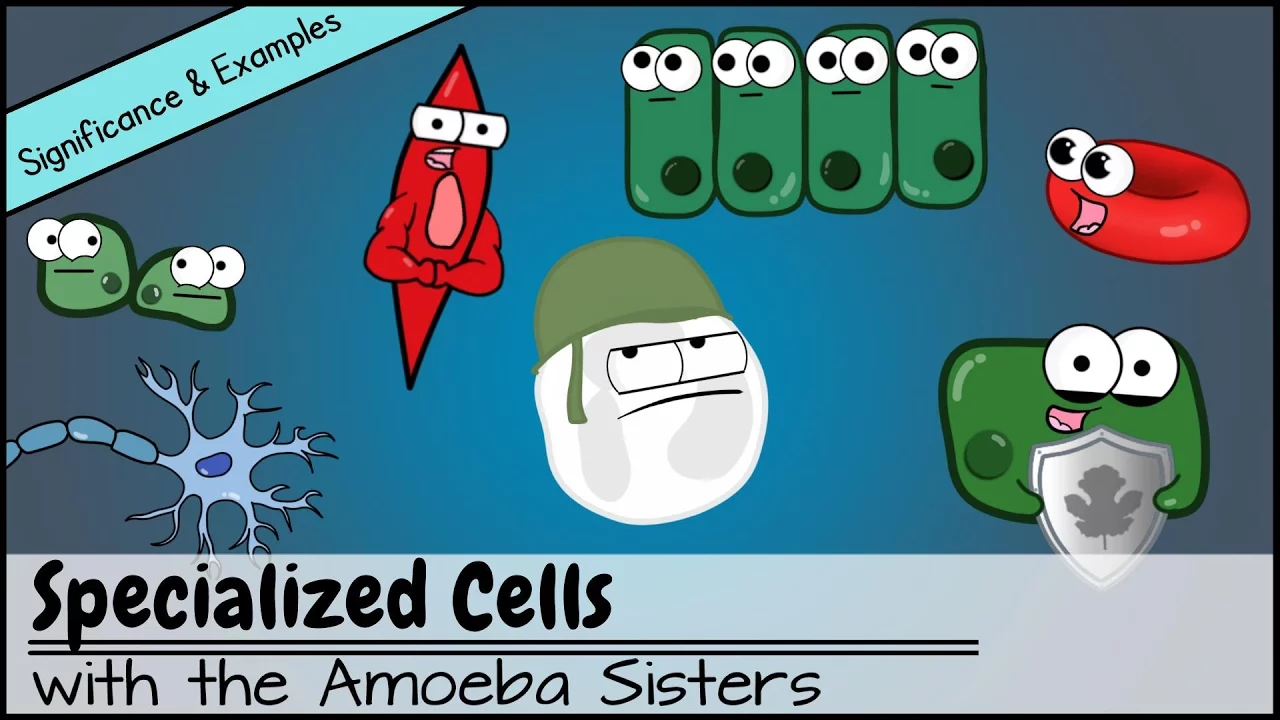
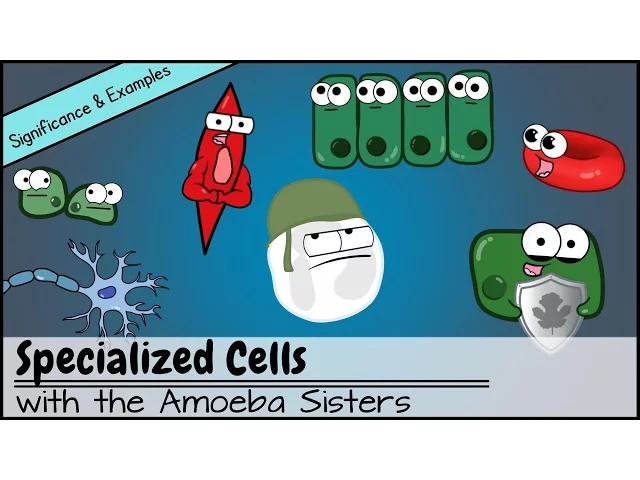
When you think of the term specialized cell, what do you think of? Well when I was younger, I used to imagine this super cell that was really important and did all these special tasks…I don’t know like some special kind of cell agent…yeah, I kind of had that wrong. A specialized cell is a cell that has a structure that suits its function.
Many cells have really different functions and so their structure can vary. Greatly. When you see a lot of pictures of plant cells and an animal cells…you might start to think that this is how they all look.
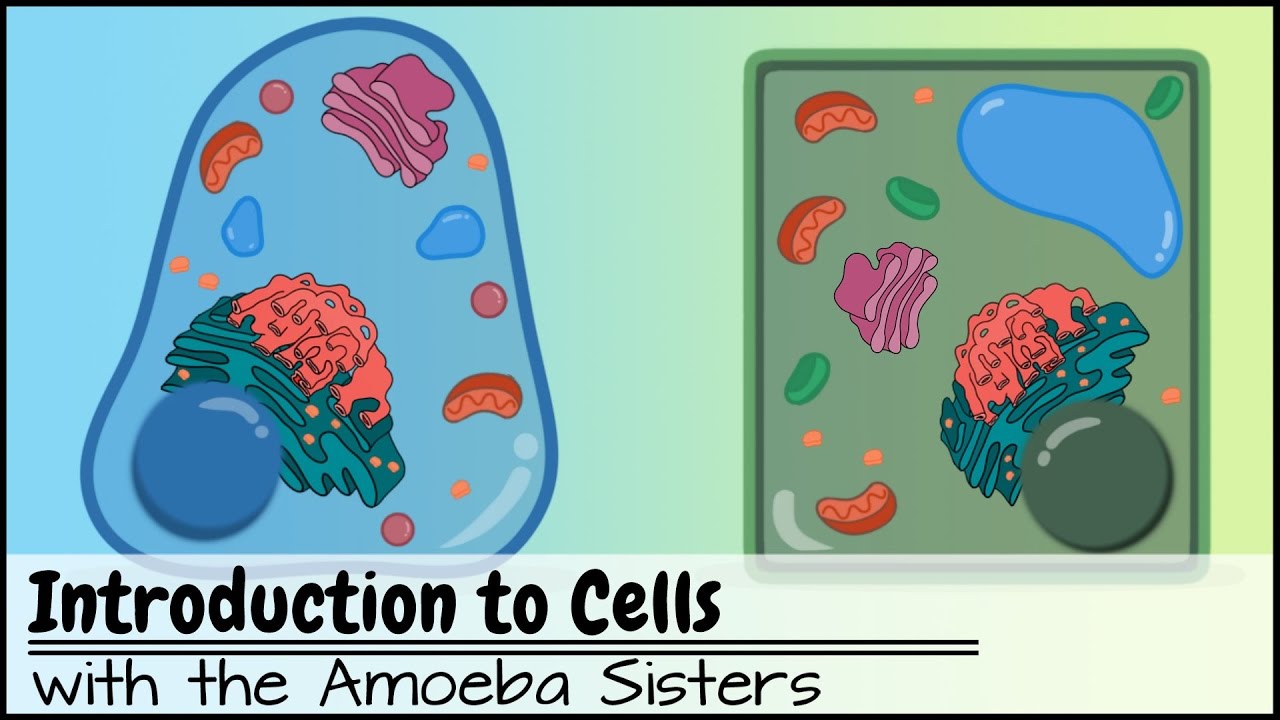
All the animal cells and all the plant cells…they might start to kind of look the same in diagrams. Well plant cells and animal cells definitely have structures that are unique to them. We have that covered in our intro to cells video.
But because cells have different functions depending on their cell type and the activated genes they contain, cells are going to have different structures too. They’re going to be…specialized. Now the process for cell differentiation---which really explains HOW cells become specialized---is a topic for another one of our videos.
This video is going to focus on examples of specialized cells so you can discover how different they really are…and why that’s so important. We can’t go through every plant and animal cell obviously, but we can give you some examples of what a specialized cell can be. Let’s start with plant cells!
Plant cells can have all kinds of other specialization depending on their function. I mean you can just look at a cross section of a leaf and see all kinds of specialization. At the top here- also often at the bottom of this cross section too---you can have a waxy cuticle layer, a protective layer, that covers plant epidermal cells.
Plant epidermal cells, among their many functions, are important in forming a boundary from the outside and help keep plants from losing precious water. Epidermal cells can be up here on the top of the leaf cross section (upper epidermis) and they can also be down here on the bottom (lower epidermis). Depending on the type of plant and where it might be living, the layer could be just one cell thick or several cells thick---especially if the plant lives in an environment that is going to have to protect against environment extremes.
Many plant epidermal cells do not even contain chloroplasts, because for many plants, that is not a main function for epidermal cells. Guard cells are specialized epidermal cells that have an important job of controlling the opening and closing of stomata, which are pores in the leaf. They tend to be on the bottom of leaves but as always, there are some exceptions.
See, you want stomata to be open to let the exchange of gases through---but you don’t want them to be open if you don’t have enough water in the plant because water can get out. We have a video on that. Here are more specialized epidermal cells---trichomes.
For plants, these can be plant hair cells. Uh, maybe not like what you are thinking. These epidermal cells can be hair shaped, and they have all kinds of different functions.
Some of them are protective and can secrete toxic substances to protect against insects that might want to eat the plant. Some of them act like light reflectors to help protect plants that live in really hot areas that get a lot of direct sunlight. Ok a side note on trichomes--- my favorite plant of all time is the Sundew.
It’s a carnivorous plant that I actually used to grow like crazy when I was a kid until it got a little too crazy but I digress…anyway, this plant actually has trichome cells that produce enzymes that digest insects because it’s a carnivorous plant. Yep. Still in this leaf cross section, look at this layer.
The mesophyll. Here are the palisade mesophyll cells. These cells are really important for capturing light and so they are specialized for this task.
So guess what they have a lot of? Chloroplasts. Lots of chloroplasts making glucose from the sun.
Food for the plant. Underneath it, take a look at these spongy mesophyll cells. The cells that make up this area are pretty loosely packed with irregular shapes.
They can have chloroplasts but in many plants, they may not have as many chloroplasts as the palisade mesophyll cells because in many plants, the spongy mesophyll cells don’t do as much photosynthesis as the palisade mesophyll cells. Their irregular shape combined with loose organization gives space for gas exchange, which you need for photosynthesis. This vein here contains the xylem and phloem.
We talk about these vessels in another clip, but the cells that make up these vessels are specialized for transporting water---in the xylem--- or products from photosynthesis---in the phloem. Ok so we saw just a few examples of specialized plant cells. Let’s take a look at specialized animal cells, shall we?
How about the animal cells in your human body? Let’s take red blood cells. RBC.
Erythrocyte. So many names. They contain hemoglobin in their cytoplasm which is a protein that helps them carry oxygen.
Its disc shape maximizes surface area for carrying oxygen…and they are also fairly flexible, which is helpful when squeezing through small capillaries. Fun fact: when they are mature, they actually don’t have a nucleus. Or a lot of other organelles.
Again, it’s all about maximizing that space for carrying oxygen. By just the name, you might hear “white blood cells” and think they are very similar to red blood cells—just a different color---but actually they are extremely different in structure and function. There are many different kinds of white blood cells.
Some of them are classified as granulocytes, which means a special part of their structure is that they can have granules in their cytoplasm which, when released, can aid them in destroying pathogens. Many white blood cell types can have an irregular shape with a structure that allows them to engulf foreign particles. How about muscle cells?
Many muscle cells can have more mitochondria than many other body cell types because of their need for ATP energy. Depending on how their overlapping filaments are arranged, they can be considered striated---which basically means a striped appearance---or not striated. Their shape differs too---smooth muscle has a shape that tapers at each end…often described as a spindle!
Skeletal muscle cells are long, cylinder shaped and often bundled. They can have lots of nuclei too which is definitely interesting. Curious about why?
It has to do with the fact that these cells developed from myoblasts that have fused together so to the Google to find out more! Cardiac muscle cells have many similarities to skeletal muscle, but because they have such an important function with the beating of the heart---they have to be in sync. They have what are called intercalated discs that joins them and helps carry the signal to maintain a heartbeat.
Cardiac muscle cells are often branched and they too can have more than one nucleus. Well with our limited time, we will mention one more specialized animal cell. Neurons.
Oh boy, where do we begin? Neurons are the cells that can sense a stimulus and transmit signals. Common places to find them include your brain or spinal cord.
These things can be over a METER long in humans. One. Meter.
Microscopic still---but wow… Just look at this beautiful cell. Its structure is specialized for signal conduction. In the neuron, structures called dendrites receive impulses and axons transmit the impulse either to another neuron or to the cell it’s targeting, like one of the muscle cells we just mentioned.
By the way---this transmitting of the signal---which can occur in an event called an action potential…is going to have to be another video. The action potential is just a beautiful, amazing process and these cells are specialized for it! Phew, that’s a lot of specialized plant and animal cells.
And that’s just a few selected examples. One thing to keep in mind is that these specialized cells can make up specialized tissues---in both plants and animals---and function together. More about tissues in our biological levels of organization video.
Well that’s it for the Amoeba Sisters and we remind you to stay curious!
![How Cells Become Specialized [Featuring Stem Cells]](https://img.youtube.com/vi/t3g26p9Mh_k/maxresdefault.jpg)