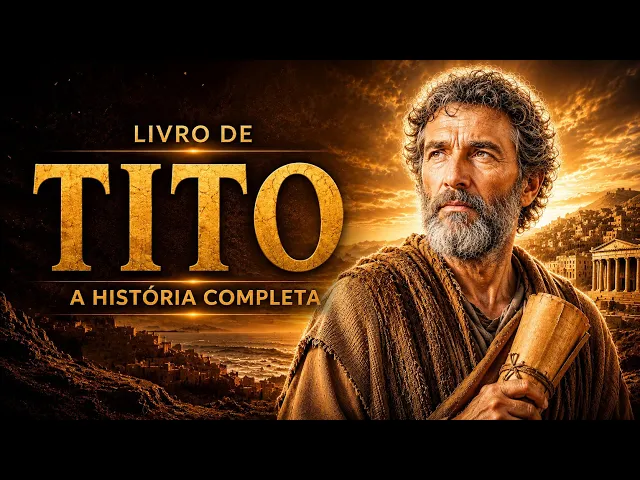
The book of Titus begins on an island. Not in Jerusalem, not in Rome, not on a grand public stage before crowds, but in Crete, where Christian communities already existed but still needed to be established. In Titus chapter 1, Paul opens the letter by introducing himself as a servant of God and an apostle of Jesus Christ. Before addressing the church's problems, before mentioning leaders, false teachers, or good works, he lays the foundation of the mission. All of that was tied to the faith of God’s elect, to the knowledge of the truth, and to godliness. For Paul,
true faith was not a loose idea, nor a religion of mere words. The truth received from God was meant to produce a life that was godly, visible, orderly , and faithful. The letter begins with a bold statement. Paul serves God based on the hope of eternal life, promised by God before the beginning of time. He looks at the church in Crete, but starts by drawing the reader’s gaze to something much greater. Before that island, before those problems, before those leaders were appointed, there was a promise from God. This promise had now been manifested through the
preaching entrusted to Paul, according to the commandment of God our Savior. So, after this solemn opening, the letter turns directly to Titus. Paul calls him a true son in their common faith. This expression shows that Titus was not just some ordinary assistant. He was someone linked to Paul by the same faith, formed in the Gospel, and trustworthy for a delicate mission. Titus appears as a capable co-worker who could represent Paul before the churches, not to dominate the people, but to lead the work that still needed completion. Then Paul reveals the reason for the letter. He
had left Titus in Crete to put in order the things that remained and to appoint elders in every city. This is the first great scene of the book. We can imagine small Christian communities scattered throughout Cretan cities, believers gathered in homes, families newly reached by the gospel, people trying to live a new faith within a culture marked by moral confusion, false talk, and practices that did not align with God’s truth. Titus is there because the church could not remain disorganized. The gospel had already arrived, but the work still needed to be consolidated. There was faith,
but it was necessary to form leadership. There were communities, but they needed direction. There was teaching, but there was also the risk of false teachers gaining ground. For this reason, Paul does not treat the organization of the church as a secondary detail. To him, putting the church in order was part of preserving the very message of the gospel. An important point here is to understand that putting the remaining things in order does not mean creating an artificial church trapped only by external rules. The idea is to complete what was still lacking so that those communities
could be spiritually healthy. The church in Crete needed structure, but that structure had to be born from truth, godliness, and the hope of eternal life. Organization in this context is not empty bureaucracy; it is pastoral care to protect the faith and strengthen God's people. This beginning already reveals the backbone of the letter. Titus is not a long book , but it is direct. Paul writes because the Christian faith needs to be seen in real life. It needs to appear in leadership, in the home, in the behavior of the elderly, the youth, the workers, church members,
and in the witness before society. But before all of this, the church needs to be set in order. And this order begins with a clear mission. Titus was to take care of what was still incomplete and prepare faithful leaders for each city. Thus, Titus chapter 1, verses 1 to 5, functions as the gateway to the entire book. Paul presents the divine origin of the message, the eternal hope that sustains the faith, and the practical task of organizing the churches in Crete. The letter begins by showing that a healthy church is not born from improvisation, but
from a faith rooted in truth, led by faithful leadership, and visible in a transformed life. After showing why Titus stayed in Crete , Paul steers the letter toward the first concrete need of those churches. Men capable of caring for God's people with firmness, maturity, and faithfulness. Still in Titus chapter 1, verses 6 to 9, Paul begins to describe who should be appointed as an elder in each city. Titus's mission was not to choose people just because they were eloquent, had social influence, or seemed strong to the community. The criteria started with their life. The leader
had to be above reproach, not in the sense of never having made mistakes , but in the sense of not living under accusations that would destroy his testimony. The camera now zooms in on this man's home. Paul says he must be the husband of one wife and have believing children who are not accused of debauchery or insubordination. Before looking at the pulpit, Paul looks at the home. Before evaluating the public ability to teach, he observes the domestic life. The church needed leaders who would not maintain a spiritual appearance before others while their own home revealed
disorder, infidelity, and lack of government. Next, Paul expands the description. The elder is called God's steward. This expression is powerful. He is not the owner of the church. He does not rule the people as if the community were his property. He manages something that belongs to God. Therefore, he must not be arrogant, nor quick-tempered, nor given to wine, nor violent, nor greedy for dishonest gain. In an environment like Crete, where Paul will soon mention deceptive speeches and impure interests. The church needed leaders who were not moved by vanity, aggression, vices, or money. But Paul does
not just say what this leader should not be. He shows what needs to be present in his life. The elder must be hospitable, a lover of what is good, sensible, just, holy, and self-controlled. The leadership that protects the church is not just that which combats error with words, but that which offers the people a visible example of a transformed life. In a community still being consolidated, the leader's character functioned as a kind of living reference. The people looked at him and saw in flesh and blood the type of life the gospel should form. Then Paul
arrives at the center of the pastoral role. The leader must hold firm to the faithful word according to the doctrine so that he may be able both to exhort with sound teaching and to refute those who contradict it. Here leadership ceases to be merely a moral example and appears also as a guardian of the truth. An elder could not be someone insecure with the word, nor someone who shaped the message according to the pressure of the environment. He needed to hold firmly to the received doctrine, teach what edifies, and respond to error when the church
was threatened. An important point here is to understand that Paul does not separate character and doctrine. For him, a leader is not approved just because he knows how to teach, nor just because he has a good reputation. The two things go together. The elder's life needs to confirm the message. And the message he teaches needs to guard the church. When one of these parts is missing, the community becomes vulnerable. Either the truth loses credibility because of bad conduct, or a good appearance fails to protect the people from deception. This list of qualifications shows that the
primary defense of the church in Crete would not be a complex strategy, but faithful leadership. Mature, sensible, hospitable, holy, just, and firm men in the word would be raised up from city to city to care for the communities. Paul knew that, without this type of leadership, newly formed churches could easily be confused by strong voices, empty religious speeches, and personal interests disguised as teaching. Yes, Titus chapter 1, verses 6 through 9, shows that the spiritual order of the church begins with leaders whose lives do not contradict the gospel. The church needed elders who would care
for it as stewards of God, live in a worthy manner, and stand firm in sound doctrine. Before speaking directly about false teachers, Paul shows that the church would only be prepared to face them if it had upright, mature, and faithful leadership. After showing the type of leadership that should care for the churches, Paul draws back the curtain and reveals why such leadership was so necessary. The church in Crete did not just need organization; it needed to be protected. Still in chapter 1 of Titus, in verses 10 to 16, Paul describes the environment that Titus would
encounter. There were many who were insubordinate. Empty talkers and deceivers, especially those of the circumcision. The letter changes its tone. Up to this point, Paul had been showing the profile of faithful elders. Now he shows the contrast. Men who spoke much, but did not lead the people to the truth. Men who seemed religious, but were disrupting the lives of families. The scene now shifts from the selection of leaders to the interior of homes. Paul says these false teachers were upsetting entire families, teaching what they should not for the sake of dishonest gain. This shows that
the problem was not small. The error was not just in a distant discussion, nor in an isolated opinion. It was already entering homes, stirring people's consciences, confusing families, and using religious language to make room for impure interests. Paul then uses a harsh phrase, citing the very testimony of a Cretan prophet. Cretans were always liars, evil beasts, and lazy gluttons. The intention is not to make an empty insult against an entire people, but to show the weight of the moral environment in which those churches were being formed. Titus was on an island where the cultural reputation
was already marked by deceit , brutality, and lack of self-control. And within this scenario, the church needed to learn to live in a different way. For this reason, Paul tells Titus to rebuke them severely so that they might be sound in the faith. The rebuke here does not appear as an outburst of anger, but as urgent pastoral care. The church was in danger. When wrong teaching begins to dominate the home, when faith becomes an instrument of profit, when religion is mixed with impurity of heart, silence ceases to be prudence and becomes abandonment. Titus was to
act so that the faith might be healed, strengthened, and preserved. Next, Paul shows one of the forms of this deception. They were paying attention to Jewish fables and commandments of men who turned away from the truth. The problem was not the law of God itself, nor the value of the Old Testament Scriptures. The problem was a religion built on distorted traditions, human rules, and speeches that led people away from the truth of the gospel, rather than fostering a godly life. This type of teaching fueled pride, confusion, and a facade of spirituality. Then Paul touches on
something deeper. To the pure, all things are pure, but to those who are defiled and unbelieving, nothing is pure. Their minds and consciences were defiled. This is a heavy statement because it shows the problem with the false teachers was not merely intellectual. They were not just getting a few points of doctrine wrong. Their hearts were corrupted, their consciences stained, and this affected how they saw everything, taught everything, and led others. One point that might be confusing here is the phrase "to the pure." All things are pure. Paul is not saying everything is permitted or that
a Christian can live without moral discernment. The meaning is that true purity is not born of human rules, external rituals, or religious appearance, but of a heart transformed before God. The false teachers, even while talking about religion, had defiled minds and consciences. Therefore, even their way of teaching and judging things was corrupted. The final portrait is one of the strongest in the letter. Paul says they profess to know God, but deny Him by their works. With their mouths they affirmed faith; with their lives they denied that faith. They claimed to know God, but their actions
revealed a different reality. They were detestable , disobedient, and unfit for any good work. The letter makes it clear: "A faith that does not produce a transformed life becomes mere religious talk." This passage helps to understand why Paul had started by talking about upright leadership. The church in Crete was being threatened by people who knew how to talk, but not how to live the truth. False teaching did not stay confined to the realm of ideas. It entered homes and affected families. It defiled the conscience and destroyed the community's witness. That is why Titus needed to
set the church in order , establish faithful leaders, and confront that which could deform the gospel from within. Thus, Titus chapter 1, verses 10 to 16, shows that the battle in Crete was a battle for lived truth. Paul denounces false teachers who combined religious speech, financial interest, moral disorder, and contradictory works. And in doing so, he prepares the way for the next movement of the letter. After showing the danger of false teaching, he will move on to show how sound doctrine should form a completely different life . After revealing the danger of the false teachers
in Crete, Paul does not leave Titus solely with the mission of fighting error. He shows the positive path, the teaching that should replace confusion and build a spiritually healthy church. In chapter 2 of Titus, right in verse 1, Paul shifts the focus directly to Titus and says: "As for you , speak what is consistent with sound doctrine." The phrase is short, but it acts as a turning point within the letter. On one side were the insubordinate, empty talkers, and deceivers. On the other side, Titus was to stand firm, teaching what aligns with the truth received
from God. The scene now shifts from the accusations against the false teachers to the pastoral voice of Titus before the church. After exposing men who were upsetting entire families, Paul places a clear responsibility in Titus 'hands: to speak differently. Not to fuel empty arguments, not to mimic tainted religious speech, not to respond to disorder with another form of disorder. Titus was to speak what is consistent with sound doctrine. This expression shows that Christian teaching has an effect on life. The word sound carries the idea of something healthy, whole, and free from corruption. Paul is not
talking about cold doctrine, kept only in the mind, as if knowing the truth were merely repeating correct phrases. In the book of Titus, sound doctrine is teaching that stems from the gospel and produces a life aligned before God. It heals the way of thinking, corrects the way of living, and guides how the church behaves at home, in the community, and in society. That is why this verse acts as a bridge. Paul had just shown people who profess to know God, but deny Him by their works. Now he prepares Titus to teach a truth that will
not be denied by life, but confirmed by it. What follows shows exactly that. Older men living with sobriety, older women teaching what is good, young people learning prudence, Titus serving as an example. Workers adorning the doctrine and the whole church being shaped by the grace of God . An important point here is to understand that sound doctrine does not mean just a set of correct facts about God. In Titus, doctrine is called sound because it produces spiritual health. It does not separate faith and behavior , belief and character, teaching and life. Paul does not tell
Titus just to win debates. He tells Titus to teach a truth capable of shaping different people in a culture marked by disorder and deceit. This short phrase also reveals the central contrast of the letter. The false teachers spoke a lot, but their words confused. Titus was to speak what edifies. They taught for personal gain. Titus was to teach the truth. They were upsetting families. Sound doctrine should organize the life of the church. They claimed to know God , but their works denied that confession. Healthy doctrine should produce works consistent with the faith . Yes. In
Titus chapter 2, verse 1, Paul places Titus before his main task: to be a faithful voice amidst the confusion. The church in Crete needed to hear teaching that didn't just inform, but formed; teaching not trapped in discourse, but reaching real life. From this point on, Paul shows how this sound doctrine should appear in every group in the community, from the oldest to the youngest, from family life to public witness. After commanding Titus to speak what is fitting for sound doctrine, Paul shows how this doctrine begins to take shape within the church. It does not remain
trapped in discourse. It walks through homes, reaches the elderly, shapes the youth, and transforms the way each group lives before God and people. In Titus chapter 2, verses 2 through 8, Paul begins to apply sound doctrine to the concrete life of the community. The church in Crete did not just need to know how to distinguish error from truth. It needed to become a community where the truth could be seen in behavior, in family, in maturity, in youth, and in public example. First, Paul looks at the older men. They were to be sober, respectable, self-controlled, sound
in faith, in love, and in steadfastness. The image is of men who already carried years of walking, experiences, losses, decisions , and stories. But age alone was not enough. They needed to grow old with spiritual firmness. In a culture marked by disorder and empty words, the older men of the church were to be a sign of stability. Their faith should be healthy. Their love should remain alive . Their perseverance should teach the community to remain firm. Next, Paul turns his gaze to the older women. They were to live reverently, not as slanderers, nor enslaved to
much wine, but as teachers of what is good. Paul does not place them on the margins of the church. On the contrary, he shows that they had an important spiritual role within the community. Their experience should transform into teaching. Their maturity should produce care. Their lives should pave the way to guide the younger women. Then, the scene enters the home environment. Older women should instruct young women to love their husbands and their children, to be prudent, pure, good homemakers, kind, and submissive to their own husbands, so that the word of God may not be slandered.
Paul is addressing a church within a real context, in an ancient society where the family testimony held great public weight. The Christian faith should not create unnecessary scandal through a disordered life, but show within family relations that the word of God formed wise, responsible, and godly people. A point that needs careful explanation is the guidance to young women regarding family life and submission to their husbands. Paul is not diminishing the value of women, nor saying that their lives are limited only to the domestic sphere. Within the context of that society, he is showing that the
gospel should produce an orderly, loving, and respectable family life, so that the word of God would not be accused because of disorderly conduct. The focus of the text is not oppression, but testimony, faithfulness, and a life consistent with faith. Then Paul turns to the young men. The guidance is simple and direct. That they should be prudent. Youth carries strength, energy , a desire to act, a will to speak, and an impulse to decide. But in the church , this strength needed to be guided by prudence, in Crete, where there were deceivers, empty speeches, and a
culture of excess. Young Christians could not be carried away by the moment alone. They needed to learn self-control, balance, discernment, and maturity. But Paul does not speak only to the groups in the church; he also speaks to Titus himself. In all things, Titus should show himself to be an example of good works. His doctrine should be sound, reverent, with wholesome and blameless language, so that the adversary may be ashamed, having nothing evil to say against the church. Here the responsibility weighs heavily upon the leader who teaches. Titus could not just tell others how they should
live. He himself had to become living proof of what he taught. The scene is very powerful when viewed as the book unfolding before one's eyes . Titus is in Crete before a church composed of older men, older women, young wives, children, developing youth , and people watching from the outside. Paul is showing that sound doctrine permeates all these layers. It does not belong only to the moment of the meeting. It shapes the older man in his perseverance, the older woman in her reverence, the young woman in her family life, the young man in his prudence,
and the leader in his example . There is a thread that connects all of this: the testimony of the word. Paul repeats this concern in different ways. The word of God must not be maligned. The adversary must find no legitimate accusation. The life of the church must confirm the beauty of the gospel. In other words, sound doctrine needs to form a healthy community, a church where every generation understands its place, its responsibility, and its witness before God. This passage shows that the church in Crete would not be protected only by leaders who fought false teachers.
It would also be strengthened by a culture of teaching between generations. The older ones should not just take up space; they should transmit maturity. The younger ones should not just receive orders; they should be formed in prudence. You should not just supervise. You should be an example. Faith, then, ceases to be just a spoken confession and becomes a life that is seen. Yes. In Titus chapter 2, verses 2 through 8, Paul shows sound doctrine descending into everyday life. It enters old age, youth, marriage, the home, speech, example, and public testimony. A healthy church is one
where truth is not only defended against error, but is also taught from generation to generation and demonstrated in a coherent life. After showing sound doctrine shaping older men, older women, young women, young men, and Titus himself, Paul takes the same truth to another setting of daily life. The Christian faith should not appear only within the gathered community, but also in social relationships, service, and the way each Christian behaved before others. In Titus chapter 2, verses 9 and 10, Paul starts speaking to bondservants: " And here the camera leaves the inner environment of the church and
enters the work relationships and social dependency of the ancient world. In that context, there were servants living under the authority of masters within a social structure very different from ours. Paul is not writing a political treatise about that institution. He is instructing Christians who were already living within that reality, showing how they should witness to the gospel even in a difficult position. Paul says that bondservants should be obedient to their masters in everything, to be well-pleasing, not argumentative, not pilfering, but showing all good fidelity. The guidance is practical and direct. The Christian should not be
known for dishonesty, empty rebellion, aggressive answers, or unfaithfulness in responsibilities entrusted to him. Even in a limited social condition, his life could still point to something greater, the transformation produced by the doctrine of God. The text shows that faith reached the most common and hardest places in life. The gospel was not an idea reserved for religious moments. It entered into the routine, the service, the way of speaking, the manner of dealing with authority, the care for what belonged to others, and the trust one could or could not place in a Christian. Paul wanted even those
in a humble social position to live in such a way that God's message would be honored in the eyes of those observing. So Paul uses a very beautiful expression: that in everything they may adorn the doctrine of God our Savior. The doctrine here is presented as something that can be made beautiful in the eyes of others through a faithful life. Not because human behavior adds power to God's truth, but because a consistent life ensures that the truth taught is not contradicted by practice. The Christian did not just say they believed in God; their daily faithfulness
was to clothe this doctrine with visible beauty. An important point here is to understand that Paul is not approving of social injustices, nor saying that every human structure is ideal. He is speaking pastorally to Christians who lived within a specific historical reality. The guidance is not to romanticize their position, but to show that even in difficult environments, faith could produce honesty, gentleness, responsibility, and testimony. The focus of the text is how the Gospel shapes the Christian's conduct wherever they are. This passage also connects with everything Paul had been saying. False teachers profess to know God,
but deny Him by their works. Now, Paul shows the opposite path. Christian servants, often without social prestige , could confirm the doctrine through an upright life. They might not have had a prominent position, might not have been leaders, and might not have taught publicly, but their daily conduct also preached. The way they worked, responded, served, and remained faithful communicated something about the God they claimed to follow. A simple yet powerful scene. In Crete, where there were empty talkers, deceivers, and people moved by dishonest gain. Paul calls Christians to live against the grain. While some used
religion for gain, Christian servants were to reject theft. While some disturbed families with empty words, they were to demonstrate quiet faithfulness. While some denied God by their works, they were to adorn the doctrine of God through consistent works. Yes. In Titus chapter 2, verses 9 and 10, Paul shows that sound doctrine also reaches into work and social life. A healthy church is not formed only by righteous leaders, guided families, and prudent youth. It is also formed by ordinary people who live out their faith in daily life with honesty, respect, and faithfulness. In Titus, God's truth
comes down to the floor of real life so that every attitude becomes a testimony of the gospel. After showing that sound doctrine must appear in the lives of the elderly, the youth, families, leaders, and even in service relationships, Paul reveals the source of it all. The Christian life is not born only from external rules, but from the grace of God that has appeared. In Titus chapter 2, verses 11 to 15, Paul leads the letter to one of its strongest points. He has just shown how Christians should live in Crete, but now he shows why this
life is possible. The grace of God has appeared, bringing salvation to all men. The word Paul uses points to something that has appeared, that has entered history, that has become visible. Grace did not remain hidden in a distant idea. It manifested itself in Christ, reaching sinners, calling people to a new life, and forming a different people in the midst of the world. Until now, Paul had been speaking of behavior, faithful leadership, sober elderly men, reverent women, prudent youth, and honest servants. But now he shows that all of this is not moralism. The Christian does not
live differently just because he received a list of conduct. He lives differently because the grace of God has reached him. This grace saves, but it also educates. It forgives, but it also forms. It rescues, but it also teaches a new path. Paul says that this grace instructs us to renounce ungodliness and worldly passions. The image is of a grace that enters like a teacher into the life of God's people. It does not just announce that there is salvation. It teaches the saved to leave behind that which no longer matches life with God. Crete, where there
were false teachers, empty speeches, moral disorder, and people who professed. Paul shows that true grace does not produce an empty faith. It teaches the Christian to say no to the old way of life. But Paul does not stop only at what must be abandoned. He also shows what must be born in its place. Grace teaches us to live in the present age sensibly, righteously, and godly. These three words organize the Christian life in various directions. Sensibility speaks of the inner life, of self-control, of a balanced mind, of a person who is not dragged along by
impulses. Righteousness points to our relationship with others, to a correct, honest, and faithful life. Godliness points to our relationship with God, to a reverent life, conscious of the Lord's presence. The scene of the letter opens up even further. The church in Crete is not just fighting against false teachers. She is being trained by grace to live in the present age. This means the Christian life happens within current reality, amidst pressures, temptations, confusing cultures, and hostile environments. Paul does not tell Christians to flee the world as if they had no further responsibility in it. He shows
that within this time, grace forms people capable of living with balance, justice , and devotion to God. Then Paul turns the eyes of the church toward the future. Christians live awaiting the blessed hope and the appearing of the glory of our great God and Savior, Christ Jesus. The grace that appeared in the past also teaches the church to wait for the future. The people of God live between two manifestations. The grace that has already appeared bringing salvation and the glory that will yet be manifested at Christ's coming. Between one and the other, the church walks
while being educated, purified, and prepared. An important point here is to understand that for Paul, grace does not mean permission to live any way one pleases. In Titus, grace is both saving and forming. It is not against obedience; it is the root of true obedience. The Christian does not practice good works to buy salvation, but because they have been reached by a grace that changes their heart, reorganizes their desires, and teaches a new way to live before God and people. Because of this, Paul turns his gaze to the work of Christ. He says that Jesus
gave himself for us to redeem us from all wickedness and purify for himself a people of his very own, zealous for good works. Here is the center of the center. Christ did not just teach a better way; he surrendered himself. His sacrifice has a purpose: to free a people from wickedness, purify a community for God, and form people zealous for good works. This sentence connects the entire letter. Paul is not interested in a church that just seems organized. He does not just want well-chosen leaders, well-guided families, and honest servants. He wants to show that all
of this is born from the work of Christ. The church is set in order because Christ is forming a people of his own. Good works appear because Christ rescued this people from wickedness. A godly life is possible because the grace that saves also educates. Correct . This message had special power. The environment was marked by distrust, deceit, and disorder. False teachers turned religion into an advantage. Many profess to know God, but deny him by their works. Against this backdrop, Paul places the work of Christ at the center. The Son surrendered himself to create a different
people. Not a people perfect in themselves, not a community sustained by appearance, but a people purified by him, belonging to him, and dedicated to what is good. So Paul concludes this section by ordering Titus to speak these things, to exhort and rebuke with all authority. No one should despise him. The truth of grace was not a secondary matter. Titus was to teach it firmly, because the health of the church depended on it. Grace needed to be announced not as an excuse to continue in error, but as the power of God that saves, instructs, purifies, and
leads the people toward a fruitful life. Thus, in Titus chapter 2, verses 11 through 15, Paul shows the theological heart of the letter. Sound doctrine produces a different life because it is born from the grace manifested in Christ. This saving grace teaches us to renounce sin, forms a sensible, righteous, and godly life, keeps the church awaiting the glory of Christ, and creates a people zealous for good works. The book of Titus, at this point, makes it clear that the true Gospel not only forgives the past, it transforms the present and points the church toward the
future. After showing that the grace of God saves, instructs, and forms a people zealous for good works, Paul takes this transformation outside of church meetings. The new life in Christ should not appear only within the Christian community, but also before the city, the authorities, and all people. In Titus chapter 3, verses 1 and 2, Paul instructs Titus to remind Christians how they should live in society. The word" remind "is important because it shows that these truths needed to be kept before the church. In Crete. Christians were not isolated from the world around them. They lived
in real cities, under real authorities, surrounded by neighbors, social relationships, conflicts, tensions, and observers who evaluated their faith by the way they behaved. He says Titus should remind them to be subject to rulers and authorities, to be obedient, and to be ready for every good work. The letter now shows that the Christian faith also had a public face. The church was not to be known as a rebellious, confused, arrogant, or destructive group. On the contrary, Christians were to demonstrate a responsible, orderly, and willing attitude toward doing good. This guidance fits with everything Paul had been
building. In chapter one, he showed that the church needed to be set in order. In chapter two, he showed that sound doctrine should shape men, women, young people, servants, and leaders. Now, in chapter 3, he shows that this same spiritual order should appear before society. The church organized from within should also bear witness to the outside. But Paul does not just speak about the relationship with authorities. He comes down to everyday life. Christians should not slander anyone. They should avoid strife, be gentle, and show all humility toward all men. The language is simple, but very
strong. A Christian should not be known for a destructive tongue, for endless arguments, for harshness, or for a quarrelsome spirit. Faith that has been educated by grace should appear in a meek, balanced, and peaceful demeanor. The scene is very practical. Cretan Christians living on busy streets, in simple homes, in work relationships, before local authorities , and people who perhaps did not understand their faith. Paul does not tell them to respond to their environment with aggression. He also does not call them to a hidden faith without presence. He calls them to live in a visible, yet
humble way; firm, yet meek. Faithful to God, but ready to do good before men. An important point here is to understand that submission to authorities in Titus does not mean blind obedience to any human order against God. The biblical witness itself shows that obedience to God remains above any earthly power. Paul is addressing the normal stance of the Christian in society, a responsible life. Respectful, peaceful, and inclined toward good, not marked by empty rebellion, disorder, or a fighting spirit. This guidance also protects the church's testimony. In a culture where Christians could be misinterpreted, any disorderly
behavior could be used against the gospel message. Therefore, Paul insists that they be ready for every good work. The people whom Christ purified for Himself should not live only by avoiding evil. They should be prepared to practice good. The Christian faith is not just separation from error, but a faithful presence in the world. Here the book of Titus shows an essential truth. Healthy doctrine does not form harsh, proud people who are always ready to fight. Sound doctrine forms prudent, just, godly, honest, and meek people. It forms Christians who know how to live in community, in
the family, at work, and also before society. In other words , the church in Crete was to be a living response to its surrounding environment. Thus, in Titus chapter 3, verses 1 and 2, Paul broadens the scope of the letter. The grace that manifested in Christ does not only transform the internal life of the Church; it also changes the way Christians present themselves before the world. They must respect authorities, be ready for good works, avoid slander, flee from strife, and demonstrate meekness toward everyone. True faith is not limited to what is confessed with the mouth.
It appears in the way God's people live before the city. After instructing Christians to live with gentleness before society, Paul makes the church look back. Before speaking again of good works, he reminds them who they once were before being reached by God's mercy. In Titus chapter 3, verses 3 to 8, Paul leads the letter to another central point. He does not allow the Christians in Crete to look at the world around them with arrogance, as if they were naturally better than others. On the contrary, he begins by saying:" For we ourselves were also once foolish,
disobedient, deceived, enslaved by various passions and pleasures, living in malice and envy, hateful and hating one another. " The scene now returns to the former human condition. Paul does not just describe minor behavioral errors. He shows a life disoriented both inside and out. Foolishness in the mind, disobedience before God, deceit in the heart, slavery to desires, malice in relationships, envy corroding life together, hatred received and hatred returned. It is a dark, yet honest portrait. Before grace, Christians were also trapped in this same condition. This reminder connects directly to what Paul had just taught. If Christians
are to be gentle toward all, it is because they know where they were brought from. The church does not live differently to place itself above others, but because it was reached by God. Gentleness is born from the memory of mercy. Whoever remembers what they were before grace does not treat others with contempt, but with humility. Then, in the midst of this darkness, Paul presents a luminous turning point. When the kindness of God our Savior and His love toward men appeared, He saved us. The letter had already spoken in chapter two of the grace of God
that appeared, bringing salvation. Now Paul speaks of the goodness and love of God manifesting itself. Salvation does not begin with human improvement, nor with a moral achievement by the sinner. It begins in God, who reveals Himself as kind, merciful, and a Savior. Paul makes this clear. God saved us not by works of righteousness performed by us, but according to His mercy. This phrase is essential for understanding the book of Titus. The letter speaks much of good works, but Paul does not allow for confusion. Good works are not the root of salvation; they are the fruit.
God's people must be zealous for good works, ready for good works, and careful in the practice of good. But no one is saved because they first became righteous by themselves. Salvation is born from the mercy of God. Next, Paul describes this salvation as the washing of regeneration and renewal of the Holy Spirit, whom God poured out on us richly through Jesus Christ our Savior. The imagery is of a profound work, not just an external one. God does not merely improve someone’s religious appearance. He regenerates, renews, purifies, and gives new life. Those who were once deceived,
enslaved, and mastered by passions are now reached by an internal work of renewal. An important point here is to understand the relationship between salvation, regeneration, and good works. Paul is not saying that humans save themselves by changing their behavior. He asserts the exact opposite. God saves by mercy, but that mercy does not leave the person the same. The regeneration and renewal of the Holy Spirit produce a new life. And this new life appears in good works. In Titus, good works do not buy salvation. They reveal that God has already begun a real transformation. Paul continues
by showing the result of this work. Being justified by grace, we become heirs according to the hope of eternal life. The letter returns to the theme with which it began. Back at the beginning, Paul spoke of the hope of eternal life promised by God before the eternal ages. Now, near the end, he shows that this hope belongs to those who have been saved, justified, and renewed by grace. The Christian does not live looking only at the present. They carry an inheritance, a promise, a destiny anchored in God. Then Paul concludes by saying that this word
is faithful and instructs Titus to affirm these things firmly so that those who believe in God may be devoted to doing good works. Once again, the letter unites doctrine and life. The truth about the mercy of God should not produce passivity. The certainty of salvation by grace should not form careless people. On the contrary, whoever has believed in God should learn to dedicate themselves to what is good. This is one of the great beauties of the letter to Titus. Paul combats two errors at the same time. On one hand, he destroys any religious pride, showing
that no one was saved by their own works of righteousness. On the other, he destroys any idea of faith without fruit, showing that the saved must be devoted to the practice of good works. Grace does not arise from works, but leads to works. Mercy not only forgives the past but forms a useful people in the present. The final scene of this block is the church looking back at its own history. Men and women who once lived in deception have now been reached by the kindness of God. People once enslaved by passions are now renewed by
the Holy Spirit. A community that could be lost to pride or empty arguments is now called to live with humility, firmness, and dedication to good. Thus, in Titus chapter 3, verses 3 to 8, Paul shows the foundation of the entire Christian life taught in the letter. Christians must live differently, not because they were born better, but because God manifested His kindness, saved by mercy , renewed by the Holy Spirit, justified by grace, and made them heirs of the hope of eternal life. A transformed life is born from this work of God and becomes visible in
good works useful to others. After showing that God saves by mercy and calls believers to dedicate themselves to good works, Paul leads the letter to its conclusion. The end of the book does not lose its focus. The Cretan church needed to be firm in the truth, careful against error, and useful in the practice of good. In Titus chapter 3, verses 9 to 15, Paul moves from great declarations about salvation to very direct final instructions. He had already shown that the grace of God has appeared, that Christ gave Himself to form a people zealous for good
works, and that God saved Christians, not by works of righteousness practiced by them, but by His mercy. Now Paul shows what Titus should avoid so that the church would not waste its spiritual strength. He tells Titus to avoid foolish disputes, genealogies, contentions, and debates about the law, because these things are useless and worthless. The scene is simple, but very real. Instead of a church focused on truth, piety, pastoral care, and good works, there was a danger of people getting lost in empty disputes, fruitless debates, and religious talk that produced no life. Paul is not condemning
the serious study of Scripture, nor the defense of truth. He is warning against discussions that seem spiritual but do not edify, do not transform, and do not lead the people to faithfulness. This warning matches everything the letter has already shown. Since chapter one, Paul had been denouncing empty talkers and deceivers, people who upset whole households, taught what was not fitting , and used religion in a contaminated way. Now, in the closing, he returns to protecting the church from that same environment. Titus needed to know that not all religious conversation deserves the center of attention. Some
discussions just suck up time, divide the community, and pull people away from the works that truly express faith . Next, Paul speaks about the divisive person. He instructs Titus to warn them once and a second time, then avoid them , knowing that such a person is warped, sinful, and self-condemned. The instruction shows balance. Titus was not to act hastily, as if every difficulty required immediate separation. There was room for warning, correction, and a call to repentance, but he was not to allow someone to insist on dividing the church indefinitely. An important point here is to
understand who the divisive person is. Paul is not speaking of someone with a sincere doubt, nor a weak Christian in need of teaching and care. He refers to someone who insists on causing division even after being warned. The church must be patient in correcting, but also needs to protect its fellowship and mission when someone persists in creating strife and disorder. After these instructions, the letter draws to a close with personal details. Paul mentions Artemas, Tychicus, Zenas the lawyer, and Apollos . He asks Titus to meet him in Nicopolis, where Paul had decided to spend the
winter. These names show that Titus was not working in isolation. There was a network of co-workers, men involved in the mission, messengers, traveling companions, and servants helping the work move forward. The letter that began with Titus in Crete ends by showing that the church's mission extended beyond a single island . But even in these final details, Paul does not abandon the main theme. He asks that Zenas and Apollos be sent on their way with care so that they lack nothing. And then he returns to saying that our people must also learn to engage in good
works for necessary needs, so they will not be unfruitful. The last great emphasis of the letter is the same that has run throughout the book: true faith must produce fruit. This phrase closes the path Paul has built from the beginning. Titus was left in Crete to set in order what remained. Elders were to be established to protect the church. False teachers needed to be confronted. Sound doctrine was to shape the older men. Older women , young people, servants, and the entire community. The grace of God was to teach the people to renounce ungodliness and live
sensibly, righteously, and godly. And now, at the end, Paul shows that the church should not spend its energy on useless disputes, but learn to meet real needs and produce fruit before God. The final word is not a distant theory; it is a church learning how to live. Christians who might have previously lost themselves in empty debates are now called to care for what is necessary. A community that could have been marked by divisions is now to be marked by good works. A people saved by mercy must now live in a useful, fruitful, and visible way.
Paul concludes with greetings. Those with him greet Titus, and he asks Titus to greet those who love them in the faith. Grace be with you all. The letter ends with grace, just as it began with hope and truth. And this grace is not just a beautiful final word. It is the foundation of everything that has been said. Grace puts the church in order, forms leaders , confronts error, educates the people, teaches gentleness, generates good works, and preserves the community from empty faith. Thus, in Titus chapter 3, verses 9 through 15, Paul closes the letter by
showing the path to a healthy church. It must avoid useless arguments , deal with those who insist on dividing, support the mission, meet needs, and remain fruitful. The book ends without spectacle, but with a very clear vision. The church of Christ must be firm in the truth, organized in its leadership, transformed by grace, and known for a life that makes the gospel visible. If you have made it this far, I want to invite you to mark this moment of learning and spiritual reflection. Comment below, not just for engagement, but as a sincere testimony of what
God spoke to your heart. Write: " I understood the message of Titus: The grace of God can also put my life in order. "This comment is not just a sentence; it is a declaration from someone who understood that Christian faith is not just discourse, not just religious appearance, and not just knowing how to talk about God. The letter to Titus showed us that the grace of God saves, teaches, corrects, organizes, and transforms. It enters real life, reaching the home, family, work, church, behavior in society, and the way we treat people. I ask you, what spoke
to you most throughout this letter? Was it Titus's mission to put the church in order? Was it the call to leadership that is upright and faithful to the word? Was it the danger of false teachers who profess to know God but deny Him by their works? Was it sound doctrine descending into everyday life, forming men, women, youth, families, and workers? Or was it the powerful message that the grace of God appeared, bringing salvation and teaching us to live sensibly, justly, and godly? Perhaps as you followed this letter, God showed you areas of your life that
also need to be put in order. Maybe it's your faith, your home, your words, your relationships, your priorities, how you serve, how you treat others, or even the gap between what you profess and what your actions reveal. The letter to Titus teaches us that God doesn't just want people who speak correctly about the faith. He is forming a people exclusively His own, zealous for good works. A people reached by mercy, renewed by the Holy Spirit, and called to live in such a way that the doctrine of God is adorned , beautified, and confirmed by their
own lives. So, share in the comments. Which part of this letter confronted your heart the most? Which area of your life needs to be reorganized by the grace of God? When you testify, you strengthen your faith and also encourage others to remain firm on the Lord's path. I pray that this journey through the letter to Titus doesn't end here as just another watched video. May it become a milestone of transformation . May God put in order what is misaligned. May your faith not be just a beautiful confession, but a visible, fruitful, and faithful life. May
your home be reached by sound doctrine. May your words carry gentleness, your works reveal the grace you received, and the hope of eternal life keep your eyes fixed on Christ. And if you haven't yet surrendered your life to Jesus, this is the moment. Do not delay. The letter to Titus reminds us that God saved us not because of righteous works we have done , but according to His mercy. You don't need to try to clean yourself up alone before approaching God. Come to Him with sincerity, recognize your need, repent, believe in the Lord Jesus Christ,
and surrender your life to God. Say sincerely: Lord Jesus, I recognize that I need Your mercy. I surrender my life to You. Save me, transform me, and put my life in order by Your grace. May the Lord bless you, keep you, give you discernment, firm your faith in the truth, and make your life a living testimony of God's grace. And until the next video, if God permits.