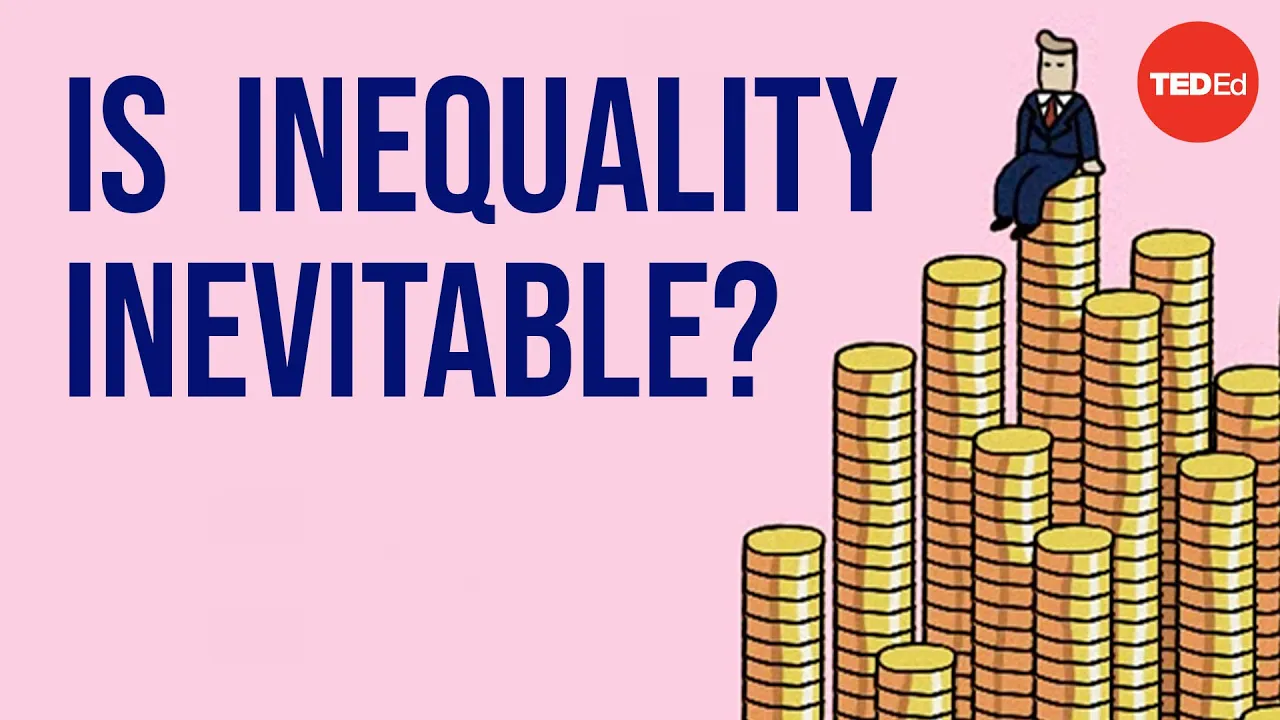
In South Africa, one of the most unequal countries in the world, the richest one-tenth of 1%, owns almost 30% of all the country’s wealth, more than double what the bottom 90% owns. Income and wealth inequality are not new. In fact, economists and historians who’ve charted economic inequality throughout history haven’t found a single society without it.
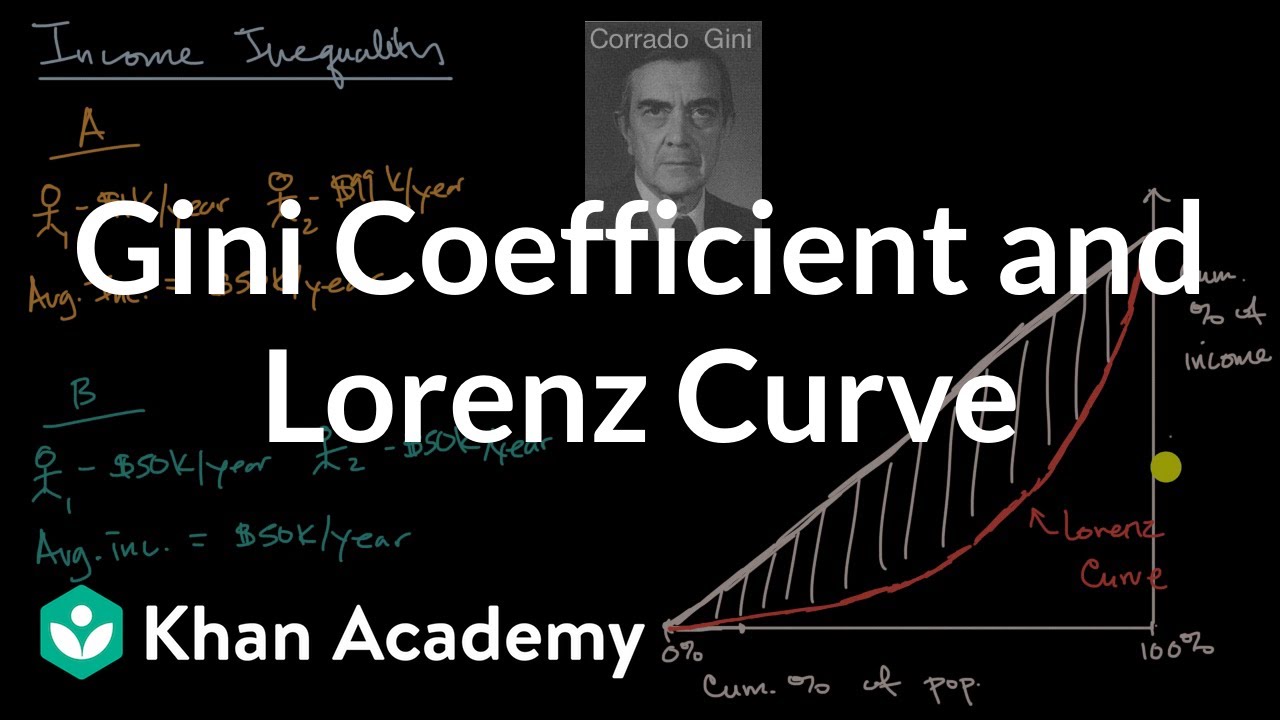
Which raises a bleak question: is inequality inevitable? One way to estimate inequality is with a number called the Gini index, which is calculated by comparing the income or wealth distribution of a perfectly equal society to the actual income or wealth distribution. The area of this shape multiplied by 2 is the Gini index.
A Gini of 1 indicates perfect inequality— one person has everything and everyone else has nothing. You’d never see this in real life because everyone except that one person would starve. A Gini index of 0 indicates perfect equality— everyone has exactly the same income or wealth.
But you also never see this in real life, not even in communist countries, because for one thing, that would mean paying everyone— no matter how young, old, what job they’re in or where they work— the exact same wage. Typical after-tax Ginis in developed countries today are around 0. 3, though there’s a wide range from pretty equal to pretty unequal.
Before we go any further, you should know what the Gini index— or any other measure of economic inequality— doesn’t tell us: it gives no information about how income and wealth are distributed across genders, races, educational backgrounds or other demographics; it doesn’t tell us how easy or difficult it is to escape poverty. And it also gives no insight as to how a particular society arrived at its present level of inequality. Economic inequality is deeply entangled with other types of inequality: for example, generations of discrimination, imperialism, and colonialism created deeply rooted power and class inequalities that persist to this day.
But we still need at least a rough measure of who gets how much in a country. That’s what the Gini index gives us. Some countries are, economically, much more unequal than others.
And that’s because a significant portion of economic inequality is the result of choices that governments make. Let's talk about some of these choices. First: what kind of economy to use.
In the 20th century, some countries switched to socialism or communism for a variety of reasons, including reducing economic inequality. These changes did dramatically reduce economic inequality in the two largest non-capitalist economies, China and the Soviet Union— especially in the Soviet Union. But neither country prospered as much as the world's leading economies.
So yes, people earned about as much as their neighbors did, but that wasn’t very much. This— and many other issues— contributed to the Soviet Union’s collapse in 1991. And China, to grow more quickly, shifted its economy towards capitalism starting in the late 1970s.
What about capitalist countries? Can they choose to reduce economic inequality? It’s tempting to think “no, because the whole point of capitalism is to hoard enough gold coins to be able to dive into them like Scrooge McDuck.
” China seems to provide the textbook example of this: after it became more capitalist, its Gini index shot up from under 0. 4 to over 0. 55.
Meanwhile, its per capita yearly income jumped from the rough equivalent of $1,500 to over $13,000. But there are many counter-examples: capitalist countries in which inequality is actually holding steady or decreasing. France has kept its Gini index below 0.
32 since 1979. Ireland's Gini has been trending mostly downward since 1995. The Netherlands and Denmark have kept theirs below 0.
28 since the 1980s. How do they do it? One way is with taxes.
Personal income taxes in most countries are progressive: the more money you make, the higher your tax rate. And the more progressive your tax system, the more it reduces inequality. So, for example, while pre-tax income inequality in France is roughly the same as it is in the US, post-tax inequality in France is roughly 20% lower.
Meanwhile, inheritance taxes can reduce the amount of wealth that a single family can amass over generations. Germany and many other European countries have inheritance or estate taxes that kick in at a few thousand to a few hundred thousand Euros, depending on who's inheriting. The US, on the other hand, lets you inherit $12 million without paying any federal tax.
Another way is with transfers— when the government takes tax revenues from one group of people and gives it to another. For example, Social Security programs tax people who work and use the revenue to support retirees. In Italy, about a quarter of Italians’ disposable household income comes from government transfers.
That’s a lot, especially relative to the US, where the figure is just over 5%. A third way is to ensure that everyone has access to things like education and healthcare. A highly educated, healthy workforce can command a higher salary on the market, thus reducing inequality.
The fourth way is addressing the digital divide: the gap between those who have access to the Internet and those who do not. A fifth way is dealing with extreme wealth. Multibillionaires can buy social media platforms, news outlets, policy think-tanks, perhaps even politicians, and bend them to their will, threatening the very fabric of democracy.
We are just barely scratching the surface of inequality here. We haven’t touched on the drastic divides in who has wealth and who doesn’t; the power structures that prevent social and economic mobility; and the drastic inequality between countries— the fact that, for example, just three Americans have 90 billion more dollars than Egypt, a country of 100 million people. And here’s one final thing to think about: power and wealth are self-reinforcing, which means that equality is not.
Left to their own devices, societies tend toward inequality— unless we weaken the feedback loops of wealth and power concentration.