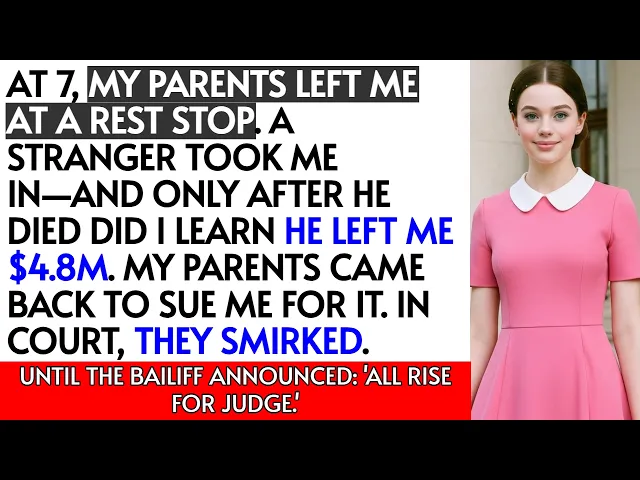
The bailiff's voice cut clean through the courtroom. All rise for the honorable Judge Kellerman. I walked in through the side door, my robe straight, my face neutral.
I had done this a thousand times. I knew how to make my footsteps sound like they belonged on that floor. I climbed the steps to the bench and sat down, and I let my eyes move across the room the way I always did, slowly, deliberately, taking inventory.
That's when I saw them. My mother was sitting at the plaintiff's table in a cream blazer she must have bought for the occasion. My father was next to her, his hair thinner now, his jaw set the way it always was when he was trying to look like he hadn't done anything wrong.
Their attorney was shuffling papers. None of them had looked up yet. I folded my hands on the bench and waited.
My clerk read the case number into the record. The attorney rose and introduced his clients. And that's the moment my father finally looked at the judge.
He looked at me. I watched the color leave his face like someone had pulled a plug. I didn't smile.
I didn't react. I just said, "You may be seated. " and opened the file.
I was 7 years old the last time I saw them before that morning. We were at a rest stop off I-70 somewhere in eastern Colorado. It was July, and the heat coming off the asphalt was the kind that makes the air look like it's breathing.
My mother had given me a juice box and told me to sit on the bench near the vending machines while she and my father used the restrooms. She said they'd be right back. She tucked my hair behind my ear when she said it, which I remember because she didn't do that often.
I finished the juice box. I sat there. I watched cars pull in and out.
A man with a golden retriever walked past, and the dog sniffed my sneakers and wagged its tail, and the man said, "Sorry. " and kept walking. After a while, I went to the women's restroom and called my mother's name.
Nobody answered. I went to the parking lot and looked for our car, a navy blue Chevy Suburban with a crack in the rear bumper. It was gone.
I went back to the bench and sat down. I think I understood immediately. I think some part of me had known it was coming the way you know a storm is coming even before the sky changes color.
I didn't cry right away. I just sat there with the empty juice box in my hands and waited for someone to notice me. A woman in a subway uniform eventually came out of the rest stop building and asked me if I was okay.
I told her my parents had left. She crouched down in front of me and looked at my face for a moment and then she said, "Okay, honey, come with me. " Her name was Rochelle.
She gave me a cookie from behind the counter and called the police and she stayed with me until they arrived. I never forgot her name. The investigation turned up almost nothing useful.
My parents had paid cash for gas two towns back. There were no relatives who came forward, no family friends, no emergency contacts on file anywhere. The social worker assigned to my case, a tired woman named Ms.
Garfield, told me once, I don't think she meant for me to hear, that it looked like they had been planning it for a while. I went into foster care. I won't spend too much time on those years because this story isn't about them.
But I'll say this, I was moved four times in three years and by the time I was 10 I had learned to keep my bag packed and my expectations very low. I was not a difficult child. I was quiet and I studied hard and I made myself useful wherever I landed because I had figured out that being useful was the closest thing to being safe.
The fourth placement changed everything. His name was Arthur Kellerman. He was 61 years old, a retired history professor, a widower, and the kind of man who had bookshelves in every room including the kitchen.
His daughter had died in a car accident years earlier and he had started fostering because, as he told me once, the house had too much quiet in it. He wasn't effusive. He wasn't warm in the way people describe warmth in movies.
He didn't hug me when I arrived or tell me everything was going to be okay. He showed me to my room which had a window seat and a lamp with a green glass shade and he said, "I eat dinner at 6:30. I hope you like soup.
I told him I like soup. Good, he said. That simplifies things.
I lived with Arthur for 11 years. He adopted me when I was 13. When I graduated from high school, he drove me to college himself and carried two of my boxes up to the dorm room and shook my hand at the car and said, "You've always been serious about the right things.
Don't stop. " I cried the whole drive back to my dorm. I'm not ashamed of that.
He came to my law school graduation. He sent me a letter, an actual handwritten letter when I passed the bar. When I was appointed to the district court at 33, he flew out for the ceremony and sat in the second row and I could see him from where I was standing and he looked so quietly pleased that I had to look away or I would have lost it entirely.
He died 14 months before the morning I sat across from my biological parents in my own courtroom. He left me his house, his library, and the entirety of his savings. $4.
8 million accumulated over a careful and modest lifetime. I didn't know about the money until the will was read. I genuinely hadn't known.
I found out my biological parents were suing me through a certified letter that arrived on a Tuesday. The lawsuit claimed they were my legal next of kin and that I had unlawfully benefited from an estate to which they had a rightful claim. Their attorney had combed through the adoption records, which were sealed but apparently not sealed well enough, and had identified me.
The suit asked for $4. 8 million plus legal fees. I stood in my kitchen and read the letter twice.
Then I called my friend Bethany, who is also an attorney, and I read it to her over the phone. There was a long pause. "They have no case," she said.
"I know. You were legally adopted. He was your father.
They terminated their parental rights voluntarily or by abandonment. Doesn't matter. Same result.
" "I know. " "So why do you sound like that? " I didn't answer right away.
I was looking out the window at the street below, at a woman pushing a stroller, at a FedEx truck double parked at the corner. I was thinking about a rest stop in Colorado and a juice box and the way the asphalt had shimmered in July because they're real, I said finally. I thought they were just a thing that happened to me.
I didn't think they were going to be people again. Bethany was quiet for a moment, then she said, "Do you want me to represent you? " I told her yes.
What I didn't tell Bethany, what I didn't tell anyone at first, was that the case had been randomly assigned to my court. I found out the morning after the letter arrived. My clerk left the new case files on my desk as usual and I almost walked past the top folder before something made me stop.
I picked it up. I read the plaintiff names. I stood there in my office for a very long time.
I thought about recusal. I genuinely considered it. A judge is supposed to recuse when there's any reasonable question about impartiality and there was no universe in which I was impartial about this case.
I knew that, but I also knew the law cold and I knew that my biological parents had no case. The adoption had been legal and fully documented. Their claim had no merit in any court.
The outcome wasn't in question, only the procedure was. I called the presiding judge of our district, Judge Abramson, a woman I respected enormously and I told her everything. I laid it out completely.
The abandonment, the adoption, the will, the lawsuit, the random assignment to my docket. I told her I would recuse immediately if she thought it was appropriate. She was quiet for a moment, then she said, "Have you reviewed the merits?
" I told her I had. "And your assessment? " "No viable claim.
Motion to dismiss should be granted at first hearing. " "Then I'll leave it with you," she said. "But I want it on the record that you disclosed fully and immediately.
" "Yes, Your Honor. " "And Kellerman? " "Yes.
" "Don't let them rattle you. " The morning of the hearing I arrived 40 minutes early, which I always do. I reviewed the file one more time even though I had it memorized.
I drank my coffee. I adjusted my robe in the mirror behind my office door. I thought about Arthur.
I thought about the letter he'd sent when I passed the bar. He had written in his careful cramped handwriting, "The law is not a weapon, and it is not a shield. It is a structure.
Build it honestly, and it will hold. " I thought about that a lot. Then I walked out to the bench.
When the color drained out of my father's face and he finally understood who was sitting in front of him, I watched him lean over and say something to his attorney. The attorney looked up at me. I met his gaze without expression.
The attorney rose. "Your honor, my clients would like to request a brief recess. " "We've just begun," I said.
"Sit down. " He sat down. I gave their side every procedural courtesy they were entitled to.
I let the attorney make his opening argument in full. I let both parties respond to questions. I was scrupulously fair.
I was the most professionally neutral person in that room, and I could feel it costing me something to be that way, and I paid it anyway, because that was the job. My father kept staring at me. My mother had her eyes on the table.
At one point, the attorney tried a different angle. He argued that the adoption itself should be scrutinized, that there may have been procedural irregularities in how my biological parents' rights had been terminated, given that they had never formally signed anything. They had simply left me at a rest stop and driven away.
I let him finish. Then I said, "Counsel, are you arguing that your clients' abandonment of a 7-year-old child at a highway rest stop was not sufficient grounds for termination of parental rights? " There was a sound in the gallery.
A few people had come in. Court observers, law clerks passing through, the usual background presence of a busy courthouse. I heard the sound.
The attorney opened his mouth and closed it. "Because," I said, "I can direct you to the statute, if that would be helpful. " He said that wouldn't be necessary.
There was one moment I hadn't prepared for. Bethany had submitted documentation from the original abandonment report, including the statements taken at the time. One of those statements was from Rochelle, the subway employee who had found me.
She had given a detailed account of what she'd seen, a small girl alone on a bench, a juice box in her lap, who told her very calmly that her parents had left. Bethany read a line from it into the record. She said, "The child appeared to have been waiting for some time.
She did not appear surprised. " I had to look down at the file for a moment. I pressed my thumbnail hard into the side of my index finger under the bench where no one could see, and I waited until I was sure of my voice, and then I continued.
There was a recess for lunch. I ate at my desk. Bethany came in and shut the door.
"You're doing great," she said. "I'm just doing the job. " "The job you're doing exceptionally well given the circumstances.
" She set down a sandwich in front of me, which I hadn't asked for but was grateful for. "How are you actually doing? " I thought about it.
"I'm okay," I said. "I'm angry, but it's quiet anger, the kind you can work with. " She nodded.
"He would have been proud of you. " I didn't ask who she meant. The part that I think people find most surprising when I tell this story is what happened at the end of the afternoon session.
The attorney had made a last-ditch argument about equitable claims, essentially trying to argue that even if the legal case was weak, there was some moral claim to the estate based on a biological relationship. It was not a serious legal argument, but I let him finish, and then I said, "I'd like to hear from the plaintiffs directly. " The attorney started to object.
I held up one hand. "This is not an unusual request. Your clients are here.
I am allowing them the opportunity to speak. " My mother stood up. She was 63 now.
She looked older than I expected and smaller. She said that she had made mistakes. She said that things had been very hard at the time.
She said that she had thought about me. I let her speak. When she was done, I said, "Thank you.
You may sit down. " Then I said, "I'm going to rule on the motion to dismiss. " I granted it in full.
I dismissed their claim with prejudice, which meant they could not refile it. I awarded attorney's fees to the defense. I stated for the record that the adoption had been fully legal, that Arthur Kellerman had been my father in every sense that the law recognized, and in every sense that mattered, and that the plaintiffs had no standing to challenge his estate.
Then I referred the matter to the district attorney's office with the recommendation that they review the plaintiffs' conduct for potential charges related to the life insurance policy they had collected after reporting me as a missing child, later presumed dead. I had found out about that 2 weeks into the case. Bethany had dug it up.
They had collected $180,000 on a policy in my name, roughly 2 years after they left me at that rest stop. I kept my voice very even when I said it. I had practiced that part.
The gallery was not silent after I ruled. There were people in there who had followed the case, a reporter from the local paper, a few courthouse regulars who had figured out the story. I heard the sound they made.
I didn't react. I gathered my papers. I acknowledged my clerk, and I walked back through the door to my chambers.
I sat down at my desk. I opened the drawer on the left side where I keep things I don't look at often. Arthur's letter, a photograph taken at my law school graduation, the two of us on the steps, him in a blazer that was slightly too large because he had lost weight that year and was stubborn about buying new clothes.
I looked at the photograph for a while. He had been a quiet man. He didn't make speeches.
He didn't tell me often that he loved me, but he showed up every time. He drove 6 hours for my college orientation. He read every brief I let him read and wrote his notes in the margins in red pen.
He learned to make the soup I liked best, a Portuguese caldo verde I had eaten at a friend's house once and mentioned maybe twice, and he made it from scratch one night without explanation and just put it in front of me and sat down. That was Arthur. That was what $4.
8 million actually was, not a number, not an asset. It was 30 years of a man deciding quietly every single day that I was worth showing up for. No one was taking that for me.
The district attorney's office opened an investigation 6 weeks later. The insurance fraud charge wasn't a certainty. The statute of limitations had run on some of it, but the DA found enough to work with.
I wasn't involved in that process. I had made my referral and stepped back as I was required to do. I heard through the court grapevine what happened.
I didn't seek the information out. I just let it reach me the way information does in a courthouse, through hallways and clerks and the particular osmosis of a building full of people who pay attention. They settled.
They paid back a significant portion of the insurance money. There were conditions attached that I was not privy to. That was enough.
I used part of Arthur's estate to set up a foundation. I named it after Rochelle, or rather, I named it after the thing she had done, which was notice. It's called the Rochelle Initiative and it funds training programs for first responders and service workers on how to identify and respond to children who appear to be alone in public spaces.
Rest stops, bus stations, laundromats, fast food restaurants. The places where nobody is really looking. The places where a 7-year-old can sit on a bench with an empty juice box for a very long time before anyone asks if she's okay.
I don't talk about it much publicly. It's not something I do for the recognition. I do it because Rochelle gave me a cookie and stayed with me and called for help.
And that was worth more than she probably ever knew. And I wanted there to be more people in the world who knew how to do that. People ask me sometimes what it was like sitting on that bench and looking at them.
I tell them the truth, which is that it was less dramatic than you think. By the time you have spent enough years building something from nothing, by the time you have put yourself through law school on loans and sleep deprivation and sheer refusal to quit, by the time a man you loved has died and left you everything he had because he believed you were worth it. By that time, the people who left you on a bench at a rest stop in Colorado are not the most powerful thing in the room anymore.
They were just two people in a courtroom, and it was my courtroom. I knew the law. I followed it precisely and without malice.
I gave them every procedural right they were owed, which is more than they ever gave me, and then I did my job. Arthur used to say that the law, at its best, is just careful attention. You look at what actually happened.
You measure it against what the rules say. You follow the logic where it goes, even when it goes somewhere uncomfortable, even when it goes somewhere personal. That morning in the courtroom, I was as careful as I've ever been in my life.
I hope I did him proud. I've thought a lot about what it actually means when people say someone got what they deserved. It sounds satisfying in the abstract, clean, final, like a door shutting.
But when you've lived inside a story like mine, you know it doesn't feel like a door shutting. It feels more like something quietly settling, like the ground finally being level after years of walking on a slope so gradual you didn't even know you were leaning. My biological parents made a choice when I was 7 years old.
They didn't make it impulsively. Rochelle's statement, the one Bethany read into the record, made clear I hadn't been forgotten in a moment of distraction. There were no frantic calls to the rest stop, no missing child report filed that night, no search.
They drove away and they kept driving. And then, 2 years later, they filed a life insurance claim on me. They turned my disappearance into a transaction.
What they didn't account for, what people who make choices like that never seem to account for, is that the child they left behind was still going to grow up, still going to become someone. The absence they created didn't erase me. It just meant I built myself somewhere else with someone else, in a quieter and steadier kind of love than I think they were ever capable of offering.
Arthur didn't save me because he was trying to be heroic. He saved me because he had a house with too much quiet in it, and he was honest enough to admit that. He showed up, not dramatically, not with speeches, but consistently.
Dinner at 6:30, red pen in the margins, a soup he learned to make because I mentioned it once. That's what integrity actually looks like in practice. It's not a grand gesture.
It's just showing up again and again until showing up is who you are. That's the thing about the choices we make over time. They don't stay still.
They compound. My parents' choice to abandon me compounded into fraud, into a lawsuit, into sitting across from the person they discarded and watching her rule against them in her own courtroom. Arthur's choice to show up compounded into 30 years of steadiness, into a career I built on the foundation he gave me, into a foundation I named after the woman who noticed a 7-year-old alone on a bench and did something about it.
The person you decide to be, not once but daily in the small unremarkable moments, is the person you become. And the person you become is what either protects you or catches up with you in the end. I am not a hard person.
I don't think I became a judge because I wanted power or because I wanted the day my parents finally saw me to go a certain way. I became a judge because Arthur taught me to believe in structure, careful, honest, patient structure, and because I had spent enough of my childhood in a world without it to know what its absence costs. What I want anyone to take from this is not the satisfaction of a twist ending.
It's something simpler and harder than that. It's this. The people who leave you do not get to define what you become.
They only define what you start with. Everything after that is yours. I earned my seat at that bench, every single day of it.