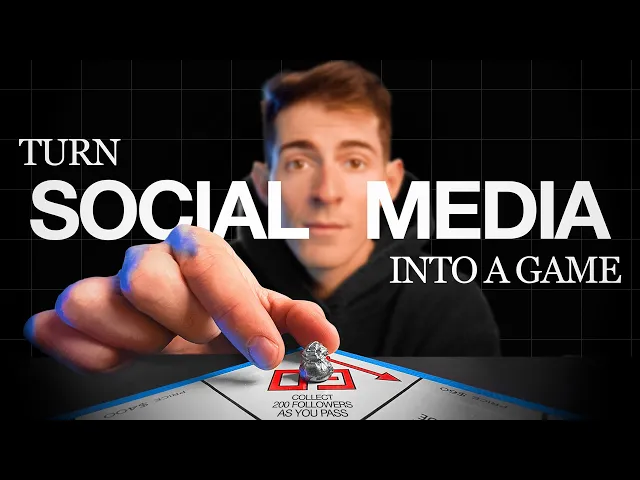
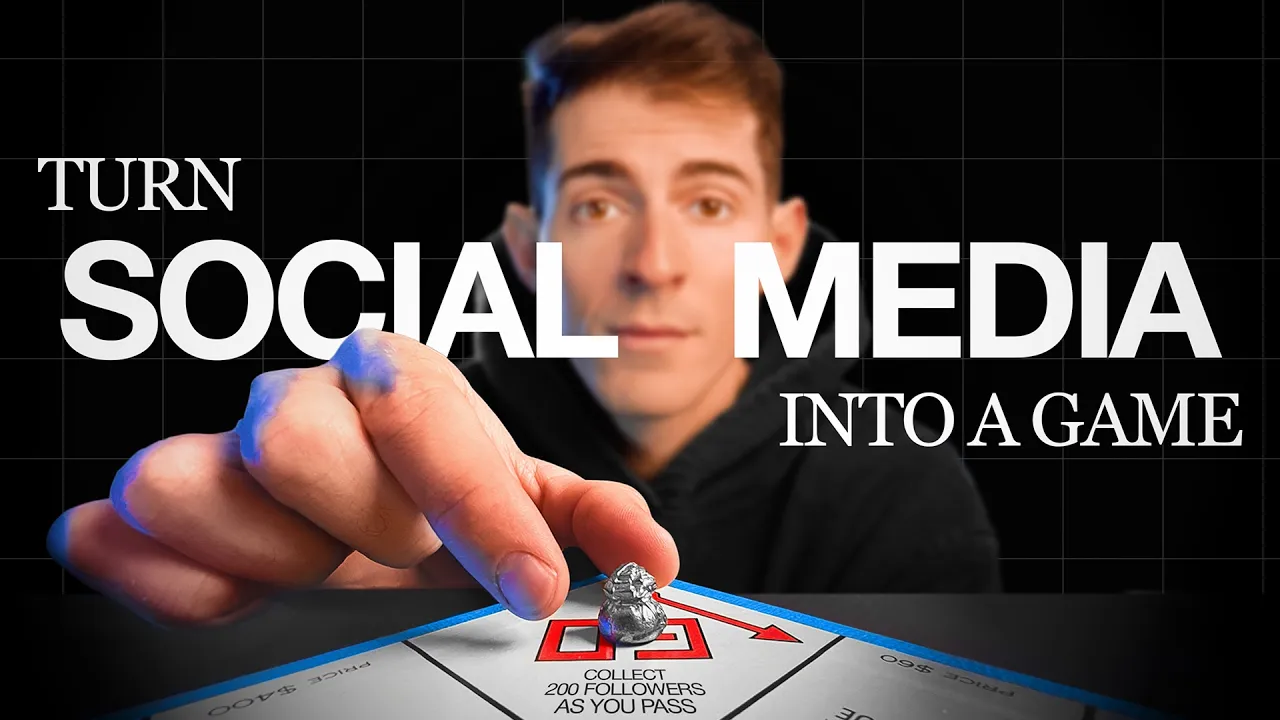
Social media is just one giant game. And if you want to grow faster, there's really only one thing you need to master, game theory. Now, game theory is understanding the reasons why different players make decisions in a game. Because the truth is, social media and YouTube are just one giant game of attention. So, if you can deeply understand why certain players act certain ways, you can build a content strategy that runs laps around all of them. And I know this works because all I do all day long is figure out ways to grow faster on
social media and YouTube. I have a million followers. I've done billions of views. And all that traction came from studying game theory. So, in this video, I'm going to break that whole framework down. This is the four-step playbook for how to actually understand social media game theory and use it to your advantage. And I promise you this will open your eyes to a whole new way of looking at the content game. Okay. Now, before we go through the four-step playbook, let's just quickly align on what game theory actually is, because you've probably heard that term,
but may not have applied it to a concept in your own life or business. Now, all game theory is is analyzing and predicting how different people will act in a game. And here's why that game Theory concept is so helpful for us. It turns out if you analyze the content game, social media and YouTube, you can apply those same game theory principles to figure out the optimal strategy. And all this really is is deeply understanding psychology and incentives. Like I said before, this one thing is the secret to how I've grown so fast on social
media and YouTube. And so in this video, I'm just going to break the whole thing down and give it to you cuz I want to see you grow fast, too. Okay. Now, here are the four parts to the game theory framework that we're going to walk through in this video. The players, the incentives, the games, and the strategies. That's what's coming up. Okay. Now, part one of the social media game theory playbook is understanding the players. We can't figure out how the players are going to act unless we know who they are. So, in addition
to you, there are six other main groups of players playing in the content game. First, we have the social platforms as represented by the algorithm. Second, we have the viewers, but there's actually two different types of viewers that behave very differently. Passive viewers and active viewers. For passive viewers, we'll consider these as viewers that do not have pain points relative to your topic niche. These are non buyers. They would never buy your stuff. They're just watchers of the content because they're interested in the topic. On the other side, we have active viewers who are Potential
buyers and do have pain points related to your topic niche. And this will help illustrate the difference. For example, if you make content about marketing for business owners, a junior staff marketer might be a passive viewer because they're not really in a buying position, but they're still interested in marketing as a topic. An entrepreneur running an agency is an active viewer because they are in a buying position and have those pain points. Now, all viewers on social media can be both passive and active viewers in different niches at the same time. It just depends on
where they actually have pain points. For example, I am a passive viewer of sports content, but I'm an active viewer of social media marketing content cuz that's where I have my business. Okay, so so far those are three of the players, the algorithms, the passive viewers, and the active viewers. Who else do we have? Third, we have other creators. And the other creators can also be split up into two subgroups. Entertainment creators and education creators. And here's the difference. Entertainment creators are trying to entertain a mass audience in their category. They do not have a
bottom of the funnel offer. So they monetize through CPMs like Tik Tok creator fund and YouTube AdSense program and brand deals. Now education creators on the other hand, they want specific views from within their buyer demographic. They're not going for mass reach. They're going for specific views from a Specific audience. They do have a bottom ofunnel offer and are solely focused on conversion from the social platforms to that offer. They may also get some income from CPM and brand deals, but it is not a primary focus for them. Okay, so we've got other entertainment creators
and other education creators in your category. That makes up four and five. And then last, we have the brands and advertisers. And in this case, the brands and advertisers are considered the people from the outside that pay creators for brand deals, not the brand accounts that make their own content. Okay? So those are the seven players in the content game. Whether you're on social media or YouTube, there's you, the algorithm, passive viewers, active viewers, other entertainment creators in your category, other education creators in your category, and the brands and advertisers. And we needed to start
there because it's impossible to figure out who's going to act in what way unless we know who's actually playing. Okay, so now question two is how do we predict how each of those players is going to act in the social media arena? Cuz if we know how they'll act and it's predictable, we can just build out a content strategy that takes advantage of those actions. And if you've never thought like this, this is some Jedi mind voodoo, but I promise you it will really make sense in a second. The way to figure out how other
players are going to act is to figure out what they want most. And the way to figure out what they want most is to deeply Understand their incentives and base psychology. Now, machine-based players in the game, the algorithm, are actually way more predictable than humans because the algorithm is essentially just math at scale. If you know what the algorithm wants and it's mathematically designed to get it, if you just give that more of it over and over, it will push you and give you what you want. But human player incentives, everybody else, are a little
bit harder to figure out because humans don't always act rationally. But don't worry, no human can outrun their base psychology. So, we can solve this as well. Okay, so as a recap so far, in order to win the social media game, all we have to do is analyze the psychology and incentives of all the other players and then reverse engineer what content we can make to give them more of those incentives. If viewing our content helps them get more of what they want most, they're going to push it for us. And this is the playbook
that I'm about to explain. Stay with me. I promise you this will make a ton of sense in like three minutes. All right, we're moving to part two in the playbook, which is incentives. In order to figure out how to give each player what they want, we need to understand what it is they want. So, let's break down the incentives for what each different player wants most. We can map those and then come up with a strategy. And this process of mapping incentives really in any area in business is actually super helpful. So, Pay attention
to this. Okay, let's start with the incentives of social platforms and the algorithm. What does the algorithm actually want? The social platforms have one job. Maximize ad revenue. And ad revenue is directly correlated to the number of user minutes on the platform. The more user minutes, the more time those users spend clicking on ads, the more ad revenue the platform makes. It's that simple. Now, user minutes are calculated from two things. The number of active users and the number of minutes each user spends per session. So, think about that. What the algorithm wants is for
new users to come to the platform and start sessions and for existing users to stay on the platform longer and extend their current session. So, it will push content, more views, more shares, whatever, as long as it helps them do those two things. new sessions, extending existing sessions. Now, the closest proxy metrics for your content's ability to extend a current user session is a combination of average view duration, how long did someone watch? Engagement rate, how much did they like it enough to interact with it? And platform bounce rate, what percent of people watched your
video and then literally left the platform and ended their session. The combination of those three things is how the platforms measure your ability to extend user sessions. So, knowing this, our content needs to be optimized for two things. To drive shares and to increase average Viewer duration. Okay, put a pin in that. Just remember, I'm going to finish all the incentives for the players and we're going to come back and break down the strategy for how to actually make content that drives those two things. Stay tuned. Okay, next let's study the incentives of the passive
viewer. And again, this is a passive viewer with respect to your topic category. If I talk about sports, I don't care about passive viewers in cooking. I just want passive viewers in sports. So whatever content you make, assume that a passive viewer is interested in that topic but is not a potential buyer. In other words, a passive viewer is using social media or YouTube for entertainment. Now the number one incentive, what the passive viewer wants most is to feel the dopamine hit that comes with scrolling and keep getting that as they scroll. Now dopamine is
typically released as a result of two things. Emotional response, surprise, shock, sadness, any of the emotions, or curiosity loops, open questions that become like a maze in the viewer's brain. Those are the two things. emotional response, curiosity loops. That's what drives dopamine for the entertainment viewer. And we will come back to how to engineer this as well in a second. Let's just go to the next one. Okay. Next, we have active viewers. Again, these are viewers with pain points in your niche category that are also potential buyers. Now, active viewers behave differently than passive viewers.
An active viewer is using social media to find tactical solutions To their problems. And so their number one incentive, what they want most from the content is to find an answer that is tactically implementable as quickly as possible where they can feel relief from a pain point they currently face. Okay, next we have other entertainment creators. And again, I'm going to go through all the players, all the incentives, map everything, and then figure out the winning strategy at the end. I promise you it's worth it because I know what the strategy is and it works.
Okay. Okay, now as a reminder, other entertainment creators are using social media to try to get as many views as possible in their category. These are people that do not have a back-end offer. They do not have a funnel. They do not have products and services to sell. They are the product and the ad revenue that they get from either brand deals or CPMs is how they monetize. So, for an entertainment creator, what they want most is to maximize view-based revenue. And the way they do that is to grow their following or subscribers as much
as possible, have the highest possible average views, and have the highest possible average engagement. All right, next up, we have other education creators in your category. And again, an education creator is using social media to drive as many conversions as possible. These are people that do have a back-end offer and they have products at the bottom of the funnel. Their main goal is to use social media as a ramp to get people from rented platforms into owned platforms like email list, Community, and paid products. For education creators, what they're looking for is to maximize ontarget
views, which is the highest possible penetration in their category set with the most free push from the algorithm. Their primary incentive is to figure out how to make content that gets pushed as hard as possible via the algorithm, but just within their target segment. So, for an education creator, what they really want most is the consistent delivery of leads from social media into their owned products. Okay. And lastly, we have the brands and advertisers. And these are people that don't actively make content, but they still play a big role in the ecosystem. Again, when we
refer to brands here, we're talking about the act of them paying entertainment creators for brand deals, not them making content. So for brands, the thing they want most is the maximum return on ad spend. And the best way to measure this are direct links on sponsored posts and the conversion rate of those links. Okay, so that's a summary of the players and the incentives each of them have in the social media game. The algorithms want more user minutes. The passive viewer wants more entertainment via dopamine release. The active viewer wants tactical solutions to their problems
faster and easier. The entertainment creator wants more ad revenue, either CPMs or brand deals. The education creator wants higher Conversion rates off platform. And the brands want a higher return on ad spend from the entertainment creators that they sponsor. These are what I call the peak incentives. If you boil everything down, each one of those players wants that thing. So, here's how it all comes together. If we can make content that gives those players those things, they will push our content more to get more of those things. So, let's keep going. The next question is,
how do we adjust our content strategy? How do we figure out what content to make to give them more of those things? And before we drill down on that, the content strategy, which is what everybody wants, that's part four. We just need to go through one more thing, which is part three. And that is which game are we actually playing? Which game are we building the right strategy for? Because based on the game you're playing, you're actually going to pay attention to different of those players and make different moves. It turns out social media is
actually two giant games meshed into one. The awareness game and the conversion game. Now, you can make nine figures annually playing either game, but you need to pick one over the other per channel because the strategies vary significantly. And I know there are two games because I've been playing both games in different places. I've played the entertainment game on social media with my tech content. And I've played the education game on this channel on YouTube with my short form, long- form Content, strategy content. You can only play one game per channel, but you can play
both games at the same time if you have multiple channels. Now, because I've played both and won both, I can break down the strategy optimal game theory moves for each game and specifically which players matter in each game and how to change your strategy to take advantage regardless of which one you're playing. Again, one more point here before I dive into all the answers. You can probably understand a that I am a complete nerd when it comes to this stuff. I love psychology more than anything, which is why I made this channel and why I'm
trying to help you guys win. This whole thing is just breaking down psychology and then building up a strategy to take advantage. And the second thing is I approach this content game like a scientist and a psychologist, not like an artist. And I know there might be some people watching this that really think of content as an art expression and might think of the way I talk about this as icky or whatever word you want to use. I apologize to you. you probably don't want to watch the rest of this video cuz I'm going to
break down an exact formula and a science for how to win. Apologies. Okay, here are the two differences between the two different games. The awareness game and the conversion game. The awareness game is the top of the funnel media game. In this game, you're going for max views at all costs in your category because you're getting paid per 1,000 impressions. Either literally per 10,000 impressions by CPMs, Tik Tok and YouTube AdSense, or as a proxy of a,000 Impressions via brand deals. In the awareness game, the players you care about are the algorithm, passive viewers, other
entertainment creators, and the brands. The other players, active viewers, and education creators in your space, you don't care about. They're just netneutral to you. They don't sway your strategy. Now, because you're looking for max views, your goal, what you want out of this game is the following. You want the algorithm to push your videos to as many passive viewers as possible. You want to get more views than the other entertainment creators you're competing with in the space and you want brands to pay you the most for brand deals. That's what you're after if you're playing
the awareness game as an entertainment creator. And again, most traditional media companies are playing the awareness game and they're making 8 to9 figures per year. Thousands of individual creators will make millions per year on their own playing the awareness game. So, it's not a bad or evil game. This game can crush. You just have to decide, is this the game you want to play? Now, the other game is the conversion game. And this is the middle and bottom off ofunnel media game. In this game, you're going for max ontarget views because you're making money. You're
getting paid based on how well your viewers convert into the products and offers you have at the bottom of the funnel. You might also be getting paid CPMs or light brand deals, but this is icing. That's not your Primary incentive. Now, in the conversion game, the only players you care about are the algorithm, active viewers, and then both other entertainment and other education creators in your space. And I'll explain why both. In the conversion game, you do not care about passive viewers in your category or the brands and advertisers. They may pay you, but that's
really not what you're building for. So, you can see there are different player groups that matter for different games depending on which one you're playing. Okay. Now, part four in this whole video, part four in the playbook, which is what everybody wants, is where I'm going to break down the specific strategy for how you make certain content to win each game. What type of content should you make to win the awareness game? What type of content should you make to win the conversion game? You can win both. You just have to pick one per channel.
Now, I'm going to start with the awareness game, cuz that's the order I explained it in. If you don't care at all about the awareness game, and you just care about the conversion game, feel free to look in the timeline and skip ahead, and I'll explain the conversion game in a second. However, if you're a nerd about this, you probably should just watch both because it's pretty damn interesting. All right, here we go. This is how to use game theory to win the awareness game on social media or YouTube. Now, the good news is the
awareness game is actually very simple. In this game, you are an entertainment creator. That's who you are. You can pick a topic that's Businessy or feels educational, but you are an entertainment person talking about topics, going for mass views in whatever category you've chosen. All you want is to get the most views possible in a given period. And doing this will help you maximally monetize from CPMs and brand deals. Okay, now let's remind ourselves quickly which players matter for the awareness game. It's the algorithm, it's passive viewers, it's other entertainment creators in the category like
you, and its brands and advertisers. Those four. Quick refresher on what each of those four wants most. I know I talked about that probably 10 minutes ago. Let's just bring it to the top of our mind. First, the algorithm wants more user minutes. And the way to get more user minutes for the algorithm, so it pushes you more, is to make content that has high shares and high average viewer duration. If our videos have high average watch time, it's elongating existing user sessions, which drives user minutes up. So the algorithm will give us more views,
which is all we care about, as long as we have high shares and high AVD. Okay. The second group that matters, passive viewers. They want the dopamine release. The way to get more dopamine for the passive viewers is to evoke curiosity or drive an emotional response. Now, we have several specific tactics for how to drive curiosity and emotions, which I'm going to go through in a second. But the way to measure our effectiveness at driving those things is shares, comments, and average view duration. Shares and comments are a proxy for a viewer wanting to share
this emotional experience with someone else. An average viewer duration is a reflection of how curious they were at watching. And at this point, if you're paying attention, you should say, "Hm, that's interesting. Algorithms and passive viewers get what they want most if we make content that has high shares and high average viewer duration. Interesting. Okay. The third group that matters in this game, other entertainment creators like us. And what do they want? They want the same thing we want, which is super high views so they can monetize with max revenue. Now, other entertainment creators are
going to make their own videos and go for views. But we could also help them by giving them banger content ideas that they could make or remix or helping them build trust with their audience so their audience wants to watch them more. And more on how we do that in a minute. Just refreshing everything. Fourth, the brands, the other player that matters, they want high return on ad spend. If they sponsor one of our videos, they want to make sure it's worth the money. And the way we get them a high return on ad spend
and high confidence is that we have consistently high views on the content we make. Okay, now let's think about this. Here's where the magic comes in. What we want is more views. The algorithm will give us more views. If we make content that has high shares and high average watch time, the passive viewer will keep watching if we make videos that induce raw curiosity and Emotional response. The other entertainment creators will share our videos with their audience, driving views up if we have such unique ideas and concepts that it helps them build trust as the
curator. This means all you need to do as an entertainment creator to win the awareness game is make content that has these four attributes. A highly shareworthy, B frame insatiable curiosity in the hook at the beginning, C have a strong emotional payoff at the end, and D appeal to as large of a total addressable market as possible. And it turns out these are the four most important foolproof ingredients for making content as an entertainment creator that will help you win in any niche. Now, let's click into those four things and deeply understand how we engineer
them. I'm going all the way down to the bare metal. You want the tactics? Here are the tactics. Let's start with sharability. First thing, you want to make videos that are shareworthy because again, if they get lots of shares from passive viewers and other entertainment creators in your space, the algorithm will like that and push it more. Okay. So, what actually drives shares? People share things because they believe they will get the social or professional credit of doing so from their friends or colleagues. Now, credit could be a laugh, a cry, a hat tip, admiration,
building trust. Regardless of which one it is, people share because They want the recipient that they share to to think positively of them in some way. For example, if you see a funny clip and you share it, it's because you want the recipient to laugh, to have that shared experience, but you also want them to think of you as that guy that shares the funny stuff. That's the credit. People share because they want the credit from the recipient of being funny, smart, tapped in, sensitive, whatever it is. Now, this is really important. That credit is
only shared back to the original sharer if the recipient hadn't seen that thing before. Cuz if you think about it, you could have the world's funniest joke, but when you share it, if that person has watched that joke five times, they're not going to give you the credit for being the funny curator. So for you as the entertainment creator, if you want to make something that's shareworthy to get shared with a ton of people, you either need to be first to share that topic with that group or different enough that when they see a new
twist on a thing they've seen before, they give that credit back. And this psychology is where shares actually come from. One more really important point on shares. A share from a normal passive viewer is worth one. But a share from a fellow entertainment creator, especially one with a huge audience, is worth thousands. I call this a super share. The more super shares you can unlock from other entertainment creators in your space, the faster you will grow and Drive that viral loop. because instead of a few hundred people being exposed on a normal person's reshare, you're
getting tens of thousands of new eyes because of that super share. Now, you might think, "Oh, there's no way other entertainment creators would share my stuff." If they're watching this, they want to beat me, so why would they ever share? But this isn't true. Remember what they want most. They want max views. And to get max views, they need trust from their audience that what they post is valuable. If your video concept is so novel and so interesting that just by reposting it, they get some professional credit attributed back to them, they will do it.
And if they do, the algorithmic flywheel will explode. So to get other entertainment creators to super share, the bar for that idea quality, the novelty and being first or different is even higher than it is for passive viewers. But if you can cross that bar, your video will explode. Okay. Now, the second attribute, the thing I said is you need to make sure you frame curiosity in the hook at the beginning of the video. And I often refer to this as building a curiosity loop. And all you have to do to build a curiosity loop
is to contrast against a conventional belief that the viewer already has. Now, I talk about this a lot in my other videos, especially the ones on hooks. So, if you want to dive deeper on this, go watch those. But, for example, if I start a video like this, this is going to change how accountants do their job. If you're an accountant, you were now extremely curious. Why? Your baseline was I know how to do my job. But now I'm introducing a new reality where something happened that might change your conventional belief. It might not be
the case now that you know how to do your job unless you watch what this thing is. That contrast between your base reality and my proposed new reality will drive curiosity. And if that's you and you're on topic, you cannot help but go down that rabbit hole. So, all you have to do as the entertainment creator is frame the hook, whether it's spoken, written, or visual, with some contrastdriven curiosity, and then you've got them hooked. And again, we need this initial curiosity loop so that we can trigger the dopamine release for the passive viewer so
they keep watching and we can extend average view duration. You see how all these pieces are starting to be connected together? Okay. Now, the third thing your videos must have is an emotional payoff by the end. Again, this is for entertainment content. If you want mass market shares, you need an emotional payoff at the end. And emotional payoffs are the best way to drive these macro viral share loops. Again, people share because they want to get the credit of being emotionally tapped in. They want that emotional feeling to transfer so they get the credit back.
Now, to build this emotional feeling in a video, you need To use your words, your tone, the topic, the visuals, the music to evoke some emotion in the viewer by the end of the video. If they don't feel that emotional response, they're not going to share because they won't think that there's credit to be earned on the way back. Now, certain topics have more emotional charge than others. There's an infinite rabbit hole about how to actually write scripts and words to drive emotion. But here's a pro tip. Typically, framing your point against what they want
most. Another contrast piece is the way to get them shock, fear, that kind of anger, emotion, which will get them to share. Okay, the last piece of the four, remember these are the four pieces that you need in your content if you want to win the awareness game as an entertainer. The last piece is that you need your topic ideas to have a large cam, total addressable market. The number of total people that will be interested in that topic is large. And this is pretty obvious, but in order to get more views, you need more
people that will be potentially interested in the thing you're talking about. So, what this really means, if you want to pick ideas that have a broad tam, you either need to pick simple topics that lots of people can understand or embed references in those topics that massive amounts of people can relate to. If you make science content, what topic is going to appeal to a larger TAM? Drilling to the center of the earth or organic chemistry? If you make law content, which topic is going to have a larger tam? You talking about Kim Kardashian getting
her law degree or section 257 of the bar? Obviously, drilling to the center of the earth and Kim K are way more broadly applicable to more people than the others. You want simpler concepts, broader concepts, and ideas that more people can relate to. And again, this is because a large possible number of viewers equals more user minutes, which means the algorithm will push you more and give you more opportunities to be shared. These are the four horsemen things that you need to do to every single piece of content to drive maximum views so that you
can win as an entertainment creator. If you do this, those four elements we just talked about, the algorithm will be satisfied, the passive viewer will be satisfied, other entertainment creators will be satisfied, and of course, the brands will be satisfied. So the only question left is where do we find all these winning ideas that satisfy those four criteria factors because that's really the question. That's really the thing holding people back. It's not the execution. It's the ideas that meet that criteria. We're talking about ideas that are so shareworthy that even your competitors in your space
have to tip the cap because they're so unique and valuable. Now, to find those ideas, what you want to look for is proven winners Or outliers that came from people that either knew what they were doing in your space or accidentally stumbled upon a brilliant insight. These are proven outlier ideas that you can remix. This is why the idea process in content is so underrated. It's everything to driving how you win. You want to study what worked in your category, reverse engineer, and then remix it. Now, if you want an easier way to do this
process, to figure out what creators to look at, which videos won, how to remix them. If you want an easier way, we're about to launch our second version of Sandcastles.ai, which will a,000x this process for people in terms of how fast they can do it. It will allow you to study and track any creators, find outliers, figure out why they want, and then remix for yourself in minutes. So, if this is a process that you want to learn how to do on speed mode, go to sandcastle.ai. There's going to be a video on the landing
page where I'll walk you through the whole thing. Okay, so to summarize the full playbook as an entertainment creator to win the awareness game, all you need to do is make content that drives these four things. Shareworthiness, curiosityinducing hooks, emotional payoffs, and a large TAM. And if you can do that consistently, it is just a volume game from there. Volume against those four things wins every time. All Right, now let's shift to the conversion game. I told you this was going to be a banger. I already gave you the full playbook and how to win
the awareness game. Let's go conversion. And the good news is with conversion you can make a lot more money and you don't experience those volatile swings of the views up and down. Now in this game you are not an entertainment creator, you are an education creator and you win by driving as much conversion from social media and YouTube offplatform to your owned products and offers. Again, it's been a while in this video. Let's remind ourselves of who the players are in the conversion game that actually matter. In a conversion game, the only players you care
about, the algorithm, active viewers, and then both other entertainment and other education creators in your niche. Okay, now the incentives. Let's set the table. Remind everyone what the incentives are for those groups. First, the algorithm wants more user minutes. The way to get more user minutes for the algorithm is to make content that has high shares and high average viewer duration, average watch time. Second, the active viewers, the potential buyers, they want tactical solutions to their pain points. Specifically, they want immediately actionable, non-obvious solutions that actually work. Third, the other entertainment creators in your space,
they want max views. We just talked about that in the last awareness game breakdown. And fourth, the other education creators, just like us, they Want high conversion from social to their offers and products as well. Okay, so similar to the awareness game, the algorithm works in the exact same way. It will give us more views if we make content that drives more shares and more AVD. But this time to satisfy everyone else that we care about and our main mission which is conversion. We don't want just any views. We want ontarget views from the right
audience. We don't want just any shares. We want ontarget shares. And that means we want our active viewers, the people in our slice with painoints ideally to only share with other active viewers in our category. It turns out that the more ontarget shares you drive, the more AVD goes up because the denser an audience gets around educational content that actually helps them, the more their peers also find value. And this makes sense, right? If you're an accountant making content for small business owners, your dream is that certain small business owners, potential buyers that find your
content valuable, share with other small business owners that would find it valuable. Then if they do that, all of those people that watch the content are going to watch the whole thing because it's tactically implementable. non-obvious solutions. So, this is the important part to take away from all that. An active viewer will watch, re-watch, comment, share, and beg you to take their money if you Give them tactically implementable solutions that solve their problems. And they'll share because they'll get the professional credit, the hat tip from their peers for helping them solve their problems. And again,
this same phenomenon with other education creators around super shares also applies here. You ideally want to get other education creators to share your videos because they're so valuable and you'll get super shares which are worth a thousand to one. Because if a fellow education creator in your space sees something from you that is non-obvious and tactical, they're going to share it with their audience and that will count as a super share. So that means for you as an education creator, all you have to do to win the conversion game is make content that does these
four things. A is ontarget shareworthy. B appeals to as large as possible of an ontarget TAM total addressable market. C frames the problem and solution clearly enough so that the active viewer can actually understand what you're saying. And then D offers a tactical useful solve that is nonobvious and can be implemented immediately. It turns out this is the formula for winning the conversion game. So there's some similarities, but there's also some really key differences between the conversion and the awareness game. Now let's click into these four things and quickly understand how to do them. Deep
tactics. Okay, again the first point is ontarget shareworthiness. You want to make your videos that drive As many ontarget shares as possible. And again, this is because the algorithm loves shares. So the more it gets shares, the more the algorithm will push you to people in your slice, which will help you drive conversion, which is what you want. And with education content, especially if it's niche, you know, the algorithm is only going to push you to interested parties because niche specific content really doesn't appeal to the masses. It will figure that out and only push
you to people that want to see it. Okay. Now, again, what we said in the awareness game, what drives shares? People share things because they believe they're going to get credit from their friends or colleagues. Specifically with education content, that credit is a super valuable colleague professional hat tip for sharing something that's tactically implementable and solves a problem. And again, this credit can only be transferred if the tip, the solve, actually works and is non-obvious or unknown to the viewer before. For example, if you see a super helpful tip or a motivational story that helps
you, you're going to share it because you want the recipient to also unlock the benefit in the same way you did and attribute the credit back to you subconsciously. But if they've already seen that thing five times, the credit's not getting transferred and you're not going to share it. So for you as an education creator, if you want to create something that has ontarget shareworthiness, it needs to be valuable obviously, but you also have to be first Andor different to the topic you're sharing. Okay. The second variable that matters in your content to winning the
conversion game is having a large ontarget TAM. Again, TAM is total addressable market. The total population of viewers that would find this topic or video valuable. And this point is very similar to the TAM explanation I made in the awareness game with one key difference. Specifically, we want only viewers that are in our slice that have the pain points that could potentially be active buyers. And what this really means is being disciplined enough to only pick content topics that would actually be tactically valuable for the people that would buy our products. This precision of topic
selection is really important in the conversion education game because it helps build the habit in the viewer's brain that you are someone that solves their problems in this category. If we expand the aperture too wide with the topics we pick and we try to broaden the TAM too much, we may miss the mark on tactically providing value and then those viewers will start to train their brain that we don't always hit the mark for them. Okay. The third aspect to winning content in the conversion game is problem solution clarity. In your videos, you want to
frame the problem and solution so clearly that it will be impossible for a viewer to misunderstand what you're talking about. Because a critical piece in delivering something of value is that The viewer actually understands what you're saying so they can gauge if the information works. And this is all about delivering your concepts in simple frames with simple words with high comprehension. Now, I talk about comprehension and clarity a ton in my other videos. All the ones on hooks and script writing cover that. So, if you need more help tactically there, watch those. I'll say this,
the laser precise clarity down to the single word is a little bit less important in the awareness game because the topics you're talking about are inherently very well understood. They're mimetic and they share on their own. With education content that's precise and deep, clarity is everything. Okay. Now, the last component in how to make winning content to win the conversion game is this. You must offer a tactical, useful solve that is nonobvious and immediately implementable. Okay. What does that mean? Ask yourself this question. Is there walkway value in what you shared? Could the viewer walk
away from the video and make a change that improves their situation in their life or business? And that's the key difference between entertainment and education. In education, the viewer can walk away, make a change, and see an improvement. Entertainment, they can walk away and know that they were entertained. So, does your content do this effectively or not? This is very binary test. If it does, you satisfied this condition, and You will win. If it doesn't, then your content is really not educational. It's actually entertainment in disguise. Okay, those are the four horsemen things that you
need to do to drive maximum conversion in your category. If you do this, the algorithm will respond favorably and push you more and the active viewer will respond favorably as well because you're helping them tactically. Now, in the conversion game, the absolute number of views you're getting will not be as high, but the conversion and the monetization will be much higher. Now, one last question. Why in the conversion game do we want to pay attention to both other entertainment creators and educational creators? When it comes to the awareness game, entertainment creators don't really need to
pay attention to educational because all they care about is views and the educational content is getting less views. So, it's not as helpful for inspiration. However, when it's the reverse, educational creators can actually learn a lot from the other entertainment creators in their space. It's often the case that an entertainment creator will stumble on a very useful premise, but not get the viral reach that they're looking for because it was poor execution. The education creator can see that premise, extract it, and remix it in a tactically valuable way. That's a great place to look for
ideas. Obviously, the best place to look for ideas as an education creator is other education creators in Your space, but the entertainment ones can also provide sneaky good inspiration. Again, the way to come up with these ideas, whether you're talking about education or entertainment, is to study what worked already, analyze the reasons, and then remix. And if you want an easy way to do this, Sandcastles.ai, our new product, is insane for this. Okay, so to summarize, all you need to do to win the conversion game is make content that drives to these four attributes. A
onarget shareworthiness, B a large ontarget TAM, C unmistakable clarity in the framing of the problem and solution. And D valuable insights that are tactically implementable and non-obvious. And if you can do this consistently in every piece of content, then it's just a volume game from there. The most volume wins. So this is how I think about the psychology of the players in the social media games. Now, of course, some of this will seem kind of obvious in retrospect once I've explained it. You still have to make good videos. You still have to do it at
a high volume consistently. And you still have to have clarity in your messaging. But what's nonobvious are the core components that you need to use as a checklist to make sure you're giving the other players in the ecosystem what they want and the differences between the awareness and the conversion game. As someone who's played both games, you will get way more dopamine and fun Playing the entertainment game, but will make way more money and have way more conversion and stability playing the conversion game. Either way, no matter which game you're playing, the key is the
idea. And to get the best ideas, you want to leverage what the other creators in your space have done, analyze why they won, and remix. There's no better way to do that than sand castles.ai. That's what I've been building for the last 6 months so that it makes it easier for you. If you want to learn this whole idea process, I walk through the whole thing. Go to sandcastle.ai. There's a video on the landing page you can watch. All right, guys. That is all I've got for this video. As a recap, we covered the full
game theory approach to social media. First, we broke down what game theory actually is. Second, we dove into all the players in the social media ecosystem. Then, we studied third, the incentives of those players. Fourth, we broke down social media into two games, the awareness game and the conversion game. And then, finally, fifth, we dissected the winning strategies for each game based on the incentives and behaviors of those players. If you like this video and you're an entrepreneur, I put everything I had into this one, so make sure to subscribe. All I do on this
channel is try to unlock non-obvious growth strategies for you so you can win social media or YouTube, grow faster, and grow your business. As a bonus, like I said earlier, I've also built a free Community called Wavy World, which has 28,000 other entrepreneurs. You get free guides, playbooks, everything in there, plus a whole community that's working together to improve their content effectiveness. If you care about growing your business, there's no reason you shouldn't be in there. All right, guys. We will see you on the next one. Peace. Social media is just one giant game. And
if you want to grow faster, there's really only one thing you need to master, game theory. Now, game theory is understanding the reasons why different players make decisions in a game. Because the truth is, social media and YouTube are just one giant game of attention. So, if you can deeply understand why certain players act certain ways, you can build a content strategy that runs laps around all of them. And I know this works because all I do all day long is figure out ways to grow faster on social media and YouTube. I have a million
followers. I've done billions of views. And all that traction came from studying game theory. So, in this video, I'm going to break that whole framework down. This is the four-step playbook for how to actually understand social media game theory and use it to your advantage. And I promise you this will open your eyes to a whole new way of looking at the content game. Okay. Now, before we go through the four-step playbook, let's just quickly align on what game theory actually is, Because you've probably heard that term, but may not have applied it to a
concept in your own life or business. Now, all game theory is is analyzing and predicting how different people will act in a game. And here's why that game theory concept is so helpful for us. It turns out if you analyze the content game, social media and YouTube, you can apply those same game theory principles to figure out the optimal strategy. And all this really is is deeply understanding psychology and incentives. Like I said before, this one thing is the secret to how I've grown so fast on social media and YouTube. And so in this video,
I'm just going to break the whole thing down and give it to you cuz I want to see you grow fast, too. Okay. Now, here are the four parts to the game theory framework that we're going to walk through in this video. The players, the incentives, the games, and the strategies. That's what's coming up. Okay. Now, part one of the social media game theory playbook is understanding the players. We can't figure out how the players are going to act unless we know who they are. So, in addition to you, there are six other main groups
of players playing in the content game. First, we have the social platforms as represented by the algorithm. Second, we have the viewers, but there's actually two different types of viewers that behave very differently. Passive viewers and active viewers. For passive viewers, we'll consider these as viewers that do Not have pain points relative to your topic niche. These are non buyers. They would never buy your stuff. They're just watchers of the content because they're interested in the topic. On the other side, we have active viewers who are potential buyers and do have pain points related to
your topic niche. And this will help illustrate the difference. For example, if you make content about marketing for business owners, a junior staff marketer might be a passive viewer because they're not really in a buying position, but they're still interested in marketing as a topic. An entrepreneur running an agency is an active viewer because they are in a buying position and have those pain points. Now, all viewers on social media can be both passive and active viewers in different niches at the same time. It just depends on where they actually have pain points. For example,
I am a passive viewer of sports content, but I'm an active viewer of social media marketing content cuz that's where I have my business. Okay, so so far those are three of the players, the algorithms, the passive viewers, and the active viewers. Who else do we have? Third, we have other creators. And the other creators can also be split up into two subgroups. Entertainment creators and education creators. And here's the difference. Entertainment creators are trying to entertain a mass audience in their category. They do not have a bottom of the funnel offer. So they monetize
through CPMs like Tik Tok creator fund And YouTube AdSense program and brand deals. Now education creators on the other hand, they want specific views from within their buyer demographic. They're not going for mass reach. They're going for specific views from a specific audience. They do have a bottom ofunnel offer and are solely focused on conversion from the social platforms to that offer. They may also get some income from CPM and brand deals, but it is not a primary focus for them. Okay, so we've got other entertainment creators and other education creators in your category. That
makes up four and five. And then last, we have the brands and advertisers. And in this case, the brands and advertisers are considered the people from the outside that pay creators for brand deals, not the brand accounts that make their own content. Okay? So those are the seven players in the content game. Whether you're on social media or YouTube, there's you, the algorithm, passive viewers, active viewers, other entertainment creators in your category, other education creators in your category, and the brands and advertisers. And we needed to start there because it's impossible to figure out who's
going to act in what way unless we know who's actually playing. Okay, so now question two is how do we predict how each of those players is going to act in the social media arena? Cuz if we know how they'll act and it's predictable, we can just build out a content strategy that takes advantage of Those actions. And if you've never thought like this, this is some Jedi mind voodoo, but I promise you it will really make sense in a second. The way to figure out how other players are going to act is to figure
out what they want most. And the way to figure out what they want most is to deeply understand their incentives and base psychology. Now, machine-based players in the game, the algorithm, are actually way more predictable than humans because the algorithm is essentially just math at scale. If you know what the algorithm wants and it's mathematically designed to get it, if you just give that more of it over and over, it will push you and give you what you want. But human player incentives, everybody else, are a little bit harder to figure out because humans don't
always act rationally. But don't worry, no human can outrun their base psychology. So, we can solve this as well. Okay, so as a recap so far, in order to win the social media game, all we have to do is analyze the psychology and incentives of all the other players and then reverse engineer what content we can make to give them more of those incentives. If viewing our content helps them get more of what they want most, they're going to push it for us. And this is the playbook that I'm about to explain. Stay with me.
I promise you this will make a ton of sense in like three minutes. All right, we're moving to part two in the playbook, which is incentives. In order to figure out how to give each player what they want, we Need to understand what it is they want. So, let's break down the incentives for what each different player wants most. We can map those and then come up with a strategy. And this process of mapping incentives really in any area in business is actually super helpful. So, pay attention to this. Okay, let's start with the incentives
of social platforms and the algorithm. What does the algorithm actually want? The social platforms have one job. Maximize ad revenue. And ad revenue is directly correlated to the number of user minutes on the platform. The more user minutes, the more time those users spend clicking on ads, the more ad revenue the platform makes. It's that simple. Now, user minutes are calculated from two things. The number of active users and the number of minutes each user spends per session. So, think about that. What the algorithm wants is for new users to come to the platform and
start sessions and for existing users to stay on the platform longer and extend their current session. So, it will push content, more views, more shares, whatever, as long as it helps them do those two things. new sessions, extending existing sessions. Now, the closest proxy metrics for your content's ability to extend a current user session is a combination of average view duration, how long did someone watch? Engagement rate, how much did they like it enough to interact with it? And platform bounce rate, what percent of people watched your video and then Literally left the platform and
ended their session. The combination of those three things is how the platforms measure your ability to extend user sessions. So, knowing this, our content needs to be optimized for two things. To drive shares and to increase average viewer duration. Okay, put a pin in that. Just remember, I'm going to finish all the incentives for the players and we're going to come back and break down the strategy for how to actually make content that drives those two things. Stay tuned. Okay, next let's study the incentives of the passive viewer. And again, this is a passive viewer
with respect to your topic category. If I talk about sports, I don't care about passive viewers in cooking. I just want passive viewers in sports. So whatever content you make, assume that a passive viewer is interested in that topic but is not a potential buyer. In other words, a passive viewer is using social media or YouTube for entertainment. Now the number one incentive, what the passive viewer wants most is to feel the dopamine hit that comes with scrolling and keep getting that as they scroll. Now dopamine is typically released as a result of two things.
Emotional response, surprise, shock, sadness, any of the emotions, or curiosity loops, open questions that become like a maze in the viewer's brain. Those are the two things. emotional response, curiosity loops. That's what drives dopamine for the entertainment viewer. And we will come back to how to engineer this as well in a second. Let's just go to the next one. Okay. Next, we have active Viewers. Again, these are viewers with pain points in your niche category that are also potential buyers. Now, active viewers behave differently than passive viewers. An active viewer is using social media to
find tactical solutions to their problems. And so their number one incentive, what they want most from the content is to find an answer that is tactically implementable as quickly as possible where they can feel relief from a pain point they currently face. Okay, next we have other entertainment creators. And again, I'm going to go through all the players, all the incentives, map everything, and then figure out the winning strategy at the end. I promise you it's worth it because I know what the strategy is and it works. Okay. Okay, now as a reminder, other entertainment
creators are using social media to try to get as many views as possible in their category. These are people that do not have a back-end offer. They do not have a funnel. They do not have products and services to sell. They are the product and the ad revenue that they get from either brand deals or CPMs is how they monetize. So, for an entertainment creator, what they want most is to maximize view-based revenue. And the way they do that is to grow their following or subscribers as much as possible, have the highest possible average views,
and have the highest possible average engagement. All right, next up, we have other education creators in your category. And again, an education creator is using social media to drive as many conversions as Possible. These are people that do have a back-end offer and they have products at the bottom of the funnel. Their main goal is to use social media as a ramp to get people from rented platforms into owned platforms like email list, community, and paid products. For education creators, what they're looking for is to maximize ontarget views, which is the highest possible penetration in
their category set with the most free push from the algorithm. Their primary incentive is to figure out how to make content that gets pushed as hard as possible via the algorithm, but just within their target segment. So, for an education creator, what they really want most is the consistent delivery of leads from social media into their owned products. Okay. And lastly, we have the brands and advertisers. And these are people that don't actively make content, but they still play a big role in the ecosystem. Again, when we refer to brands here, we're talking about the
act of them paying entertainment creators for brand deals, not them making content. So for brands, the thing they want most is the maximum return on ad spend. And the best way to measure this are direct links on sponsored posts and the conversion rate of those links. Okay, so that's a summary of the players and the incentives each of them have in the social media game. The algorithms want more user minutes. The passive viewer wants more entertainment via Dopamine release. The active viewer wants tactical solutions to their problems faster and easier. The entertainment creator wants more
ad revenue, either CPMs or brand deals. The education creator wants higher conversion rates off platform. And the brands want a higher return on ad spend from the entertainment creators that they sponsor. These are what I call the peak incentives. If you boil everything down, each one of those players wants that thing. So, here's how it all comes together. If we can make content that gives those players those things, they will push our content more to get more of those things. So, let's keep going. The next question is, how do we adjust our content strategy? How
do we figure out what content to make to give them more of those things? And before we drill down on that, the content strategy, which is what everybody wants, that's part four. We just need to go through one more thing, which is part three. And that is which game are we actually playing? Which game are we building the right strategy for? Because based on the game you're playing, you're actually going to pay attention to different of those players and make different moves. It turns out social media is actually two giant games meshed into one. The
awareness game and the conversion game. Now, you can make nine figures annually playing either game, but you need to pick one over the other per channel because the strategies vary significantly. And I know there are two Games because I've been playing both games in different places. I've played the entertainment game on social media with my tech content. And I've played the education game on this channel on YouTube with my short form, long- form content, strategy content. You can only play one game per channel, but you can play both games at the same time if you
have multiple channels. Now, because I've played both and won both, I can break down the strategy optimal game theory moves for each game and specifically which players matter in each game and how to change your strategy to take advantage regardless of which one you're playing. Again, one more point here before I dive into all the answers. You can probably understand a that I am a complete nerd when it comes to this stuff. I love psychology more than anything, which is why I made this channel and why I'm trying to help you guys win. This whole
thing is just breaking down psychology and then building up a strategy to take advantage. And the second thing is I approach this content game like a scientist and a psychologist, not like an artist. And I know there might be some people watching this that really think of content as an art expression and might think of the way I talk about this as icky or whatever word you want to use. I apologize to you. you probably don't want to watch the rest of this video cuz I'm going to break down an exact formula and a science
for how to win. Apologies. Okay, here are the two differences between the two different games. The awareness game and the conversion game. The awareness game is the top of the funnel media game. In This game, you're going for max views at all costs in your category because you're getting paid per 1,000 impressions. Either literally per 10,000 impressions by CPMs, Tik Tok and YouTube AdSense, or as a proxy of a,000 impressions via brand deals. In the awareness game, the players you care about are the algorithm, passive viewers, other entertainment creators, and the brands. The other players,
active viewers, and education creators in your space, you don't care about. They're just netneutral to you. They don't sway your strategy. Now, because you're looking for max views, your goal, what you want out of this game is the following. You want the algorithm to push your videos to as many passive viewers as possible. You want to get more views than the other entertainment creators you're competing with in the space and you want brands to pay you the most for brand deals. That's what you're after if you're playing the awareness game as an entertainment creator. And
again, most traditional media companies are playing the awareness game and they're making 8 to9 figures per year. Thousands of individual creators will make millions per year on their own playing the awareness game. So, it's not a bad or evil game. This game can crush. You just have to decide, is this the game you want to play? Now, the other game is the conversion game. And this is the middle and bottom off ofunnel media game. In this game, you're going for max Ontarget views because you're making money. You're getting paid based on how well your viewers
convert into the products and offers you have at the bottom of the funnel. You might also be getting paid CPMs or light brand deals, but this is icing. That's not your primary incentive. Now, in the conversion game, the only players you care about are the algorithm, active viewers, and then both other entertainment and other education creators in your space. And I'll explain why both. In the conversion game, you do not care about passive viewers in your category or the brands and advertisers. They may pay you, but that's really not what you're building for. So, you
can see there are different player groups that matter for different games depending on which one you're playing. Okay. Now, part four in this whole video, part four in the playbook, which is what everybody wants, is where I'm going to break down the specific strategy for how you make certain content to win each game. What type of content should you make to win the awareness game? What type of content should you make to win the conversion game? You can win both. You just have to pick one per channel. Now, I'm going to start with the awareness
game, cuz that's the order I explained it in. If you don't care at all about the awareness game, and you just care about the conversion game, feel free to look in the timeline and skip ahead, and I'll explain the conversion game in a second. However, if you're a nerd about this, you probably should just watch both because it's pretty damn interesting. All right, here we go. This is how to Use game theory to win the awareness game on social media or YouTube. Now, the good news is the awareness game is actually very simple. In this
game, you are an entertainment creator. That's who you are. You can pick a topic that's businessy or feels educational, but you are an entertainment person talking about topics, going for mass views in whatever category you've chosen. All you want is to get the most views possible in a given period. And doing this will help you maximally monetize from CPMs and brand deals. Okay, now let's remind ourselves quickly which players matter for the awareness game. It's the algorithm, it's passive viewers, it's other entertainment creators in the category like you, and its brands and advertisers. Those four.
Quick refresher on what each of those four wants most. I know I talked about that probably 10 minutes ago. Let's just bring it to the top of our mind. First, the algorithm wants more user minutes. And the way to get more user minutes for the algorithm, so it pushes you more, is to make content that has high shares and high average viewer duration. If our videos have high average watch time, it's elongating existing user sessions, which drives user minutes up. So the algorithm will give us more views, which is all we care about, as long
as we have high shares and high AVD. Okay. The second group that matters, passive viewers. They want the dopamine release. The way to get more dopamine for the passive viewers is to evoke curiosity or drive An emotional response. Now, we have several specific tactics for how to drive curiosity and emotions, which I'm going to go through in a second. But the way to measure our effectiveness at driving those things is shares, comments, and average view duration. Shares and comments are a proxy for a viewer wanting to share this emotional experience with someone else. An average
viewer duration is a reflection of how curious they were at watching. And at this point, if you're paying attention, you should say, "Hm, that's interesting. Algorithms and passive viewers get what they want most if we make content that has high shares and high average viewer duration. Interesting. Okay. The third group that matters in this game, other entertainment creators like us. And what do they want? They want the same thing we want, which is super high views so they can monetize with max revenue. Now, other entertainment creators are going to make their own videos and go
for views. But we could also help them by giving them banger content ideas that they could make or remix or helping them build trust with their audience so their audience wants to watch them more. And more on how we do that in a minute. Just refreshing everything. Fourth, the brands, the other player that matters, they want high return on ad spend. If they sponsor one of our videos, they want to make sure it's worth the money. And the way we get them a high return on ad spend and high confidence is that we have consistently
high views on the content we make. Okay, now let's think about this. Here's where the magic comes In. What we want is more views. The algorithm will give us more views. If we make content that has high shares and high average watch time, the passive viewer will keep watching if we make videos that induce raw curiosity and emotional response. The other entertainment creators will share our videos with their audience, driving views up if we have such unique ideas and concepts that it helps them build trust as the curator. This means all you need to do
as an entertainment creator to win the awareness game is make content that has these four attributes. A highly shareworthy, B frame insatiable curiosity in the hook at the beginning, C have a strong emotional payoff at the end, and D appeal to as large of a total addressable market as possible. And it turns out these are the four most important foolproof ingredients for making content as an entertainment creator that will help you win in any niche. Now, let's click into those four things and deeply understand how we engineer them. I'm going all the way down to
the bare metal. You want the tactics? Here are the tactics. Let's start with sharability. First thing, you want to make videos that are shareworthy because again, if they get lots of shares from passive viewers and other entertainment creators in your space, the algorithm will like that and push it more. Okay. So, what actually drives shares? People share things because they Believe they will get the social or professional credit of doing so from their friends or colleagues. Now, credit could be a laugh, a cry, a hat tip, admiration, building trust. Regardless of which one it is,
people share because they want the recipient that they share to to think positively of them in some way. For example, if you see a funny clip and you share it, it's because you want the recipient to laugh, to have that shared experience, but you also want them to think of you as that guy that shares the funny stuff. That's the credit. People share because they want the credit from the recipient of being funny, smart, tapped in, sensitive, whatever it is. Now, this is really important. That credit is only shared back to the original sharer if
the recipient hadn't seen that thing before. Cuz if you think about it, you could have the world's funniest joke, but when you share it, if that person has watched that joke five times, they're not going to give you the credit for being the funny curator. So for you as the entertainment creator, if you want to make something that's shareworthy to get shared with a ton of people, you either need to be first to share that topic with that group or different enough that when they see a new twist on a thing they've seen before, they
give that credit back. And this psychology is where shares actually come from. One more really important point on shares. A share from a normal passive viewer is worth one. But a share from a fellow Entertainment creator, especially one with a huge audience, is worth thousands. I call this a super share. The more super shares you can unlock from other entertainment creators in your space, the faster you will grow and drive that viral loop. because instead of a few hundred people being exposed on a normal person's reshare, you're getting tens of thousands of new eyes because
of that super share. Now, you might think, "Oh, there's no way other entertainment creators would share my stuff." If they're watching this, they want to beat me, so why would they ever share? But this isn't true. Remember what they want most. They want max views. And to get max views, they need trust from their audience that what they post is valuable. If your video concept is so novel and so interesting that just by reposting it, they get some professional credit attributed back to them, they will do it. And if they do, the algorithmic flywheel will
explode. So to get other entertainment creators to super share, the bar for that idea quality, the novelty and being first or different is even higher than it is for passive viewers. But if you can cross that bar, your video will explode. Okay. Now, the second attribute, the thing I said is you need to make sure you frame curiosity in the hook at the beginning of the video. And I often refer to this as building a curiosity loop. And all you have to do to build a curiosity loop is to contrast against a conventional Belief that
the viewer already has. Now, I talk about this a lot in my other videos, especially the ones on hooks. So, if you want to dive deeper on this, go watch those. But, for example, if I start a video like this, this is going to change how accountants do their job. If you're an accountant, you were now extremely curious. Why? Your baseline was I know how to do my job. But now I'm introducing a new reality where something happened that might change your conventional belief. It might not be the case now that you know how to
do your job unless you watch what this thing is. That contrast between your base reality and my proposed new reality will drive curiosity. And if that's you and you're on topic, you cannot help but go down that rabbit hole. So, all you have to do as the entertainment creator is frame the hook, whether it's spoken, written, or visual, with some contrastdriven curiosity, and then you've got them hooked. And again, we need this initial curiosity loop so that we can trigger the dopamine release for the passive viewer so they keep watching and we can extend average
view duration. You see how all these pieces are starting to be connected together? Okay. Now, the third thing your videos must have is an emotional payoff by the end. Again, this is for entertainment content. If you want mass market shares, you need an emotional payoff at the end. And emotional payoffs are the best way To drive these macro viral share loops. Again, people share because they want to get the credit of being emotionally tapped in. They want that emotional feeling to transfer so they get the credit back. Now, to build this emotional feeling in a
video, you need to use your words, your tone, the topic, the visuals, the music to evoke some emotion in the viewer by the end of the video. If they don't feel that emotional response, they're not going to share because they won't think that there's credit to be earned on the way back. Now, certain topics have more emotional charge than others. There's an infinite rabbit hole about how to actually write scripts and words to drive emotion. But here's a pro tip. Typically, framing your point against what they want most. Another contrast piece is the way to
get them shock, fear, that kind of anger, emotion, which will get them to share. Okay, the last piece of the four, remember these are the four pieces that you need in your content if you want to win the awareness game as an entertainer. The last piece is that you need your topic ideas to have a large cam, total addressable market. The number of total people that will be interested in that topic is large. And this is pretty obvious, but in order to get more views, you need more people that will be potentially interested in the
thing you're talking about. So, what this really means, if you want to pick ideas that have a broad tam, you either need to pick simple topics that lots of People can understand or embed references in those topics that massive amounts of people can relate to. If you make science content, what topic is going to appeal to a larger TAM? Drilling to the center of the earth or organic chemistry? If you make law content, which topic is going to have a larger tam? You talking about Kim Kardashian getting her law degree or section 257 of the
bar? Obviously, drilling to the center of the earth and Kim K are way more broadly applicable to more people than the others. You want simpler concepts, broader concepts, and ideas that more people can relate to. And again, this is because a large possible number of viewers equals more user minutes, which means the algorithm will push you more and give you more opportunities to be shared. These are the four horsemen things that you need to do to every single piece of content to drive maximum views so that you can win as an entertainment creator. If you
do this, those four elements we just talked about, the algorithm will be satisfied, the passive viewer will be satisfied, other entertainment creators will be satisfied, and of course, the brands will be satisfied. So the only question left is where do we find all these winning ideas that satisfy those four criteria factors because that's really the question. That's really the thing holding people back. It's not the execution. It's the ideas that meet that Criteria. We're talking about ideas that are so shareworthy that even your competitors in your space have to tip the cap because they're so
unique and valuable. Now, to find those ideas, what you want to look for is proven winners or outliers that came from people that either knew what they were doing in your space or accidentally stumbled upon a brilliant insight. These are proven outlier ideas that you can remix. This is why the idea process in content is so underrated. It's everything to driving how you win. You want to study what worked in your category, reverse engineer, and then remix it. Now, if you want an easier way to do this process, to figure out what creators to look
at, which videos won, how to remix them. If you want an easier way, we're about to launch our second version of Sandcastles.ai, which will a,000x this process for people in terms of how fast they can do it. It will allow you to study and track any creators, find outliers, figure out why they want, and then remix for yourself in minutes. So, if this is a process that you want to learn how to do on speed mode, go to sandcastle.ai. There's going to be a video on the landing page where I'll walk you through the whole
thing. Okay, so to summarize the full playbook as an entertainment creator to win the awareness game, all you need to do is make content that drives these four Things. Shareworthiness, curiosityinducing hooks, emotional payoffs, and a large TAM. And if you can do that consistently, it is just a volume game from there. Volume against those four things wins every time. All right, now let's shift to the conversion game. I told you this was going to be a banger. I already gave you the full playbook and how to win the awareness game. Let's go conversion. And the
good news is with conversion you can make a lot more money and you don't experience those volatile swings of the views up and down. Now in this game you are not an entertainment creator, you are an education creator and you win by driving as much conversion from social media and YouTube offplatform to your owned products and offers. Again, it's been a while in this video. Let's remind ourselves of who the players are in the conversion game that actually matter. In a conversion game, the only players you care about, the algorithm, active viewers, and then both
other entertainment and other education creators in your niche. Okay, now the incentives. Let's set the table. Remind everyone what the incentives are for those groups. First, the algorithm wants more user minutes. The way to get more user minutes for the algorithm is to make content that has high shares and high average viewer duration, average watch time. Second, the active viewers, the potential buyers, they want tactical solutions to their pain points. Specifically, they want immediately Actionable, non-obvious solutions that actually work. Third, the other entertainment creators in your space, they want max views. We just talked about
that in the last awareness game breakdown. And fourth, the other education creators, just like us, they want high conversion from social to their offers and products as well. Okay, so similar to the awareness game, the algorithm works in the exact same way. It will give us more views if we make content that drives more shares and more AVD. But this time to satisfy everyone else that we care about and our main mission which is conversion. We don't want just any views. We want ontarget views from the right audience. We don't want just any shares. We
want ontarget shares. And that means we want our active viewers, the people in our slice with painoints ideally to only share with other active viewers in our category. It turns out that the more ontarget shares you drive, the more AVD goes up because the denser an audience gets around educational content that actually helps them, the more their peers also find value. And this makes sense, right? If you're an accountant making content for small business owners, your dream is that certain small business owners, potential buyers that find your content valuable, share with other small business owners
that would find it valuable. Then if they do that, all of those people that watch the content are going to watch the whole thing because it's tactically Implementable. non-obvious solutions. So, this is the important part to take away from all that. An active viewer will watch, re-watch, comment, share, and beg you to take their money if you give them tactically implementable solutions that solve their problems. And they'll share because they'll get the professional credit, the hat tip from their peers for helping them solve their problems. And again, this same phenomenon with other education creators around
super shares also applies here. You ideally want to get other education creators to share your videos because they're so valuable and you'll get super shares which are worth a thousand to one. Because if a fellow education creator in your space sees something from you that is non-obvious and tactical, they're going to share it with their audience and that will count as a super share. So that means for you as an education creator, all you have to do to win the conversion game is make content that does these four things. A is ontarget shareworthy. B appeals
to as large as possible of an ontarget TAM total addressable market. C frames the problem and solution clearly enough so that the active viewer can actually understand what you're saying. And then D offers a tactical useful solve that is nonobvious and can be implemented immediately. It turns out this is the formula for winning the conversion game. So there's some similarities, but There's also some really key differences between the conversion and the awareness game. Now let's click into these four things and quickly understand how to do them. Deep tactics. Okay, again the first point is ontarget
shareworthiness. You want to make your videos that drive as many ontarget shares as possible. And again, this is because the algorithm loves shares. So the more it gets shares, the more the algorithm will push you to people in your slice, which will help you drive conversion, which is what you want. And with education content, especially if it's niche, you know, the algorithm is only going to push you to interested parties because niche specific content really doesn't appeal to the masses. It will figure that out and only push you to people that want to see it.
Okay. Now, again, what we said in the awareness game, what drives shares? People share things because they believe they're going to get credit from their friends or colleagues. Specifically with education content, that credit is a super valuable colleague professional hat tip for sharing something that's tactically implementable and solves a problem. And again, this credit can only be transferred if the tip, the solve, actually works and is non-obvious or unknown to the viewer before. For example, if you see a super helpful tip or a motivational story that helps you, you're going to share it because you
want the recipient to also unlock the benefit in the same way you did and attribute the credit back to you subconsciously. But if they've already Seen that thing five times, the credit's not getting transferred and you're not going to share it. So for you as an education creator, if you want to create something that has ontarget shareworthiness, it needs to be valuable obviously, but you also have to be first andor different to the topic you're sharing. Okay. The second variable that matters in your content to winning the conversion game is having a large ontarget TAM.
Again, TAM is total addressable market. The total population of viewers that would find this topic or video valuable. And this point is very similar to the TAM explanation I made in the awareness game with one key difference. Specifically, we want only viewers that are in our slice that have the pain points that could potentially be active buyers. And what this really means is being disciplined enough to only pick content topics that would actually be tactically valuable for the people that would buy our products. This precision of topic selection is really important in the conversion education
game because it helps build the habit in the viewer's brain that you are someone that solves their problems in this category. If we expand the aperture too wide with the topics we pick and we try to broaden the TAM too much, we may miss the mark on tactically providing value and then those viewers will start to train their brain that we don't always hit the mark for them. Okay. The third aspect to winning content in the Conversion game is problem solution clarity. In your videos, you want to frame the problem and solution so clearly that
it will be impossible for a viewer to misunderstand what you're talking about. Because a critical piece in delivering something of value is that the viewer actually understands what you're saying so they can gauge if the information works. And this is all about delivering your concepts in simple frames with simple words with high comprehension. Now, I talk about comprehension and clarity a ton in my other videos. All the ones on hooks and script writing cover that. So, if you need more help tactically there, watch those. I'll say this, the laser precise clarity down to the single
word is a little bit less important in the awareness game because the topics you're talking about are inherently very well understood. They're mimetic and they share on their own. With education content that's precise and deep, clarity is everything. Okay. Now, the last component in how to make winning content to win the conversion game is this. You must offer a tactical, useful solve that is nonobvious and immediately implementable. Okay. What does that mean? Ask yourself this question. Is there walkway value in what you shared? Could the viewer walk away from the video and make a change
that improves their situation in their life or business? And that's the key difference between entertainment and education. In education, the viewer can walk away, Make a change, and see an improvement. Entertainment, they can walk away and know that they were entertained. So, does your content do this effectively or not? This is very binary test. If it does, you satisfied this condition, and you will win. If it doesn't, then your content is really not educational. It's actually entertainment in disguise. Okay, those are the four horsemen things that you need to do to drive maximum conversion in
your category. If you do this, the algorithm will respond favorably and push you more and the active viewer will respond favorably as well because you're helping them tactically. Now, in the conversion game, the absolute number of views you're getting will not be as high, but the conversion and the monetization will be much higher. Now, one last question. Why in the conversion game do we want to pay attention to both other entertainment creators and educational creators? When it comes to the awareness game, entertainment creators don't really need to pay attention to educational because all they care
about is views and the educational content is getting less views. So, it's not as helpful for inspiration. However, when it's the reverse, educational creators can actually learn a lot from the other entertainment creators in their space. It's often the case that an entertainment creator will stumble on a very useful premise, but not get the viral reach that they're looking for because it was poor execution. The Education creator can see that premise, extract it, and remix it in a tactically valuable way. That's a great place to look for ideas. Obviously, the best place to look for
ideas as an education creator is other education creators in your space, but the entertainment ones can also provide sneaky good inspiration. Again, the way to come up with these ideas, whether you're talking about education or entertainment, is to study what worked already, analyze the reasons, and then remix. And if you want an easy way to do this, Sandcastles.ai, our new product, is insane for this. Okay, so to summarize, all you need to do to win the conversion game is make content that drives to these four attributes. A onarget shareworthiness, B a large ontarget TAM, C
unmistakable clarity in the framing of the problem and solution. And D valuable insights that are tactically implementable and non-obvious. And if you can do this consistently in every piece of content, then it's just a volume game from there. The most volume wins. So this is how I think about the psychology of the players in the social media games. Now, of course, some of this will seem kind of obvious in retrospect once I've explained it. You still have to make good videos. You still have to do it at a high volume consistently. And you still have
to have clarity in your messaging. But what's nonobvious are the core components that you need to use as A checklist to make sure you're giving the other players in the ecosystem what they want and the differences between the awareness and the conversion game. As someone who's played both games, you will get way more dopamine and fun playing the entertainment game, but will make way more money and have way more conversion and stability playing the conversion game. Either way, no matter which game you're playing, the key is the idea. And to get the best ideas, you
want to leverage what the other creators in your space have done, analyze why they won, and remix. There's no better way to do that than sand castles.ai. That's what I've been building for the last 6 months so that it makes it easier for you. If you want to learn this whole idea process, I walk through the whole thing. Go to sandcastle.ai. There's a video on the landing page you can watch. All right, guys. That is all I've got for this video. As a recap, we covered the full game theory approach to social media. First, we
broke down what game theory actually is. Second, we dove into all the players in the social media ecosystem. Then, we studied third, the incentives of those players. Fourth, we broke down social media into two games, the awareness game and the conversion game. And then, finally, fifth, we dissected the winning strategies for each game based on the incentives and behaviors of those players. If you like this video and you're an entrepreneur, I Put everything I had into this one, so make sure to subscribe. All I do on this channel is try to unlock non-obvious growth strategies
for you so you can win social media or YouTube, grow faster, and grow your business. As a bonus, like I said earlier, I've also built a free community called Wavy World, which has 28,000 other entrepreneurs. You get free guides, playbooks, everything in there, plus a whole community that's working together to improve their content effectiveness. If you care about growing your business, there's no reason you shouldn't be in there. All right, guys. We will see you on the next one. Peace.