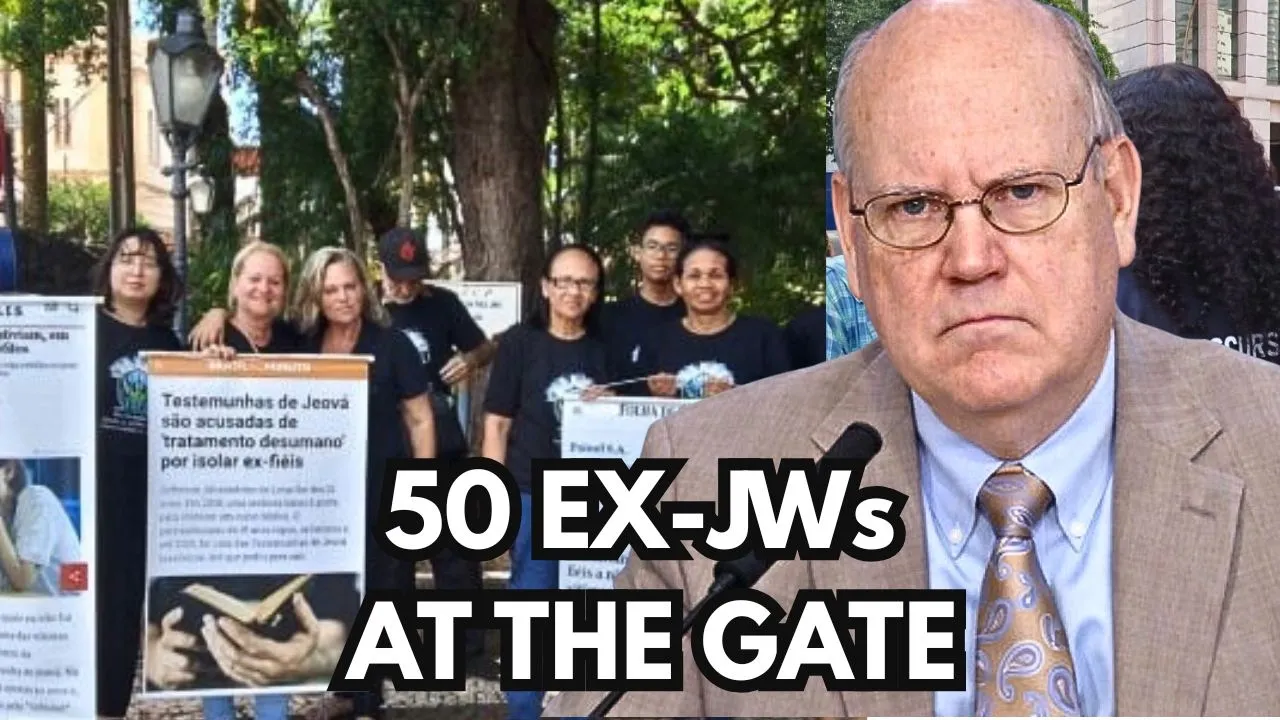
In February 2025, one of the most powerful men inside the Watchtower organization landed in Brazil. No press release, no public announcement, just a private schedule of internal meetings at the South American headquarters of the Jehovah's Witnesses, a compound buried in the countryside of S. Paulo State, far from cameras and far from scrutiny.
What he did not expect was to find 50 people already waiting for him at the gate. Those 50 people were former members. They had lost families, childhoods, and in several cases nearly their lives inside the organization he serves.
They had signs, they had testimonies, and after that morning, they had something else. A legal strategy that is still developing right now in 2026 with formal complaints filed to Brazilian federal authorities and a criminal investigation that has never been closed. In this video, you are going to understand exactly who Robert Chirano is and why his presence in Brazil triggered a public confrontation.
What happened at the Bethl Gate on that February morning, what the protesters were demanding, and why those demands carry real legal weight today, and why Brazil, a country the Watchtower Society once treated as its crown jewel in Latin America, is becoming one of the most dangerous legal and political fronts the organization has ever faced. Stay with me because this story did not end when Chirano boarded his flight home. It is still moving.
One, what the Brazilian Bethl actually is and why it was built in the middle of nowhere. Cesario Langja is not a city most people outside S. Paulo State could find on a map.
It sits about 150 km from the state capital. Small, agricultural, the kind of place that barely registers as you pass through it on the highway. There is no major industry there.
No university, no reason for the international press to ever point a camera in its direction. And that is precisely why the Watchtower Society chose it. In 1980, the organization built their Brazilian headquarters on the edge of that city.
What they constructed was not a church and not an office building. It is a self-contained compound large enough to house over 1,200 full-time residents, equipped with its own printing infrastructure, its own food production facilities, its own internal transport network. Every year, roughly 7,000 tons of religious literature leave that facility in more than 90 languages, of watchtowwer operations across the entire Latin American region.
Understanding the scale of that facility matters because it tells you something about how the organization thinks about Brazil. This is not a regional office. This is a headquarters built to last, built to grow and built to operate at a remove from the kind of public scrutiny that comes with being located in a major city.
The choice of Chisario Lang was not accidental. Organizations that prefer to operate without interference tend to build their infrastructure in places where interference is unlikely. For decades, that strategy worked.
Brazil ranked among the most densely active Jehovah's Witness populations anywhere on Earth. Roughly one active publisher for every 222 people in the country. Publisher is the term the organization uses for members who go doortodoor regularly.
For a long time, Brazil was a growth story and the Bethl in Cesario Lang was the symbol of that growth. The printing presses ran, the literature shipped, the congregations multiplied. Then around 2020, the numbers started moving in the wrong direction.
Membership began declining. Congregations reported drops in attendance and in the number of hours being reported by active publishers. The pandemic played a significant role.
It forced congregations online and exposed many members for the first time in their lives to information the organization had spent years instructing them to avoid. What they found did not match the version of history they had been taught. The 1975 prophecy failure.
The internal handling of abuse allegations. The billions in real estate the organization had quietly liquidated over the previous decade while simultaneously requesting financial contributions from congregations. The gap between what they had been told and what was publicly documented was for many of them impossible to close.
By the time Robert Chirano boarded a flight to Brazil in early 2025, the Bethl in Cesario Lang was no longer just a symbol of watchtower expansion. It was the address on a building where an organization was trying to understand why it was losing the country it had spent 40 years building. Point two, who Robert Tureno a presidency of over a decade in a country with one of the largest active witness populations on Earth.
And this was his first trip. When the Brazilian XJW community learned that Sirco was coming, not for a public convention, not for an event that would be announced on JWorg, but for closed-d dooror institutional meetings. The response was immediate.
What the organization described publicly as a series of institutional commitments was, by all available evidence, a crisis management visit. The membership decline accumulating since 2020 had reached a point where it required attention at the leadership level. Tenko came to Cesario Lang to sit in rooms with branch leadership and work through why Brazil was no longer performing the way the organization needed it to perform.
That is not speculation. It is the only organizational logic that explains why the president of the Watchtower Society of Pennsylvania would make his first ever trip to Brazil at that particular moment without any public-f facing program and with no announcement made in advance. He came to address a crisis from the inside.
He arrived to find that the outside had been waiting for him. Point three, the protest. What happened at the Bethl Gate on February 15th?
The demonstration began at approximately 9 in the morning on Saturday, February 15th, 2025. Around 50 former Jehovah's Witnesses gathered outside the Bethl perimeter in Cesario Lang. They had driven from S.
Paulo, from Campinas, from cities across the interior of the state. Some had traveled further. They had signs, they had banners, and they had a spokesperson who had spent the previous year building the infrastructure to turn individual pain into collective legal pressure.
His name is Yan Rodriguez. He was expelled from his own home at 15 years old when he stopped believing. He did not leave gradually or quietly.
He was pushed out the way the organization instructs families to push out anyone who stops complying. He lost his home, his social circle, and every support structure he had ever known in a single moment. That experience is not unusual inside the Jehovah's Witnesses.
It is policy. It has a name. And in 2024, Rodriguez built an organization around it.
The MAVTJ, the movement to aid victims of Jehovah's Witnesses, is a Brazilian advocacy group focused on legal action, public documentation, and direct pressure on They had specific demands. They had documented cases and they had names. Tyranco did not come out to meet them.
No representative of the organization spoke to the protesters directly. The Watchtower Society later issued a press statement describing the visit as institutional in nature and treating the demonstration as something separate from its purpose. That response, a statement issued to the press with no direct engagement with the people at the gate, told the protesters everything they needed to know about how seriously the organization intended to take their concerns.
They decided that if the organization would not answer their questions voluntarily, they would find venues where answering was not optional. In the weeks that followed, the MAVTJ began formally collecting documentation for legal action. Rodriguez organized subsequent protests in S.
Paulo, Brazilia, Rio de Janeiro, and Kuratiba. Formal complaints were submitted to Brazil's Ministry of Human Rights, and the movement that began with 50 people outside a gate in a city nobody had heard of started drawing attention from international advocacy networks that had been fighting the same organization on different continents for years. Three categories of demand appeared on the signs at Cesario Lang and each one represents a separate legal and human rights crisis that is now generating real institutional consequences.
Understanding all three is necessary to understanding why this protest was not a moment. It was the opening of something that is still ongoing. The first demand was an end to shunning.
When a member of the Jehovah's Witnesses is dysfellowshipped for leaving the faith, for accepting a blood transfusion, for a same-sex relationship, for doctrinal disagreement, for any number of reasons the organization treats as grounds for expulsion, the congregation is directed to treat that person as though they no longer exist. Family members still inside are instructed to cut contact entirely. Parents stop speaking to children.
Siblings stop speaking to siblings. adult children stop speaking to elderly parents. The organization frames this as a matter of personal biblical conscience, but the guidance is published in official Watchtower literature, reinforced in congregation meetings, and applied consistently enough across thousands of congregations worldwide that calling it a personal decision is at minimum a significant distortion of how it actually operates.
The MAVTJ has documented case after case of former members who filed police reports, not because they expected criminal charges, but simply to create a Cesario Lang. In February 2026, exactly one year after the protest, the Supreme Court of Norway was hearing arguments over whether the Norwegian state should strip the Jehovah's Witnesses of government subsidies specifically because of this practice. The legal principle being tested in Oslo is the same one the Brazilian activists are pushing for at home.
If shunning causes documented, measurable psychological harm to citizens, the state has grounds to treat it as something other than protected religious expression. That case is being watched by XJW legal networks in every country where this movement has a docket. What Norway decides will matter far beyond Scandinavia.
The second demand was accountability for the blood transfusion doctrine. The organization teaches that accepting a blood transfusion, even in a life-threatening emergency, even to save a child, is a violation of divine law. The biblical basis is a set of passages from Genesis, Leviticus, and the book of Acts that the Watchtower Society interprets as a prohibition on consuming blood in any form.
The organization publishes accounts of members, including children, who refused transfusions and died, and frames those deaths as evidence of spiritual faithfulness, as acts of heroism that honor God. That material is produced and distributed from the printing facilities in Cesario Lang. Brazilian hospitals have documented cases of parents refusing life-saving treatment for their children based on this doctrine.
Courts have been called upon to intervene, authorizing emergency transfusions over parental refusal. the institutional pressure standing behind every single one of those refusals, the literature on the kitchen table, the elder who reinforced the doctrine in a home visit, the congregation that would treat a blood transfusion as grounds for dysfellowshipping. All of it traces back to decisions made at the top of the organization that Sherano flew to Brazil to represent.
The protesters at the gate were asking him to acknowledge that chain of responsibility. He went inside authorities. The organization fought the search and seizure orders that followed.
They lost. Their Kingdom Halls and branch offices were searched. That investigation is still open as of early 2026, and the MAVTJ has since submitted additional documentation to federal authorities as part of its postprotest legal campaign.
This is the architecture the protesters at Cesario Lang were asking Chirano to answer for, not theology, not doctrine in the abstract. a specific documented operational system that has protected abusers and silenced victims across multiple countries for decades and that continues to operate out of the compound he flew to Brazil to visit. Robert Cheno sat inside the Bethl compound while the protest unfolded at the gate.
The Watchtower Society issued a press statement. They said the two-witness rule does not apply to criminal matters. They said the blood transfusion question had already been settled by Brazil's own Supreme Court.
They said shunning is a personal decision, not organizational policy. All three of those answers are technically accurate in the narrowest possible legal reading. None of them addressed the child who reported abuse and was told to wait on God's justice.
None of them addressed the parent who will watch their child die before allowing a transfusion because the literature distributed from Cesario Lang told them that is what faithfulness looks like. None of them address Yan Rodriguez, who was pushed out of his own home at 15 years old and who stood at that gate not as a protester performing anger for a crowd, but as someone asking a precise question to a man who flew across the world and chose not to answer it.






![Mix - Valesca Mayssa | Eu Sou Teu Pai [Clipe Oficial]](https://i.ytimg.com/vi/RDkNJPalON82E/mqdefault.jpg)