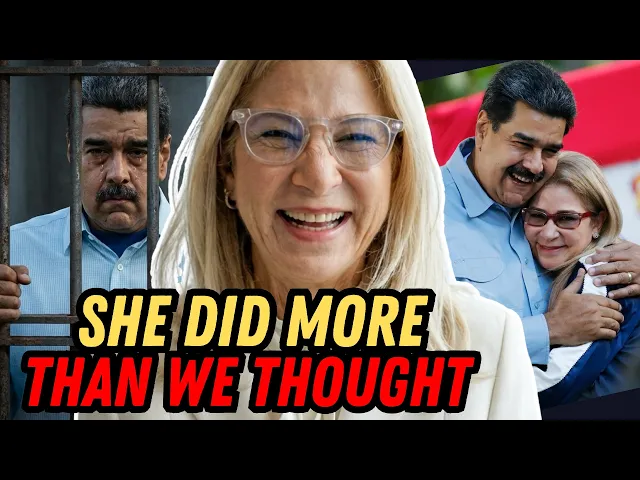
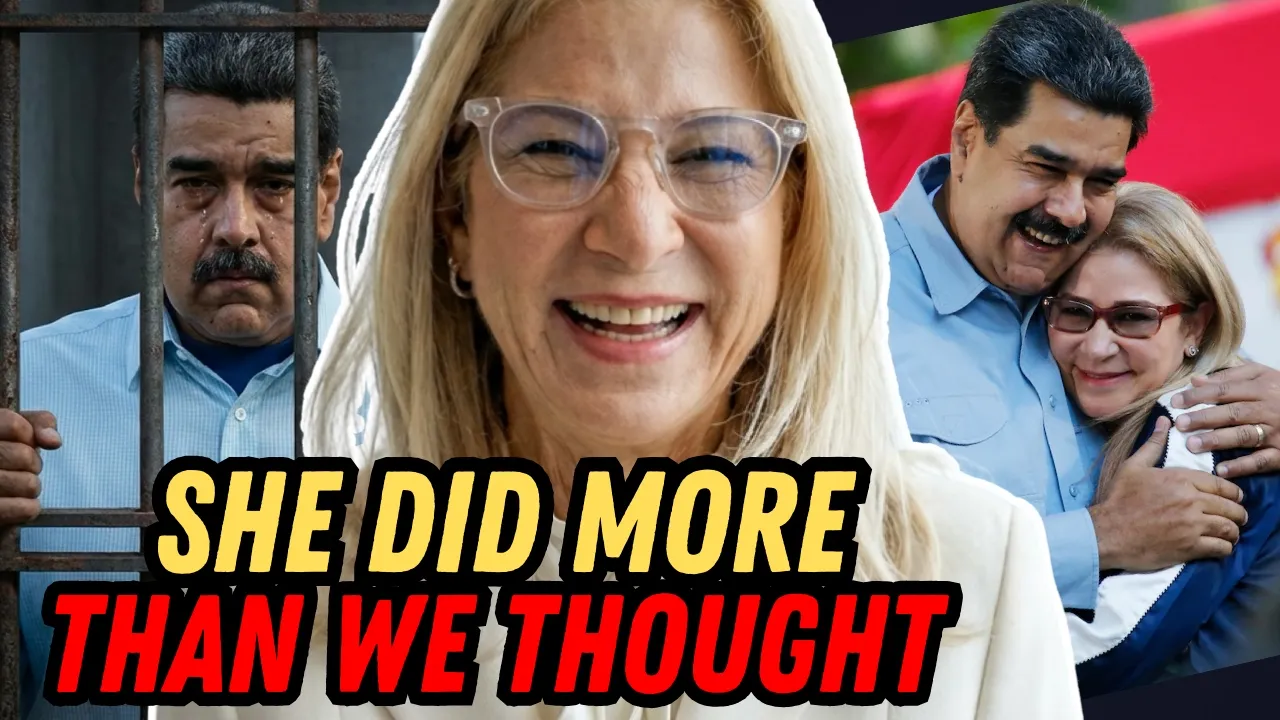
The lightning fast US operation to capture Venezuela's President Nicholas Maduro shocked the entire world. On the night of January 3rd, 2026, in just a matter of hours, the president was seized inside his own bedroom and urgently flown to New York to face charges related to naroterrorism. Along with him, his wife, 69-year-old Celia Flores, was also detained.
Her arrest was not accidental. Celia was not just the first lady of Venezuela. She was often referred to as the country's first combatant.
She played an active role in her husband's affairs, and her involvement turned out to be far more serious than many had assumed. On the night of January 3rd, Celia Flores was sleeping next to her husband at their residence inside Fort Tuna, a massive military complex in Caracus. Like many nights before it, this one was tense and uneasy.
For months, the couple had been changing sleeping locations almost every night. Donald Trump had been openly threatening them for a long time. >> Venezuela is not very far away, and the people are suffering and they're dying.
We have many options for Venezuela, including a possible military option if necessary. >> If Maduro did not step down from what Trump called an illegitimate presidency, and stop his criminal activities, the United States would remove him by force. Maduro and his wife could have fled long ago.
Turkey or Russia would have welcomed them with open arms. They had more than enough stolen wealth to live comfortably for the rest of their lives, not just for themselves, but for their children and likely even their grandchildren. But a dictator's hunger for power has no limits.
In response to Trump's threats, Maduro laughed in front of the cameras. He even danced mockingly as if nothing could touch him. And it is very possible that his wife played a key role in reinforcing that confidence.
According to people close to the couple, Celia reassured him again and again. Nicolito, she allegedly told him, "What can they really do to us? They don't have the guts, and even if they try to grab us, we have secret tunnels.
We'll escape and end up in Russia with our friend Putin. " That confidence would prove to be a fatal mistake. Celia was more than her husband's ally.
Some would say she was the one truly in charge of the family. Smarter, better educated, and far more experienced than Nicholas Maduro himself. Celia did not just own a house.
She owned an entire street of luxury properties in Caracus. Of course, she had no desire to abandon all of that and flee into the unknown to cold, distant Russia and risk ending up like the wife of Bashar al-Assad, the fallen dictator of Syria, forced into quiet exile. Celia Flores believed she was untouchable.
That confidence is why on the night of January 3rd, she slept peacefully beside her husband, unaware that her lavish life was about to come to an abrupt end. When Delta Force units stormed the president's hidden bedroom, Maduro and his wife ran for a secret bunker, but the escape failed. The bunker door refused to close.
The panicked retreat collapsed in seconds. Elite American operators seized the couple and placed them under arrest. During the detention, Celia appeared to resist more aggressively than expected and suffered a minor head injury.
She was treated immediately and received medical care after her arrest. Later, Celia Flores appeared in a New York courtroom alongside her husband. US authorities intend to prosecute her just as seriously as Maduro.
Investigators believe her role in the regime was no smaller and possibly even more significant. For years, she operated as the regime's quiet power broker, the shadow figure, the woman who avoided the spotlight while influencing decisions from behind the scenes. which raises the real question.
How did a woman born into an ordinary family rise to such extraordinary power? Celia Adella Flores Demaduro was born in 1956 and raised in Caracus in a lower middle-class family. She grew up in workingclass neighborhoods and had no exposure to luxury in her early years, but she clearly dreamed of it.
Intelligent and driven, Celia developed an early interest in law. She later graduated from Santa Maria University in Caracus as a lawyer specializing in labor and criminal law. Her national prominence began in 1992 when she led a legal team that provided defense for a military officer named Hugo Chavez following his failed coup attempt against Venezuela's sitting president Carlos Andres Perez.
According to multiple accounts, Flores played a key role in securing Chavez's release from prison in 1994. That moment would prove decisive. It helped pave the way for his political comeback and ultimately his successful presidential campaign in 1999.
By the 1990s, Celia's career was at its peak. She was considered a central figure in the Chavista movement, named after Chavez himself. It was during this period that she met her future husband, Nicholas Maduro.
Their paths crossed inside a Venezuelan prison during visits to their imprisoned political mentor, Hugo Chavez. Around that same time, their romantic relationship began. At the time, Celia was still legally married to her childhood sweetheart, Walter Ramon Gvidia Rodriguez, with whom she had three sons, Walter Jacob Gvidia Flores, Yoser Daniel Gvidia Flores, and Yos Alexander Gvidia Flores.
She divorced her first husband in the early 1990s, and by the time she met Maduro, she was determined to begin a new chapter in her life. Years later, Maduro would describe her as a woman with a fiery temperament, someone who from the very beginning cast flirtatious and confident glances in his direction. Maduro himself was also divorced at the time and had a son.
Their relationship was built not only on passion but on shared ambition. Both were deeply involved in politics and fiercely loyal to Yugo Chavez. Still, at that point, Nicholas Maduro was far from a rising star.
Few could have imagined him as a future president. Kilia, by contrast, already had a strong career and an extensive network of powerful connections. Unlike her, Maduro had no university degree.
In his early years, he worked as a bus driver. Yet, that did not prevent his rapid political ascent, a rise that notably began soon after he entered a relationship with Celia Flores. When Chavez first came to power in 1999, they were rewarded with senior posts and steadily expanded their political influence.
In 1998, Maduro was elected to Venezuela's Chamber of Deputies. He later became speaker of parliament. It is hard to ignore the possibility that his influential partner helped smooth that path.
During this period, Flores was also advancing rapidly through the ranks of power. In 2006, she became the first woman to serve as president of Venezuela's National Assembly. While in that role, she appointed around 40 of her relatives to government positions.
When journalists criticized her for this, she dismissed them as mercenaries and moved to ban the press from covering the work of Congress. In 2012, shortly before his death, Hugo Chavez named Nicholas Maduro as his chosen successor for the presidency. Maduro never possessed the same level of charisma as his mentor, but his loyalty to the regime and the right political connections allowed him to climb into the highest circles of power.
In 2013, Maduro won the presidential election, defeating his opponent, Henrique Capri, by just 1. 5%. That same year, Maduro and Celia officially became husband and wife.
Once in power and once she became first lady, Celia began to impose her own rules. First and foremost, she placed her relatives into key positions across Venezuela. Nepotism reached extraordinary levels.
One of her favorite nephews, Ephrain Malpa Flores, was put in charge of finances at PDVSA after previously serving as the country's treasurer. The head of Venezuela's Supreme Court, Michaelel Moreno, a central figure in the regime's grip on power, is widely seen as her close ally and someone who ultimately answered to her. In a 2013 interview with Laanguardia, Flores defended the presence of her family members in government, stating, "My family got in based on their own merits.
I am proud of them, and I will defend their work as many times as necessary. " According to journalist Mayboard Pati, Flores's son, Walter Jacob Gavidia Flores, traveled around the world on private flights. A single trip could cost as much as $20,000.
At the same time, his official salary was reportedly no more than $1,000. Gavidia spent much of his time in the United States, but was also seen in France, Spain, Malta, and Germany. Few doubted that corruption was flourishing.
Celia's close relatives not only held senior positions, but were also repeatedly accused of involvement in drug trafficking. In 2015, two of her nephews, Ephrain Antonio Campos Flores and Francisco Flores Deus were arrested in Porto Prince, Haiti by local police while attempting to negotiate a deal to transport 800 kg of illegal substances. They were later handed over to the United States.
Campos told agents on the DEA plane that he was Maduro's stepson and that he had grown up in the Maduro household under Flores's care. He also said he was raised as part of the family. The two men had traveled to Haiti using Venezuelan diplomatic passports.
However, according to former DEA International Operations Chief Michael Vigil, they did not have diplomatic immunity. The incident occurred at a time when several high-ranking members of the Venezuelan government were already under investigation for ties to the drug trade. On November 18th, 2016, the two nephews were convicted of attempting to smuggle drugs into the United States in order to obtain a large amount of money to help their family stay in power.
The Venezuelan government did not comment on the trial and did not respond to requests for comment on the verdict. The country's first lady claimed that her nephews had been kidnapped by US authorities. Many believe that Celia was involved.
Flores is Maduro's wife first and foremost, but really more. She's his key partner, one of his closest confidants, and in large part helped his rise into politics, said Eva Golinger, a US lawyer and writer who met the couple several times while acting as an adviser to Chavez before later breaking with him and writing the Chavis code, cracking US intervention in Venezuela. Flores was more the brains and Maduro was more the brawn.
Not to downplay his abilities as a very successful political operator in his own right, but she has been his pillar of support throughout everything. Golinger added, "She may not have been the face of the government, but she certainly had all the influence behind. I believe he would consult her on everything," she said.
Over the years of his rule, Nicholas Maduro has been accused of more than 20,000 extrajudicial killings, enforced disappearances, and acts of torture. Thousands of political opponents were imprisoned. As corruption deepened and the economy collapsed, 8 million Venezuelans were forced to flee the country.
That number is staggering, especially considering Venezuela was not formally at war. Venezuela is known to possess the largest proven oil reserves in the world. And yet, despite this immense natural wealth, the country lives in extreme poverty.
Under Maduro's rule, inflation reached an astronomical 65,370%. According to the Venezuelan Finance Observatory, in 2024, 86% of Venezuelan households were living below the poverty line. Why did this happen?
Many point to the same conclusion. Maduro and his wife appeared far more focused on personal enrichment than on the condition of their country. In 2018, Canadian authorities imposed sanctions on 13 Venezuelan officials.
Silia Flores was among them. They were accused of crimes against humanity. A few months later, the US Treasury Department added its own sanctions, explaining in a press release that Maduro relies on his inner circle to remain in power.
In response, Maduro declared, "If you want to attack me, attack me. Don't mess with Celia. Don't mess with the family.
Don't be cowards. Her only crime is being my wife. By that time, Flores had returned to the Legislative Palace.
She was elected to the constituent assembly in 2017 and later in 2021 to the National Assembly as a deputy, a position she still held at the time of her arrest. While she has not attracted as much public attention as Maduro, Artiaga said she is just as polarizing as the ousted president. Currently she is unpopular.
She has the same image as him. They work closely together and public opinion perceives them as a single entity. Artiaga a professor at Simone Bolivar University said this public image was carefully cultivated.
When the government distributed millions of toys for Christmas in 2022, children received figures of Super Begot, a cartoon character inspired by Maduro along with a doll called Celita, the co-star of the animated series. During the 2024 presidential campaign, which ended with Maduro's controversial re-election, Flores accompanied her husband at several public events and even danced with him on stage. As an experienced lawyer, Flores also took direct control over the judicial system, said Casto Okando, a Venezuelan investigative journalist living in the United States.
She was very actively involved in the process of appointing judges and prosecutors, a crucial area because they replaced them to install others loyal to the revolution, Okando added. He noted that while Flores wielded significant influence, it is difficult to say whether she clearly ranked as the regime's second in command, a role often attributed either to Interior Minister Dostado Cabelloo or to the current acting president, Rodriguez. The regime is not homogeneous, but made up of factions that each controlled parts of power.
Maduro was the president, but he did not necessarily control all power, even though the strongest faction was the one formed by him and his wife, Okando said. In 2020, the United States officially accused Nicholas Maduro and his inner circle, including his wife, Celia Flores, of narot terrorism and conspiracy to import illegal drugs into the United States. It was a turning point.
For the first time, a sitting Venezuelan president and a first lady were no longer treated as political figures, but as criminal defendants under US law. American prosecutors alleged that Maduro had spent years working with international drug cartels, using the institutions of the Venezuelan state to move illegal substances into the United States. According to the indictment, this was not a series of isolated incidents, but a large-scale system involving military officers, government officials, and people personally connected to the presidential family.
Investigators believe that Celia Flores played a central role in this system, not as a bystander, but as a political enforcer who controlled judicial appointments and protected the regime from within. The indictment was filed in federal court in Manhattan. Alongside Maduro, several of his closest allies were charged.
That same year, the United States announced its first reward for information leading to his arrest, $15 million. The amount did not stay there. It was later increased to $25 million.
The same figure the United States once offered for the capture of Osama bin Laden after the September 11th attacks. Then under the Trump administration, the reward was doubled to $50 million. It became one of the largest bounties ever placed on a sitting head of state and his network.
US Attorney General Pam Bondi stated publicly that Maduro would not escape justice. According to her, he remained in power only because of his inner circle, corruption, and criminal alliances. And within that inner circle, Selia Flores held a unique position.
US officials described her not as a ceremonial first lady, but as an active participant in the machinery that kept the regime alive. Despite the massive reward and growing international pressure, Maduro and Flores openly defied the United States, the European Union, and several Latin American governments. His reelection in 2024 was widely condemned as illegitimate.
Yet inside Venezuela, the couple remained firmly in control. At the same time, back channel negotiations continued. At one point, the United States agreed to a prisoner exchange.
10 Americans held in Venezuelan prisons were released in exchange for the return of Venezuelan migrants who had previously been deported under strict US immigration policies. The deal sparked controversy. Among those freed was a former US soldier convicted of murder in Europe.
Washington, however, continued to act pragmatically. Shortly after the exchange, the United States allowed the American oil company Chevron to resume drilling operations in Venezuela despite existing sanctions. The move underscored just how complex and contradictory the policy toward Maduro and Flores had become.
Meanwhile, the US Department of Justice reported that it had already seized more than $700 million in assets linked to the presidential family, including private jets. According to US authorities, millions of tons of illegal substances had been traced to networks operating under the protection of the Venezuelan state. American officials also focused attention on the criminal group Trend Aaragua.
The Trump administration claimed that the Maduro regime used such organizations as tools to spread violence, intimidate opponents, and facilitate drug trafficking. Both Maduro and his wife denied these allegations. Some experts questioned whether these gangs acted under direct orders from the presidential palace.
Intelligence assessments suggested that contacts existed, but that there was no clear evidence of direct command. Still, for US authorities, the conclusion remained unchanged. The Maduro Flores regime had become embedded in a global criminal ecosystem.
By early 2026, the accusations against the presidential couple were no longer abstract. They had been transformed into a detailed legal case built over years of investigations. A case that ultimately became the formal justification for the most drastic step of all, the operation to capture them.
After the capture of the presidential family, the story fully shifted into the legal arena. Nicholas Maduro and his wife Celia Flores were flown to the United States and brought before a federal court in Manhattan. Inside the courtroom, Maduro behaved defiantly.
He waved at Judge Alvin K. Helerstein and then launched into accusations against the Trump administration. US authorities alleged that Maduro and Flores had led the so-called cartel of the Suns and had spent years flooding the United States with illegal substances.
Celia Flores appeared far more restrained. When the charges were read, she spoke only once, saying, "Not guilty, completely innocent. No explanations, no emotion, just a flat denial.
Maduro, meanwhile, complained that he had not seen the indictment before his arraignment and claimed he had not been informed of his rights. The court was not persuaded. The judge ordered both defendants held in custody until their next court appearance on March 17th.
At the same time, even Venezuelan media critical of the regime noted an important detail. as they wrote, "Whatever your opinion of the criminal nature of Maduro's regime, his relationship with Celia seems sincere and filled with love. He really seems to trust her judgment more than anyone else.
" Under standard Chavista slogans, she is not overtly ideologue, more pragmatist than doctrinire. That chapter of their power had ended. A new one, inside an American courtroom, had begun.
What kind of punishment do you think Nicholas Maduro and his wife Celia Flores deserve? Write your opinion in the comments below. If this story helped you understand what was happening behind the scenes, don't forget to like the video.
Thank you for watching.