this is a presentation of the natural stone Institute's natural stone University thank you for watching great thank you and thanks to all of you for coming so today I'm going to show you the church of the trade and also I've got a bunch of questions stacked up that people have submitted beforehand most of them are the picture and the name of this lab and I can sort of help guide you through what's what there are a lot of questions at the end objectives for today to learn how to identify stones specifically we're going to look
at hardness and reactions or resistance to acid and then specifically the biggest confusion always seems to be quartzite versus marble and so we're going to spend a lot of attention on that particular distinction which luckily it's actually pretty easy to tell so don't mess with a poll because what do you do what do you come across a stone that you haven't seen before and you're not sure do you ask your sales rep your distributor do you ask within your own organization ask your colleagues your manager to take it upon yourself to google around for it
or you just sort of take it as it is and let the chips fall where they may and I had no judgment here I'm just curious as to sort of what the background behavior is here 37% will ask a sales rep or distributor 31% will ask colleagues and another 31% will search online for information and nobody doesn't worry too much about it I like it good so I kind of evenly split amongst all the different methods here you're gonna basically add another option to this poll which is to take it upon yourself figure out what
the heck's going on so in everything Iraq there's a lot of different questions you might want to know you know what is it what gives it that particular color what's cool about it but other questions on the bottom of the screen here is it practical for the customer for their intended purpose for their behavior they are they neat are they OCD or they not care they're like patina you know what's the intended use is it compatible with that is it durable enough in terms of acid scratching staining how do we take care of it and
in particular we're going to look at these questions today the sort of hardness durability and etching can't answer all these questions in one click but these are sort of good questions you want to wrap your head around when you're looking at a rock for the first time so here's the tools of the trade got a couple rock samples we got a little dropper bottle of hydrochloric acid we have a pocketknife this pocketknife is not really good enough for the job but it was what I had and geologists are closely associated with beer so if you
want to have a really authentic experience I suggest having a beer nearby when you're doing this no beads just so I guess strong it's gonna hold up for my kids and my family whatever and so that goes in two directions it's important to distinguish hardness versus durability so harness is is the rocks resistant to scratching and actually really it's determined by the minerals themselves every mineral has its own properties and one of those properties is how hard it is and then durability is how well are those mineral pieces stuck together and you can have a
rock that's made out of soft minerals that's really well stuff together like soapstone or you can have a rock that's made that are very hard minerals that's not very well stuff together like some sand stones and so the hardness scale is Mohs hardness scale and this just goes by mineral names here from soft to hard I left it open arrow on the end because it continues on up to diamonds but that's not really practical for us but these are the minerals arranged in their order of hardness and it really is about scratch ability so quartz
can scratch feldspar and sell far can't scratch quartz that's how it works it's really like a lot of geology it's ultra basic it's not particularly sophisticated some reference is because we don't necessarily have this kit of minerals in your shops or common materials so you can scratch gypsum with your fingernail you can scratch talc with your fingernail but not calcite same with a copper coin that one's not that practical but then glass and steel up here between feldspar quartz and then how that applies to the rock names themselves here's where the rocks fall on this
scale so soapstone is made of talc low end of the hardness scale limestone and marble and made of calcite right here granite quartzite all up on the heart and now this is a big open space in the middle that's great we don't have to like get in there and determine between four and a half and five and a half on the hardness scale there's a big dividing line between basically three and basically six that's really that makes life very easy for us and so a lot of our tests are just trying to decide it over
here or is it over here and so that's good because we can do that we can figure that out in our kitchens so this one s that yeah of you afterwards you'll get a copy of this PDF this thing right here is probably a great thing to print out and have in your shop it's a nice little reference for the scale overall we're a common objects fall and we're common rocks fall this is the official hardness scale goes all the way up through diamonds like again the relevant part really in the middle to low-end for
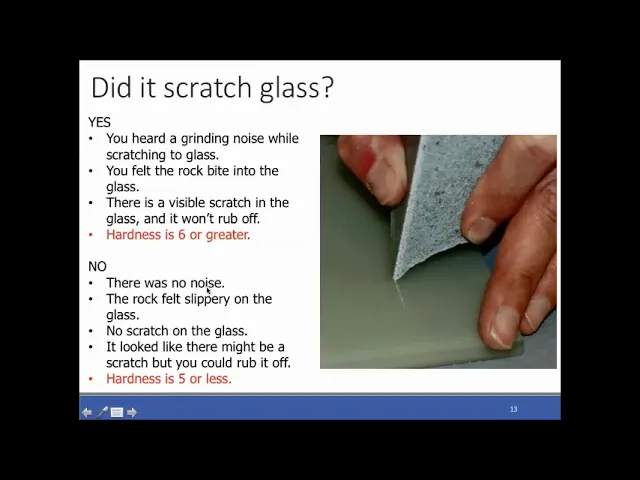
what we're looking with in the real world grab yourself a glass tile which I'm sure you have floating around yourself it's called out on a flat take a sharp edge of the rock so can't be a fully polished sample you need like a natural broken edge find that pointy part and press really hard and you drag it along and just go in a straight line just scrape it right along and as you're doing that have all your senses going listen and feel how it feels and see what you see be careful do not serve the
glass tile in the palm of your hand and then try to scratch it unlikely but you could actually break the tile in your hand and we know that we don't want messy showrooms here despite the fact that we want to learn what's what need to avoid excessive blood so don't do it that way so you put it on the surface of the bench or table or whatever scratch along yes here's how you make sense of what you did if it's scratched glass a couple things will be obvious one if you hear this winding scraping noise
and you can feel that the rock is biting right into the glass you can barely even need to look afterwards that's usually pretty obvious but of course you're going to look and there's a visible scratch that won't rub off and you can actually feel it like with your fingernail that yeah there's actually a mark that's permanent in there so that's a yes to the scratching glass yes it's scratched glass so that tells us the hardness is six or greater so that puts us in the South bar and quartz family and that means it's going to
be granite of course like if now usually there's no noise and the rock concerns to feel slippery like I can't get a grip on the glass there's either no scraps on the glass or what's really common is it looks like there's a scratch but you can rub it off that's because the rock itself is actually powdering on the glass and leaving a little trail so that's the case hardness is five or less and that means you've got marble limestone travertine things like that you have a broken edge you might have a full pristine slab that
has no broken edges sometimes editor wrapped or covered in epoxy so and your manager fries and they're willing to go break a piece off of that so then you can use a nice bleed test the same basic thing but now you're trying to scratch the rock with the tip of a nice blade the technique here is you press straight down with the tips don't saw added with the blade itself just press straight down it doesn't need to be a knife it can be any kind of pointy tool it should be a better knife so not
even using your nice pretty Limpy same basic technique press down hard go in a straight line and then look at the scratch this actually can be a tiny bit trickier because no matter what there's going to be a mark on the rock you have to inspect that to see what is it again use your fingernail go back and forth because this rock is harder than the knife you'll get a trail of knife basically you'll get a server a little streak on there a little scrape that rubs right off if the nice is harder than the
rock you'll get an actual scratch that you can feel and you can't rub off also nice blades vary in hardness so this is generally just to break apart the big families of is it the marble calcite family which is going to the knife will scratch it what's happening in this picture or is it in the quartzite granite feldspar quartz family in which case the knife will not scratch it so that's your back-up plan I think the glass test is much more clear so when possible get yourself a sample that you can drag across the glass
tile this one it's a little bit more awkward so here's your results if it look if the rock is harder than the glass or the knife you have granite or quartz sandstone sorry or quartzite we're shift or an onyx that's made out of quartz all these nice hard minerals if not if the knife scratches right through the rock or if the rock won't scratch the glass you've got marble the laminate marble like an onyx that's made out of calcite limestone travertine all these are in the three range on the Mohs hardness scale big distinction between
the two so should be pretty clear we're gonna talk about acid and stuff too but here's a little rule of thumb it's not perfectly true but usually if the rock really scratches glass very well it probably won't match because if it's hard enough to scratch glass it's not one of these edible minerals so these two properties the stretchability and the acid etching kind of go as pairs it's not your rule of thumb if it's scratching glass it probably won't edge don't stop there but you've got a sort of a checks and balance as you go
through the tests okay why are you scratching and scraping and poking at it with a knife into that durability part is it crumbling apart so sandstone this is a picture of fans only you can miss a carve right into so it's made out of quartz which is very hard but each quartz grain isn't stuck very well to its neighbor so it's crumbly not particularly durable similarly rocks that are made up of a lot of mica usually mica is gonna be in a rock that's has hard minerals like quartz and feldspar but mica itself it's flaky
if it has a lot a lot a lot of my cousin that whole surface is going to be flaky so as you're scratching and poking pay attention to the rock overall see what you can learn about its durability how'd it like to break does it break along layers or pieces pop out or does it make really sharp corners it don't look like they're gonna stay that way it's gonna flake off there's a lot of observations you can make and looking at how the rock he's either when you break it or when it's already been broken
those remnant pieces lying around the yard and you can learn a lot by that talking to fabricators is another really good way because they have a sort of intimate relationship they know exactly how these things behave when they're broken polished cut that tells you something about how it's gonna hold up on those corners and someone drops their cast-iron skillet on it and it's key to remember that durability and hardness are not the same thing so hardness is how scratch Abal are the minerals and durability is how well stuck together are they that's hardness and durability
and we could sort of put air quotes around the words drinks next comes acid behavior becomes the lab type phase here and I was played with this a bunch of different ways I advise homeowners to use lemon juice and vinegar but for you guys I think really you want to do it the way the pros do it which is using a very dilute solution of hydrochloric acid don't be scared it's not particularly much more acidic than vinegar but it is a little bit you can order it already in this five percent concentration and that's what
I would recommend I found this on the Google and the lab Depot it's get the the smallest bottle is 500 milliliters so that should be enough for a lifetime of rock testing it's already nice and weak I would do not buy a stronger concentration and then dilute it because it's nasty when it's in higher concentrations so just buy this $15 on sale and it gives you a real advantage when you're diagnosing rocks because when you put this kind of acid on a rock that's made out of calcite it gives you a visual instant visual feedback
which is that it'll fizz and bubble so this really is the way to go in the absence of this if you use vinegar or lemon juice what you have to do is take a polished sample put it on there leave it on there and wipe it off and then see the etch that's subtle and I don't think you guys want subtlety I think you want something more defended so you order up your hydrochloric acid you put it in a little dropper bottle that will make a single drop at a time find a good part of
the rock where you can really watch what's going on just put one drop on there and watch just look inside that drop and helps you the magnifying glass or reading glasses and what you're looking for is little bubbles and if you see little bubbles that's the acid dissolving the minerals and that's the same thing as etching so if you see bubbles right away you've got limestone marble travertine or an onyx it's actually made out of calcite and it's instant it's and it's completely obvious that's why I think hydrochloric acid is really helpful for you guys
because it's a black and white answer if it doesn't you're not quite done yet because there's another test to tell us dolomite or dolmen marble so then you clean off your rock get your knife and just scratch up a little bit of rock rock just powder it up to scratch back and forth back and forth and then you leave all the powder that you scratched leave it right on the surface of the rock and then you put a drop of acid on top of that little powdery part then again look at what's going on and
you'll see little bubbles but usually only on the part that's scratched up or possibly your only see bubbles you know you see them over all that sort of just pretty weakly so this is the test for dolomite so if it reacts only once you scratch it up then it's dolomite or dolomitic level if you don't get any bubbles at all even on this second try then it's neither it's not a calcite type of rock and here's another test to show how these accessories are related you can't get any powder to scratch up if you go
to scratch it and you're just making a silver or streak with your knife then the rocks not scratching that's probably not even in this family anyway the second part of the test it's really important for rocks like super white which are a little subtle they don't react with acid right away gets you another layer deep in the equation a couple caveats is that there's a really common on the Earth's surface most rocks when left outside will get a skin on them a weathered skin and very frequently that contains calcite so if you just walk up
to any random rock outside and put a drop of acid it'll probably react almost no matter what the rock is this is one of the reasons why geologists always love their hammers because you break off a fresh surface this caveat is less applicable to you guys you've got these cut pieces and cut slabs but it is just worth mentioning that you always want to be testing a fresh surface not a weathered surface how long is long things in the rock so veins occur in a number of different ways but one way they can occur is
that after the rock is formed its fractured apart due to some sort of stress it's experiencing and then there's open cracks will fill up with a new mineral and usually that mineral is carried along by groundwater and the minerals that like there are most frequently carried in groundwater are calcite and quartz they both look exactly the same it's just a white vein going through a rock so regardless of what the rock is if it has prominent veins you want to repeat those tests right on the veins so get in there with your little dropper bottle
of acid get in there it's a tip of your knife and see if there's a difference between the vein and the rock in some cases there will be in some cases not but it's there's no rules on there it could go either way so that's a nice thing to test so you don't get confused by different parts very similar to that there are some rocks that are made out of more than one kind of rock where they're layers that go back and forth Phantasy Brown is a really good example of that this is a layered
sort of assembly of quartzite and marble and it depends on where you are in Iraq so what you need to do is the same thing you need to test each section clear thing about this is actually spend some time doing this you'll start to learn the visual cues I really don't want to emphasize to you to make these judgments visually because they're too similar but after you start doing it you'll get kind of in there and you'll figure out oh yeah quartz usually looks a little more gray a little more clear calcite looks a little
more white and a little more opaque perhaps so yeah I get you don't take your tools and get into a rock like this and figure out what's going on suss out each individual layer quartz right always the big mystery rock what do we do when we get the brand-new shipment of quartzite but we're not really sure what it is so the first things are to ignore the name and where it's from the names as you already know go freeform through the industry country of origin doesn't help at all but get in there and do your
test do the scratching test do the acid test and see if the results match each other so here's some examples so here's your mystery rock he tries scratch glass and it won't that's a bit acid right away so yes it's marble or limestone but in this case we're doing a sort of marble versus quartzite game here next one it doesn't scratch glass it doesn't itch with acid but it did once I powder it up so that's our test for dolomitic marble next one scratch the glass and it didn't add so good that's quartzite for sure
and these properties go in pairs as you can see and then the one that doesn't behave it didn't scratch the glass but also didn't it so that one we don't know so that could be one of these ones we have to keep looking that the rock is probably made out of different things or something totally unexpected keep digging keep observing see if you can figure that out but ideally you look for ones like examples one two and three where they confirm each other those two tests back each other up and you can feel pretty confident
in your assessment super right always a confusing one and for me that's the one that started this whole process so let's take our super white to the scratch glass I know it berries but either it doesn't or it barely does so let's keep digging so the X or bubble with the acid hmmm also kind of alright do the goal of my test take a knife blade scratch it up and then yes you do get some pretty visible bubbling with hydrochloric acid when you do that so then that's how you get your there we go your
answer that is stolen minik marble so it doesn't really catch right away only when you powder it up may or may not scratch glass so you can see that it's got a little bit of fuzzy results here and so that's why you have to just sort of keep plugging away until you get an answer that makes sense this is why super white is sometimes called granite which it is not but sometimes called quartzite which for the most part it is not I know different rocks go by the same name but really it's marble or even
better yet dolomitic normal and again I know the caveat this doesn't apply to everything labeled super white but in general this is sort of a sequence you would go through and the results you'll most likely get with you are super white another super white and ones like it tricky that they're actually made out of a couple different things and there is a little bit of quartz in super white and that is why sometimes it will scratch glass but not all parts of the rock whole scratch glass visually you know once you sort of you know
taking your pocket knife and scratch this and scratch that and put acid on this and acid on that then you can start to see for yourself where the differences are but again I don't recommend using just a visual but the bottom line here is that rocks can be made out of more than one thing and they keep testing keep looking and expand your own diagnostic skills to start to figure out some of these puzzles you will be the champion of your shop if you're the one that can start to figure this out for people okay
you ready for quiz what is this nice so let's put between quartzite and we don't know here's my favorite answer we don't know maybe it's a total ace and he knew exactly what this is until I ran an image I don't even know what it's called but you know we don't know and so what I want a sort of cultural change that I'm pushing for here is the I don't know but let's see if I can find out so using the glass acid your own skills looking at how it breaks looking everything you can about
it see if you can find out be careful going just visually and see what you can learn by taking the hands-on diagnostic approach this was a presentation of the natural stone institute's natural stone university thank you for watching