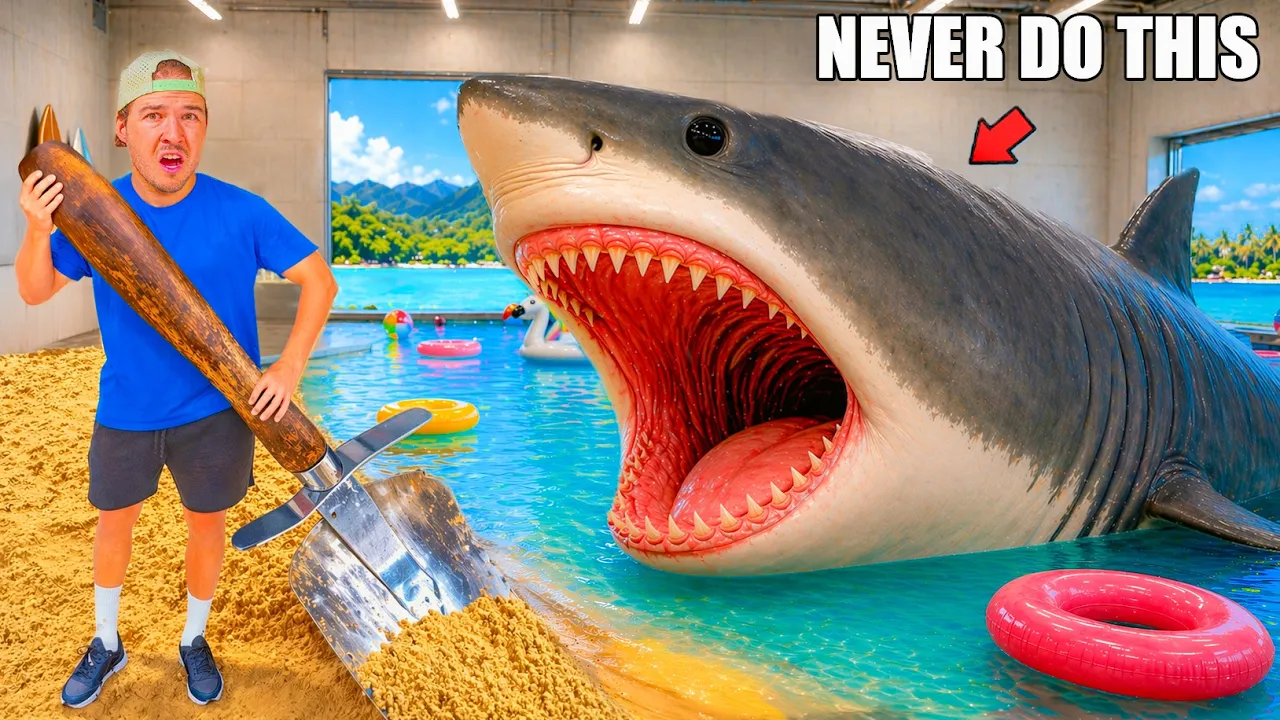
Today, I'm building a giant beach ecosystem inside of my warehouse. It'll be filled with exotic fish, sea creatures, and even dangerous predators. With 3,000 gallons of water and 2500 lb of sand, our goal is to make this the biggest beach ecosystem ever built on YouTube.
And it all starts with the foundation of our beach. >> Like the biggest roll of bubble gum we'll ever see. This is a huge tarp.
Big did we order? This is massive. This tarp is going to hold our entire ecosystem, the sand and the ocean.
But as we started rolling it out, we realized we might have a huge problem. It was way bigger than we expected. This is so big.
This is like too big. Why are we such a big one? >> And that's when we realized this ocean was about to be massive.
>> You got this, Chris. Make >> Yes, you do. Believe in yourself.
>> Yes. Oh my god, that could have tore my leg in half. That's how heavy that thing is.
>> It is a solid hunk of rubber. >> This is so dense. >> Take it away, Chris.
Nice. >> Yeah. >> NICE.
NICE. >> OH MY GOD. >> THIS MIGHT BE THE craziest video we've ever filmed.
>> It's so big. I hope it fits. I think we just need to start blowing it up.
This thing is going to expand. This whole entire warehouse is going to be a beach. And it's going to take a lot of willpower to break it down because I think we leave it all summer long.
It's time to blow this puppy up. And by the time we were done filling it up with air, it took over the entire warehouse. This thing is massive.
I cannot wait to see fish swimming inside of here. We have so many fish coming. It's going to be crazy.
>> The beach will be broken up into four different zones. The shoreline, the shallows, the reef, and the deep sea. With each having different specialized creatures.
We're starting the build off with the shoreline. We added in some sand to mimic the natural surf of the beach. Then we moved on to the shallow zone, planting seaggrass and adding smaller rocks to create a habitat where small ocean fish can hide.
Look at that. Double the kelp. A lot of holes in this.
The tanks are going to love this stuff. Extra greens. Next came the rocky reef where we stacked large rocks and coral to build a rugged reef structure just like you find in the ocean.
And finally, the deep sea zone where we used black sand and our biggest rocks and objects like shipwrecks and even a treasure chest. The best part of this all filling the pond with water. Our ocean is almost complete.
Here we go. We're going to need a lot more water. BACK UP THE TRUCK.
THIS is equivalent to a fire hose. Soon as this thing fills, I really hope there's not a hole in it. If there's a hole in this thing, our whole warehouse could flood.
I hear it coming. Oh yeah. That's what I'm talking about, baby.
>> 3,000 gallons of water later, and all of our ocean zones have come to life. It's now time that we build our beach. Each one of these bags is 50 lb.
And my back already hurts. But we're laying over 2,000 lb here. So, this is going to be a lot more work, and it's going to be a lot heavier than we thought.
That's a lot of sand. Building a project this big, we want everything to go perfectly. And if something goes wrong, like this pond pops, it can go wrong fast.
And there's a reason you don't risk a 2,000lb beach project and hope for the best. Just like there's a reason why Morgan and Morgan is America's largest injury law firm. They've been fighting for the people for over 35 years.
And they've recovered over $30 billion for their clients. With more than 1,000 lawyers and 100 offices nationwide, Morgan and Morgan knows a thing or two about fighting to get you the compensation you deserve. And their fee is free unless they win.
You can start your claim in just a click at forthepeople. com/fishguys. After laying all the sand, no beach is complete without the essentials.
So, we brought out beach chairs, floaties, buckets, and even my favorite, beach balls. With the beach finally built, it's time to move on to the best part of the video, adding in all of our creatures. Starting with all the fish and invertebrates that live along the shore.
And first up are the sands sifting starfish. These are pristine sand sifters. They're really going to do work on our beach shore.
Wa! Let's go. Start to work, boys.
The first three creatures of the pond have officially been added. These guys are pros at air raating the sand and cleaning up any leftover food scraps. Next up, we've got 25 hermit crabs.
All right, boys. You guys play a crucial role inside of here. Get to cleaning.
Let's go. These guys may look like just rocks, but they're an essential cleanup crew for the beach. And check it out.
The starfish are already almost all buried in the sand. You all right? NOW, TIME for the weirdest creature of the shore zone, the sand, fleas.
Let's see if these things are going to bury right into the sand. They should as soon as they feel it. Oh my god, that one's taking off.
They're swimming. >> They're swimming. They're coming to the top.
Why are they? >> What are they doing? Go to the sand, boys.
Go to the sand. They are one of the weirdest creatures ever, bro. Look at them.
They've got to be eyelashes to swim, dude. I have no idea. >> Oh, that one found the sand.
Let's go. Let's go. Come on, boys.
These tiny crustaceations live buried in the sand and play a huge role by breaking down organic material and keeping the shoreline clean. Our shore ecosystem is coming to life already. This is about to be an insane video.
And now for the kings of the shore zone, the baby puff fish. I love these guys. They have the coolest eyes.
>> I am so pumped to add fish. You know, I really just noticed how insane their eyeballs are. They're bright orange.
>> I wish I could have that eye color, bro. >> Oh my god. >> That's one in a million.
>> Here they go. >> Kings of the Kings of the Shore zone. >> Go, boys.
into the shore zone. >> Go, boys. >> Let's go.
They may venture off a bit, but they know where to go. They like that sand. >> They're staying in a school.
>> Let's go. >> Go in the corner. >> Redemption, baby.
What goes around comes around. Watch the shadow, brother. Watch the shadow.
He's going to leave. >> That's right. Even with 35 creatures already added to the shore zone, the pond still looks empty.
Good thing we have so many more fish, including one of the rarest eels in the world that we'll be adding later in the video. Now, it's time to move on to the shallows, and this is where things will get interesting. We need a lot more fish.
So, while I'm adding some exotic creatures, I'm sending Jack on a mission to get a huge school of them. I'm going to use this net to catch 100 fish. Let's see if I can find them.
And while Jack's trying to find those fish, I'm going to add in my personal favorites, these firefish goies. I don't know what it is about them. Whenever I look at them, the inner fish guy just wants to jump out.
These things are near flawless fish. The first school being added to the kelp forest. Let's go.
They all are known to stick together, so hopefully they stay in one tight giant school. I'm so hyped. Firefish gobies are known for their bright colors and tall dorsal fin, which they raise like a flag to warn other fish to stay out of their territory.
They love the kill forest. They all found a rock and they're all going to stay in there. That's exactly what we wanted.
>> Big school right here. Here. I think I see him right here.
Sink. I got him. Crushed them.
Crushed them. >> These are glass minnows. A schooling bait fish that will bring non-stop action and movement to the shallow zone.
Jack's on his way back with apparently a giant school of fish. But I have a school of my own. These colorful damsels.
We've got yellow ones, blue ones, and even black and white striped ones. This should really spice up the kelp forest. Another school getting added.
Come on, boys. Be free. I love the black and white stripe ones.
Those are my favorite. >> What's cool about these guys is they're super active schooling fish that bring constant movement and energy to the kelp forest. >> I'm back with a giant school of fish, and this is going to level up our pond big time.
I think we should feed one to Barry. Let's do it. You really think Barry's going to eat a fish that small?
Barry will never pass up a meal ever. Let's see. Here we go.
Barry. OH, ABSOLUTELY CRUSHED. >> Barry destroyed that thing.
>> He'll never pass up a meal. You are right. I love Barry.
The largest school yet. Oh my god. That's what we needed.
Now we've got some action. >> These glass minnows are exactly what the shallows needed. But the creatures are only going to get crazier from here.
>> I think Grizzly is really enjoying the beach. What do you think about our starfish? He loves the starfish.
Next, we're adding in a chocolate chip starfish. I'm going to put him right on top of this rock where all the damsels and the firefish are. So, it's one big happy family.
>> Let's go. >> There we go, baby. We got it all now.
Covered in spikes, it eats in one of the strangest ways in the ocean by pushing its stomach out of its body to digest food. >> It's now time to spice it up with some more crustaceians. We got sea urchins and emerald crabs, and they're going in all at once.
Here you boys go. These two are crucial members of the cleanup crew, moving across the shallows, grazing on algae, and helping keep the ecosystem healthy. This pond is starting to look really good.
We kind of want to keep it. That's a big ass because it takes up a lot of the warehouse. So, if this video gets 1 million likes, we'll find a way to keep this thing.
With the shallows complete and looking good, it's time to move on to the expensive fish in the reef zone. This is where we're going to be adding in lots of color and our bigger fish. And we're kicking off the reef zone in a big way.
Starting off with the clown fish. And we got about 10 of these guys. So, that color is really going to pop in this pond.
I'm so excited for the reef section of this video. I think the reef section might be my favorite section of them all. >> Oh, for sure.
This is where the colors are about to fly. Go, boys. >> Oh, we got clowns.
This is literally like an ocean for these guys. It's such a big pond. Famous for their bright orange color and their ability to live safely inside stingy anemies.
These clown fish are going to be a perfect fit for the giant pond. They're all already schooling together and really pop inside the blue pond. We're starting to get into some bigger reef fish.
Like this giant extra-L large chocolate tank. He's going to look great in there. Dude, this guy is big, bro.
That fish is incredible. >> He's huge. Let's go.
He's swimming around like crazy. >> Wo. He likes to kill forest.
Maybe he's thinking it's algae. >> These tangs actually start out bright yellow and then change into this darker brown color as they mature. Now, if you guys could add one creature to this ecosystem, what would it be?
Comment down below for a chance to get shouted out in our next video. We actually shout one of you guys out at the end of every single one of our videos. So, make sure you're on the lookout for your comment.
Grizzlies are really enjoying the beach. It's very peaceful, huh? Next, we're adding in this blue-eyed tank.
Let's get this big boy inside of the reef. Let's go. That's two big tangs in there already.
>> Oh my god, this guy is cool. He loves that reef zone. This reef fish is known for the bright blue ring around its eye and its constant grazing on algae.
Perfect for a big ocean. Next up, this coral beauty angelfish, and he is bright orange. All right, buddy.
First angel in the pond. >> He's going right to the reef. That's where he's meant to be.
Right in the corals. Looks so cool. >> This is one of the most iconic angel fish in the ocean with its bright purple and orange colors that really help it stand out on the reef.
To bring this pond to life, we're adding in a big school of bright yellow angel fish. Wo! Those are practically yellow tanks, dude.
Those things are wicked cool. These are one of my favorite additions to the reef zone cuz they are so bright in color and there's a whole school of them. The constant movement in these fish is really going to make the reef full of light.
Next, we're adding in two orange Sri Lanka starfish. These slowmoving creatures help clean up the reef by feeding on algae and other organic debris. Next, we added a tensil urchin, an arrow crab, and a cleaner shrimp.
Each helping the reef by grazing on algae and cleaning other fish. The Reef Zone has taken our beach to the next level. But now it's time to move on to the deep sea trenches.
This is where we're going to be adding all of our deep sea predators. Starting with the rarest eel in the world, the banana eel. This guy is gorgeous and he's going to love that deep sea section.
This guy literally looks like a banana. Drp a name for him down in the comments. This guy is flawless.
>> Oh my god. Electric yellow, bro. Right in that deep sea.
Go on. Go to that rock. That's perfect.
Oh, this pond is so cool. By far my favorite eel in the ocean. They get their name from their bright yellow color, which makes them look like a glowing banana hiding in the reef.
And those bright yellow colors really show off in the deep sea zone. And finally, the king of the deep sea, the marbled cat shark. >> LET'S GO.
THAT THING LOOKS crazy in here next to that shipwreck. He looks so good on black sand. >> Let's go.
The deep pants. He is patrolling off rift. >> A stealthy bottom dwelling shark that hunts crabs and fish along the ocean floor using its incredible sense of smell.
And believe it or not, this guy was already hungry. As soon as we put shrimp in the water, he wanted to eat. Our beach ecosystem is finally complete.
What started as an empty space inside our warehouse is now a living ocean habitat. Literally. From the sandy shoreline where the starfish bury beneath the sand to the lush shallows filled with colorful reef fish all the way out to the rocky reef and the predators that patrol it, every zone we built has creatures that play their own role in the ecosystem, working together just like they would in the wild.
And seeing all these fish and sea creatures thriving together makes this one of the craziest ecosystems we've ever built. Huge shout out to this guy for being last video's top comment. If you want to be featured in the next video, leave a comment down below.
And if you didn't see our last video, we set 100 fish traps. And what we found will blow your mind. Click right here to check it out.