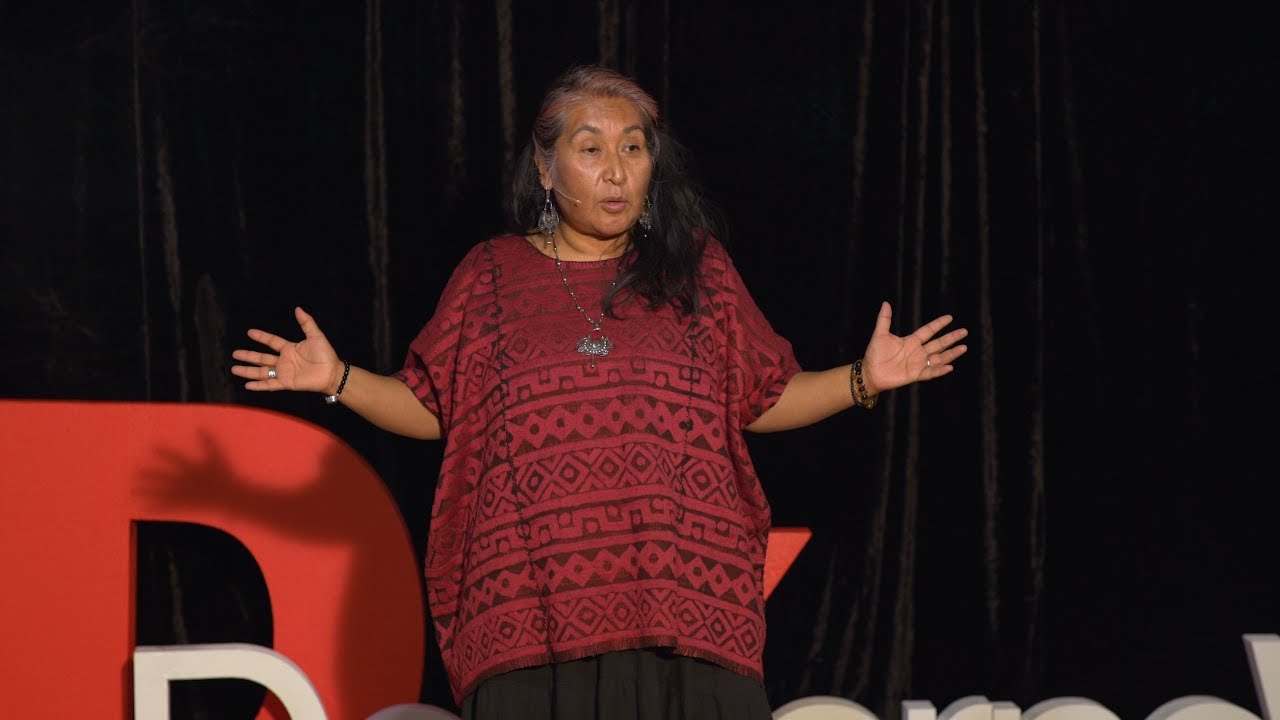
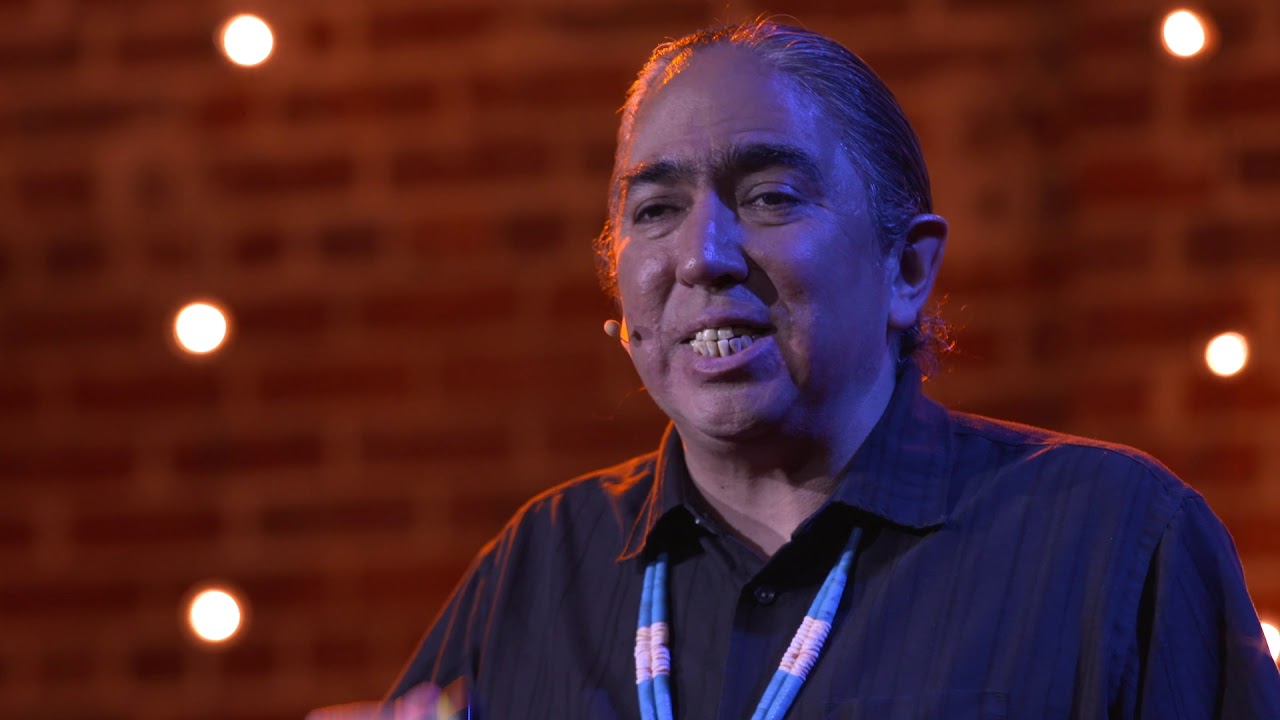
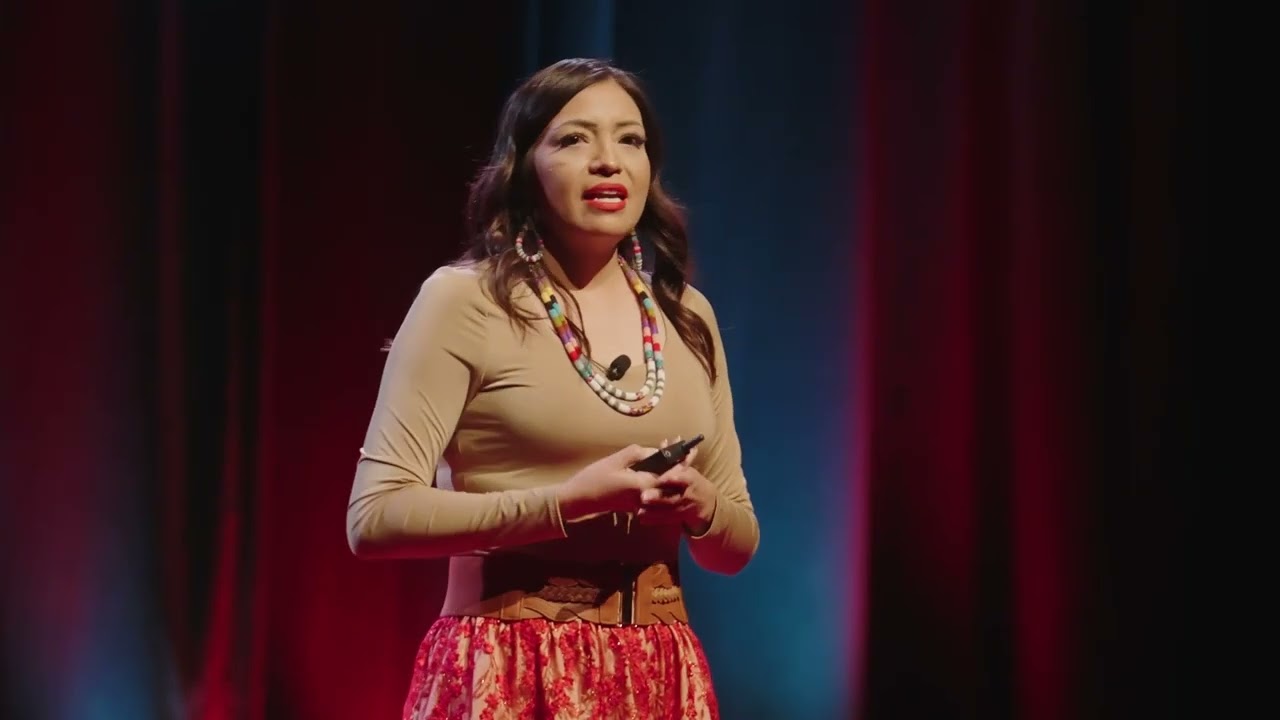
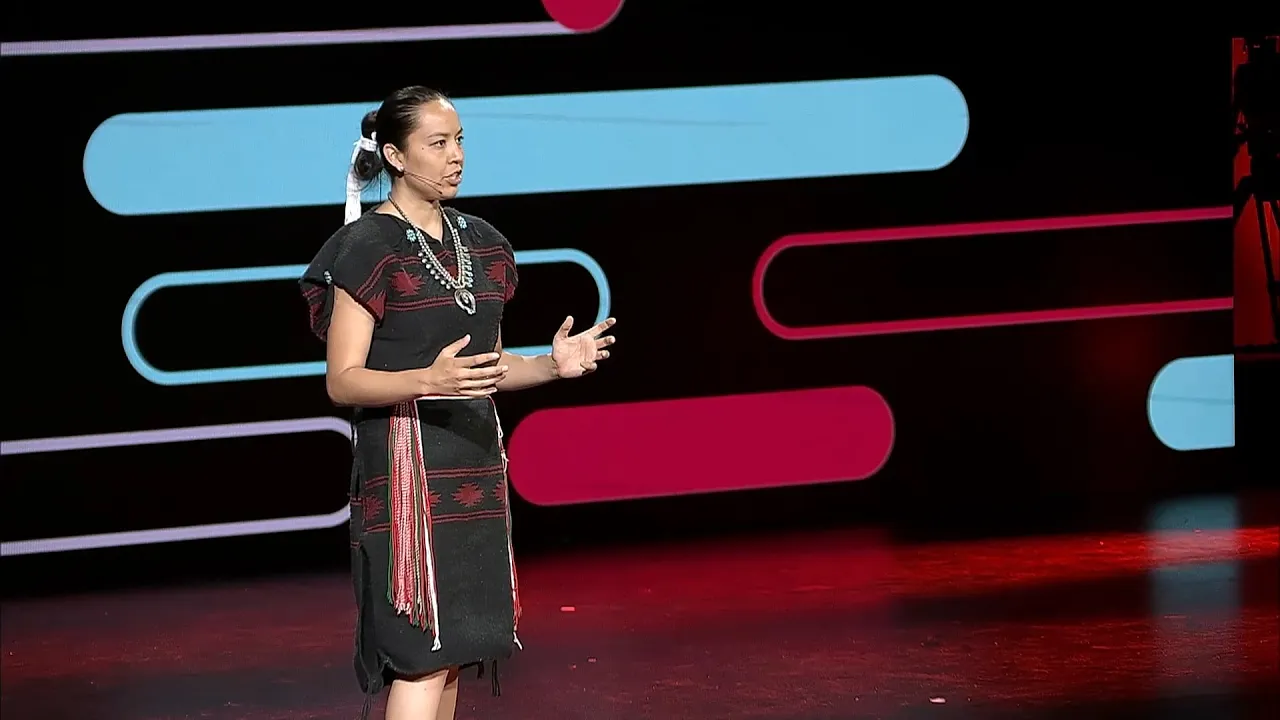
Transcriber: Rhonda Jacobs Reviewer: Zsófia Herczeg (Speaking Indigenous language) Greetings, my relatives and my people. (Speaking Indigenous language) My name is Lyla June. (Speaking Indigenous language) I come from the [Indigenous name] matrilineal clan of the Diné Nation.
We are also incorrectly known as the “Navajo Nation. ” We are indigenous to what is now called New Mexico, Arizona, Colorado and Utah, but we call it Diné Bikéyah, the people’s land. (Speaking Indigenous language) I’m originally from Taos, New Mexico.
(Speaking Indigenous language) In this manner I present myself as a Diné woman. I'm here today to share a message of hope. This hope comes from what I’ve come across in my doctoral research.
This hope comes from what Native people have proven is possible. For tens of thousands of years, Native people of this land constructed beautiful gardens all around them. Contrary to the myth of the “primitive Indian,” we were not passive observers of nature, nor were we wandering bands of nomads looking for a berry to eat or a deer to hunt.
No. By and large, we were active agents in shaping the land to produce prolific abundance. We expanded and designed grasslands and forests for the benefit of all life.
And in many places, we still do these things. We became what the world calls a keystone species, or a species upon which entire ecosystems depend. And our cultures became keystone cultures refined over time.
Now, much was made last year about the positive environmental effect of the pandemic. As more people stayed home, pollution levels dropped, animals began to reclaim habitat, and the logical leap that many observers seemed to make was that the earth would be better off without humans. I reject that leap.
(Laughter) The earth may be better off without certain systems we have created, but we are not those systems. We don’t have to be, at least. What if I told you that the earth needs us?
What if I told you that we belong here? What if I told you I've seen my people turn deserts into gardens? What if these human hands and minds could be such a great gift to the earth that they sparked new life wherever people and purpose met?
I’d like to share with you today four important Indigenous land management techniques, ones I’ve identified through my doctoral research in hopes that they might inform and inspire us today. The first is to tap into and align ourselves with the forces of nature. Why try to control the earth when you can work with her?
In Southwest deserts, for example, Native farmers have leveraged the pre-existing topography of the land. They place their fields at the base of watersheds to catch every drop of the monsoon rains, and the nutrients that flow down with them carried down from upland soils. This alluvial farming technique requires no outside fertilizers or irrigation because all of this comes with the rain.
By tapping into pre-existing natural systems, Native farmers have been able to cultivate the same plots of land for centuries without ever depleting the soil. Another fascinating land management technique is intentional habitat expansion. Why put plants and animals into farms and cages when you can simply make a home for them and they come to you?
For example, Indigenous peoples have intentionally augmented grasslands for buffalo by bringing gentle fire to the Great Plains. For millennia, following the grass burning moon of our lunar calendars, we would transform dead plant tissues into nutrient dense ash, nourishing the soil and unlocking the seeds of pyro-adapted grasses and medicines like echinacea. Over time, this fire would prevent trees and shrubs from taking over the grasslands and would nourish the soil to generate topsoils up to four feet deep.
Many people think that we followed the buffalo, when in fact the buffalo followed our fire. In this manner, we anthropogenically expanded buffalo habitat as far south as Louisiana and as far east as Pennsylvania. A third strategy I want to mention is to de-center humans, create non-human-centric systems.
Why hoard for your own species when you can live to serve all life around you? For example, Coastal Salish Nations of British Columbia enhance fish habitat by planting kelp forests where the herring lay their eggs. This helps that small silver fish lay even more eggs, rebound in even greater numbers, and both the eggs and the hatched herring fish cascade up the food chain, nourishing so many other life forms, such as bear, salmon, orca, eagles, wolves and more.
Ironically, by seeding this food web and feeding all life around them, Coastal Salish Nations have greater food security for themselves because they feed the hand that feeds them. The last strategy I want to mention is to design for perpetuity. Design for perpetuity.
Why plan for just the next fiscal quarter when we could plan for generations not yet born? For example, tree pollen and ash fall onto ponds for millennia. They sink to the bottom and engrave an ancient story in the fossil record.
One Kentucky sediment record shows how Shawnee ancestors took care of a chestnut food forest for over 3,000 years straight. A sudden influx of fossilized charcoal during the same period indicates that they managed it with routine burning of the forest floor. Presumably this enriches the soil, helps the soil hold more water, and eliminates competing vegetation to boost the immune systems of the trees they selected.
Apparently it worked because it lasted for millennia. What if our systems were designed to last forever? So those are just four of many strategies that Native peoples and peoples around the world have used: work with nature.
expand habitat, de-center humans and design for perpetuity. These are the types of food and land management systems that Europeans came across as they spread westward. They often mislabeled them as “terra nullius” or “virgin land” or “wilderness” instead of what they really were: living heirlooms, thousands of years in the making.
You might say, Oh, that’s very nice, Lyla, but that could never scale. That could never feed today's massive global population. And to that I say, contrary to popular belief, these continents were actually densely populated by Indigenous people, as more and more studies are proving, and their food systems still supported them.
I would venture to say that these systems are even more efficient than industrial food systems because they protect and augment the very things that give us life instead of extracting and destroying them. Sometimes I wonder what the world would look like if we applied these strategies to today - if we protected life and expanded life. I guarantee you, if we did, we'd no longer see humans as a bane to the earth or something she'd be better off without.
We'd see humans as a critical piece of the ecological puzzle. I would love to see the world adopt these strategies. And at the same time, I know it’s not enough to simply mimic Native practices, we must also work to return some of these lands to their original caretakers, for in addition to healing the soil - (Laughs) (Applause) (Cheers) Oh, thank you.
I like this crowd. (Laughs) For in addition to healing the soil, we must also heal our history as a nation. And we can do that together.
So much of these continents were conquered and stolen from a people who often never wanted to fight in the first place. Countless Native people were displaced from their homelands, their children put into boarding schools where our languages and cultures were prohibited and destroyed. This legacy will not be healed by simply appropriating and mimicking Native knowledge.
We must also work to restore at least some of these stolen places to Native people, who often live like refugees today, aching to return to their sacred homelands. If we all unite together in courage, in forgiveness, in amends and generosity, knowledge could be exchanged and lands could be returned. There is a word in my language, “hózhó.
” Can you guys say that? Hózhó. (Audience) Hózhó.
Ooh, that sounds cool. (Laughter) We’ll do it one more time: hózhó. (Audience) Hózhó.
Ooh, I like that. Hózhó is the joy of being a part of the beauty of all creation. When we understand that humanity is an expression of the earth’s beauty, we understand that we too belong.
Hózhó understands that we have an ecological role. Hózhó understands that our Mother Earth needs us. When we become her friend, her confidant, her ally, her partner in life, instead of her dominator, her “superior” or her profiteer, we can transform dead systems to living ones.
And this does not involve isolating national parks and never touching a blade of grass. No, it involves rolling up our sleeves, living within her processes, becoming a part of the earth’s system as we were born to be, and using these minds to protect and augment life on a holistic regional scale. If our ancestors around the world proved this is possible, then it gives us hope that we can do it again.
Thank you for listening.