We are, as United Nations Secretary General António Guterres recently said, on the verge of the abyss. As the IPCC report said, the science is now unequivocal. The latest available science tells us that, in order to avoid the worst impacts of the climate crisis, we must reduce global CO2 emissions by somewhere between 7% to 11% this year, and next year and every year after until we get to zero.
So what are we doing to pull ourselves back from the abyss? Countries have come to COP26 to make new pledges to reduce their emissions, and lots of companies and banks and investors have descended upon Glasgow to make big climate commitments. And let me say that, of course, the idea that countries, companies and investors committing to drastic and immediate action to reduce emissions would be most welcome.
But let us be honest: We have been here before. There have been 25 COPs before this one, and every year, leaders come to these climate negotiations with an array of new pledges, commitments and promises. And as each COP comes and goes, emissions continue to rise.
This year will be no different. CO2 emissions are forecast to jump in 2021 by the second-biggest annual rise in history. So I hope you can understand why many of the activists who are here in Glasgow, and millions of activists who could not be here, do not see the success that is being applauded within these halls.
I hope — [Audience applauds] I hope that you can appreciate that the nine million people dying every year from breathing toxic air from fossil-fuel-driven air pollution do not have decades to wait for oil, gas and coal to be phased out. I hope you can appreciate that we may be skeptical when the largest delegation here at the COP26 climate summit does not belong to a country, but instead belongs to the fossil fuel industry. [Audience applauds] I hope you can appreciate that where I live, a two-degree world means that a billion people will be affected by extreme heat stress.
In a two-degree-Celsius world, some places in the global south will regularly reach a wet-bulb temperature of 35 degrees Celsius. At that temperature, the human body cannot cool itself by sweating. At that temperature, even healthy people sitting in the shade will die within six hours.
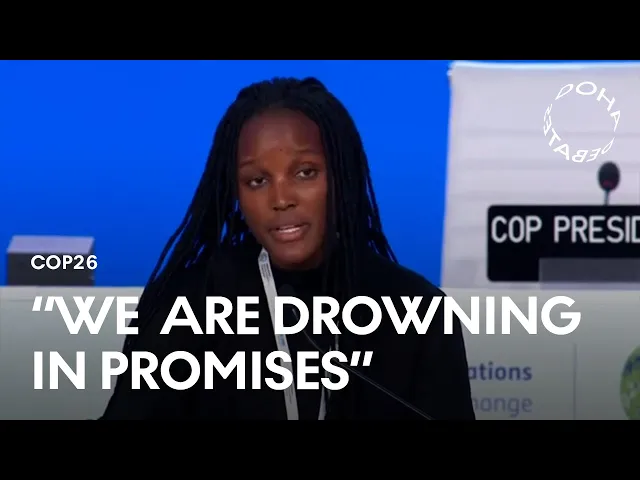
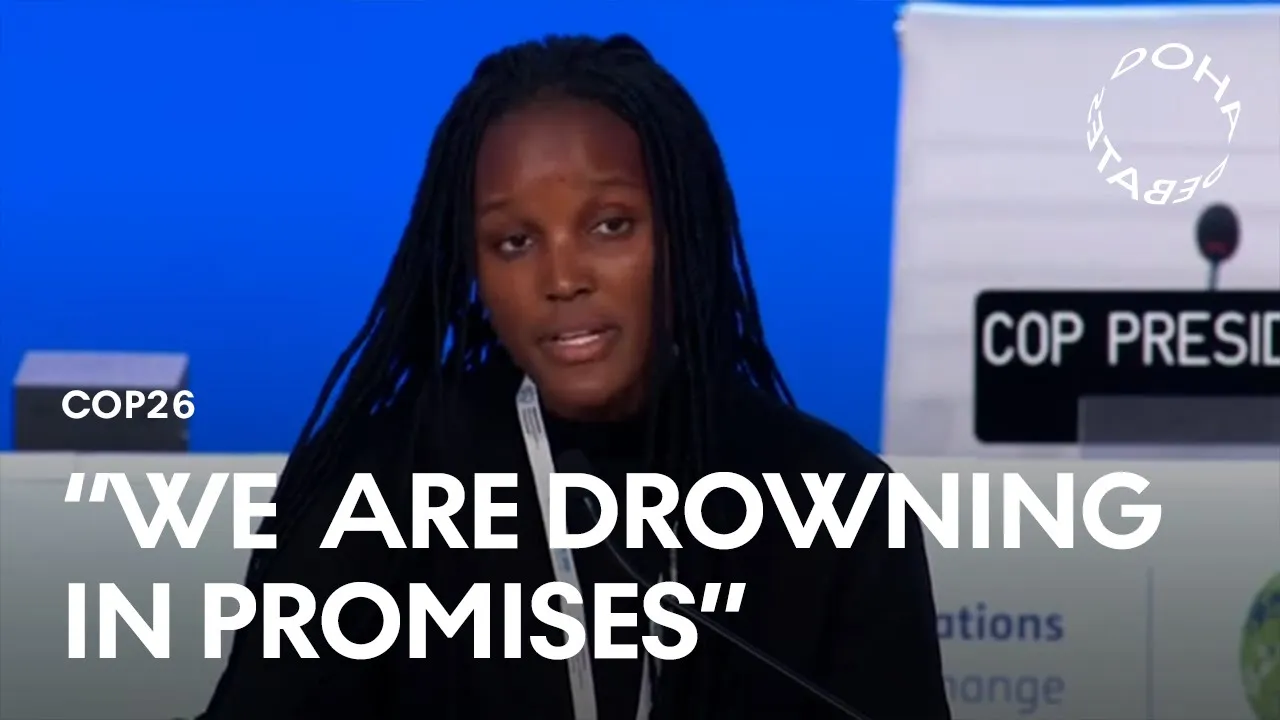
We see business leaders and investors flying into COP on private jets. We see them making fancy speeches. We hear about new pledges and promises, but we are drowning in promises.
Commitments will not reduce CO2. Promises will not stop the suffering of the people. Pledges will not stop the planet from warming.
Only immediate and drastic action will pull us back from the abyss. So we have some who are already starting to call COP26 a success. But a few days ago, a Climate Action Tracker report showed that COP26 is actually putting us on a pathway for a 2.
4-degrees-Celsius world, and this is our problem. We have two pathways. There is the pathway of commitments and hype and promises and fanciful net-zero targets and happily ever after.
And then, there is the pathway of the best available science. Of ever-stronger storms and droughts and floods. Of toxic, polluted air.
Of real people suffering and dying. And these two pathways are diverging. The truth is that the atmosphere doesn't care about commitments.
It only cares about what we put into it or stop putting into it. Humanity will not be saved by promises. It's hard to believe business and finance leaders when they haven't delivered before.
They have not been faithful in their promises. They have not been honest in fulfilling their commitments. They have not been trustworthy in making their pledges a reality.
So I have come here to tell you that we don't believe you. We don't believe that banks will suddenly put trillions of dollars on the table for climate action, when rich countries have struggled since 2009 to raise $100 billion for the world's most vulnerable countries. [Audience applauds] We don't believe that promises made by financial companies to end deforestation will actually prevent trees from being cut or burnt down.
We simply don't believe it. But I am here right now to ask business and finance leaders: Show us your faithfulness. Show us your trustworthiness.
Show us your honesty. I am here to say, "Prove us wrong. " I'm actually here to beg you to prove us wrong.
We desperately need you to prove us wrong. Please, prove us wrong. God help us all.
If you fail to prove us wrong. God help us. Thank you.